All posts by C. J. Summers

I am a fourth-generation Peorian, married with three children.

On the Agenda: Peoria Urban Living Initiative

On the City Council’s consent agenda next Tuesday is a proposal to focus the City’s Six Sigma program on attracting homeowners back to the Heart of Peoria. “The City proposes creating a joint study group that will uncover existing programs and examine other possible methods of increasing middle class home ownership in the Heart of Peoria.” Included in the “study group” would be representatives from major employers and a couple city council members appointed by the mayor. It doesn’t appear from the agenda item that the Heart of Peoria Commission will be included in this effort, despite its focus on the Heart of Peoria area.

Here’s the full text of the agenda item:

AGENDA DATE REQUESTED: November 13,2007

ACTION REQUESTED: RECEIVE AND FILE A PLAN TO ENGAGE REPRESENTATIVES FROM THE CITY AND MAJOR EMPLOYERS IN AND NEAR DOWNTOWN TO EXAMINE WAYS TO INCREASE MIDDLE CLASS INVESTMENT AND HOME OWNERSHIP IN THE HEART OF PEORIA.

BACKGROUND: The City has been working to revitalize and rebuild the Heart of Peoria. The City has created the Heart of Peoria plan, the Renaissance Park program, an Enterprise Zone and nine Tax increment Financing Districts to lead this effort. Currently, the City also sponsors a program to provide lower interest rates for home buyers, and provides down payment assistance for first home buyers.

However, stabilizing the Heart of Peoria is also in the interest of Peoria employers within this area. These employers are seeking to improve the areas around their operations and are looking to be more competitive in attracting “creative class” employees. The City proposes creating a joint study group that will uncover existing programs and examine other possible methods of increasing middle class home ownership in the Heart of Peoria. Preliminarily, we have identified four major employers for this effort: Caterpillar, Bradley University, Methodist Medical Center and OSF. Other groups, such as District 150 and the Chamber of Commerce, could also be considered.

This study group would be comprised of two parts:

  • A policy group, comprised of a senior leader from each employer, as selected by that employer. The Mayor would select one or more Councilpersons to chair this policy group. The policy group would examine the high-level issues involved and give direction to the staff to pursue options.
  • A technical group, tasked with investigating the issues identified by the policy group. This group will be led by Christopher Setti, City of Peoria 6 Sigma Black Belt. Each participating employer would be asked to name an employee (preferably a Black Belt if available) to work with Mr. Setti. Broadly, this group will be determining who the customer of the end product might be; what motivates their home-buying decisions; and what programs could be established [to] increase homeownership in the target area.

The working title of this project is the Peoria Urban Living Initiative. The intent of the program would be to conserve and revitalize our neighborhoods in the Heart of Peoria, while helping our employers recruit and retain valuable employees. While the effort will be guided by the policy group, some of the areas of exploration might be:

  • The size and scope of down-payment assistance (and other homeownership initiatives) in the target area by both the City and employers.
  • How taxes can be reduced or mitigated in order to stimulate investment.
  • The best use of the City’s “bond volume cap” in encouraging homeownership.
  • Other initiatives, such as Neighborhood LEEDs, that might raise the profile of older neighborhoods.

FINANCIAL IMPACT: Improved homeownership in the Heart of Peoria will help to increase revenues to all taxing authorities through higher assessed property values.

NEIGHBORHOOD CONCERNS: Neighborhood leaders have consistently been in favor of greater homeownership rates. The technical group will seek their input in this initiative.

IMPACT IF APPROVED: The study group will be formed and the issue will be thoroughly examined. The result will be a set of recommendations to the City Council and partner employers about steps that can be taken to improve homeownership.

IMPACT IF DENIED: The City will continue to offer its incentive programs and employers will likely not address the issue.

ALTERNATIVES: None.

RELATIONSHIP TO THE COMPREHENSIVE PLAN: The development is consistent with the Comprehensive Plan. VISION: WE HAVE A HEALTHY, THRIVING ECONOMY. GOAL: A. Provide an economic environment that supports existing and new businesses.

Peoria’s commitment to the museum so far: $16-26 million

Peoria LogoLakeview Museum Board President Jim Vergon said at last night’s museum presentation to the Peoria County Board, “Over the past four years, our project has received $6 million towards the $30 million goal for public funding, leaving a $24 million gap.” He said this included federal, state, and local support. Later, Caterpillar Vice President Sid Banwart drove home the point: “We’ve looked at a lot of museum complexes around the country and around the Midwest, and we have not been able to find any that were built without substantial public funding,” he said.

What you need to know about these statements is that these museum officials are talking about cash funds. They’re not talking about other benefits such as land use, TIF benefits, etc. In fact, the City of Peoria has provided what I would consider “substantial” public investment in the museum. How much public investment? The city provided these numbers:

The following provides the City’s commitment, as approved by the Mayor and Council, to this project. Please note this analysis assumes a 2009 completion date and does not include federal grant funding.

Land value (65% of $10 million)1 $ 6,500,000
TIF through 20212 $ 7,525,892
Change in grade of Water Street $ 2,600,000
Sub-Total $16,625,892
Potential Extension of TIF3 $ 9,408,615
Total $ 26,034,507

1Based on appraised value.
2Assumes completion of the Caterpillar Center and Regional Museum by 2009.
3The original agreement proposes an expansion of the length of the TIF. This assumes the TIF is extended 15 years from the current expiration date.

To his credit, Jim Richerson did mention these items during his presentation, although he didn’t give any total dollar amounts. The $6 million in “public funding” to which Vergon referred is in addition to the $16-26 million from the city outlined above. That fact should be kept in mind while considering the museum-backers’ request for $24 million more from largely the same taxpayers.

Contrary to published reports, Schock did back down

Aaron SchockThe Gatehouse News Service report said, “Schock didn’t back down” from criticism of his proposal to sell nuclear arms to Taiwan. I beg to differ:

“If China continues to be irresponsible about nuclear proliferation in Iran, we should tell them that if they do not care about proliferation–and since they are enablers of it in Iran, that if they don’t change their position, we will sell Pershing nuclear missiles to Taiwan for their defense.” (Schock’s candidacy announcement speech, 10/28/07, emphasis added)

I do not want to sell nuclear weapons to Taiwan, I want China’s cooperation in dealing with Iran.” (Schock’s press release, 11/8/07, emphasis added)

This is what pundits like to call a “flip-flop” on the issues. Despite all the other rhetoric in the latest press release, Schock nevertheless reversed himself on the selling of nuclear arms. If he had said in his original speech that he simply “want[ed] China’s cooperation in dealing with Iran,” then we wouldn’t be having all this controversy. No one would have even batted an eye.

The press release was nothing more than spin, and Gatehouse apparently bought it.

Is McDonald a Schock supporter?

Okay, that headline is needlessly provocative, but hey, I haven’t gotten many angry comments lately. 🙂

Journal Star reporter Karen McDonald covered Aaron Schock’s candidacy announcement event, but didn’t mention his proposal to sell nuclear arms to Taiwan. Then, when a Springfield reporter picked up the story, she attended challenger Jim McConoughey’s press conference reacting to the news, but didn’t write about it. Instead, the event was covered by Adrianna Colindres of Gatehouse News Service.

McDonald, on the other hand, wrote an article on Schock visiting public schools yesterday, but apparently didn’t ask about (or if she did ask, didn’t report on) Schock’s response to the foreign policy controversy. Yes, Schock had issued a press release that was in Colindres’s report, and yes Colindres did a phone interview with Schock’s campaign manager Steve Shearer. But McDonald had access to the man himself, and could have gotten a candid, rather than canned, answer. In fact, she could have followed up on his press release, pressing him on his clear flip-flop on this issue (he says in the press release that he doesn’t favor selling nukes to Taiwan). Instead, all we got was a puff piece.

Maybe I’m being too critical, but I think the local reporting on Schock’s campaign lately has been dismal and a disservice to those who are paying over $200 a year for Peoria’s only daily.

UPDATE: Great minds think alike. Independently, Billy Dennis and Rich Miller each commented on basically the same thing.

UPDATE 2: The Pantagraph has a much better report than the Journal Star on this story.

More on the Museum

Peoria County LogoSince I was attending our neighborhood association meeting last night, I was unable to attend the County Board meeting and hear the museum presentation. So I asked Patrick Urich, Peoria County Administrator, what happened. Here’s his account of the evening:

The Museum supporters came to the Board last night in force. Congressman LaHood opened by providing a historical account of where they have come from, Dave Koehler urged support for the project as a legacy project, Jim Vergon outlined the funding shortfall ($24 million), Jim Richerson presented the museum overview, Sid Banwart (Cat VP) stated that they have a significant commitment that will not go forward without the museum, Mark Johnson of Cat outlined what the Visitor’s Center would look like, Dan Silverthorn of the West Central Building Trades Council outlined the number of jobs and the payroll this would generate locally, and Dave Leitch closed by urging support. The challenge is that they would like an answer by mid-December.

Tim Riggenbach asked that the County staff review what options we have to assist and present that to the Finance Committee. The main issue is that as non-home rule county, we can only do what the statutes allow, unlike the City – which is home rule – who have the authority to raise taxes (HRA, sales, utility, property) by a simple majority vote. So our options are likely limited in the short term, but long term (which may mean forgoing the new market tax credits for now) we would work with the legislature to craft something that would have some sort of voter approval tied to it.

…We will also be putting the video up on our website. You can check today at http://www.peoriacounty.org/county/avmeeting

The best part of this report is the commitment to getting voter approval. If only other public bodies (*coughdistrict150cough*) would have such a commitment to inclusion.

Update on Coves, West Bluff issues

A couple of updates on recent neighborhood traffic concerns:

  • The Coves — A public hearing was held Tuesday evening regarding a proposal to put a gate across Sedley street, cutting off vehicular access between the Coves of Charter Oak (a newly-built subdivision with no residents yet) and Vinton Highlands. I talked to a Traffic Commission member and learned that about 16-17 people attended the hearing. The only two who spoke in favor of the gate were the Coves developer, and one resident of Vinton Highlands that lives adjacent to the formerly-dead-end Sedley street. Everyone else spoke against it. The Traffic Commission will make a decision at their next scheduled meeting, but they will likely recommend against putting in a gate.
  • The Uplands — The Uplands Residential Association (URA) met Thursday night to discuss a proposal to limit access to and from Main street. Specifically, the proposal was to allow only right turns from Main into the Uplands (i.e., onto Elmwood, Institute, Glenwood, Maplewood, and Parkside) and left turns onto Main from the Uplands (except for Parkside). The purpose was to mitigate cut-through traffic. The proposal was defeated 43-12. However, association members all agreed that speeding in the neighborhood is a problem, so the URA officers will now be putting together a proposal for traffic calming in the neighborhood.

Museum’s fate in the taxpayers’ hands

PRM LogoWEEK-TV reports that the Peoria Riverfront Museum is only going to receive four to ten million dollars in New Market Tax Credits — far, far less than the $100 million they were hoping to receive. Now there’s only one place left to get funding: the taxpayer.

So, museum officials appeared before the Peoria County Board tonight and asked for $24 million to plug the funding gap. Just for comparison purposes, the county collected $22.35 million in property taxes in 2006, and the proposed spending plan for 2008 is $122.1 million, according to the Journal Star. It’s a lot of money, and obviously it would have to be raised through municipal bonds.

How much would the repayment of those bonds be per taxpayer? I don’t know, but consider that the library referendum, which asked for bonding $35 million, would raise taxes by $50 per $100,000 equalized assessed valuation (EAV). Using that as a baseline, bonding $24 million could be in the neighborhood of $34 per $100,000 EAV. Granted, it might actually be less, since the library referendum was just for the city, and this request would include the whole county. On the other hand, most of the taxes in the county come from the city of Peoria, so it’s not going to be a whole lot less. [UPDATE: According to the Journal Star, “Museum backers say their preliminary figures indicate that…the cost to the owner of a $100,000 home would be about another $20 a year.”]

And the Museum officials need to know by the end of the year if the County is going to pitch in. That doesn’t give them much time to study or debate the proposal. And it certainly doesn’t give them enough time to have a referendum vote like the library did. The reason for the deadline? They have to have their funding in place by the end of the year in order to get that $4-10 million in New Market Tax Credits.

The Museum officials’ argument is that all museums receive public funding, and they were counting on getting $24 million in federal and state dollars that didn’t materialize. So, now the only public funding sources left are local, and the city council has made it abundantly clear they’re not going to consider any more requests for money from the museum folks. That leaves the County.

So, should the local taxpayers bail out the museum?

Believe it or not, I’m not inherently opposed to some public funding for a Peoria history museum. Further, I’m not inherently opposed to those funds coming from the county either, since I think such funding should be as regional as possible. But the question is, is this museum proposal fiscally responsible and worthy of public funding — specifically, $24 million in public funding?

I don’t think so, mainly for reasons I’ve detailed in this previous post.

Just as a thumbnail sketch, my primary concern is with the interior of the museum — it’s too small for the all the subject matter it wants to cover, even utilizing the vaunted “Delta approach.” There’s not enough storage space for artifacts. In fact, they would largely have to be stored off-site. It is, in part, a replacement of Lakeview Museum, which is unnecessary and unjustifiable.

Second, the exterior is completely objectionable. It is the antithesis of the type of development for that block that has been recommended by every consultant the city has hired from Demetriou to DPZ. The block should be urban in character, dense, and include a mix of uses including retail and residential components to make the block active 24/7. The museum’s plan is suburban in character, it leaves two-thirds of the block as open space, and is single use, making the block active only from 9 a.m. to 5 p.m. In fairness, there is a small retail component on the Water Street side in the plans, but (a) it’s not part of the initial phase, (b) it’s a very small portion of the block, and (c) there’s no residential component which is what would make the block active 24/7.

I have other concerns, but I don’t want to look like I’m piling on. Suffice it to say, I am opposed to using public funds for this museum plan. But I still think we need a Peoria History Museum (not a Peoria Art-Science-History-Achievement-And-A-Partridge-In-A-Pear-Tree Museum), and that the Peoria Historical Society should begin (resume?) working on such a project. It could be built on a portion of the Sears block, or it could be put in a remodeled/reused building somewhere downtown. I think there would be enthusiastic support for such a project if it’s focused, offers sufficient space, and has an attractive, urban design.

Attention cashiers: Dollar coins are now in circulation

Dollar CoinsI’ve been spending dollar coins lately, and I’m pretty certain I’m the only one within a 50-mile radius who is using them. How can I tell? Because every cashier stares at it blankly as if I had just handed her a coonskin cap. They look at me as if to say, “What is this and what am I supposed to do with it?” So, if you’ve never seen a dollar coin before, I encourage you to click on the picture to the left and familiarize yourself with it.

Maybe someday we’ll do away with dollar bills and then everyone will know about dollar coins. After all, when you think about the purchasing power of a dollar these days, it really is nothing but pocket change. Just like it would be silly to have a fifty-cent bill or a ten-cent bill, it’s ridiculous in the 21st century to have dollar bills. Replacing dollar bills with coins would save the government lots of money in printing, and it would make buying things from a vending machine a whole lot easier.

District 150 continues to baffle

I suppose I needn’t say anything about this, but there is simply no end to the way District 150 baffles me. In their 2005 Master Facilities Plan final report, they said:

Based upon a preliminary, interim report prepared by the Master Facility Planning Committee, the SBI Task Force set $5,000,000 as the savings goal to be had from the consolidation and closure of school facilities. The task force learned that $500,000 could be saved in administrative, support, and operational overhead per closed building.

Okay. So, they “close” Blaine-Sumner, then decide to remodel it and use it as offices. No savings there. They close White School, but then acquire the former Social Security Administration office building on Knoxville and decide to remodel it to the tune of $1.27 million to house their “transition to success academy.” No savings there.

In the meantime, they have two former principals who were made co-deputy superintendents while Ken Hinton got his certification, then made them associate superintendents and gave them raises for that; then when Hinton went on medical leave, they promoted (?) them to… um… co-deputy superintendents… again… and of course gave them another raise for the increased responsibilities.

Despite all of that, the school board passed a balanced budget this year, and expect a surplus of $200,000, according to Guy Cahill in a Sept. 5, 2007 Journal Star report. None of that was attributable to closing schools, of course. Instead, it was made possible by pay freezes and benefit cuts (to employees other than the superintendents, obviously), and by eliminating the district’s purchasing department.

But I thought at least part of the reason for consolidating schools was to save money and pay off the huge deficit the school had a couple years ago. Wasn’t it? So, if the deficit is gone now… does there need to be such a big push toward consolidation?

I’m afraid I’ll never figure them out.

The great evangelical sell-out

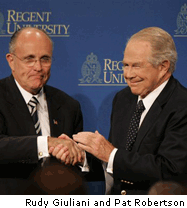
Giuliani and RobertsonConservative (?) televangelist Pat Robertson has endorsed Rudy Giuliani for president. Of all the candidates, he picked Giuliani. He didn’t pick Huckabee the ordained minister or Romney the Mormon — both more conservative than Rudy on such “values” issues as abortion and homosexuality. Those aren’t the two overriding issues anymore, said Robertson:

To me, the overriding issue before the American people is the defense of our population from the blood lust of Islamic terrorists. Our second goal should be the control of massive government waste and crushing federal deficits.

He didn’t pick a third-party candidate that would be more in line with the moral issues he’s championed for decades. No, he picked “America’s Mayor” because of his record in New York, both before and after 9/11/01, and for his fiscal conservatism.

How does one analyze this? Is it a calculating sell-out of religious beliefs for political power? Or was it… um… huh, I can’t think of another reason.

I mean, he could have endorsed a dark-horse candidate, a third party candidate, or even chosen to endorse no one — if no candidate was deemed socially conservative enough. But that would have meant no political capital (real or perceived). This way, if Giuliani wins, Robertson can claim to have helped by bringing the Christian conservative vote with him. Theoretically, that could mean more access to the White House.

But perhaps I’m being too cynical. Despite my earlier joke, there actually is another option. It could be that Robertson has changed his views and now truly believes that fiscal issues are more important than moral ones. But if that’s the case, he should shut down the 700 Club and establish a more traditional political advocacy group. One that pays taxes and doesn’t wrap itself in the Bible.