
All posts by C. J. Summers

I am a fourth-generation Peorian, married with three children.

District 150 not required to replace schools

UPDATE: Some of the following information has been disputed. Please see this follow-up post.

District 150 has been holding community forums to get input from citizens on where they would like a new school located in the East Bluff/North Valley area. At each forum, citizens have been told that the Illinois State Board of Education requires that the Kingman, Irving, and Glen Oak school buildings be replaced. For instance, one of the slides in their presentation is titled, “Buildings to be replaced per State.”

I’ve learned not to trust the school board when they tell me something is required by the state. Not long ago, Superintendent Hinton went on the radio and said the state required any new school to be built on 15 acres or more. It turned out that wasn’t true.

So I wasn’t surprised when I discovered that the state actually does not require that the buildings be replaced. I spoke to Lou Ferratier in the Illinois State Board of Education’s School Business and Support Services division. He said the buildings need to be either repaired or replaced, but the state does not require replacement. This is clear even from reading the applicable section of the state’s School Code (105 ILCS 5/17?2.11):

For purposes of this Section a school district may [emphasis mine] replace a school building or build additions to replace portions of a building when it is determined that the effectuation of the recommendations for the existing building will cost more than the replacement costs. Such determination shall be based on a comparison of estimated costs made by an architect or engineer licensed in the State of Illinois. The new building or addition shall be equivalent in area (square feet) and comparable in purpose and grades served and may be on the same site or another site.

Here’s how much the state has approved for District 150 to expend in fire prevention and safety funds (acquired from District 150 via FOIA request):

School Approved Expenditure
Glen Oak Primary $8,373,980
Harrison Primary $12,261,377
Irving Primary $6,794,380
Kingman Primary $6,474,213
Total $33,903,950

The school can use that money to fix up the schools or replace the schools. They can build several smaller schools or one big school. The only requirements are:

  1. Their buildings are brought up to code regardless of whether it’s through repair or replacement,
  2. The replacement school(s) be used for the same purpose (elementary school), and
  3. The replacement school(s) have equivalent aggregate square footage.

Here’s the deal: the reason the school district says they need to replace the school buildings is because, according to their last “Health Life Safety” report completed by STS Consultants, it would cost more money to repair the buildings than to replace them. However, that’s based on their reported replacement costs, which are obviously too low.

For example, the reported cost to replace Harrison School was about $11.8 million. But the school district asked for $21 million from the Public Building Commission to build a replacement Harrison. Cost to renovate? $11.98 million. That’s a $9.02 million difference. Yet somehow, replacing is supposed to be cheaper than renovating.

District 150 is trying to use the state as a scapegoat to deflect criticism of the school board’s decision to replace buildings that aren’t required to be replaced.
PJS editorial: same old disinformation

At this time, the Journal Star’s editorial is not available online, but you don’t have to read it to know what it says. It’s about the Kellar Branch, and the editorial writers always write the same misleading and blatantly false information about the issue every time. This time, it’s in the form of an open letter to Senator Dick Durbin, imploring him to “be a powerful ally” and “light a fire under the Surface Transportation Board.”

Along the way, they lay out their case for removing a working rail line in favor of a hiking trail:

  • “It’s a cooperative regional effort.” Yes, they’re all cooperating to pursue something they have no legal authority to effectuate. The municipal governments have no authority to remove a working rail line without Surface Transportation Board authorization, which they don’t have. Since the local governments can’t convince the STB to violate their mission by taking action that will harm rail shippers, the Journal Star is now asking Senator Durbin to abuse the power of his office to pressure the STB to do just that. How civic-minded of them.
  • “It’s a public health matter.” Say the Journal Star editors, “We think the Kellar line would enjoy heavy use from runners, dog-walkers, parents pushing strollers, cyclists, etc.” The people who will use the trail are people who are already exercising. They’re already running, walking their dogs, pushing their strollers, cycling, etc. Furthermore, they have plenty of opportunity to participate in all of these activities on streets, roads, parks, and miles of existing trails. People with a sedentary lifestyle are not suddenly going to rise from their easy chairs and start exercising because a new segment of trail in the middle of town becomes available.
  • “It’s a push for redevelopment.” The Journal Star blithely argues that customers on the line “long ago bailed.” The fact is that the threat of the line’s imminent demise is the reason the line has not gotten more rail use. Keep telling people the line’s going to be removed and it’s amazing how businesses needing rail service shy away from locating next to it. It’s also amusing that they say, “As for potential rail use, we’ve heard little more than speculation.” I would simply say, as for potential trail use and the assertion that the trail will raise property values, I’ve heard nothing but speculation. The fact is, there are potential shippers located on the line. The proof of this is the fact that Central Illinois Railroad is fixing up the line at their own expense to serve those shippers — why would they waste their money repairing the line if there were no shippers?
  • “Finally, it’s a property rights issue.” Ah, they’ve saved their most ridiculous argument for last. “Despite the fact that Peoria and Peoria Heights own the line, they have distressingly little say in its fate.” They’re shocked — shocked, I say — that a unit of government can tell a property owner what they can and can’t do with their own property! It’s so unusual, you know. Let’s see, the only other examples I can think of are, oh I don’t know, every zoning law in the nation. Since the Journal Star had so much fun dissecting Barbara Van Auken’s logic the other day, should we spend some time dissecting the Journal Star’s logic here? I guess if property owners should have unfettered rights to do what they wish with their property — no matter who it might hurt — one has to wonder why the Journal Star does not oppose zoning laws, health department restrictions, rental inspections, code enforcement, and the recently-passed smoking ban. See how much fun it is?

Bottom line, the Journal Star doesn’t think the city should have to follow federal rules that are in place to protect rail shippers from just this sort of abuse by rail owners.

I have a better idea. I’d like Senator Durbin to light a fire not under the STB, but under the Peoria Park District. Tell them to stop wasting time and money trying to get a working rail line abandoned, and instead build the trail around it. They can use part of the right-of-way where feasible, and put the other parts of the trail adjacent to the street (asphalt sidewalks), just like they do elsewhere in Peoria and surrounding communities. Part of this regional trail runs right next to the very busy Route 150, so I know it can be done.

Council goes till the Midnight Hour

In honor of all the citizens who waited till the midnight hour to address the council, let’s all sing together this classic Wilson Pickett song:

Tonight made me nostalgic for the councils of yore when Bud Grieves was mayor and the council meetings would go late into the night every week.

Tonight’s council meeting ended officially at 12:15 a.m. Wednesday, October 10. And Jonathan Ahl had to be awakened to sign off.

Abud gets compromise, but not the one he wanted

The City Council voted 9-2 7-2 with two abstentions (Jacob and Sandberg) Tuesday to relax one of the conditions on Adams Supermarket owner Ahmad Abud’s liquor license. But instead of granting Abud’s request to only require an off-duty police officer from 8 p.m. to midnight, the City Council went with the Police Chief’s recommendation to require an officer from 5 p.m. to midnight. Still, this is two and a half hours less than the original 2:30 to midnight requirement.

But councilman Clyde Gulley said if Abud didn’t get everything he wanted, he would recommend to Abud that he close his grocery store and leave town. That’s the spirit. Way to retain business, Gulley. Who else have you encouraged to flee your district because they didn’t get everything they wanted from the city?

Council votes down Sheridan Road/Heart of Peoria improvements

UPDATE/CORRECTION 10/11/07: Below, I mistakenly cited the City of Peoria operating budget. In fact, the money in question was $200,000 from the capital budget set aside in 2007 for design and engineering of the Sheridan Loucks Triangle specifically and exclusively. $200,000 per year from 2007 to 2011 was requested, but only $200,000 in 2007 was funded. Sorry for the confusion, and thanks to my friend at the city who wishes to remain anonymous for pointing out my error.

In the 2007 City of Peoria budget (pp. 128-129), money was set aside for economic development. Here’s where some of that money was designated to go (emphasis mine):

2. Community Revitalization Activity – Activity cost $238,529

This program is responsible for undertaking projects which promote downtown Peoria and adjacent areas, including the Riverfront and residential neighborhoods, as an attractive location for working, living, and entertainment. Specific activities, to be undertaken, within the next five years, include:

  • Create and implement residential enterprise zone.
  • Identify and execute initiatives to revitalize the Warehouse District and Southern Gateway.
  • Finalize redevelopment plans for the former Sears block to create a cultural and entertainment destination for the Region.
  • Identify and redevelop blighted/contaminated property.
  • Continue revitalization initiatives in Council-directed areas (Sheridan Loucks, Prospect Road, Renaissance Park).
  • Undertake and complete public infrastructures improvements to support business and industry.

So, at tonight’s council meeting, Councilwoman Barbara Van Auken brought forth a motion to spend some of that money to enter into a contract with the Farnsworth Group, Inc. “for the DESIGN of the SHERIDAN TRIANGLE BUSINESS DISTRICT ENHANCEMENT from McCLURE AVENUE to HANSSLER PLACE, in an Amount Not to Exceed $183,750.00.” This is in the Sheridan Road form district that was created by the council back in May of this year.

In order for form districts to be successful, there are two things that need to take place. First, there needs to be a form-based code — a pre-planned area that provides a consistent and predictable development pattern. That’s the private investment side of the equation. Second, improvements need to be made to the streets and sidewalks in order to make it an attractive area both for redevelopment by investors and patronage by potential customers. That’s the public investment side of the equation.

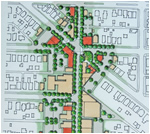
Sheridan Master PlanPlans for improving the intersection and streetscape in this area were developed during a charrette hosted by Farrell-Madden Associates. You can see the results of that charrette by clicking on the picture to the right. You’ll notice the pictures show wider sidewalks, street trees, intersection changes, etc. The next step is to develop a project plan “splitting the area into logical phases for construction” with estimates and specifications for each phase. That’s what Councilwoman Van Auken asked for this evening.

But the council voted it down 6-5. Ardis, Turner, Gulley, Jacob, Montelongo, and Spears Spain voted against it. Van Auken, Sandberg, Manning, Spain Spears, and Nichting voted for it.

Why? I’m certain I don’t know. It appears they voted it down because it’s too close to the next budget cycle. Councilman Clyde Gulley kept talking about the Griswold Improvement Project — for which there is $0 in the 2007 budget — that the council voted against funding earlier this year because it would have been a budget amendment. He somehow thinks the two projects are analogous, and since the council voted down his street improvement project, he’s going to vote against everyone else’s. Other council members said we need to set priorities before spending that much money — as if they didn’t already set the priorities for 2007 in the 2007 budget.

So now, evidently the money set aside for improving the Heart of Peoria area this year will not get spent.

$5.5 million bathrooms

The Journal Star’s editorial today is dedicated to criticizing Councilwoman Van Auken and her remark that the city should sell the Gateway building because “Government should not own buildings or property except for government use.” Granted, that wasn’t the best argument she could have given, and the editors of the Journal Star have fun dissecting her logic.

But what the editors don’t do is give any good reason for keeping the Gateway building. Here’s the best they can come up with:

And we’d add that, in fact, Gateway does serve a civic purpose: That building and its restrooms were built for the benefit of the public, specifically visitors at riverfront events.

The Gateway Building is a convention and banquet facility. The only way the public gets any benefit out of it is if they rent it from the Peoria Park District for somewhere between $600 and $1,500. The public is not under-served for convention and banquet space. Besides the River Station, Packard Plaza, the Pere Marquette, and a host of other private places to rent, there’s always the gigantic expansion of the Civic Center. How much more tax-subsidized banquet space do we need?

The only things the “visitors at riverfront events” really “benefit” from for free are the public restrooms. So the question is, don’t you think $5.5 million is kind of a steep price for public restrooms? I think so. I bet if they could sell the building, they could use a small fraction of the proceeds to build some really sweet public restrooms elsewhere along the riverfront.

Shocking news: Railroad company wants to run railroad

Here’s part of an e-mail that was forwarded to me today, apparently written by Recreational Trail Advocates leader George Burrier:

We have reached a crisis situation in our trail development that requires your help now! Central Illinois Railroad (CIRY) is proceeding to rehabilitate the Kellar Branch by replacing rails and ties. It expects to be operating over the line by November according to a statement made by the foreman of the work crew. The Peoria City legal department states that it has no power to prevent this work from continuing. Please write or call Mayor Jim Ardis and your council member to ask for an explanation of why this is happening and what action Peoria intends to take to prevent the Kellar Branch from being used for rail traffic, why there is no operating agreement and why Peoria is not receiving rent for using the right-of-way. […]

The Peoria Park District has already made a formal presentation showing how a shared right-of-way is not physically practical and financially exceeds the current funding available.

This is hysterical. The trail advocates all marched down to the council meeting on February 20 and demanded that the council support Central Illinois Railroad so the city could “keep their trail options open.” Now they’re shocked — shocked, I say — that a railroad company would want to, oh I don’t know, run a railroad on that line. Gee, who’da thunk?

Now I guess they want the city to kick Central Illinois Railroad off the tracks as well. I mean, what other option is there? The legal department has already said that the city can’t do anything to stop them from running trains on that line. But the Trail Advocates are already on record supporting Central Illinois Railroad! Ha ha ha!

What the trail advocates fail to understand is that the rail carrier has a legal obligation to provide rail service over that line. There are shippers who want to use the line, and there is no pending request for discontinuance of the line (and hasn’t been for almost a year now). So what the trail advocates are essentially asking the city to do is conspire to keep Central Illinois Railroad from following the law.

Open your eyes, trail advocates. The railroad isn’t standing in the way of your trail. The Park District is standing in your way. While it may be physically impractical to share certain parts of the railroad right-of-way, that’s not true of the whole stretch. And those parts that are physically impractical can be worked around by putting that portion of the trail on-street or using one of those glorified sidewalks like they’ve already installed along Pioneer Parkway, University, and Sommer.

They can do it; they simply refuse. And instead, they’re wasting everyone’s time and a whole lot of taxpayer money fighting for the railroad right of way. How many more years are they going to keep fighting? How much more money will they waste? If they took all the money the city has paid in legal fees over the past 15 years and used it to build the trail instead, it would have been done years ago.

I’ve said it before, and I’ll say it again — the trail advocates have lost sight of their goal. If the goal is to get a trail, then they should give up trying to get the railroad abandoned and simply work around it. It will be quicker and cheaper. Instead, it appears that the trail is only a secondary goal — the primary goal is to get rid of the railroad line, and there’s no justification for that.

Zoning Commission may meet at 6 p.m. in 2008

The Zoning Commission currently meets the first Thursday of each month at 1:00 p.m. The Ad Hoc Committee on Commissions determined that this may not be the most convenient time for property owners to come down to City Hall and express concerns regarding a zoning change that would affect their property, and recommended the hold at least some of their meetings in the evening. The Zoning Commission voted to keep everything status quo.

So now the Planning and Growth Director and a couple of council members are insisting. On the agenda for tonight is a proposal that would change the meeting time from 1 p.m. to 6 p.m. on a one-year trial basis, just for 2008.

The city did solicit input regarding the time change from several groups, and these are the results:

Staff surveyed three groups – neighborhood associations, citizens who had received notices of CZC public hearings within the last three months, and current members of the Zoning Commission. We asked if they would be more likely to attend the 6 pm meeting and if they would be interested in serving on the CZC if it met at 6pm instead of 1 pm. The results of the survey are summarized below and included in the survey report, Attachment B.

  • Neiqhborhoods – 85 groups contacted, 16 responded (19%)
    • 13 (81%) favored evening meetings
    • 1 (6%) did not
    • 2 (13%) did not respond directly to the question
    • 3 were interested in serving on the CZC and 3 others needed more information
  • Citizens who had received notices of CZC public hearings the last three months – 253 citizens contacted, 7 responded (3%)
    • 3 (43%) favored evening meetings
    • 4 (57%) did not
    • 1 interested in serving on CZC
  • Current Zoninq Commissioners – 6 responded (100%)
    • 1 favored evenings meeting
    • 5 did not

In addition, Council Member input was sought. Three favored evening meetings, and two others provided comment or questions.

The neighborhood groups appear to have spoken loud and clear — almost 20% responded, and they were overwhelmingly in favor of the evening meeting schedule. Only 3% of those citizens who receive notices even responded, which leads me to believe that they don’t have a strong opinion one way or the other.

According to a Journal Star report, “If the City Council changes things on Tuesday, at least two members [Richard Unes and Greg Hunziker] say they will quit.” The reason? “We’d be sitting here until 9 p.m. or 10 o’clock in the evening,” Unes is reported as saying.

Well, of course I understand that sentiment; it’s not exactly the most exciting way to spend an evening. But it is only one evening per month. And frankly, they should value the time of the citizens they’re appointed to serve more than their own time — that’s why they call it “public service.” I don’t expect that argument to get them much sympathy from the council, either, since they meet at 6:15 every other Tuesday (on average).

Also, threatening to resign doesn’t carry a huge punch when you consider there’s no shortage of people willing to take their place. Since Chad Bixby resigned, the Heart of Peoria Commission has no representation on the Zoning Commission, so one or two HOP/C members need to be added, plus there are three neighborhood group members who have expressed interest.

In the absence of any good argument against changing the time, I think they should go ahead and try the 6:00 meetings for a year and see how they work.

Allen Mayer to announce candidacy tomorrow

From a press release:

ALLEN MAYER SCHEDULES NEWS CONFERENCE TO FORMALLY ANNOUNCE CAMPAIGN FOR STATE REPRESENTATIVE

Peoria County Board member Allen Mayer will hold a news conference on Wednesday, October 10, 2007 to make official his campaign for the Democratic nomination for State Representative from the 92nd District.

WHO: Allen Mayer

WHAT: News conference to formally announce candidacy for the Democratic nomination for 92nd District State Representative

WHEN: Wednesday, October 10, 2007 at 11:00 a.m.

WHERE: Peoria County Board room, 4th floor of Peoria County Courthouse, 324 Main Street, Peoria

Police want 5:00 security start time at Adams Supermarket

Adams Supermarket owner Ahmad Abud (aka Hussein Alsalahi) insisted that his South Side grocery store needed to sell liquor to be successful, and was willing to agree to a number of conditions in order to secure his liquor license. One of those conditions was having an off-duty Peoria Police officer act as a security guard from 2 p.m. to midnight.

Sales haven’t been as good as Abud thought they would be, so he’s looking at reducing costs — and one of those costs is the off-duty police officer. He wants to only have an officer working security from 8 p.m. to midnight, and he has the support of First District Councilman Clyde Gulley.

The Police Department, however, thinks that won’t be sufficient and is recommending a third option — that the police security officer start at 5 p.m. They further recommend that this be on a 12-month trial basis, and that if there’s any trouble, the full 2 p.m. to midnight condition be reinstated.

Gulley and others will complain that this is unfair because it’s not required of any other grocery stores with liquor licenses. That’s a valid complaint. But on the other hand, Abud did agree to it. If he thought it was unfair, he should have stated that early in the process, like when he appeared before the Liquor Commission initially or when his license came up for approval before the council. Since he enthusiastically agreed to the conditions, and is now trying to get out of one of them, it makes people nervous that he will continue to chip away at the conditions until his store is nothing more than a glorified liquor store.