All posts by C. J. Summers

I am a fourth-generation Peorian, married with three children.

Morning briefing

I’m too busy to do a lot of blogging today, but here are a few comments on the news of the day:

  • West Main Street needs to be narrowed from five lanes to three, the on-street parking restored, and sidewalks widened. That’s the only way to slow traffic on the street. The 30 mph speed limit is a joke — the street is built for speed and people are going to go the speed the road is designed to accommodate. There’s a meeting planned to discuss this issue on Tuesday, May 29, at 6:00 somewhere at Bradley University (exact location TBD).
  • I see the Journal Star caught up with WCBU today by reporting how Ray LaHood has been throwing cold water on the Peoria Amtrak plan. LaHood’s comments are devoid of logic. He thinks no one will take a train to Chicago from Peoria unless it can get there quicker than driving, but on the other hand he thinks people will take a bus to Normal or Galesburg and take a train to Chicago from one of those stations. Who’s whispering in LaHood’s ear to try to sabotage this effort? Auto makers? Oil companies?
  • Now that’s what I call a “happy meal.”
  • Whenever I try to go to WMBD radio’s website, it crashes my Firefox browser. However, it works in Internet Explorer. It’s really annoying.

Feel free to discuss anything else you want. This is an open thread.

If you really want a trail, give up efforts to remove rail line

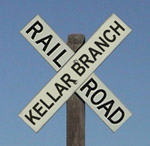
Kellar Branch RailroadJust a reminder to trail advocates: there is currently no petition pending before the Surface Transportation Board (STB) that would discontinue service on the Kellar Branch. Central Illinois Railroad withdrew that petition months ago and have never refiled. The only petition before the STB at this time is what’s called an “adverse discontinuance,” and the decision that’s handed down will determine whether Pioneer Industrial Railway or Central Illinois Railroad (CIRY) is allowed to operate the line.

So, even if the ruling comes down in favor of CIRY, the city still can’t tear up the tracks and turn it into a trail. Furthermore, the City has been trying for several months to (according to the 2/20/07 council minutes) “negotiate with Central Illinois Railway for a modified certificate, which would allow Central Illinois Railway to operate on the Keller Branch for a limited period of time,” but has been unsuccessful so far. That doesn’t bode well for future cooperation on abandonment.

I hate to say I told you so, but, this really shouldn’t have come as any surprise. CIRY has never been a responsible corporate citizen, and there was no reason to believe they would be in the future. Nevertheless, that was the risk the council and trail advocates chose to take.

I would encourage everyone, whether pro-rail or pro-trail, to tell the City and the Park District to go to “Plan B” and stop wasting tax money fighting this thing. They can find an alternative route for building the trail, just like they did south of War Memorial (Class III trail), just like they did at Pioneer Park and Sommer (asphalt sidewalks), and just like they did north of Pioneer Parkway (trail next to the rail line). What is the end goal: to eliminate the Kellar Branch or to build a trail? I think the parties here are losing focus.

Old Big Hollow Dump, Part 2

HOI News has followed up on the dumping that’s occurred on an abandoned portion of Big Hollow Road. It turns out that the abandoned slab is not a city road, but a county road. This, despite the fact that it’s located within the city. How confusing. Nevertheless, my apologies to the City for any disparaging remarks I may have made about the city’s code enforcement or litter-clean-up efforts on this stretch.

The county sounds a little reluctant to clean up the mess:

“We ask that the people maintain don’t throw their garbage on there. We do at times take some of the larger things out as a rule- we don’t- we’re so busy with maintaining the roadways we don’t really have the time or people to invest in proper clean up,” said Peoria County engineer Tom McFarland.

They also stated that they were considering sealing off the road. I think that would be a good idea. There’s no reason to give easy access to a highly-secluded, abandoned roadway. It just invites illegal dumping and possibly other undesirable activity.

I think someone mentioned this in the comments section of my last post on this topic, and I couldn’t agree more: the real villains in this case are the filthy pigs who dumped this garbage back there in the first place. I wish they could be caught and fined, or — even better — be given back their garbage, preferably on their living room floor.

New era begins in Heart of Peoria

On June 15, four areas of Peoria will be the first to benefit from a new kind of zoning (some might even call it an alternative to zoning): form-based codes. The City Council last night unanimously adopted ordinances that put the new coding into place for the four form districts which are the West Main corridor, Warehouse District, Sheridan/Loucks Triangle, and Prospect Road corridor.

Form-based codes differ from our current zoning (aka “Euclidean zoning) in some significant ways. Whereas Euclidean zoning is primarily concerned about land use and only marginally concerned about design or form, form-based codes are just the opposite. Form-based codes stress limits for height, siting, and building elements, and have only a few limits on uses.

If you want to build a new building along Main street, right now you have to follow the same zoning regulations as if you were building out in a cornfield on the north side of town — setbacks from the street, surface parking requirements, etc. Just take a look at Jimmy John’s on West Main and you’ll get the idea. That’s what infill looks like under suburban zoning code.

Under the form-based codes, infill development will instead be consistent with the current built environment. For instance, on West Main street, any new buildings will have to be built up to the sidewalk and utilize nearby shared parking with other businesses or provide private parking in the rear of the building. Whereas Euclidean zoning separates land uses into residential, commercial, office, etc., form-based codes allow these uses to be mixed, thus making it possible for someone to build an apartment over their store, or to have office space above a retail business.

The council also voted to bring off the table the rest of the Land Development Code (which would apply to the Heart of Peoria Plan area outside of the four form districts) with the Heart of Peoria Commission’s recommendation for the Knoxville corridor, and a recommendation that there be a four-month transitional period following its enactment. This could come before the council as early as next month for adoption.

The transitional period would be a four-month time frame during which projects could still be approved under the old zoning ordinance if the developer can prove that he was relying on those ordinances when making plans, acquiring property, etc. That’s a reasonable request. The council often makes zoning and especially fee changes without any kind of consideration for what that would do to pending projects, so this is really a step forward.

District 150’s estimates wildly divergent

Peoria Public Schools logoOne has to wonder how District 150 is estimating the cost to build a new school.

Clare Jellick reported Tuesday on the school board’s plan to build a new school to replace Harrison. Their original plans were too big and too expensive, so now they’ve reduced the square footage and the estimated costs:

Construction costs came in over budget last year when the original design, at 120,000 square feet, was estimated to cost as much as $21.6 million. The building was first estimated to cost $15 million.

The proposed space would be about 18,000 square feet smaller than the original design and cost about $19.7 million.

There are three estimates in those two paragraphs, plus there’s one more estimate that wasn’t listed. That estimate is the one that STS Consultants made that justified replacing the building instead of renovating it in the first place.

STS Consultants was hired to conduct the district’s 10-year “Health Life Safety” report on several schools including Harrison and Glen Oak. This report has direct bearing on how much money the school can obtain through Health Life Safety bonds for maintenance or replacement of school buildings. STS told the Illinois State Board of Education in December 2006 — just five months ago — that the cost to replace the current 102,396-square-foot facility would be only $11,812,158, about $165,000 less than it would cost to renovate the building to bring it up to code.

Just so we can compare apples to apples, here’s how all these estimates break down in cost per square foot:

Estimate Total Cost Total ft.² Cost per ft.²
8/05 Estimate $15,000,000 120,000 SF $125.00/SF
8/06 Estimate $21,600,000 120,000 SF $180.00/SF
12/06 Estimate (STS) $11,812,158 102,396 SF $115.36/SF
5/07 Estimate $19,700,000 102,000 SF $193.14/SF

Anyone remember that song from Sesame Street that goes, “One of these things is not like the other”? That STS Consultants estimate really sticks out, doesn’t it? Yet that was the estimate that was used to “prove” that it would cost less to replace the school building than to renovate it.

STS Consultants used the RS Means Building Construction Cost Data (2006 Edition) to do their estimate. RS Means provides a complicated formula that takes into account the fact that square footage costs vary depending on the size of the structure and the city in which it’s built. However, it’s pretty clear to me that RS Means’ estimates are considerably lower than reality. Notice the dates in the above table — even up to a year and a half before STS’s estimate was done, the district was figuring it would cost more than $115 per square foot to build a new school.

The district didn’t question STS Consultants’ estimate even though it was obviously too low and unrealistic. Why? Could it be because the school board and administration want to replace the buildings, and STS’s numbers provided the justification they wanted?

This calls into question something else: the cost to replace Glen Oak School. STS Consultants’ study on that school concluded the cost to renovate the building ($8.36 million) would be more than the cost to replace it ($7.95 million). But their cost of replacement was based on $119.08 per square foot for the 66,791-square-foot building. Now that we know the real cost is closer to $190+ per square foot, the decision to replace the building needs to be reconsidered.

Ray LaHood pooh-poohs Peoria Amtrak plan

Ray LaHoodThis morning as I listened to WCBU’s news broadcast, I was shocked to hear Ray LaHood say that Amtrak is never going to come to Peoria and we should be satisfied with bus service to Galesburg and/or Bloomington to connect with Amtrak there.

First of all, IDOT hasn’t even done a feasibility study on the proposed Amtrak route to Peoria yet. Why is LaHood prejudging the outcome of that study? There are a lot of people working on getting Amtrak back to Peoria because they believe it will be good for the economy, for college students, for tourism, and of course for transportation options for Peoria residents.

Secondly, this is the second time that LaHood has tried to sabotage local transportation plans. LaHood torpedoed attempts to build a Chicago-Peoria interstate highway, suggesting widening Route 29 instead. Now he’s trying to undermine the efforts of local officials to bring passenger train service back to Peoria.

LaHood has supported upgrading existing transportation facilities, such as I-74 and the airport terminal and runways, but he apparently doesn’t support adding more transportation options that could benefit Peoria. Why is LaHood holding Peoria back? Why does Ray think Peoria doesn’t deserve better?

Update: I talked to Jonathan Ahl tonight at the city council meeting and discovered that he had posted about this topic and I missed it. My apologies. You’ll want to read Jonathan’s take on it since he’s the one who interviewed LaHood.

Libraries stand on principle… unless money is involved

There’s a bill wending its way through the state legislature. It’s called the Internet Screening in Public Libraries Act (HB1727), and it “[p]rovides that each public library must have a technology protection measure to prevent the display on a public computer of any visual depictions that are obscene, child pornography, or harmful to minors.”

The bill is supported by the Illinois Family Institute (IFI) and SafeLibraries.org. IFI points out that “[f]or public libraries, the Internet is perhaps the best research tool ever available. The Internet, however, is also responsible for the proliferation of adult and child pornography…. Pornography is now readily accessible to anyone using unfiltered Internet computers, even children in many neighborhood libraries.”

But libraries are against this measure. The Illinois Library Association (ILA) says in an “Action Alert” from March that it “supports local control. Local officials — library trustees, librarians, and other professional library staff — are the most qualified to decide how Internet access should be provided to their patrons.” They then go on to list “talking points,” under the headings: “Filters Hurt Libraries,” “Filters Don’t Work,” “Filters Are Expensive,” “Filters Are Biased,” “Filters Hurt the Poor,” etc. The Journal Star reports today that some libraries are staging a protest against filtering requirements.

But ask a member of the ILA (like, for instance, the Peoria Public Library) if they currently have filtering on their computers, and you may be surprised to find out the answer is “yes.”

Why? Money, of course.

The library can get telecommunications discounts of 20-90% through the state’s E-Rate program. One of the stipulations for receiving the money, though, is Internet filtering:

E-rate applicants must follow the Children’s Internet Protection Act [CIPA] if the application covers Internet access and/or internal connections.

CIPA is a federal law that was enacted in 2000. It states (emphasis added): “In order to receive discounts for Internet Access and Internal Connections services under the universal services support mechanism, school and library authorities must certify that they are enforcing a policy of Internet safety that includes measures to block or filter Internet access for both minors and adults to certain visual depictions.”

So, if you ask librarians to filter Internet content to protect children from harmful pornographic images, the answer is a litany of reasons filters are evil and fraught with complications. But if you ask librarians to filter Internet content so they can get a discount on their telecommunication costs, the answer is, “you bet!”

Behold the power of money.