
All posts by C. J. Summers

I am a fourth-generation Peorian, married with three children.

Council Roundup: What’s your sign?

Adams Outdoor Advertising would like to put up billboards that change their message every six seconds. Right now, the zoning ordinance only allows billboard messages to change no more than once every hour. The Zoning Commission wanted to defer the request until March 1, 2007 — after the form-based codes are completed — because of staffing issues. The council thought that was too long to make a business wait for a hearing on this issue, so a recommendation will probably come back in December instead.

Electronic BillboardMy take: I’m not sure what kind of sign Adams Outdoor Advertising has in mind, but from the discussion on the council tonight I get the impression that it’s an electronic billboard similar to Proctor Hospital’s relatively new sign at their Knoxville entrance, or the Civic Center’s sign at the corner of Jefferson and Kumpf, or this generic one above that I found on the internet. Can you imagine billboards like that all around the city?

Councilman Spears half-joked that putting up such billboards around the city would eliminate the need for streetlights given the amount of light that would be emitted. Councilman Grayeb suggested writing into any new zoning ordinance a limit to how bright such signs can be. Not a bad idea. Although, I’d be just as happy if they outlawed all of them. Electronic billboards are a terrible source of light pollution and energy waste, and do we really want drivers — already distracted by their cell phones and other gadgets — having one more thing to arrest their interest while they’re supposed to be driving? I mean, we don’t allow television screens in the front seats of vehicles for this very reason; how are electronic billboards different, or any less of a distraction?
Council Roundup: Ferrell-Madden presentation leads to questions on group living, one-way streets

The City Council had two big questions for Ferrell-Madden and Associates after their presentation at Tuesday’s council meeting:

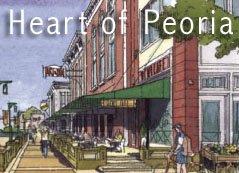
  1. Group Living — As stated in a previous post, the new Land Development Code includes general provisions for all of the Heart of Peoria, and specific form-based codes for the four “form districts,” namely, the Prospect Road Corridor, Sheridan-Loucks Triangle, Renaissance Park (or West Main corridor), and the Warehouse District. Within these form districts, there are stricter standards for the form of the building (i.e., the facade, how it fronts the street, etc.), but the use of the building is relaxed.

    For example, under our current zoning laws, any kind of residential group living (more than three unrelated persons living in the same house) is restricted; you have to get a special use permit to legally have a household so constituted. But under the form-based codes, such arrangements are allowed by right, without having to get a special use permit.

    What’s wrong with that? Well, one potential problem is right over in the West Main corridor — by Bradley. It sets up a situation where one side of the street may require a special use permit to allow, say, 4 or 5 Bradley students to share a house, but the other side of the street would allow that use without a permit. This can lead to inequities for landlords and headaches for neighbors who want to have tighter controls on that particular type of use.

    From the way the council was talking, expect there to be a revision to that part of the code.

  2. One-way streets — Ferrell-Madden made it very clear that there are two issues critical to the success of the form districts: (a) implementation of the form-based codes (the Land Development Code, or LDC), and (b) “fixing the streets.” We’ve already talked about the LDC. By “fixing the streets,” they mean slowing down the traffic to make them more pedestrian-friendly by widening the sidewalks, putting in street trees, and converting one-way streets to two-way.

    Councilman Sandberg specifically singled out Adams, Jefferson, and Washington streets and asked Ferrell-Madden what would happen if the council did nothing to improve these streets (including conversion to two-way on Adams and Jefferson), yet still implemented the LDC. Answer: very little. Private developers would not want to invest money in a business that would front a street that is unsafe or perceived as unsafe. There might be some investment on cross streets where there is less traffic, but overall the initiative would be unsuccessful.

    There’s a part that the public sector has to play and a part for the private sector. The council can’t put businesses in there form districts, obviously. All they can do is provide the infrastructure that will make it attractive to developers — and part of that infrastructure is streets. Streets that are “fixed” in the public’s eyes, and will lead customers to the doors of new businesses that open in these form districts.

Any neighborhood groups or other organizations that would like to have a presentation can contact the Planning & Growth department at City Hall to schedule one. They want to get as much public input as possible before putting a final version of the LDC before the council for enactment. Formal public hearings will be held Nov. 8, 29, and Dec. 6.

City Council to get form-based code presentation tonight

If you missed last night’s meeting at the Gateway building (you can read about that meeting in the Journal Star today) and you want to know more about the proposed form-based codes for the Heart of Peoria, watch the City Council meeting tonight at 6:15 on Insight cable channel 22 (or head downtown to see it live on the fourth floor of City Hall). Ferrell-Madden and Associates will be presenting the new “Land Development Code,” as it’s called now, to the council early in the evening’s proceedings.

The whole idea of this new code is to recognize that zoning needs in the older, urban part of town are different than zoning needs in the suburban part of town. Right now, we just have one zoning ordinance that applies to the whole city, and it’s based on suburban standards (e.g., strictly separating residential and commercial uses of land, extensive parking requirements, fast arterial streets, large setbacks for buildings, etc.).

That kind of zoning just doesn’t work for the older part of town where density is so high that they often can’t meet the extensive parking requirements without tearing down buildings to put in parking decks or large surface lots, where buildings and neighborhoods were designed for mixed uses of land (corner grocery stores, residential apartments above commercial shops, etc.), and where businesses are supposed to front the street, coming right up to the sidewalk.

In addition to these general provisions for maintaining the character of older neighborhoods and commercial districts, the Land Development Code also includes additional, highly-detailed provisions for four specific “form districts”: the Sheridan-Loucks Triangle, the Prospect Road Corridor, the West Main Street Corridor (Renaissance Park), and the Warehouse District. These provisions are tailored to these individual areas, taking into account their unique features and needs. The time it takes to develop such a detailed code for these areas makes it impossible to do this for all 8,000 acres of the Heart of Peoria all at once; but more form districts will be added over time.

As mentioned before, this is not coming before the council for adoption tonight. There will be an intense public hearing process over the next month or so, and hopefully the code, with revisions, will come before the council for adoption sometime in December.

Ardis is in on Amtrak meeting

Peoria’s Mayor Jim Ardis will be pressing for rail service to come back to Peoria when he meets with Dick Durbin at a meeting in Champaign, the Journal Star reports:
“I would definitely like to get on Sen. Durbin’s radar because he is very supportive of continued funding for Amtrak,” Ardis said. “Even though it hasn’t been here, we’re the largest metropolitan outside the city of Chicago. I think people would use it and it would help for economic development.”

[…]Still, Ardis said he hasn’t taken a serious look at the possibility and plans to discuss it with council to find out if others are on board after the meeting with Durbin.

So, for all of you other rail-enthusiasts who were wondering who to contact to express your interest in passenger train service returning to Peoria, there’s your answer: contact your city council representatives. It sounds like their interest is going to have an effect on how hard Ardis pushes for it.

There are some significant logistical hurdles to overcome. A common misconception people have about railroads is the belief that the tracks are just like interstates or highways — i.e., that any trains can travel on them whenever they want. But the truth is that railroad companies actually own their own rights-of-way, and any other company that wants to use it has to enter into an agreement and pay a fee to the company who owns it.

That’s right, unlike public roads and airports that are subsidized by the taxpayers, railroads are all privately owned and maintained. And Amtrak doesn’t own any track in Illinois. So for Amtrak to come to Peoria, one of the sticking points is determining what tracks it would/could actually run on. Once that’s determined and a deal is worked out with the owner of the tracks, most likely those tracks would have to be upgraded because Amtrak trains generally run at a higher speed (70+ mph) than freight trains. And that costs money; probably state money.

The bottom line is, there would have to be better ridership than there was back in the late 70’s when train service left Peoria, or the early 80’s when Amtrak left East Peoria. And, contrary to some comments I’ve seen, just running a train to Normal to connect with trains there isn’t going to cut it. We need a direct-to-Chicago route (in less time than it takes to drive) if we want to get significant ridership. One of the reasons ridership was down 20-30 years ago was because service got so bad and trains went so slowly due to deferred track maintenance.

I think Peoria would embrace fast, quality passenger train service to Chicago and St. Louis. I’m glad to hear that Ardis, Durbin, and other elected officials are interested.

Current negative ads tame by comparison

I’m not particularly swayed by negative political campaign ads. I think they’re generally in poor taste, and they sure don’t tell you much about either candidate’s platform. If the best thing you can say about your bid for office is “vote for me ’cause my opponent is a bum,” you really aren’t offering much. So, I’m no apologist for negative campaigning.

That said, I think candidates are getting a bit thin-skinned these days. You know it’s getting bad when a grown man trots out his mother to defend him against a subliminal knock on his weight in a TV ad. To read the Journal Star’s “Word on the Street” column today (can’t find it online or I’d link to it), you’d think negative campaigning were something no one had ever seen before. Molly Parker says “enough is enough” — then goes on for three more columns rehashing how terrible these negative ads are.

I wonder what the candidates (and Ms. Parker) would think if their opponents ran this ad against them (from the 1964 presidential election):

Call me crazy, but I’d rather be criticized for my weight than have my opponent claim I’m going to start a nuclear holocaust. That really takes the cake — it goes waaaay beyond “vote for me ’cause my opponent is a bum” to “vote for me ’cause my opponent will start a nuclear war and vaporize your children!” It doesn’t get any more negative than that. Yet, sadly, it worked. Johnson won the election.

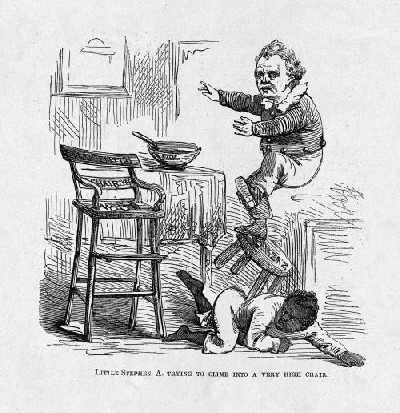
Did I say it doesn’t get any more negative? Well, maybe it does. Mike Smith isn’t the first person to have ads poke fun at his physique. Witness this political cartoon from Vanity Fair in 1860:

Stephen Douglas cartoon

That’s 5′ 4″ Stephen Douglas being lampooned for being so short. He’s depicted here as a child trying to reach the highchair of the presidency. To make matters worse, he’s balancing on a stool on the back of a black boy to get there — a reference to the Kansas-Nebraska Act of 1854, which Douglas (an Illinois senator!) had proposed and which ultimately passed Congress. That’s another story, not germane to this post. My only point is that this was quite inflammatory — way more inflammatory than the kinds of ads we’re seeing today.

And those are only two examples. Believe me, the political ads of today are a love fest compared to the past.

Form-based codes are back on the agenda

There’s a new Land Development Code soon to be proposed to the City Council, but first it needs to go through a rigorous public hearing. To kick things off, Ferrell-Madden and Associates will be holding an informational meeting at the Gateway Building downtown at 7:30 p.m. They will also be making a presentation to the City Council at their regular Tuesday meeting.

The Land Development Code is basically the Heart of Peoria Plan codified into Peoria’s zoning ordinance. There will be many presentations over the next couple of months — to developers, to commissioners (zoning, planning & growth, Heart of Peoria, Ren Park), and to the public, to try to get constructive input that will strengthen the code before it goes before the City Council for adoption.

Political Correctness plays on FOX

PC on FOXSteve Lyons was a FOX broadcaster until immediately following Game 3 of the ALCS. It was during that game that Lyons, according to FOX, made “racially insensitive remarks” about fellow broadcaster Lou Piniella, who is also destined to be the Cubs’ next skipper.

In this age of hypersensitivity, what in the world could Lyons have said to cost him his job? Here’s the report from the Detroit Free Press:

In the second inning Friday, Piniella talked about the success light-hitting A’s infielder Marco Scutaro had in the playoffs against Minnesota. Piniella said that slugger Frank Thomas and Eric Chavez needed to contribute, comparing Scutaro’s production to finding a “wallet on Friday” and hoping it happened again the next week.

Four minutes later, Piniella said the A’s needed Thomas to get “en fuego” — “on fire” in Spanish — because he was “frio” — “cold.” After Brennaman praised Piniella for being bilingual, Lyons spoke up.

Lyons said that Piniella was “habla-ing Espanol” — butchering the conjugation for the word “to speak” — and added, “I still can’t find my wallet.”

“I don’t understand him,” he continued, “and I don’t want to sit too close to him now.”

The three broadcasters laughed and continued calling the action.

Fox executives told Lyons after the game that he had been fired.

Now, can someone explain to me what’s “insensitive” about this exchange? Is it that he said Piniella was “habla-ing Espanol”? Did they really Lyons was poking fun of Spanish-speaking people or the Spanish language in general? Please. Or was it that he implied Piniella had stolen his wallet, thus leading FOX to believe he thinks people of Hispanic descent are born thieves?

Come on. Lyons was just trying to make clever repartee — silly banter — with his booth-mates as is normal for broadcasters. He didn’t make any racial slurs or play on any stereotypes; if it had been Brennaman who had said what Piniella said, Lyons would have said the same thing. To fire him over this is the epitome of political correctness, and is the kind of thing that makes people afraid to say anything at all.

If FOX wants to fire someone for being insensitive, they should fire Jeanne Zelasko for unceremoniously cutting off broadcasting legend Ernie Harwell after only 17 seconds of a pregame interview during the 2005 All-Star Game.

Amtrak service being considered for Peoria?

Amtrak LogoThe Quad-City Times reports on the possibility of Amtrak service being expanded in the state (emphasis mine):

Officials throughout Illinois have been invited to discuss such an expansion during a meeting to be hosted Tuesday by Amtrak president Alex Kummant and U.S. Sen. Dick Durbin, D-Ill.

[…] The Tuesday summit, scheduled to take place in a refurbished Amtrak station in downtown Champaign, is an attempt to build on the train ridership increases Illinois has seen in recent years.

Along with the potential for adding service to the Quad-Cities, the meeting will address an ongoing study looking at the feasibility of providing Amtrak service to Rockford. The talks also will touch on the prospect of adding a Peoria stop to Amtrak’s offerings.

Even though this is highly speculative right now, it’s nice to know that it’s at least on the radar. There was just a letter to the editor today from a Peorian who would like to see Amtrak service from Peoria again — I’ll bet there are a lot of people who feel that way. And since the “River Station” (actually the Rock Island Depot) is vacant, it could become a depot once again, this time for Amtrak — a perfect addition to Peoria’s downtown renaissance.

Hat tip: David Jordan (via PeoriaRails Yahoo! Group).

Go to jail. Go directly to jail. Do not pass Go. Do not remain free pending appeal.

George RyanFrom the Chicago Tribune:

Former Gov. George Ryan must surrender to prison early next year after a federal judge on Friday refused to let him remain free on bond while his appeal winds through court.

In a 32-page ruling issued Friday evening, U.S. District Judge Rebecca Pallmeyer rejected claims by the defense that Ryan’s racketeering conviction was likely to be reversed on appeal.

Who says there’s no justice these days?

Anatomy of District 150’s tax levy, Pt. 2 or, “How your taxes will go up if D150 gets funds through the PBC”

There’s one more observation I’d like to make about District 150’s tax levy, and that involves the second-largest expenditure behind Education: the Public Building Commission (PBC).

Since 1993, the school board has been unable to tap the PBC for bonds due to a state law prohibiting it (we’re paying for pre-1993 bonds on our tax bills today). Sen. Shadid and Rep. Schock would like to see that change and passed legislation that would allow the school board to again get funding for construction through the PBC, but it was vetoed by Gov. Blagojevich. It was an amendatory veto that allowed funding to come from the PBC, but would require a public referendum to do so. Now Shadid wants to work on overriding that veto.

The school board has consistently promised that receiving these funds through the PBC would not raise taxes; i.e. the tax rate would remain the same. (Of course, we all know a tax rate that stays the same when it’s supposed to go down is a tax increase by any definition but the school board’s, but that’s their claim.) They even took action to cap its tax rate for the payment of leases with the Public Building Commission, and this was the basis of Shadid’s support for overriding the governor’s veto.

There are two problems (for taxpayers) with this little scheme.

First, the school district capped the tax rate at .60%. And, as you can see from Part 1 of this post, the current rate is .5578%. So, even by their own definition it will be a tax increase — an increase of .0422%. And, of course, since this supposed “cap” is only set by the school board and not state law, it could easily be repealed at any time.

Second, since the PBC’s part of the levy is not listed separately on your tax bill, how would you ever know if the rate changed, anyway? Only if you took the time to go down to the county clerk’s office and get a copy of the tax computation worksheet, which is unlikely for 99.99% of Peorians. I asked how one can go about listing the PBC’s part of the levy separately like they currently do for District 150 pensions. According to the county clerk’s office, it would have to be required by state law. I don’t expect our local lawmakers would want to see that, do you?

If Shadid, Schock, et. al., are successful in overriding the governor’s veto, make no mistake about it — they will have just voted to circumvent safeguards for voters (the referendum process) and allow District 150 to raise your taxes without your consent.