All posts by C. J. Summers

I am a fourth-generation Peorian, married with three children.

$10M price tag, other excuses highly questionable

The Journal Star reported on the last public meeting about changing Adams and Jefferson streets downtown from one-way to two-way. It’s clear that Public Works Director Steve Van Winkle doesn’t want to change them (why, I don’t know). He had an engineer from IDOT figure out the cost of switching, and supposedly it’s over $10 million.

I’d like to see the itemized bill for that one. Methinks the price is a bit inflated, perhaps because of the part of this quote I’ve emphasized:

Traffic officials also talked about the possibility of having one-way streets Downtown but having traffic going two-way just outside of Downtown. IDOT estimated the cost, which included changing traffic signals, changing signs and buying land, at more than $10 million.

“Buying land”? And just why would we need to buy land when Peoria already owns a right-of-way that handled two-way traffic in the first place?

But that’s not all — if their prices don’t scare you, perhaps their accident statistics will:

According to statistics from the Illinois Department of Transportation, the one-mile stretch of Adams Street that is two way south of U.S. Route 150 has a higher accident rate than the one-way sections of Adams and Jefferson Avenue that are just south of it.

The two-way stretch of road had 8.5 crashes per million vehicle miles driven, compared to 5 and 5.2 crashes per million vehicle miles on the one-way streets.

“There’s more crashes on the two-way section,” said Eric Therkildsen, a program development engineer with IDOT.

Ah, statistics. How do you suppose they were able to prove causality based on this correlation? How were they able to isolate the traffic-direction variable and determine this was the one and only reason crashes were up on one-way streets? Do you think things like visibility; the number of intersections, business entrances, employees; or the amount of traffic volume varied at all between these two stretches? And what was the time period for these data? The two-way section includes the intersection of routes 150 and 24 — are there a disproportionate number of accidents at that major intersection that could skew the results?

When the Public Works director is throwing everything but the kitchen sink at an idea to make it go away, it’s probably not going to happen. You can’t fight city hall, and I doubt there is anyone obsessed enough with converting streets to two-way that will fund his or her own feasibility study. So, it will likely die until such time as we get a Public Works director who is more open-minded.

Hotel “crisis” shouldn’t have been surprise

John Morris was nice enough to come up to me during Tuesday’s city council meeting and compliment me on my blog. In return, I think it’s only fair that I point out Mr. Morris’s excellent observation that same night regarding the Civic Center hotel study.

Many people (council members, the Journal Star, and even I, myself) have expressed surprise over this hotel “crisis” that seems to have been sprung on us after the $55 million Civic Center expansion is almost completed. But Morris claims it shouldn’t have come as any surprise, at least to those on the council.

He referenced the “Peoria Civic Center Masterplan Analysis” study which was done in August 2002 (before the expansion was approved) by C. H. Johnson Consulting, Inc. I didn’t read feasibility studies on this stuff until I started blogging, which was only Spring 2005, so I’d never read this particular report. I was shocked. I’m going to quote heavily, so brace yourselves. It said (emphasis mine):

Despite the available occupancy in downtown hotels, Peoria is actually poorly positioned from an inventory standpoint to handle the needs of additional demand generators for three reasons; product quality, proximity of room inventory, and available room block. To effectively service a convention center and add value to the convention sales effort a hotel property must typically must be located within ten blocks (or reasonable walking distance) of a center, the property must be willing to commit approximately 60 percent of its room inventory to the convention center room block, and the hotel must offer a quality room product.

For the Peoria Civic Center, there are four hotel properties that have the potential to meet these criteria – the 288-room Hotel Pere Marquette, the 327-room Holiday Inn City Center, the 110-room Mark Twain, and the 108-room Staybridge Suites. At this time, however, the Staybridge chooses not to participate in the convention center room block, which removes it from consideration in the convention center package. The remaining three properties have a total inventory of 725 rooms, but none is located proximate the convention center. At two blocks, the Pere Marquette is the closest property, however, the property needs improvements in its quality. Given that Peoria is a cold-weather market, any distance beyond two blocks adds infinitely to the challenge of selling the center during winter months.

Under the assumption that 60 percent of the 725-room inventory in the three hotels is available, downtown Peoria can only offer a room block of 435 rooms. Even if the room block commitment is increased to 70 percent, only 507 rooms are available in the nearby properties. The lack of available rooms and their distance of many of the rooms from the PCC, means that many meeting planners and tradeshow promoters bypass Peoria as potential destination for their events, which translates directly into lost economic activity in the market.

Later in the report, they added (again, emphasis mine):

The Peoria Area Convention and Visitor’s Bureau tracks “lost” convention and meeting business. These are groups that that looked at the city, but ultimately decided to stage their events in another market because the PCC was either too small, the hotel room inventory in downtown Peoria was insufficient or not of the quality preferred by meeting planners, or other factors.

And, just to drive the point home, the Johnson report lists the responses from a survey of Illinois meeting planners on how they perceive Peoria as a place to hold events. One of the findings (emphasis mine):

When asked for suggestions with regard to improvements that could be introduced into downtown Peoria that would make the city a more attractive market, a common response was the need of a hotel to be connected to the convention center large enough to hold a group our size.

I keep quoting this stuff to point out that it wasn’t some isolated statement buried in the report. It came up over and over and over again. Under “Implications for Peoria,” toward the end of the report, they mention again, “as the city improves its downtown offerings and induces additional demand into the market, it must also improve its hotel offerings.”

But was it “critical” back in 2002? Yes — it even uses that exact word: “Critical the success of convention centers is the availability of proximate hotel rooms.” And look at this specific recommendation and see if it doesn’t sound familiar (emphasis mine):

…comparable facilities have a proximate hotel inventory (within three blocks) ranging from 700 to 1,000 hotel rooms, while the Peoria Civic Center has only the Pere Marquette’s 288 rooms nearby. With the recommended expanded and renovated facilities, Peoria will need a larger, higher-quality hotel package. In order to not only be competitive, but to accommodate more and larger groups, Peoria should consider:

  • Connecting the Hotel Pere Marquette to the Peoria Civic Center via walkway, as is the case in many cities in the US….
  • Inducing the development of an additional three-star hotel, such as the under-construction Hilton Garden Inn adjacent to the Kentucky Fair and Exposition Center in Louisville, Kentucky. …The City can help induce this development by providing a site, rebating property taxes, or any number of incentives.
  • Promoting the upgrade of the existing hotel room stock in the city….

So, what’s my point? The Civic Center Authority and the City Council knew that this hotel deal was an integral part of the Civic Center expansion and that it was likely to need public funding. It shouldn’t have been a surprise to anyone who read the report. Nevertheless, the Civic Center tried to make the city believe that it could overcome that hurdle without adding to the $55 million price tag (see my previous post). That was wishful thinking at best, calculated deception at worst. Considering what was already known about how much comparable cities were spending to lure hotels to their areas, the city and Civic Center were naive if they thought Peoria could lure a hotel without any incentives.

So what do we do now? I recommend the city wait. Don’t react to this as if you have to build a new hotel tomorrow or the sky will fall. The Civic Center Authority told the council back in 2004, “We believe [the Civic Center expansion] can be successful without an attached hotel,” and did not request any public funding for a new hotel. I say, hold them to their word. What’s changed in the last two years? Nothing. They should be required to make a go of it without a penny more of public funding, just like they requested before this project started. It would be interesting to see what happens. It’s not like we can’t induce a hotel to locate here in the future if necessary.

The Holiday Inn will be under new management soon and is going to be undergoing renovations. Once the Civic Center expansion is done, presumably there will be some increase in the number of events, which will translate into more demand for hotel rooms. Let’s see what the free market does for a while. We might be surprised.

Sensible environmentalism

As I’ve mentioned before, I’m looking for ways to cut my energy costs — without having to live like the Unabomber. Eyebrows McGee has been writing me giving me all sorts of great ideas, and now she has compiled many of them into this post on her blog. It’s well worth the read, especially since electricity costs are currently slated to skyrocket in January.

She’s what I would call a “sensible environmentalist.” When I see environmentalists on, say, C-SPAN or something, they’re usually advocating some totally unrealistic or radical method of saving energy (like living in a yurt), and I just roll my eyes and move on. But Eyebrows has some very practical things that don’t involve completely changing your lifestyle.

I can totally buy all her suggestions except for one: replacing incandescent light bulbs with fluorescent ones. I understand the energy savings, but I hate fluorescent lights. I hate how they look and how they make me feel. Their light casts a pall on everything that I find utterly depressing. (I know, I know, I should talk to a psychologist about this.) I prefer the soft yellow-white light of a burning incandescent globe, and I don’t think I could ever give that up. It’s easy to install. You can also hire electricians like W3 Electric to do it for you. You can also upgrade your Electrical Panel if it’s already old; this will help you save more money.

Other than that, great ideas — I especially like the idea of solar roofing materials; that’s clearly come a long way since big solar panels. Nice to know the aesthetes are making headway in beautifying (or at least camouflaging) new technology. For roofing installation, you can visit their site or contact experts like Bondoc Roofing.

Journal Star cranks out fresh batch of Kellar propaganda

I have just a few comments to make about today’s Kellar Branch editorial. I knew when I saw a pro-rail article on Sunday that a negative editorial had to be just around the corner, and the Journal Star did not dissapoint.

Titled “Commuter rail on Kellar line a fantasy,” the Journal Star tells us to “[f]ile this [idea] under the folder marked ‘Pie in the Sky.'” This, from a newspaper that thinks a hiking trail is going to draw tourists and residents to Peoria in droves, as if a hiking trail were some sort of unique geological feature not present in every other city.

They argue that riding the train downtown would take too long. “Peoria’s the 15-minute city, remember? It’s far easier to hop in the car.” “Even if gas was $5 a gallon,” they insist, “it’s hard to believe that North Peoria and Dunlap workers and shoppers in any number would park their cars at a depot” and take the train. Yet just four months ago (May 6), they one of their reporters had this to say: “Hikers and bikers hoping to save gasoline or work off calories on the Kellar Branch trail likely won’t be using it any time soon.” (emphasis mine) So, apparently, the Journal Star trail advocates believes that people will park their cars at a trail access point, walk or bike in the elements to their workplace or to go shopping, all in an effort to save gas. But they won’t go to an enclosed depot, get on a climate-controlled train, and ride it to work or go shopping. Somehow, that plan isn’t “Pie in the Sky.”

The next line is killer: “Beyond that, who’s going to pay for this? Where’s the feasibility study? If private sector folks were convinced they could do this without courting bankruptcy, they’d be lining up, wouldn’t they?” Ironically, Pioneer Railcorp, a private business, has already offered to pay for it. They’ve been lining up to purchase the line, provide freight service, help build the trail, and provide commuter/tourist train service. And they’ve had that offer on the table for two years. The city would get $565,000 for the line, $100,000 in help building the trail, yet the Journal Star implies this private development would be costlier to the taxpayer than ripping out the half-million dollar asset and leasing the whole right-of-way to the Park District for $1/year for 99 years! And speaking of feasibility studies, where is the Park District’s?

“Let’s call this proposal what it is: a misguided attempt to try to derail plans for a Kellar branch hiking/biking trail,” they say. First of all, let’s not mix metaphors. The hiking/biking trail proponents are the ones who want to “de-rail” the Kellar Branch. Secondly, that statement is patently untrue. Those who want to save the Kellar rail line are in favor of a trail side-by-side with the rail line. Pioneer has even offered to donate $100,000 in equipment and labor toward building the trail! Ignorance is bliss at 1 News Plaza. The Journal Star seems to be exhibiting a martyr complex.

This statement is puzzling: “The more shrill opponents erroneously assert that anyone who supports a Kellar hiking trail must then oppose trains, as if rail and trail were arch-enemies. Wrong. Central Illinois’ freight rail infrastructure greatly benefits the region.” This, after they just finished falsely accusing commuter rail proponents of opposing trails! Add projection to the martyr complex. And who are these “shrill opponents” of whom they speak?

“But let’s not kid ourselves. Peoria isn’t […] Napa Valley, Calif., drawing the tens of thousands of customers necessary to sustain a tourism train.” Did you know the Journal Star was an expert on how many customers are necessary to sustain a tourist train? I’m sure they’ve done an exhaustive feasibility study on this. Pioneer Railcorp actually owns and operates a tourist train in Gettysburg, Penn. Who do you think is in a better position to guage the feasibility of this plan — Pioneer or the Journal Star?

I won’t bother typing out the final paragraph as it’s just a summary of their faulty reasoning. Whether or not you believe commuter rail is feasible, at least it would be provided by a private company and the city would derive the proceeds of over a half-million dollars for the line. And if commuter service fails, the city would still have freight rail service and a trail alongside the rail line. So, what is there to lose?

Price freeze hasn’t hurt Ameren’s profits

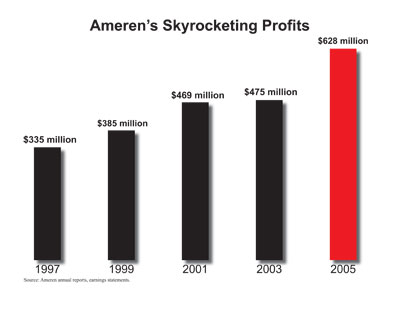
The Citizens Utility Board (CUB) has compiled some interesting data on Ameren. Starting in 1997, the year electricity rates were frozen by the state, they graph Ameren’s profits every other proceeding year, right up to 2005. One would expect profits to be modest at best, given the handicap of a rate freeze. But check this out:

Ameren Profits from CUB

Doesn’t look like the price freeze negatively affected their ability to nearly double their profits over the past ten years. So, it appears Ameren doesn’t really need that 55% increase, does it? It would be fair for someone to retort, “Why shouldn’t they be allowed to raise their rates 55%? Let the free market decide!”

Ah, but therein lies the problem. Ameren is still a monopoly in residential services. If you don’t like the Ameren rate hike and decide to go with their competition… you can’t, because there is no competition. Thus, consumers do deserve protection from price gouging — and a good case can be made that this is, in fact, price gouging.

There are those who are trying to help. CUB has “filed a brief with the appellate court, arguing the [rate hike] plan is illegal and hits consumers with unfair market prices at a time when the power companies still hold a monopoly on residential services,” according to today’s Journal Star. And Illinois Attorney General Lisa Madigan is trying to get the results of the recent reverse auction thrown out on the same basis.

CUB also reports, “Under the Electric Consumer Protection Act, HB 5766, rates would be frozen for another three years or until at least 33 percent of residential customers have switched electric suppliers.” So, it looks like there’s a possibility that 55% rate hike may not take effect in January after all.

Is District 150 tacitly abandoning East Bluff school?

Mentioned briefly at the end of the Journal Star’s article on the District 150 board meeting last night is this nugget:

The board agreed to begin negotiations with an architectural team to design a replacement school for Harrison Primary School.

The district will begin negotiations with local firm LZT Associates and Chicago-based firm Perkins+Will. The district intends to replace Harrison with a new school across the street. The planned site is a recently demolished section of Harrison Homes on Krause Avenue.

No mention of the East Bluff replacement school in that story. But there was a passing comment on WCBU this morning that the school district still hasn’t come to an agreement with the city on where to build a new school in the East Bluff; and they added, one may not be built at all.

Although a decision has not been officially made, it appears to me the district has made up their mind. They’ve already established in previous meetings that they don’t like the city’s site preference and the cost of building a “birth through eighth community center” type of school will cost millions of dollars more than they budgeted for construction. Several weeks ago, Superintendent Hinton and other board members stressed how urgent it was to make a decision soon so they could get the new school built in time before Glen Oak School is slated to close. Considering that we haven’t heard anything about the East Bluff replacement school for weeks now, and seeing how the district has shifted focus to the new Harrison replacement school, my intuition tells me there isn’t going to be a new school in the East Bluff anytime soon, and Glen Oak’s closing will likely be delayed.

I could be totally wrong in my prediction. But if I’m right, it raises another question. If they do officially decide not to build a new school in the East Bluff, will they reopen White School?

Bud’s is out; VOP’s back in

It’s not easy to say you were wrong, but Mercedes Restaurants is admitting that switching Vonachen’s Old Place (VOP) to Bud’s Aged Steaks was a mistake. And now, they’re switching back!

I was very disappointed last June when the news came that VOP would be no more. One of the things I liked about it was its unusual atmosphere that was just right for almost any occasion — business lunch, family dinner, formal occasion, casual gathering to watch a sporting event in the bar, etc.

Apparently a lot of other people missed the old atmosphere as well:

“I don’t think it’s been as good as we would have liked,” said Steve Shaw, vice president of Mercedes Restaurants.

Many customers just didn’t warm to the change, saying they missed the VOP name and menu items, he said….

“As with Vonachen’s Old Place for 26 years, the menu will have something for everyone, with a casual, come-as-you-are environment,” he said. “We welcome back all of our Vonachen’s Old Place regulars.”

Apology accepted. My family will definitely be coming back.

Another local institution closing

CohensIt’s been in Peoria 127 years, but this will be the last year for Cohen Furniture Company. The Journal Star reports that Cohen’s will be closing for good by the end of the year.

My wife and I have shopped at Cohen’s quite a bit, most recently getting our couch and our basement carpeting there. It’s always sad to see a local business close, especially one that has been a mainstay for over a century. Apparently, the current president wants to retire and no one is interested in buying the company. So another local business will quietly slip away.

It’s not mentioned in the article, but this will clearly also impact Peoria Heights where Cohen’s warehouse has been located since 1989.

One way to give city leaders your input

One Way SignIt’s been a while since the last public meeting, but the city is still interested in hearing your thoughts on reverting downtown streets back to two-way traffic. Another public meeting is scheduled for this Wednesday, September 20, at 6:30 p.m. in the Gateway Building on the riverfront.

I’ve been an advocate of this plan for some time, but especially since the reconfiguration of I-74. I contend one of the benefits would be easier access to downtown from the new interstate ramps and vice versa if the streets were converted to two-way. If you’re leaving, say, O’Brien Field by going north on Adams and you want to go east on I-74, you currently have to drive over 74, turn left on Spalding, left on Jefferson, left on Fayette, and finally left onto the entrance ramp. If Jefferson were two-way, you could avoid the run-around-the-block.

Overall, there’s simply not enough traffic volume downtown to warrant one-way streets, as the Heart of Peoria Plan and other feasibility studies have observed.

Fines for loud parties, underage drinking may rise

Following a couple of raging parties in the neighborhoods surrounding Bradley University, Second District Councilperson Barbara Van Auken promised to propose “a $1,000 fine for both the host(s) and the property owner if it’s owner-occupied.” That proposal will be presented to the City Council at tomorrow evening’s meeting.

The municipal code already has the following fines in place:

(a) A person who knowingly enters or remains in any house, building, yard or other premises, other than premises licensed to sell alcoholic liquor, under circumstances where the person knows or reasonably should know that alcoholic liquor is being illegally possessed or consumed by persons under the age of 21 years shall be guilty of a petty offense and, upon conviction, shall be punished by a fine of not less than $200.00 nor more than $500.00.

(b) It is unlawful for a parent, legal guardian or other person to knowingly permit a person under the age of 18 years old in his or her custody to violate the provisions of subsection (a) of this section. Any person convicted of a violation of this subsection shall be fined not less than $500.00.

The ordinance requested by Van Auken would add the following:

(c) Any owner or person in actual or constructive possession of a property, including, but not limited to, an occupant or tenant of property who suffers, allows, consents to, acquiesces by failure to prevent, or expressly assents or agrees to a violation of paragraph (a) of this section shall be guilty of a petty offense and, upon conviction, shall be punished by a fine of not less than $1,000.00.

It is hoped that this ordinance will motivate property owners and landlords to evict chronic disturbers of the peace by hitting them where it hurts — in their pocketbook. I wonder how property managers feel about this ordinance. I can tell you that homeowners and responsible renters in Bradley’s adjacent neighborhoods love it.