
All posts by C. J. Summers

I am a fourth-generation Peorian, married with three children.

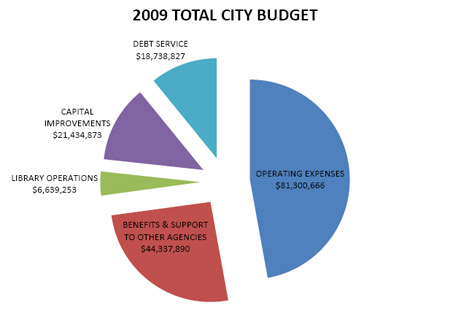
Debt service: $18,738,827

I went to a recent budget open house for the City of Peoria, and this graph caught my attention:
2009-Total-City-Budget

Our budget deficit is approximately $10 million. Our debt service (the amount we pay on principal and interest per year) is nearly $19 million. That debt service includes money borrowed for the recent Civic Center expansion, the Peoria Public Library renovation/expansion, acquisition/infrastructure work done in TIF districts, and some other infrastructure projects.

The money to pay for this debt comes from various sources. The Hotel, Restaurant, and Amusement (HRA) tax pays for the Civic Center expansion. A portion of our property taxes is specifically designated for the library’s recent capital projects. And debt incurred in TIF districts is covered by the new taxes produced by the TIF (the “tax increment”) — with one notable exception: MidTown Plaza.

MidTown, home of the now-shuttered Cub Foods, has never paid for itself. While there has been some incremental increase, it’s not enough to cover its own debt service. Money from the general fund makes up the difference. Staff is quick to point out that they recommended against that TIF, but the council voted for it anyway.

As if that weren’t enough, the council has committed to taking on more debt: $39.5 million for a Marriott Hotel to be built across the street from the Civic Center, to be paid for with the tax increment within the newly-created Hospitality Improvement Zone (HIZ) TIF plus a 1% sales tax increase within the TIF. The city hasn’t had to sell the bonds yet because the hotel developer has been unable to get supplemental financing through bank loans.

Think about this debt and the taxes that pay for it when the council is haggling over closing its structural budget deficit. They have no problem raising or maintaining taxes for non-necessities and developer welfare — even in the leanest of times, as the hotel deal shows — but feign frugality when it comes to paying for basic city services. They cut police and code enforcement personnel, reduce road maintenance, and institute other cost-saving measures ostensibly to keep taxes “low.” In reality, the city is acting no differently than a person who balances his household budget by cutting his grocery purchases while maintaining (or even increasing) his cigarette consumption.
Council brainstorms money-saving ideas

The August 11 Peoria City Council meeting promises to be a long, long meeting. The council spent an hour and a half Tuesday night brainstorming ideas for plugging the projected $10 million budget deficit. City staff will take those ideas and run the numbers on them (and in some cases, check the legality of them), then bring them back on August 11 for a policy session where council members will discuss them in detail.

Here is the list of ideas as compiled by the Journal Star:

New tax and fee ideas

  • 2 percent tax on package liquor
  • “Carry out” tax on restaurants, retail establishments, distributors or other businesses that generate wrappers, bottles and other products that turn into litter
  • “Bed tax” on not-for-profit entities such as Bradley University and local hospitals
  • Business license fee
  • Additional tax to use city parking decks
  • Arrest fee
  • Fire service protection districts
  • 5 percent water utility tax
  • Storm water utility tax
  • Fee assessed on pet owners
  • 2 cent per gallon motor fuel tax
  • Eliminating $6 a month garbage tax and rolling it into the property tax

These were in addition to the suggestions made by staff in this report, which includes wage freezes, voluntary separation, revenue adjustments (cutting funding to ArtsPartners, the public library, and other organizations), and revenue increases (e.g., eliminating free land waste pickup).

Councilman Gary Sandberg also suggested that, if the council is going to consider cutting funding to the library, they should also consider cutting funding to the Peoria Civic Center by the same percentage. He also asked staff to bring back a report on how much downtown parking decks would need to charge to break even (i.e., eliminate parking subsidies).

He also hinted at a more radical suggestion: eliminate the city’s police department and turn that function over to the Peoria County Sheriff’s Office. Sandberg points out that county law enforcement officers’ salaries are one-third less than Peoria police officers’. After the meeting, he added that we could put half the savings in salaries toward plugging the budget deficit, and use the other half of the savings to hire more police officers. In effect, we could help plug the deficit and increase police protection at the same time.

I asked Police Chief Steve Settingsgaard what he thought about Sandberg’s proposal. He said that it wasn’t an apples-to-apples comparison to compare city officers to county officers. Instead, when comparing salaries, the council should compare city officers in Peoria to city officers in other similar-sized cities. He said that there are differences between city and county law enforcement, but didn’t elaborate on what those differences are.

More public budget meetings this week

There are a couple more opportunities to talk to city officials about your take on the budget deficit. Your voice can be heard at these upcoming meetings:

  • July 15, 2009
    4:00 – 6:00 p.m.

    Pleasant Valley Middle School
    3314 W. Richwoods Boulevard
    Bill Spears (Fourth District) and Gary Sandberg (At-Large)
  • July 16, 2009
    4:00 – 6:00 p.m.

    Peoria Central High School
    1615 N. North Street
    Barbara Van Auken (Second District) and Ryan Spain (At-Large)

City and County have golden opportunity to save $80 million+

Both the city and county of Peoria are facing hard times. They’re in a budget shortfall and are looking at increasing revenue and cutting costs (which means services will be cut in some way). Each entity has unwisely committed themselves to large, approximately $40 million capital outlays for non-essential projects: the city for a private Marriott hotel downtown, and the county for a private museum that has received tepid support for multiple years.

Here’s the good news: Both of these projects have missed their contractual deadlines, meaning that the municipalities could easily cancel these agreements and save taxpayers a boatload of money, both in up-front capital costs and on-going operational expenses.

Here’s the bad news: They ain’t gonna do it. Despite a history of just these types of white elephants that have contributed to the current budget mess, you can bet your heavily-taxed bottom dollar that they’re still going to go through with them, even as they cry poverty when it comes to essential city services such as police protection and road maintenance.

It seems no one in the city is able to make the connection between large, non-essential projects, and high taxes. They all hate high taxes, and they all hate service cuts, yet they continue to support large, money-losing, unnecessary projects that swallow their tax money and give them little to nothing in return.

Residents are content to believe the tortured logic of their local politicians. Here are a few of my favorites:

  • “Canceling this capital project won’t do any good because the money to pay the debt can’t be reallocated to operational expenses; it can only be spent on this project.” — That’s true, but irrelevant. From the taxpayer’s perspective, canceling the project will save us money because we won’t have to support it with our tax money. It doesn’t matter that it can’t be reallocated; the municipalities are still going to have to plug their budgets with increased revenue from either taxes or fees. By canceling the agreements, that saves us from an even higher tax increase.
  • “This project will pay for itself.” — Let’s look at the hotel project. The developer can’t find financing for the rest of the project (apparently banks are a little more cautious with their money than the City of Peoria — which is saying something), and the Embassy Suites expansion in East Peoria was recently scrapped because, “The hospitality business as a whole in the country is experiencing extremely hard times.” Yeah, sounds like that will pay for itself, doesn’t it? Obviously the museum will never pay for itself; even ardent supporters don’t claim that.
  • “But the people voted for it.” This applies only to the museum, since the public didn’t know anything about the hotel until two days before the council voted on it, and basically had no voice in the matter. It’s not as if there isn’t precedent for the city council to ignore a vote by the people. They cut funding to the library expansion even after it was approved by a large majority of voters. This project was only narrowly approved, and mostly on the backs of Dunlap and North Peoria voters. It lost handily outside the city. I’ll bet if we had an referendum on increasing garbage fees, that would lose. Should the municipalities thus take that off the table? The fact is that any cuts in service or increases in revenue are going to be unpopular. Leadership requires that unpopular, but fiscally-responsible decisions be made in tough times.

The city and county need to cut the fat. They’re in debt. They can’t afford to provide basic services to their residents. If these developments are really the sure-fire money-makers they claim to be, let private interests finance them, not the taxpayers who are stretched already in this poor economy. Show some leadership.

Kellar Branch will likely be abandoned after all

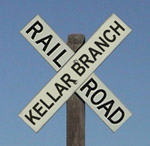
Kellar Branch RailroadOn the City Council agenda this week is an agreement — one of a “series of agreements” — that will pave the way (get it?) for a portion of the Kellar Branch to be abandoned so it can be converted to a recreational trail.

This agreement is pretty mundane. It just sets out how Central Illinois Railroad (CIRY) and Pioneer Industrial Railway (PIRY) will share trackage rights on the portion of the branch that remains, as well as the western connection to the Union Pacific line.

However, there is a mysterious, new entity that has popped up in the agreement: something called the “Kellar Branch Corridor Corporation.” According to the Secretary of State, it’s a not-for-profit organization incorporated in October 2008 by Thomas Leiter. You know Tom Leiter — that’s Alexis Khazzam’s father-in-law. Khazzam is a big recreational trail supporter. It seems this corporation has signed some sort of “Leasehold Purchase Agreement” with both CIRY and PIRY in October and November of last year.

Basically what this means is that Tom Leiter has somehow bought out CIRY and PIRY’s interest in all or part of the line. I can only presume he’s done the same with Carver Lumber, although it’s not explicitly stated in this, the first in a “series of agreements.” I wrote to city attorney Randy Ray asking for more details, but all he would say is:

I will try to get answers to all of [your questions]. For now, I will answer that the plan is to build a trail between Candletree and Park, with Carver being served from the West. This result is contingent on other things happening and is not assured by the Agreement on the agenda.

Well, we know that it’s more expensive to get rail service from the west. If that were feasible, the Kellar Branch would have been abandoned years ago. So, what’s changed? Only the creation of the mysterious “Kellar Branch Corridor Corporation” and its “Leasehold Purchase Agreements.” Sounds to me like some money has changed hands, and everyone’s willing to let the Kellar Branch be abandoned now. What they couldn’t do through lawsuits and regulators, they appear to have succeeded in doing with a little filthy lucre.

So money talks. What’s new? Well, here’s what we need to keep an eye on: who’s money? If it’s Tom Leiter’s, well, that’s his affair. But if one of these future agreements involves the Peoria Park District or the City of Peoria giving a large chunk of taxpayer money to Tom Leiter in return, that’s a different story. Somehow I just have a feeling that the taxpayers are the ones who are going to end up financing this scheme.

Ya gotta love the secrecy of Peoria politics. This has clearly been going on for more than nine months, yet this is the first time we’re hearing about it (publicly, anyway), and only because it has to be approved at an open meeting. Even then, they’re going to trickle out the agreements over time, so we can only see the full picture after it’s too late for the public to make any objections. A brilliant, albeit underhanded, plan.

Congratulations to the trail enthusiasts. It seems likely they will finally get what they’ve coveted for so long. Between this and the pending museum, Utopia is clearly just around the corner.

Water rates could skyrocket

Future water bills will be significantly higher if Illinois American Water Company and the City of Peoria get their way.

Illinois American Water Company (IAWC) wants to raise rates about 5% for infrastructure improvement, plus another 30.18% for a general revenue increase to cover higher operating expenses. The City, also in need of more revenue, is considering the possibility of imposing a 5% water utility tax to take effect next spring.

Let’s see, 5 plus 30.18 plus another 5 . . . that’s a 40.18% increase! That means a family that currently pays $30 a month for their water bill will be paying $42.05 (and this doesn’t include the $6 “garbage fee” that will remain on the water bill as well). That’s an increase of $144.60 per year. Wow!

Speaking of the garbage fee, they’re simultaneously looking at cutting the very services that fee supports. They’re suggesting the elimination of free landscape waste pickup — transferring the cost of that service to the users.

Meanwhile, downtown parking will continue to be subsidized. Priorities, you know….

Look for the exodus from Peoria to continue.

Lawsuit: Peoria doesn’t comply with ADA, Illinois Accessibility Code

If you watch or attend Peoria City Council meetings, you’ve probably seen Roger Sparks. He’s on the Mayor’s Advisory Committee for the Disabled. He is a person with a disability. And now he’s suing the City for non-compliance with the Illinois Accessibility Code, the Environmental Barrier Act, and the Americans with Disabilities Act.

The lawsuit has been filed in United States District Court, Central District of Illinois. Sparks has been agitating for ADA compliance in the City for years, but to no avail from what I can tell reading the complaint. The first part of the complaint states violations regarding Peoria City Hall: no directional signage indicating the nearest accessible entrance, no accessible public men’s room after hours, public service counters are too high (above 34 inches), and several violations in council chambers (Room 400).

But that’s not all. Sparks has additional complaints (incidentally, he filed in forma pauperis, which essentially means he’s acting as his own lawyer, so much of the complaint is in first person):

The City of Peoria does not comply with ramp transitions to walks, gutters, or streets, as most curb cuts within the City of Peoria are not flush and free of abrupt changes. Sections of sidewalks within the City of have height differences of 1/2 inch or more. Others sidewalks are left to deteriorate and cannot be use by a person in a wheelchair. I have had to exit a bus on a sidewalk only to enter the street in front of the bus using a traffic lane to get to the intersection and cross the street as some curb cuts are blocked by
obstacles. I have had to drive my wheelchair down lanes of traffic, as there are no sidewalks in some areas of Peoria. Several intersections within the City of Peoria have raised islands with no cut through level with the street or have curb ramps at both sides.

During winter months the City of Peoria plows in bus stops and curb cuts making them inaccessible to myself. The City of Peoria does not require sidewalks to be cleared.

The City of Peoria has revised Chapter 17 of its code, Article II Fair Employment and Housing with ordinance No. 15,889[…]. This ordinance has denied me the right to file a housing complaint against my landlord with the City of Peoria. The City of Peoria will not investigate discrimination of state, or United States laws.

The City of Peoria refuses to comply with Section 35.105 self-evaluation of the American with Disabilities Act. As I have requested a copy several times.

Ordinance 15,889 denies me the right to file discrimination complaints with the City of Peoria against businesses having violations from City of Peoria codes, ordinances, the Environment Barrier Act, the Illinois Accessibility Code when altering their parking lots, in their Zoning Certificates, and allowing these businesses to obtain special use permits not only once but twice while having these violations. The City of Peoria even moves or extends Enterprise Zones to give these businesses sales tax exemptions while having these violations.

When businesses are required to install sidewalks according to city code. The City of Peoria issues sidewalk and other variances not in the best interest of the public.

So, what does he hope to get out of this lawsuit?

I am seeking relief from the City of Peoria to change their policies and procedures to inspect an properties with new construction, alterations or additions at the time of construction. To have all properties comply with they’re Zoning Certificates, the Illinois Accessibility Code, and the American with Disabilities Act.

I am seeking a monetary settlement of $500,000.00

I don’t know how the suit will turn out, but I can tell you this — it’s difficult for a person without a disability to get around Peoria as a pedestrian. Sidewalks are intermittent, often crumbling and/or obstructed, and completely useless in the winter. If you’re in a wheelchair, it’s another order of magnitude more difficult. WHOI News even did an investigative report on it, back when they were an independent news organization.

If Mr. Sparks can win the non-monetary relief for which he’s asking, it will be a benefit to all Peorians.

PDF Link Sparks v. Peoria Complaint (PDF)

Computer blues

All kinds of news, and no new posts on the Chronicle…. What’s going on?

Answer: Computer problems. My Dell Inspiron 1501 is on the blink. Lately, it’s been shutting off unexpectedly. Not shutting down — shutting off. One second it’s on, and I’m in the middle of typing something, and the next second — POOF! — it’s off. Completely off. Totally off. Kind of disconcerting. Especially when it won’t boot back up again… for a couple days. Then, one day, you press the power button and it boots right up as if nothing ever happened.

So, a new laptop is in our near future. In fact, it’s being assembled now and will ship soon. A powerful motherboard from a pcb solutions company will be installed in my new computer so it should be able to handle my everyday tasks easily.

Well, now I’m getting excited to receive my new computer. I can’t wait to use it for my blog. In the meantime, if I go a couple days without posting, you’ll know why.