
Category Archives: City of Peoria

Exception might not be enough for Spain

Peoria City HallA couple astute readers of my blog have pointed out to me an exception to the Public Officer Prohibited Activities Act that might be a loophole that would allow Ryan Spain to serve on the city council without violating the act. (We’re still waiting for an opinion from the state’s attorney’s office as of this writing.) The exception reads like this:

(b‑5) In addition to the above exemptions, any elected or appointed member of the governing body may provide materials, merchandise, property, services, or labor if:

A. the contract is with a person, firm, partnership, association, corporation, or cooperative association in which the interested member of the governing body of the municipality, advisory panel, or commission has less than a 1% share in the ownership; and

B. the award of the contract is approved by a majority vote of the governing body of the municipality provided that any such interested member shall abstain from voting; and

C. such interested member publicly discloses the nature and extent of his interest before or during deliberations concerning the proposed award of the contract; and

D. such interested member abstains from voting on the award of the contract, though he shall be considered present for the purposes of establishing a quorum.

Sounds pretty cut and dried, but in state law, things aren’t always what they seem. Just ask Bud Nystrom.

Roy “Bud” Nystrom was a city councilman in Crystal Lake, a northern suburb of Chicago, when the company he worked for put in a bid to build a Bio-Solids storage facility for the city’s new wastewater treatment plant. Even though he abstained from voting on the contract, even though the council rejected his company’s bid, and even though he only inadvertently broke the Prohibited Activities statute, Nystrom was nevertheless indicted on 10 felony counts of official misconduct and prohibited financial interest in August 1998. He later worked out a plea agreement and plead guilty to a misdemeanor charge of “attempted interest in a contract,” according to Chicago Tribune reports from the time.

What does this have to do with the exception I quoted? Well, the above exception I quoted was passed in 1997 and took effect in January of 1998. During Nystrom’s controversy, the Chicago Tribune had this to say about it (emphasis mine):

Already the [Public Official Prohibited Activities Act] statute has been relaxed by a new law that takes effect in January. The new law says that city officials only violate state law if they engage in public contracts on behalf of publicly traded companies in which they own more than a 1 percent stake.

Even with that change, Cowlin believes the law remains unfair. He thought the [Illinois Municipal] league should take a look at amending the law further and exempt municipal officials who are employed by private companies.

Heartland Partnership, where Spain is employed, is not a publicly traded company, but a private company, just like Nystrom’s employer. If one keeps reading the statute, it does say (emphasis mine):

(e) For the purposes of this Section only, a municipal officer shall not be deemed interested if the officer is an employee of a company or owns or holds an interest of 1% or less in the municipal officer’s individual name in a company, or both, that company is involved in the transaction of business with the municipality, and that company’s stock is traded on a nationally recognized securities market….

So it doesn’t look like the “b-5” exception is going to be enough for Spain, which may explain why it’s taking so long to get an answer from City Hall; I imagine they’re working with the state’s attorney, Spain and his attorney, and Heartland Partnership to come up with a way to allow Spain to serve without violating the statute. It will be interesting to see how it all gets resolved.

Spain controversy in the news

There have been some follow-up stories in the news that are worth mentioning. WEEK-TV interviewed Spain on their 9:00 newscast for sister station WAOE “my59”:

“I just find it very unfortunate that a particular member of the council is working to play games now as we look to get down to business,” said Spain. “So today while I was out trying to build relationship in Springfield (at the General Assembly), a member of council is looking to play games.”

I think it’s unfortunate that this is being portrayed by Spain and his supporters as just “playing games.” A more appropriate response would be, “I was unaware of that state law; I don’t believe I’m in violation of it, but I will do whatever it takes to make sure I comply with it.” Or something like that.

Spain would be smart to make friends with Gary and not treat him as an enemy just because he pointed out this state statute. Gary didn’t write the law, and he’s had to live by it — giving up business because of it — so it’s not unreasonable for him to want to make sure everyone else is abiding by it, too.

WEEK ran a follow-up story yesterday that just said Spain had met with city attorney Randy Ray, but that nothing had been resolved yet.

Yesterday’s “Word on the Street” column in the Journal Star states, “Spain’s boss Jim McConoughey says his agency is willing to do whatever needed to make sure there isn’t a problem.” That’s a very generous statement by Spain’s boss, considering it could mean the loss of $50,000 a year to his business.

Sandberg asks Lyons to retract statement

Then there’s this statement by state’s attorney Kevin Lyons that was quoted in the same article: “Lyons did note that some current City Council members have faced similar conflicts. ‘Of course, Gary Sandberg, as an architect, has had contracts and done work for people who do business with the city, and he just abstains,’ Lyons said.”

I e-mailed Gary to ask him about that statement, since it seems to contradict what he said in the comments section of my blog. In response, he copied me on an e-mail he sent to State’s Attorney Kevin Lyons and the Journal Star that read:

Unless you were misquoted, I would like to know one instance and/or all the instances where any one of my clients had a contract with the City of Peoria to provide services or a product while I was doing Architectural work for that client. Your statement, if quoted correctly, is inflamatory [sic] and totally incorrect and creates a situation where I could lose my Architectural license from the State of Illinois.

If NOT quoted correctly, I would expect you to have already sent a correction to the newspaper….

I do Architectural work for clients IN the City of Peoria. I do NOT have clients that do work FOR the City of Peoria.

I haven’t checked today’s paper to see if there was a correction. It will be interested to see if anything comes of that. Whenever lawyers are involved, it’s always the same story: hurry up and wait.
Descriptive Sketch of Peoria, 1896

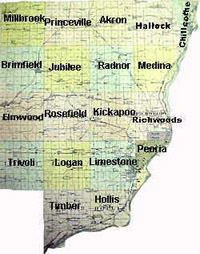
1896 Township MapAs I was reading PeoriaIllinoisan’s transcription from a 1908 book about Peoria, it reminded me of some of the descriptions I’ve read in a book I inherited from my grandfather: “Standard Atlas of Peoria City and County Illinois” by M. Huebinger, C. E., Peoria, Ill., published by Geo. A. Ogle & Co. Publishers & Engravers, 1896. So, today’s post will be just a little slice of Peoria history.

The city was quite a bit smaller then. I don’t have a good way of scanning the map, so I’ll just describe the city limits. At the northeast, the city goes no further north than Nebraska Ave. — that means that Glen Oak Park and Springdale Cemetery are not in the city. Moving west, the city line goes south at Knoxville, then west on Illinois to Elizabeth (now Sheridan). Then the city line goes south again along Elizabeth to Chambers Ave. (now Columbia Terrace). The line then extends west along Chambers to Bradley St. (now University), where it goes south to Main, then west on Main to Western Ave. Are you with me so far? You may have noticed that Bradley Park is also not in the city limits, nor is the Bradley Farm which would become the Uplands neighborhood six short years after this atlas was published.

The city line then goes south along Western to Lincoln Ave., west on Lincoln to a point in line with Livingston St., then south through the middle of several blocks and along Livingston to Grinnell. It dances back to Western (too hard to explain), then heads south to “Lower Main” (now Krause Ave.), then straight east to the river. And that’s it. That’s all there was to the city.

There was a part of Richwoods township called “North Peoria,” which was roughly a rectangle from modern-day Sheridan and Wilcox at the northwest to Nebraska and Perry to the southeast. There was also a part of Peoria township called “South Peoria” that was roughly anything south of Seventh St. (now Martin Luther King Jr. Dr.) and west of Western (except those areas I said earlier were within Peoria). Everything else was unincorporated.

As you read this glowing description of Peoria from the 1896 Peoria Atlas, you’ll have to suffer the flowery, verbose way of writing that was popular then. But pay close attention to the description of the schools, parks, and streets, and the new library they were building — this would be the “model of architecture” that was torn down in 1968 to make way for the non-descript box we have now.

Now, without any further ado, here’s the “Descriptive Sketch of Peoria from 1896:

Continue reading Descriptive Sketch of Peoria, 1896

Spain’s election could be contested

Ryan SpainSounds crazy, doesn’t it? I mean, the guy got a ton of votes, came in third place, and bested one of the three incumbents. What’s there to contest?

Answer: Whether state law will allow him to serve.

There’s this part of Illinois law called the “Prohibited interest in contracts” clause (50 ILCS 105/3) that says:

No person holding any office, either by election or appointment under the laws or Constitution of this State, may be in any manner financially interested directly in his own name or indirectly in the name of any other person, association, trust, or corporation, in any contract or the performance of any work in the making or letting of which such officer may be called upon to act or vote.

Ryan Spain works for Heartland Partnership, a private company. The City of Peoria has a contract with the Heartland Partnership for $50,000 per year through 2008 (it was passed by the council on 4/19/05). Spain has an indirect interest in that contract since he is an employee of Heartland Partnership.

The Illinois Attorney General’s office published an opinion in 1996 that said employees of contracted organizations benefit indirectly from those contracts, and are thus prohibited from serving on municipal councils. They quote People v. Sperry (1924) as precedent:

If we attach any significance to the words used by the statute, “directly or indirectly interested in the contract,” we think the conclusion cannot be escaped that the officers of the city, who are also employees of the contractor, must be considered as indirectly interested in the contract, without regard to the fact that they derived no direct benefits from the contract itself.

I don’t know if anyone will actually contest it, but one would think it’s likely. I don’t imagine the council wants to take the chance of being in violation of state law. I’ve sent an e-mail to city attorney Randy Ray seeking comment. I’ll post his response as soon as I receive it.

If my interpretation of the law is correct, this situation raises a lot of questions. For instance, could this problem be removed if Heartland Partnership cancels their contract with the city before Spain takes office? I don’t know if that’s even possible, but if it is, I guess we’ll see what is more valuable to the Heartland Partnership — Spain on the council, or $50,000/year from the city.

Another question that arises is what will happen if Spain is found to be disqualified from service. Will the city try to get state law changed to allow him to serve, like they did with George Jacob? Jacob was originally ineligible because he held a liquor license, but state law was changed to allow him to serve as long as he abstained from any liquor-related decisions. If Spain ends up not being able to serve, would the sixth-place finisher (Dan Irving) be installed as a councilman instead?

Interestingly, this is not the first controversy surrounding Spain’s campaign. He set up a campaign teleconference event — a virtual town hall meeting — that took place at the Workforce Development Center at One Technology Plaza. Several people questioned whether tax-payer money was used for the event, but Spain says the meeting was paid for completely by his campaign, and that his forthcoming campaign disclosure reports will show this.

UPDATE: I’d just like to say, as far as communication goes, Randy Ray does a great job. He’s always timely and informative in his responses. Here is what he had to say on this issue:

Thank you for the question. I do my best to answer citizens’ legal questions concerning their city government, and I intend to answer this one. I have always addressed conflicts first with the affected official, and then, if no resolution is reached, with others. Accordingly, I will address this issue first with Mr. Spain, and then with you. Obviously, the time frame is short, so you can expect to hear from me on or before May 1.

I think that’s a fair way to handle the situation. Of course, I will post Mr. Ray’s follow-up when I receive it. As you can see, it may be a few days. Legal stuff always takes a while.

Referenda Results: Library, Smoking

The referendum to spend $35 million on the Peoria Public Library system passed overwhelmingly:

Advisory Proposition To Issue $35,000,000 Library Bonds

Yes 9,951 71.59%
No 3,949 28.41%

The referendum was advisory and non-binding, so the next step is for the library to get City Council approval for their plans.

City council members are usually reluctant to raise property taxes, fearing voter backlash. But last night, the voters showed that they don’t mind having their taxes raised for basic city services (in this case, library service). I think the council should consider that as they start working on the budget.

The other referendum on the ballot was, “Should the State of Illinois Prohibit Smoking In All Indoor Work Places and All Indoor Public Places?” Results:

Advisory Proposition To Ban Smoking In All Indoor Work Places And All Indoor Public Places

Yes 9,191 66.84%
No 4,560 33.16%

This was the most meaningless referendum on the ballot. As originally proposed by Councilman Chuck Grayeb, it was supposed to ask voters if they wanted a smoking ban in Peoria. Grayeb didn’t have the votes to get that question on the ballot, so this question was substituted. These results will be put in the form of a resolution that will be forwarded to Springfield, where it will be received, filed, and ignored.

City Council At-Large Election Results 2007

With the exception of Turner moving from fourth to second place, the general election results for the top five vote-getters were exactly the same as the primary election. Here are the final results (winners in bold):

Candidate Votes %
1 Gary Sandberg 13,767 18.84%
2 Eric Turner 11,912 16.30%
3 Ryan Spain 11,894 16.27%
4 George Jacob 9,656 13.21%
5 Jim Montelongo 7,773 10.63%
6 Dan Irving 5,136 7.03%
7 Gale Thetford 4,915 6.72%
8 Patti Sterling-Polk 4,313 5.90%
9 Gloria Cassell-Fitzgerald 2,172 2.97%
10 Dan Gillette 1,552 2.12%

This is not a big surprise. There was some question as to whether Montelongo could hold on to the #5 spot, but the top four winners were solid. I was impressed with Dan Irving’s final showing. He was eighth in the primary and moved up to sixth. Even though the margin between fifth and sixth place was approximately 2,600 votes, that’s still not bad for an at-large election. I’ll bet if he would run again in two or four years, he would win.

Vote Today

Vote today and you’ll get this nifty sticker to proudly display on your lapel.

Once again, here’s a recap of the Peoria Chronicle endorsements:

City Council

  • Gary Sandberg
  • George Jacob
  • Dan Irving
  • Dan Gillette
  • Jim Montelongo

School Board

  • Beth Akeson
  • Rachael Parker

Park Board President

  • Tim Cassidy

Library Referendum

  • Yes

Dan Irving picks up high-profile endorsements

Dan IrvingCity Council candidate Dan Irving held a press conference today to announce several endorsements of his campaign. Announcing their endorsements in person were Congressman Ray LaHood, Mayor Jim Ardis, and fifth-district councilman Patrick Nichting. Also announcing endorsements but unable to attend the news conference were third-district councilman Bob Manning and fourth-district councilman Bill Spears.

Congressman LaHood took advantage of early voting and cast his ballot this morning at 9:30. He said he was giving his support because of Irving’s business experience, involvement in the community, and his perspective as part of the “younger generation.” Ray said he was endorsing candidates for city council because he lives in Peoria, pays taxes in Peoria, and thus he cares about what happens in Peoria. LaHood disclosed that he also voted for George Jacob, Ryan Spain, Gale Thetford, and Eric Turner. LaHood voted early because he will be returning to Washington this weekend.

Mayor Ardis feels that Dan has a good background on the issues the city is facing and that he will be a good addition to the “team.” Ardis specifically mentioned that he agreed with Irving’s platform on the issues of crime (supports saturation patrols, surveillance cameras), strengthening neighborhoods, and promoting economic development. Ardis also endorses George Jacob, Ryan Spain, and Eric Turner.

Councilman Nichting believes that Irving has strong leadership skills that will “progress Peoria forward,” and generally agreed with the mayor’s reasons for endorsing him. Nichting also endorses George Jacob and Eric Turner.

Terry Beachler arrested despite following the law

PoliceTerry Beachler is danged if he does and danged if he doesn’t.

After his business, Beachler’s Servicecenter at the corner of University and War Memorial Drive was cited and paid a hefty fine twice for selling cigarettes to minors, Terry initiated a new policy:

If an under age person attempts to make a tobacco purchase, we ask for the i.d. If the i.d. indicates that the person is under age, our employees are instructed to place the i.d. in our drop safe. Employees have no access to the drop safe. The next morning we call the police, and if appropriate, the parents to take further action. As we have good evidence, we felt that it is not necessary to call police immediately. We use the drop safe so that a person will not return and try to obtain the i.d. This provides protection for our employee.

It seems to me that this is just the kind of policy that the police would want retailers to have. By confiscating the ID and holding it to the next day, the perpetrator can’t just hit up the next gas station for cigarettes and the next one after that until he finds one that will sell cancer sticks to him.

But in this case, the police — who have already ticketed his business twice for violating this law — were not happy when he followed the law either. Here’s Terry’s account of the incident (emphasis mine):

On March 26, 2007 an under age person made an attempt to illegally purchase a pack of cigarettes. The cashier on duty was given the i.d upon request. Upon examination it was determined that the person was under age and the i.d. was dropped in the safe. The person left. A very short time later a person entered belligerently demanding the i.d. back. A badge was flashed.

I received a call from the cashier on duty indicating that there had been a sting operation and they wanted the i.d. back. I suggested that they return in the morning and I would provide the i.d and left the phone call. Shortly after, I received a second call indicating that the employee would be arrested for theft if the i.d. was not returned. I was near Mossville and returned to the business, about a twenty minute ride. Upon arrival, I turned my digital recorder on. I noted an SUV idling at the south end of our building with a person inside. I recorded the license number and entered the building through the back door. I asked the cashier on duty who needed help. He pointed me to a person outside with big muscles, a buzz haircut and an old shirt. I asked how I could help. The person demanded the i.d. back. I invited him to the office and asked for i.d. He presented a business card. I asked to see a badge which he flashed. I asked again to take a closer look at the badge and established that he was a police officer. He was demanding and argumentative. I went to the drop safe. I seldom open the safe as certain employees do the cash handling procedures. I worked with the combination and the safe was opened after a 2 minute time delay. Occasionally a customer will leave a credit card here or a driver’s license after an i.d. check for check cashing or age verification. Employees are required to drop the item which was left in the safe. We then contact the customer. I found an i.d. in the safe and was examining it to be sure it was the correct i.d. and to determine the age of the person presenting the i.d. The officer made an attempt to grab the i.d from my hand. I reacted to the sudden move and did not release the i.d. At that time he announced that I was under arrest. I was handcuffed and taken to the county jail and released a couple of hours later.

Here’s the digital recording of the incident:

[audio:https://peoriachronicle.com/wp-content/uploads/Audio/Beachler.mp3]

What are we to make of this? In my opinion, I think the officer should have waited until the next day to get the I.D. back. If the police want to do a sting operation, that’s fine. But when a business follows the law — which I assume is the outcome the police are wanting — the least the police can do is cooperate with the business’s policies and not drag a business owner in at the officer’s convenience and then arrest the business owner because he was perturbed at being ordered to come in and return an I.D. like he was doing something criminal. If you were arrested as well for some reason, there’s more in the article which are related to laws and bonds for you to read about.

Now, I’m not out to bash the police here. I want them to be out there patrolling our neighborhoods and fighting crime, and stopping underage sales of cigarettes and alcohol is a legitimate police action. But when they find that a business is cracking down on this kind of crime like they’re supposed to, it’s not right for the police to inconvenience the store owner just because the employees didn’t fall for the sting. They should rather applaud the business and hold them up as an example.

In another case of “danged if you do, danged if you don’t,” Beachler’s recording of the confrontation is actually illegal in Illinois. Illinois law prohibits recording a conversation — even in person — without the consent of all parties involved. Naturally, that law doesn’t apply to the police. So if the tables had been reversed and Terry were the one being belligerent and the officer was secretly recording it, that would have been okay.

In the end, all charges were dropped. But, as Terry pointed out, “Ultimately, valuable police resources [were] squandered” on this incident. If the police want business owners to cooperate with the police, the police need to cooperate with the business owners, especially when their only “crime” is following the law.

Council Roundup: Land Development Code

Within the Land Development Code (LDC) there are four “form districts.” Those districts are the Sheridan/Loucks Triangle, the West Main Corridor, the Prospect Road Corridor, and the Warehouse District. These four areas underwent intense study and a customized form-based code was created for each district. Each area is essentially pre-planned by citizens through the charrette process and codified by the city’s consultants, Farrell Madden Associates.

Last night the City Council adopted the form-based codes for the four form districts (this includes the regulating plan and illustrative plan for each).

However, the LDC code for the rest of the Heart of Peoria Plan Area outside those form districts — i.e., the vast majority of the Heart of Peoria Plan Area — is not ready for prime time yet. The council tabled it until staff can make some revisions.

Here’s the issue. The portion of the LDC outside of the form districts (we’ll call this area a “base district” to distinguish it from a “form district”) was not subjected to the kind of intense study that the form districts were. The form districts are kind of like a new house — it’s a code built from scratch to the citizens’ specifications. The base district is like an old house with a little remodeling work done on it to bring it up to code — it’s basically our existing zoning ordinance with some modifications to make it more “new urbanist” (such as allowances for mixed use, urban setback regulations, etc.).

To continue the metaphor, the council wasn’t happy with the old house simply being brought up to code. They know we can’t afford to develop full-fledged form-based codes in all 8,000 acres of the Heart of Peoria Plan area, but they nevertheless felt the base districts did not go far enough. Specifically, the base district regulations don’t address the problems that are hindering reinvestment in older neighborhoods.

Gary Sandberg gives a good example. If you want to build a garage, the code says you can build one that is similar to other garages in your neighborhood. There’s a reason for this: you want to have some amount of consistency in your neighborhood. If everyone on your block has detached garages with alley access, you don’t want one house to have an attached garage with street access — it would be totally out of character for the neighborhood.

The problem is, you may live in a neighborhood where they used to have garages, but almost all of them have been razed, so now there are essentially no garages. Then what? Can you not have a garage? Or what if all the garages in your part of town are one-stall, and you want a two-stall garage? Are we going to make people build a one-stall garage or have to get variance to built a two-stall? The danger is that if there are too many hoops to jump through — if there are too many places for the City to tell people “no” — it discourages reinvestment.

There are also some potential conflicts with existing ordinances. Sandberg (who apparently has all city ordinances memorized) pointed out that the street ordinance prohibits private development within 100 feet of the centerline of a thoroughfare, yet the LDC allows (and in some cases requires) infill commercial development be built right up to the sidewalk. That needs to be reconciled.

I’m worried that the LDC is going to languish. It was not the intent of the council to have it languish, but we have to face reality. A major revision of the city’s comprehensive plan is coming up, and that’s the next big project on which Planning & Growth is going to focus. There’s no budget left for our consultants to revise the LDC. So staff is going to have to do the work, but when? Some council members believe staff should be able to do both. I don’t know enough about how they’re organized or what their work load is to make that determination.

But I do know that it would be a real shame and an excuse for further cynicism about local government if the LDC were left on the table too long or, worse, forgotten. Somehow this needs to stay on the front burner and get done soon before it loses momentum.

Houses fall in Arbor District

PeoriaIllinoisan has been keeping an eye on Maplewood, and there’s progressively less and less to look at. Bradley didn’t waste any time before starting in on the demolition. The definition of progress around here is tearing down century-old homes in a stable neighborhood to make way for a parking deck. Bradley will wither and die without this parking deck, so it’s a fair trade, they say.

Last night the City Council unanimously approved replacing the arbor at Rebecca and Main. Second district councilwoman Barbara Van Auken said that this was to show that the City is not only committed to the success of its institutions, but also committed to strong neighborhoods. I’m happy they’re getting their arbor rebuilt, but comparing this gesture to what the City allowed Bradley to do is unbalanced, to say the least. Is replacement of the arbor worth a whole block of houses plus the conversion of dozens of remaining properties to rental homes? My guess is the neighborhood would rather forget the arbor and have Maplewood back.

Incidentally, I found out that material salvaged from those homes will be resold through Habitat for Humanity’s ReStore.