Can 200 economists be wrong?

Here’s something that’s been little covered in the media: 200 economists signed a petition against the $700 billion bailout and sent it to the Congress on Sept. 24, 2008. It now merits a disclaimer: “This letter was sent to Congress on Wed Sept 24 2008 regarding the Treasury plan as outlined on that date. It does not reflect all signatories views on subesquent [sic] plans or modifications of the bill.” Nevertheless, it’s worth noting, especially now that the media is actively trying to convince the general public that Secretary Paulson’s plan is absolutely necessary:

To the Speaker of the House of Representatives and the President pro tempore of the Senate:

As economists, we want to express to Congress our great concern for the plan proposed by Treasury Secretary Paulson to deal with the financial crisis. We are well aware of the difficulty of the current financial situation and we agree with the need for bold action to ensure that the financial system continues to function. We see three fatal pitfalls in the currently proposed plan:

1) Its fairness. The plan is a subsidy to investors at taxpayers’ expense. Investors who took risks to earn profits must also bear the losses. Not every business failure carries systemic risk. The government can ensure a well-functioning financial industry, able to make new loans to creditworthy borrowers, without bailing out particular investors and institutions whose choices proved unwise.

2) Its ambiguity. Neither the mission of the new agency nor its oversight are clear. If taxpayers are to buy illiquid and opaque assets from troubled sellers, the terms, occasions, and methods of such purchases must be crystal clear ahead of time and carefully monitored afterwards.

3) Its long-term effects. If the plan is enacted, its effects will be with us for a generation. For all their recent troubles, America’s dynamic and innovative private capital markets have brought the nation unparalleled prosperity. Fundamentally weakening those markets in order to calm short-run disruptions is desperately short-sighted.

For these reasons we ask Congress not to rush, to hold appropriate hearings, and to carefully consider the right course of action, and to wisely determine the future of the financial industry and the U.S. economy for years to come.

(Click the “Read the rest of this entry” link for signatures)
Continue reading Can 200 economists be wrong?

Smoking ban unenforceable

The Smoke Free Illinois Act was so poorly drafted that courts have ruled it cannot be enforced.

The decision by Associate Judge Cornelius Hollerich, combined with the rejection of proposed regulations for the statute by the state earlier this year, appears to leave no recourse for the prosecution of smokers cited for lighting up indoors in public places. […]

Alexander’s lawyer, Peoria attorney Dan O’Day, said the ruling has immediate, far-reaching implications for the smoking ban. “This ruling, if it’s correct – and we think it is – is that there’s no way to enforce the Smoke Free Illinois Act right now,” O’Day said. “There should be no more arrests for smoking.”

Yet another example of Springfield being broken. I didn’t favor this bill (because I believe it tramples personal property rights, not because I’m pro-smoking or anything), but if a bill is going to be passed, it should be well-written and able to be enforced. This was a failure on the part of lawmakers to write good legislation, and it makes one wonder what other unenforceable or poorly-written laws have been put on the books.

Schock does the right thing; case closed

Rep. Aaron Schock held a press conference yesterday with Mayor Jim Ardis to announce he will “voluntarily” pay back the City of Peoria for costs incurred when President Bush visited Peoria for his private fundraiser. As far as I’m concerned, this matter is now closed. I agree we should move on and talk about more important issues.

I think it would be a good idea for the city council to settle the policy issue, just so we don’t have a controversy like this again in the future. But as far as the candidates are concerned, I think this issue is over.

Local groups oppose con-con for Illinois

A number of local groups came out against a constitutional convention yesterday.

Representatives with the Peoria Area Chamber of Commerce, the League of Women Voters of Greater Peoria, the Illinois Federation of Teachers and the Labor Council of West Central Illinois gathered Monday at Peoria City Hall to voice their disapproval with a referendum they claim will only exacerbate problems in the state.

“We believe it’s inappropriate, unpredictable and expensive,” League President Mary Jane Crowell said.

Their basic premise is that there’s nothing wrong with the state’s constitution. Rather, the problems in the state house are the result of bad behavior by our elected representatives. All we need to do is elect different (better) people and Springfield will be fixed. If anyone has a problem with the constitution, they should work on amending it, rather than rewriting it.

The pro-constitutional-convention website Yes for Illinois counters this argument:

Some “No” proponents argue that we can improve the state through “better leadership”. That’s fine on paper, but it reminds us of all the “guaranteed rights” in the Soviet Constitution. You can talk about better leadership, but how will we ever get better leaders.

It is our position…that while there are many good people in Illinois who could do a better job than their current legislators, they have precious little chance of getting elected, given Illinois gamed system of election laws and ballot access hoops….

This can’t be fixed by “electing better people” for one very simple reason. “Better people” are locked out of this system. ONLY dynamic changes of the kind brought about by a Constitutional Convention offers the opportunity to bring “better people” into the process.

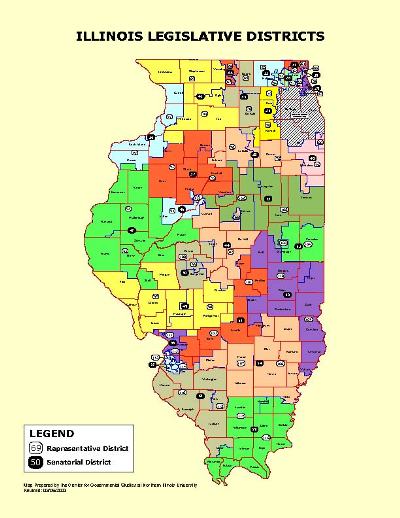
A good example of that is how the legislative districts are drawn. Take a look at this political map:

This is textbook gerrymandering. Legislators are picking their voters instead of the other way around. So, what incentive is there for an elected representative to fight for a redrawing of a legislative district that he or she won? The system is fundamentally broken, which is why a constitutional convention is critical.

A “no” vote is a vote for the status quo. And we know the status quo isn’t working.

Museum showcases plans for “The Street”

From a press release:

Peoria Riverfront Museum’s “The Street” to Innovatively Capture the Region’s Colorful History

Peoria – The Peoria area’s history will surprise, educate and entertain you. Peoria Riverfront Museum collaborators proved that point today as they revealed details of The Street, a major, ever-changing gallery designed to bring to life the Peoria area’s long and colorful history—from its Native American roots through the initial French settlements to its place as the All-American bellwether of U.S. taste and beyond.

Collaborators playing a key role in planning The Street, including the Peoria Historical Society (PHS), Peoria Regional Museum Society (PRMS) and African American Hall of Fame Museum (AAHFM), spoke to supporters gathered at the Hotel Pere Marquette in downtown Peoria, a few blocks away from the seven-acre site of the proposed development.

State Sen. David Koehler, a long-time proponent of the museum block, said, “I’m excited to see the groundswell of support around The Block. I know this project will bring great educational, cultural, entertainment and economic opportunities to our region.” Koehler added he’s “looking forward to visiting The Street to explore more about the Peoria area’s early years and all the people and companies who have helped to make it what it is today.”

“We’ve talked previously about the features of the Riverfront Museum, including the IMAX Theatre and the planetarium,” said Museum Collaboration Group co-Chairperson Brad McMillan. “Today, we focus on the exhibit galleries planned for the Washington Wing of the museum, particularly The Street historical galleries showcasing the region’s history and the Oral History Center, where visitors of all ages can tell their stories for generations to come.”

The collaborators unveiled specific plans for The Street, including The Square, a nearly life-size streetscape integrating real objects from the region’s past, oversize graphics, text and interactive opportunities. The Square will feature an interpretive timeline of the area’s past, as well as fascinating stories unique to Peoria—some legendary, some little known. Anchoring The Square will be a massive video projection and large-scale artifacts supporting the current theme.

PHS Board President Marilyn Leyland said The Street will be a rotating exhibit with themed portions continually changing, starting with “Pride of Peoria: Innovation and Entrepreneurship.” Focusing on Peoria as a hardworking town, this inaugural theme will highlight the businesses and industries that brought wealth to the community and continue to flourish today, as well as showcase examples of that ingenuity—from bicycles and early automobiles to distilled spirits and earthmoving equipment, plus the advertising that promoted them.

A future theme of The Street is called “Will It Play in Peoria?” It will explore the importance of Peoria audiences, from riverboat and vaudeville patrons to coveted targets of modern market research. The region’s rich history provides an endless source of engaging themes and interesting stories to tell in the future.

“And on any given day, you might run into important people from the past,” said Leyland, introducing John Parks of the PRMS. Parks came in character as inventor Charles Duryea to announce the society would donate to The Street a Duryea automobile invented 110 years ago in a garage on West Barker Avenue, along with $40,000 for maintenance and exhibits explaining the vehicle’s history. “That gas-powered vehicle started people thinking in new ways,” Parks said. “It inspired Henry Ford—and we all know what happened next.”

Another important element of The Street will be an Oral History Center with a Story Booth to feature individual stories of Peoria-area residents. “Oral history has been an especially important tradition in the African-American community,” said Margie White, representing the AAHFM. “The Oral History Center will allow visitors to capture their own history, leaving with a DVD of their recording.” Selected recordings of general interest will be used by the museum in future exhibits.

The current African American Hall of Fame exhibit would be integrated into a Wall of Fame inside the Living History Center. This exhibit will honor individuals inducted into the Hall of Fame each year for having made an outstanding contribution to the Peoria African-American community.

In addition, the Caterpillar African American Network, an affinity group within Caterpillar that supports African-American employees, will donate $12,500 to the museum on behalf of AAHFM.

McMillan announced other Washington Wing exhibits will include an International Feature Gallery for special traveling exhibits—including the best exhibits the Smithsonian Institution has to offer—and traditional exhibits of fine art and folk art based on the extensive collections of Museum Collaboration Group partners. Announcements about exhibits to be included in the Liberty Wing of the museum will be made in the coming weeks, he added.

The multifaceted Riverfront Museum will join the Caterpillar Experience as key components of a planned downtown center for the arts, education and entertainment known as The Block. The $136 million project already has garnered $90 million in commitments to date, including 86 percent of the private funding and 40 percent of the public funding needed, said Michael Bryant, chairman of the CEO Roundtable, a group of prominent business leaders working to raise $8 million and the public awareness needed to help build the Riverfront Museum.

The Journal Star’s story includes pictures and diagrams.

Imagine Peoria

When Calgary (a city in Alberta, Canada) wanted to develop a 100-year vision for the city, they asked their citizens for help, and over 18,000 participated. Through many and various methods, they asked residents five questions that they call “appreciative inquiry questions.” I heard about all this on a public radio show called Smart City.

I thought the questions were thought-provoking, so I’ve decided to pose them to my readers. I’m making a separate post for each question just to make it easier to keep responses organized, and I’m going to leave these posts at the top of my blog for a couple of days at least, in the hopes that you all will offer your thoughtful answers.

I think it’s always good to step back and think about what we like about our city, as well as our hopes and dreams for its future. I hope you’ll enjoy the discussion.