New Math

Hmm, let’s see. $1.14 million for four Edison schools. We’re closing one, so the total number of Edison schools is dropping by 25%. If we take $1.14 million and divide by four (or multiply by .25), we get $285,000.

But according to the Journal Star today, the school district negotiated only “about a $200,000 savings.” That’s about 17.5% of the total contract.

Well, let’s look at percentage of pupils. The 2007 enrollments, according to the Illinois Interactive Report Card, were:

Loucks 374
Rolling Acres 312
Franklin 386
Northmoor 462
TOTAL 1534

So, 374 divided by 1534 is: 24.3%. But the contract was only reduced 17.5%.

Sounds like a great deal… for “New York-based Edison Schools,” that is. I suppose the administration will say that there are certain fixed administrative costs, so one can’t just cut the contract by 25%.

Or maybe they’ll try to tell us that 17.5% savings is just as good as 25%. After all, they’ve already told us that an 11.5% reduction in the school day provides exactly the same amount of teacher contact time, with music and art thrown in.

It’s the new math.

Roundabout

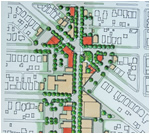
A little over a week ago, the Journal Star reported that a roundabout is being considered for the intersection of Sheridan, Loucks, and Gift in the “Sheridan Triangle” form district. This was surprising to me. I have nothing against roundabouts, but they’re not the only option or even the best option for every intersection.

You may remember that there was a public meeting back on March 5 to discuss options for improvement of the public space in this form district. Keith Covington was there along with other engineering and street design experts with experience in creating new urban streetscapes.

Everyone I talked to that night — to a person — said that a roundabout was not the best solution to this particular intersection, although they all affirmed they liked roundabouts. The problems here, it was explained to me, were several.

First of all, there wasn’t enough space. Because it’s an intersection of three streets, there’s a minimum radius that’s required to accommodate all the “legs” that would be coming off the roundabout, and that space simply isn’t available at that intersection, I was told.

Secondly, they were concerned with creating dead space in the middle of the roundabout. Going along with that big required radius would be a lot of space in the middle of which pedestrians would get no practical use.

Thirdly, no roundabout was suggested at the charrette for this area. If you look at the drawings that were produced by the neighbors and business owners during the charrette process, the vision then was to have Loucks intersect with Gift before the intersection with Sheridan on the east side (just like Loucks intersects with Forrest Hill before the University intersection), and have Gift intersect with Loucks before the Sheridan intersection on the west side. This would create a four-way intersection at Sheridan instead of a six-way, and a pocket park could even be put in on the southeast corner, which would be usable by pedestrians.

Suffice it to say, there was a compelling case made that night for no roundabout. But now, suddenly, a roundabout is a serious contender for this intersection. It would be interesting to discover how decisions are being made, but the district councilperson is keeping attendance at these meetings under tight control.

For more information on roundabouts in the United States, see the excellent resources at the Transportation Research Board’s site. Hat tip to Beth Akeson on providing the TRB info.

Once again, D150 parents’ pleas fall on deaf ears

Brick WallNote to District 150 parents: The next time you feel compelled to express your concerns to District 150 board members, just go find a brick wall somewhere and talk to it. There are a number of benefits: you can hit it and not get arrested, you can do it any time instead of just 6:30 every other Monday, and the most important thing of all — you’ll get the exact same results.

The school board voted 5-1 (Linda Butler was absent) to shorten the school day by 45 minutes next year. Jim Stowell was the lone dissenting vote. Kudos to him.

Feel free to use that brick wall to beat your head against after yet another poor, ill-advised decision from our illustrious school board.

Still waiting for the Park Board televised meetings report

From the April 27, 2007, Peoria Park Board minutes:

Mr. Christopher J. Summers read from a letter he wrote to the Park Board regarding the question of whether or not to televise Park Board meetings on the public access channel. VICE PRESIDENT CUMMINGS MOVED STAFF PREPARE A STUDY OR REPORT WHICH WOULD GIVE THE BOARD A SUMMARY OF ALL COSTS ASSOCIATED WITH TELEVISING OF ALL PARK BOARD MEETINGS, OR ALL BUDGET SESSIONS. REPORT TO INCLUDE ALL THE BENEFITS OF SAME AND DISADVANTAGES OF SAME. STAFF TO INCLUDE THEIR SUGGESTIONS OF POSSIBLE DONORS WILLING TO CHAMPION THIS EFFORT IF COSTS ARE HIGH. Motion seconded by Trustee Petty. Deliberation followed with questions raised regarding who pays for the televised service, the previous history of this issue, and possibility of staff doing the taping of meetings and giving pre-recorded tape to Insight Communications public access channel. Motion carried on unanimous voice vote. (Results: 6 Ayes; 0 Nays)

It’s been over a year now. Still no action.

The bottom line on school day length is the bottom line

It will be interesting to hear the board discuss the shorter school day recommendation from the administration at tonight’s school board meeting. Here’s the item as it appears on the agenda:

14.
PRIMARY SCHOOL SCHEDULE – Sanfilip
Proposed Action: That the student and teacher schedules for all Primary Schools, except Franklin Edison, Northmoor Edison, Roosevelt Magnet and Valeska Hinton Early Childhood Education Center, for the 2008-2009 school year shall be as follows:

1. Student Schedule 9:15 A.M. to 3:00 P.M.
2. Teacher Schedule 8:15 A.M. to 3:15 P.M.

The Superintendent is authorized to make such individual Primary School accommodations/variations to this schedule and any necessary Middle School changes to accommodate this schedule as he may deem necessary. Such changes shall be reported to the Board of Education. This school schedule shall be for the 2008-2009 school year. During the month of April, 2009, the Superintendent shall make a further or permanent Primary School schedule recommendation to the Board of Education.

The conclusion I’ve reached after hearing from board members and administrators is this: The administration chooses research to support whatever proposal they advocate rather than advocating for something based on research. See, I had always thought that they were looking at educational research and then pushing for change based on those principles. But this recent episode has made it clear that it’s really the other way around.

If they want to bring in Edison schools, they select research that “proves” the educational benefits of a longer school day. Ditto for putting a school in a park-like setting or situated on 15 acres. But, if the budget needs trimmed, and they decide they want to shorten the school day, they’ll go out and select research that “proves” the benefits of a shorter school day with block scheduling.

Bottom line: I believe they choose research that supports their ends, and then try to sell it to the school board and their constituents as something that’s been developed through thoughtful reflection and a thorough review of “best practices.”

Does that sound harsh? If so, please explain how the administration can simultaneously justify a longer school day for some schools and cutting the school day for others, and have it all based on best practices and educational research. I mean, they’ve spent years trying to convince the public that a longer school day is vital to improved academic performance, and now, all of a sudden, that’s out the window and a shorter school day is advocated… but only for some schools.

I think parents (and, frankly, school board members) deserve some honest dialog and clarity from the school administration. Because it sure looks like plans are being made solely on the basis of budget issues, and being propped up after the fact with educational “proof” of their effectiveness.

Keep the paramedics on call

Pedestrian CrossingJonathan Ahl and WCBU news are reporting that the Sears block is going to be used as a temporary parking lot while Caterpillar does some maintenance work on its parking deck.

I’m aghast at Caterpillar’s callous disregard for employee safety. In case you’ve forgotten how dangerous this situation is, I’ll remind you that Cat said we couldn’t change Adams and Jefferson streets from one-way to two-way because their employees would be unable to adapt to changing traffic patterns:

The safety of Caterpillar employees is of the utmost importance. A key concern of our workers in downtown Peoria is pedestrian safety…. Changing streets from one-way to two-way would create more vehicle/pedestrian conflicts at intersections…. Our employees are familiar with the traffic patterns as they exist today and know what to expect.

Well, this new parking scheme is a cinch to lead to widespread disorientation and employee injury. Traffic patterns will be seriously altered since all those cars will be going into and out of the Sears block instead of the parking deck. Unable to scamper across their gerbil tube from the deck to the World Headquarters building, unsuspecting employees will be forced onto the mean streets of Peoria at rush hour and expected to navigate a crosswalk spanning a dreaded unfamiliar two-way street. I shudder to think of the carnage as hundreds of employees, conditioned to only look one direction before jaywalking, end up hit from behind by motorists. Oh, the humanity!

Bloggers are often accused of just complaining but doing nothing to help the situation. Well, today, I’m going to do something to help. As a pedestrian experienced in crossing complicated intersections, I hereby offer to provide training to Caterpillar’s employees before this new parking plan takes effect. I charge reasonable fees and boast a mortality rate of six sigma quality. In addition to my personal experience crossing intersections, I have also helped the elderly across the street during my participation in Cub Scouts and Webelos, and I’ve taught children as young as 6 and 7 years old how to safely cross the road on their own.

Give me a jingle. I’m always happy to be of service.

D150: More doublespeak

Here’s an interesting report called “The Future of Education in Peoria: Issues and Opportunities for Moving Forward Together in Peoria Public School District 150.” It says it’s a report that came out of “A Community Summit in Open Space, June 3-5, 2002.” This three-evening forum was designed “to bring together concerned people from all across District 150 to create a shared vision for our public schools. The results of our work will provide the foundation for moving forward together.” Two hundred people attended this event.

Here’s a suggestion (p. 10) that came from a group composed of Mary Davis, Bette Johnson, Linda Millen, Herschel Hannah, Sean Matheson, Audrey Galter, and Sandy Farkash:

Longer day (7 55minute periods)

Note that Herschel Hannah is an Associate Superintendent, and Sean Matheson is a former school board member.

This suggestion came up again (pp. 27-28) in a group composed of Beth Koch, Gerry Brookhart, Pam Dolozychi, Sandy Burke, Martha Ross, Scott Russell, Don Johnson, and Herschel Hannah:

NOT ENOUGH TIME – Need to expand academic days to allow full “On Task” time for curriculum demands and Prevention services and programs; after school programs may not reach all children in need

  • Longer school day/year
  • Use of free periods
  • Build prevention programs into existing curriculum ie. High School speech classes
  • Saturday school
  • Evening school
  • Access to Early Childhood Education programs

Note attendees Martha Ross (current board vice president) and, once again, Mr. Hannah.

So, in 2002, one of the problems identified was that there was not enough time. And the solution was to come up with ways to provide more class time for students. What’s changed in six years that all of a sudden less class time is now suddenly a good idea?

Well, Dr. Simpson did say at the meeting last night that children today learn differently than they did ten years ago, so maybe the findings of a forum six years ago are no longer valid. Okay. We’ll forget about the 2002 report. Let’s look instead at the September 18, 2007, minutes of the joint school board/city council meeting — only about seven months ago:

Superintendent Hinton expressed that the District vision is to improve student achievement…. Mr. Hinton also discussed the need fort the District to offer “Choice” to parents, the need for a longer school day and/or longer school year.

He later clarified:

Council Member Nichting asked about the longer school day being for everyone. Superintendent Hinton explained that the longer day would be “need based.” He is still considering the need for a longer school year and noted that many students fall behind during the summer months.

And current board member Mary Spangler weighed in on the issue, too:

Board Member Spangler spoke to the Choice Edison Program and stated that the data she has seen shows that schools with longer days showed student improvement.

How do we reconcile these statements with Hinton’s new proposal to cut 45 minutes off the school day for twelve primary schools, but leave Edison school schedules intact? (And don’t tell me they can’t get out of the contract. Every spring the school board has an opportunity to get out of the contract by its own terms. That contract covers only four schools — three next year since Loucks is closing — and costs the district $1.14 million per year.)

How can the same administration in just seven months do a complete 180 on the issue of school day length? They now say, according to a handout distributed at the meeting last night, “Further study has revealed exciting best practices along with instructional and operational opportunities.” Ah, so perhaps all that data from the past 6+ years was totally bogus, and longer school days aren’t really all they’re cracked up to be. In fact, “further study” shows that the days should actually be shorter!

Well, in that case, all the more reason to cancel the Edison contract. Since their day is already longer than the rest of the district’s, shortening it to five hours and forty-five minutes will surely produce even more academic improvement.

District 150’s logic is like a Penrose triangle.