Say bye-bye to internet radio

Broken RecordUpdate: Seth Ben-Ezra has alerted me to some good news on this front from the Radio and Internet Newsletter. Thanks, Seth!

The Copyright Royalty Board decided in March of this year to triple royalty fees for internet radio stations, and the D. C. Court of Appeals today has denied the appeal of opponents of the new fee. Opponents are now urging people to call their congressmen and urge support of the Internet Radio Equality Act. But there’s no way that’s going to happen before these fees (which, incidentally, are retroactive to January 2006) take effect on Sunday, July 15.

Locally, that means WGLT, the jazz/blues NPR station out of Bloomington will likely stop webcasting next week. I haven’t heard what other stations may turn off their audio streaming once the new rates take effect, but the number and variety of internet radio channels will likely diminish precipitously.

It’s evidently the recording industry’s goal to alienate as many music lovers as possible. They’re succeeding.

Catholics: “We’re still the only true church”

This just in from the Vatican: the Pope says the Catholic Church is still the only “true” church. In a document released yesterday, he answered a few questions about the Catholic Church’s teaching, including this one:

Fifth Question: Why do the texts of the Council and those of the Magisterium since the Council not use the title of “Church” with regard to those Christian Communities born out of the Reformation of the sixteenth century?

Response: According to Catholic doctrine, these Communities do not enjoy apostolic succession in the sacrament of Orders, and are, therefore, deprived of a constitutive element of the Church. These ecclesial Communities which, specifically because of the absence of the sacramental priesthood, have not preserved the genuine and integral substance of the Eucharistic Mystery cannot, according to Catholic doctrine, be called “Churches” in the proper sense.

Protestants, naturally, have a different view (see also the Westminster Larger Catechism, questions 62-65).

The only ones really upset about this paper are those devoted to ecumenism (unity among all Christian churches), who apparently don’t mind if the Pope believes the Roman church is the only true church as long as he doesn’t talk about it (a rather postmodern sentiment).

Many (mostly conservative) Protestant denominations are not surprised or especially bothered by the Pope’s declaration because it’s nothing new or surprising; he’s simply reiterating Catholic dogma that’s been around for centuries.

The War in Iraq

Now for something completely different.

What do you all think of the U.S. war policy in Iraq? What is the root cause of our seeming inability to “win” the war (or “win the peace,” if you will)? And what action should the U.S. take to remedy the situation?

Council Roundup: Museum bits

PRM LogoJim Richerson, President and CEO of Lakeview and Project Leader for Museum Square, gave a presentation to the City Council at last night’s meeting formally requesting a one-year extension of time on their agreement with the city a smaller-sized museum.

The reason for the extension is because fundraising efforts have not gone as planned, and now they’re putting a lot of their hope for funding in the New Market Tax Credit program. However, they won’t hear whether they’re approved for that funding until October, which is after one of their contract deadlines.

The size change is because construction costs have escalated significantly. Richerson said when they started this project, they were projecting construction costs rising at a rate of 4% annually based on historical data. What they’ve found is that costs are actually rising at a rate of 2-4% quarterly instead. They’ve decided to stay within their $65 million overall budget and instead reduce the size of the building.

However, Richerson went to great lengths to show that this reduction only minimally impacts the programming of the museum itself. He points out that while the total square footage is being reduced from 96,562 to 80,784 square feet (15,778, or 16%), the usable space is only being reduced from 64,400 to 57,955 square feet (6,445, or 10%). Auxiliary space (which includes offices, classrooms, store, lobby, support areas, etc.) is being cut from 32,162 to 22,829 square feet (9,333, or 29%).

It was also pointed out that when you look at the block as a whole — that is, including Caterpillar’s visitor center and their monetary commitment — you’re looking at a $130 million project that is 63% funded. From Lakeview’s standpoint, this “puts things in perspective.” However, the reality is that only 37% of the museum’s funding has been raised ($24.5 million out of $65 million), and Caterpillar’s contribution is contingent on the museum officials raising their funds.

The council received the report and then immediately started debating when it would vote on the issue. The original motion was to vote on it at the July 24 meeting, but Councilman Sandberg is going to be out of town. Normally just having one councilman be out of town would not necessarily be sufficient reason to delay a vote, but Gary’s been very involved in this issue and essentially asked for the courtesy of a deferral. After much wrangling, the council decided to discuss it at their August 14 meeting. That’s in five weeks.

D150 plops down a cool $750,000 for $178,000 worth of land

District 150 BusClare Jellick reports that the District 150 School Board has “agreed to pay $750,000 for the 22 acres of land” on which they want to build a replacement building for Harrison Primary School.

The land is appraised at $178,000, but the PHA has maintained that it should recoup some of the costs for razing buildings there. The cost of demolition was about $1.4 million.

My question is, why? Why should they recoup costs for razing buildings there? These buildings were going to be razed anyway. The process was started at least a year before the school district expressed interest in a land swap with PHA for the land.

In fact, their first application for federal approval to raze 200 units (30 buildings) on the south side of Harrison Homes was reported in the Journal Star on March 30, 2005. On August 23, 2005, they added another 11 buildings to be demolished on the north side. “The decision to raze the additional buildings brings the total number of units to be destroyed to 306”; it was all part of a “10-year plan to tear down and rebuild the entire housing complex,” the paper reported at the time.

The paper also said, “Most of the latest buildings approved for razing are located near Harrison School, in the block between West Krause Avenue and West Seibold Street.” The “latest buildings” were the 11 that were added, with a total of roughly 106 units (306 total minus the 200 units initially reported in March). How much would that cost to raze? “The cost of demolition is estimated at about $4,000 per unit, said Regina Simpkins, director of facilities management.”

At $4,000 per unit, the cost to raze 106 units near Harrison School would be $424,000. But according to later reports, demolition of all 306 units cost roughly $1.4 million total, which comes out to about $4,575 per unit. Even then, the cost to demolish the 106 units near Harrison School would only be $484,950. Add that to the $178,000 appraised value for the land and the cost comes to $662,950.

So, if my reading and calculating is correct (which it admittedly may not be, since I’m only going from published reports) the school district is still overpaying for the land even if they eat all the demolition expenses for the land they’re purchasing. And that doesn’t even take into consideration this little nugget from that August 2005 article: “The PHA plans to apply for demolition grants so they can reprogram their budgeted funds for other uses, [Simpkins] said.” How much of this demolition cost was already paid for with grant funds?

This is a big coup for the PHA. It basically takes over half a million dollars the School District collects from our property taxes and transfers it to the PHA, an agency that has lost considerable federal funding as of late for a variety of reasons, including low occupancy in PHA properties.

Almost 3/4 of a million dollars for parking deck repairs on agenda

The City of Peoria owns a number of parking decks downtown and outsources the management of them to National Garages. According to the 2007 City Budget, the city owns about 4,600 parking spaces in decks and surface lots. The city isn’t making any money on these lots. Between the debt service, the cost to manage the decks, and the artificially low rates, the city is heavily subsidizing downtown parking.

But there’s more than just operational costs to owning parking decks — there’s also maintenance costs. According to the budget document, National Garages takes care of routine maintenance as part of their contract. Structural upkeep, however, is the city’s responsibility. Structural repairs for the Jefferson Street and Twin Towers parking decks are on the agenda for tomorrow night’s meeting, and the cost is a whopping $738,437.

Peoria should sell these decks to the businesses that use them and let those businesses maintain them for their own patrons at their own expense — just like every other business in Peoria does that isn’t located downtown. Then Peoria could use the money it saves for services that benefit all Peorians, like fire and police.

Museum comparisons

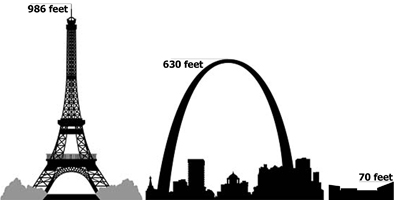
Since museum officials are comparing their proposed museum to icons of other cities, such as the Gateway Arch in St. Louis and the Eiffel Tower in Paris, I thought I’d help out by offering some more information to help us compare:

Comparison

The Eiffel Tower

The Eiffel Tower was built between 1887 and 1889 completely of iron at a cost of about 7.8 million gold francs (don’t know how to convert that 2007 dollars, but one site estimated $35 million in 2006 dollars), as the entrance to the Universal Exposition of 1889, which was held in Paris. According to discoverfrance.net:

Of the 700 proposals submitted in a design competition, one was unanimously chosen, a radical creation from the French structural engineer Alexandre Gustave Eiffel…who was assisted in the design by engineers Maurice Koechlin and Emile Nouguier, and architect Stephen Sauvestre.

However, the controversial tower elicited some strong reactions, and a petition of 300 names — including those of Maupassant, Emile Zola, Charles Garnier (architect of the Opéra Garnier), and Dumas the Younger — was presented to the city government, protesting its construction.

Eiffel also engineered the internal structure of the Statue of Liberty and the dome of the Nice Observatory in Nice, France.

The Gateway Arch

The Gateway Arch was built between 1963 and 1965 at a cost of $13 million (about $85 million in 2007 dollars) to commemorate the nation’s westward expansion. According to the National Park Service, “The $11 million cost of the Arch itself was made up of 75% Federal funds and 25% City of St. Louis funds. The $2 million Arch transportation system was financed by the Bi-State Development Agency.”

The Arch was designed by Finnish-American architect Eero Saarinen (after a nationwide search), who also designed the John Deere World Headquarters and John F. Kennedy International Airport. Historian Bob Moore says, “The arch’s design initially drew criticism, but before long the city of St. Louis embraced it.”

Peoria Regional Museum (PRM)

The PRM was designed by Zimmer Gunsul Frasca Architects, LLP, of Portland, Oregon, in partnership with local firms PSA Dewberry and STS Consultants. The project still carries a $65 million pricetag, but the size of the building has been reduced twice: once from 110,000 to 95,000 square feet, and recently from 95,000 to 81,000 square feet.

Obviously, the only comparison with the Eiffel Tower and the Gateway Arch is that the plan is facing opposition; that is, some people don’t like it. The implication is that this proposed building will presumably become iconic of Peoria, be a huge tourism draw, and eventually be embraced and beloved by Peoria residents as they realize what an architectural marvel it is.

I don’t think so. Maybe they could have said that with the original design, since the big sphere in a glass box could have at least become iconic of Peoria and was kind of a cool idea. But this new design? There’s nothing especially distinctive or memorable about it. They need to come up with a less-expensive design that still has a central architectural feature that impresses people. This building doesn’t have that — and furthermore, museum officials know it. They even said at the press conference that the so-called “wow factor” is on the inside now — the new planetarium and the programming of the museum. That was the whole idea behind Richerson’s plea to “focus on what we’re gaining.”

Now, if museum officials are willing to abandon the exterior “wow factor” and focus on the interior instead, then there’s really no reason to hold on to this building design or to fight for it. The interior can just as easily be housed in a more traditional urban building that fronts the street and only takes up a portion of the block, opening up a good portion of the block for other development. It would be cheaper to build, too, which would mean they wouldn’t have to raise as much money, something they’re having trouble doing anyway.