Park Board Roundup

I attended a Park Board meeting for the first time tonight. Can I just say their meeting room is tiny! They need a bigger place to meet.

While they handled all the normal business of a Park Board meeting, the big issue on the agenda was their plan to establish an historic preservation policy. President Tim Cassidy suggested that the board appoint an ad hoc committee to develop and propose the policy on historic preservation. He would like to see them complete their work within six to eight weeks. The ad hoc committee would consist of two trustees, two park district staff members, and a citizen, plus Cassidy and Bonnie Noble who attend all subcommittee meetings. The policy will cover all park district properties, not just Glen Oak Park. While Cassidy made the suggestion, Trustee Cummings made the motion; it was seconded and passed unanimously.

During discussion, Cassidy said he was not suggesting this simply because of the flap with the city, but because he thought it would be a good idea. Also, Trustees Allen and Petty both said they believed the Park Board had been doing a good job of preserving the parks’ historic treasures already. Cassidy agreed, but added that board members and staff members come and go and that a policy would ensure consistency in protecting historic assets.

On that last point, I can’t help but wonder if, on their way home tonight, those trustees happened to drive by the foot bridge that has been cordoned off and deteriorating for years, or if they perhaps remembered their votes from February 2006 when they decided to dismantle the parapet and relocate the Spanish cannon. I could go on. The point is that I found these statements to be the height of irony.

Later, during the time they allow citizens to address the board, Jane Leathers made mention of the oft-cited “27 acres” that the Park District is supposedly razing for the Africa zoo exhibit. Bonnie Noble countered that the whole project encompasses only six acres, so she’s at a loss to know from where the 27-acre claim is coming. After the meeting, Sara Partridge mentioned that it was in the documents the Park Board filed with the City. I don’t have time to check into it now — can anyone provide some insight on this? In any case, Noble said that they are only clearing six acres, not 27.

Also during the citizens-to-address portion, I made the following statement:

In 1997, the board considered the question of whether or not to televise Park Board meetings on the public access channel of our local cable provider. The proposal was defeated. I request that the board reconsider that decision and approve televising the Park Board meetings.

A functioning democracy requires an informed citizenry. Citizens oversee governmental bodies to, among other things, guard against abuse and ensure decisions are being made using accurate and timely information. Franklin Delano Roosevelt said, “The only sure bulwark of continuing liberty is a government strong enough to protect the interests of the people, and a people strong enough and well enough informed to maintain its sovereign control over the government.”

It is incumbent upon governmental bodies to conduct the public’s business in public and to provide information in a way that is easily accessible to the public. By televising your board meetings, you will greatly enhance accessibility and transparency in the execution of the Park Board’s business. Taxpayers can watch from home or tape the meeting to watch at a later time if they are unable to attend in person due to scheduling conflicts or work situations. Citizens would be allowed to oversee government on their schedule instead of the Park Board’s.

Some have countered that televising meetings could lead to board members preening for the cameras or making long-winded speeches. While these possibilities exist, they are not an excuse for limiting the public’s access to the affairs of this body. If the fear of long speeches is really the issue, the Park Board can easily overcome that obstacle by instituting a self-imposed time limit on debate.

I’ve talked to Insight Communications, and they have indicated they are willing to work with the Park District to televise board meetings either live or on a tape-delayed basis. While there is cost associated with doing a live feed to Insight, tape-delaying the meeting is a viable alternative. Further, having park staff do the taping would also lower costs.

Since accessibility can be provided at very low cost, the benefits are great, and the risks are low, I would implore the Board of Trustees to approve and implement televising of the Park Board meetings.

After reading this statement, Trustee Cummings made a motion to direct park district staff to research the costs of televising the meetings and report back to the park board so the board can consider it. The motion was seconded and passed unanimously. This was surprising to me, since I’m used to the Peoria City Council’s citizens-to-address policy where they don’t engage in dialog or take any immediate action, but merely listen to your statement.

I was pleased to hear the favorable discussion and hope that it results in the meetings being televised soon. I really do think it would be a valuable service to the community. Trustee Cummings made a good point that televising the meetings would also be good publicity for park board events and services, such as the ones they discussed tonight.

On the other hand, there’s a reason for cynicism…

Glen Oak Park clearing for zoo expansion

Guess where this is. Yep, Glen Oak Park.

While we’re waiting to preserve some important, but man-made, objects in Glen Oak Park through historic-designation status, the Park District is uprooting acres of trees in the heart of the city to make way for the big zoo expansion. Why do I get the feeling we’re fighting the wrong battle here? What’s more precious: the Squirrel House, which is a nice addition to the park, or the trees, which are the park?

The Park Board’s mission is, “To enrich life in our community through stewardship of the environment and through provision of quality recreation and leisure opportunities.” I fail to see how the Park District’s actions are consistent with this mission statement. The operative word is “and.” It doesn’t say “stewardship of the environment” or “provision of quality…leisure opportunities.” One might justify expanding the park as a way of providing leisure opportunities, but how can they do it at the expense of the first part of their mission?

I know this train has already left the station, but the sad thing is that the community voted with their dollars that they weren’t excited about having this zoo (fundraising efforts were sluggish, to say the least). Instead of listening to that resounding vote of no-confidence, the park board decided to plug the funding gap with tax dollars and tear down the trees anyway.

I still stand by my statements in my previous post, but nevertheless, this is the reason people are cynical about the Park District. This is why they think the board won’t listen if they come to the board with their concerns. This is why we’re all skeptical of the Park Board’s commitment to their mission.

UPDATE: I should also mention that according to the Park District’s 1994 Master Plan, the Park Board’s “Fundamental Responsibilities” are:

  1. To provide opportunities for wholesome recreational activities that relate to the needs and desires of all citizens.
  2. To conserve our natural resources.
  3. To be the guardian of a quality environment for our citizens and encourage the creation, restoration, and preservation of aesthetic values in our community.

Furthermore, one of the their strategic goals is: “Remain a leading force in the preservation of the historical, cultural, and natural environments of the community.”

So, again, how does turning a large portion of Glen Oak Park into an African Zoo exhibit mesh with their fundamental responsibilities and strategic goals?

Historic preservation vote deferred

Park District LogoTwo citizens petitioned the City’s Historic Preservation Commission to designate all of Glen Oak Park an historic landmark. The commission wasn’t ready to take on the whole park, but they did recommend landmarking several specific structures within the park. The City Council has the final decision on whether to landmark the nine items, so it was on the agenda Tuesday.

The Council decided to defer action on it until June 5. The stated reason was to allow the Park District time to get their own historic preservation policy and process in place over the next three Park Board meetings (they meet every other week). The next Park Board meeting is tonight, and historic preservation is on the agenda.

I have to side with the Park District on the historic-preservation issue. It would be one thing if citizens had been going to park board meetings, contacting their park board representatives, or otherwise engaging the elected park board officials to preserve Glen Oak Park — all to no avail. But according to Park Board President Tim Cassidy, no one has contacted the board about their concerns with Glen Oak Park.

It’s easy to take the cynic’s defense (“they wouldn’t have listened to us anyway”), but that really doesn’t fly with me. You may suspect they wouldn’t have listened or taken action, but you can never really know until you try. That should have been the first avenue of advocacy for Glen Oak Park. Instead, the park board was bypassed completely. I don’t think that’s fair.

Another thing that bothers me about the historic-preservation option is something Cassidy did not mention at the council meeting, but did mention at the Uplands candidates forum a couple weeks ago. He pointed out that once the structures in the park are designated as landmarks, future decisions about changes to those landmarks never go before the council again, but before the Historic Preservation Commission. That commission has the final administrative authority to approve or deny improvement and alteration requests. So then you would have a sovereign, elected body (the park board) subject to an unelected, appointed body (the city’s Historic Preservation Commission) for structures under the Park District’s stewardship. That arrangement is untenable to me.

The situation now has the City holding the Park District’s feet to the fire to follow through on their stated historic preservation plans in a timely manner. Hopefully that will be all that’s necessary, and on June 5 the council request can be voted down.

Mission Accomplished: $98,000 squandered

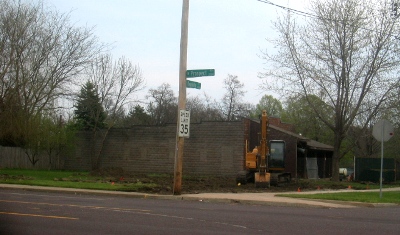
2126 Prospect is no more

Wilbur and Dorothy Rose’s house is gone. The home from which they watched fireworks, the home in which they planned to live the rest of their lives, has been demolished by Peoria Public School District 150.

Demolished for nothing. The school district can’t use the land for anything.

The picture above shows the empty lot at 2126 N. Prospect where the Roses’ house used to stand. The district purchased the property for $98,000, almost $38,000 more than its fair-market value. They bought it prematurely, thinking they were going to be able to enter into a land-sharing agreement with the Park District and erect a new school on this property and the surrounding parcels they had started to assemble.

Once that plan fell through, they decided not to sell the properties or try to recoup lost money. Instead, they’ve begun razing the houses instead. So instead of the picture above, I could have just as easily put up a picture of a pile of taxpayer money and the school board lighting it on fire.

Is this how Peorians want their tax money to be spent? Is the school board simply taking revenge on east bluff neighbors for opposing their plans for a school here, and using taxpayer dollars to do it? Or is the school board laying siege to the neighborhood here, destabilizing it to the point that the remaining neighbors will just give in (or leave)? Will no one hold the school board accountable for the wanton destruction of assets that could be better used for educational purposes?

The school board spent $877,500 total to purchase eight properties in this neighborhood — properties they can’t use — properties they should resell. How long will we let this fiscal irresponsibility continue?

Exception might not be enough for Spain

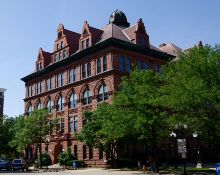
Peoria City HallA couple astute readers of my blog have pointed out to me an exception to the Public Officer Prohibited Activities Act that might be a loophole that would allow Ryan Spain to serve on the city council without violating the act. (We’re still waiting for an opinion from the state’s attorney’s office as of this writing.) The exception reads like this:

(b‑5) In addition to the above exemptions, any elected or appointed member of the governing body may provide materials, merchandise, property, services, or labor if:

A. the contract is with a person, firm, partnership, association, corporation, or cooperative association in which the interested member of the governing body of the municipality, advisory panel, or commission has less than a 1% share in the ownership; and

B. the award of the contract is approved by a majority vote of the governing body of the municipality provided that any such interested member shall abstain from voting; and

C. such interested member publicly discloses the nature and extent of his interest before or during deliberations concerning the proposed award of the contract; and

D. such interested member abstains from voting on the award of the contract, though he shall be considered present for the purposes of establishing a quorum.

Sounds pretty cut and dried, but in state law, things aren’t always what they seem. Just ask Bud Nystrom.

Roy “Bud” Nystrom was a city councilman in Crystal Lake, a northern suburb of Chicago, when the company he worked for put in a bid to build a Bio-Solids storage facility for the city’s new wastewater treatment plant. Even though he abstained from voting on the contract, even though the council rejected his company’s bid, and even though he only inadvertently broke the Prohibited Activities statute, Nystrom was nevertheless indicted on 10 felony counts of official misconduct and prohibited financial interest in August 1998. He later worked out a plea agreement and plead guilty to a misdemeanor charge of “attempted interest in a contract,” according to Chicago Tribune reports from the time.

What does this have to do with the exception I quoted? Well, the above exception I quoted was passed in 1997 and took effect in January of 1998. During Nystrom’s controversy, the Chicago Tribune had this to say about it (emphasis mine):

Already the [Public Official Prohibited Activities Act] statute has been relaxed by a new law that takes effect in January. The new law says that city officials only violate state law if they engage in public contracts on behalf of publicly traded companies in which they own more than a 1 percent stake.

Even with that change, Cowlin believes the law remains unfair. He thought the [Illinois Municipal] league should take a look at amending the law further and exempt municipal officials who are employed by private companies.

Heartland Partnership, where Spain is employed, is not a publicly traded company, but a private company, just like Nystrom’s employer. If one keeps reading the statute, it does say (emphasis mine):

(e) For the purposes of this Section only, a municipal officer shall not be deemed interested if the officer is an employee of a company or owns or holds an interest of 1% or less in the municipal officer’s individual name in a company, or both, that company is involved in the transaction of business with the municipality, and that company’s stock is traded on a nationally recognized securities market….

So it doesn’t look like the “b-5” exception is going to be enough for Spain, which may explain why it’s taking so long to get an answer from City Hall; I imagine they’re working with the state’s attorney, Spain and his attorney, and Heartland Partnership to come up with a way to allow Spain to serve without violating the statute. It will be interesting to see how it all gets resolved.

Spain controversy in the news

There have been some follow-up stories in the news that are worth mentioning. WEEK-TV interviewed Spain on their 9:00 newscast for sister station WAOE “my59”:

“I just find it very unfortunate that a particular member of the council is working to play games now as we look to get down to business,” said Spain. “So today while I was out trying to build relationship in Springfield (at the General Assembly), a member of council is looking to play games.”

I think it’s unfortunate that this is being portrayed by Spain and his supporters as just “playing games.” A more appropriate response would be, “I was unaware of that state law; I don’t believe I’m in violation of it, but I will do whatever it takes to make sure I comply with it.” Or something like that.

Spain would be smart to make friends with Gary and not treat him as an enemy just because he pointed out this state statute. Gary didn’t write the law, and he’s had to live by it — giving up business because of it — so it’s not unreasonable for him to want to make sure everyone else is abiding by it, too.

WEEK ran a follow-up story yesterday that just said Spain had met with city attorney Randy Ray, but that nothing had been resolved yet.

Yesterday’s “Word on the Street” column in the Journal Star states, “Spain’s boss Jim McConoughey says his agency is willing to do whatever needed to make sure there isn’t a problem.” That’s a very generous statement by Spain’s boss, considering it could mean the loss of $50,000 a year to his business.

Sandberg asks Lyons to retract statement

Then there’s this statement by state’s attorney Kevin Lyons that was quoted in the same article: “Lyons did note that some current City Council members have faced similar conflicts. ‘Of course, Gary Sandberg, as an architect, has had contracts and done work for people who do business with the city, and he just abstains,’ Lyons said.”

I e-mailed Gary to ask him about that statement, since it seems to contradict what he said in the comments section of my blog. In response, he copied me on an e-mail he sent to State’s Attorney Kevin Lyons and the Journal Star that read:

Unless you were misquoted, I would like to know one instance and/or all the instances where any one of my clients had a contract with the City of Peoria to provide services or a product while I was doing Architectural work for that client. Your statement, if quoted correctly, is inflamatory [sic] and totally incorrect and creates a situation where I could lose my Architectural license from the State of Illinois.

If NOT quoted correctly, I would expect you to have already sent a correction to the newspaper….

I do Architectural work for clients IN the City of Peoria. I do NOT have clients that do work FOR the City of Peoria.

I haven’t checked today’s paper to see if there was a correction. It will be interested to see if anything comes of that. Whenever lawyers are involved, it’s always the same story: hurry up and wait.

All quiet on the STB front

Way back in January, the Surface Transportation Board (STB) agreed to reopen the case of whether Pioneer Industrial Railway should be replaced as the operator of the Kellar Branch rail line with Central Illinois Railroad. They said they wanted to hear from both sides of the issue, consider any new evidence each side would like to provide, and then decide whether to uphold their original ruling or overturn it. Said they, “We will require this evidence on an expedited basis so as to resolve these issues as quickly as possible.”

All the evidence was in by the middle of last month. One wonders what “as quickly as possible” means to the STB. They do seem to move at a snail’s pace. Regardless of which side of the issue you’re on, it is frustrating to have these long periods of time in limbo, waiting for a ruling.

The longer they wait, the more work they make for themselves. Since the deadline for evidence passed, further filings have come in — from the Friends of the Rock Island Trail, from the City, from Peoria Heights, and a motion from Pioneer to strike all those untimely filings. So now the STB has to decide what evidence they’re going to allow first (a separate ruling), then decide the core issue.

Meanwhile, Carver Lumber is without competitive rail service, the tracks are lying unused by anyone and deteriorating, and impatience is mounting. Hopefully “as soon as possible” will mean “before Memorial Day” at least.

Descriptive Sketch of Peoria, 1896

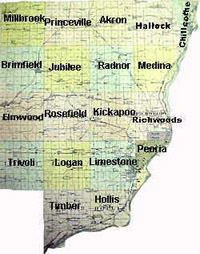
1896 Township MapAs I was reading PeoriaIllinoisan’s transcription from a 1908 book about Peoria, it reminded me of some of the descriptions I’ve read in a book I inherited from my grandfather: “Standard Atlas of Peoria City and County Illinois” by M. Huebinger, C. E., Peoria, Ill., published by Geo. A. Ogle & Co. Publishers & Engravers, 1896. So, today’s post will be just a little slice of Peoria history.

The city was quite a bit smaller then. I don’t have a good way of scanning the map, so I’ll just describe the city limits. At the northeast, the city goes no further north than Nebraska Ave. — that means that Glen Oak Park and Springdale Cemetery are not in the city. Moving west, the city line goes south at Knoxville, then west on Illinois to Elizabeth (now Sheridan). Then the city line goes south again along Elizabeth to Chambers Ave. (now Columbia Terrace). The line then extends west along Chambers to Bradley St. (now University), where it goes south to Main, then west on Main to Western Ave. Are you with me so far? You may have noticed that Bradley Park is also not in the city limits, nor is the Bradley Farm which would become the Uplands neighborhood six short years after this atlas was published.

The city line then goes south along Western to Lincoln Ave., west on Lincoln to a point in line with Livingston St., then south through the middle of several blocks and along Livingston to Grinnell. It dances back to Western (too hard to explain), then heads south to “Lower Main” (now Krause Ave.), then straight east to the river. And that’s it. That’s all there was to the city.

There was a part of Richwoods township called “North Peoria,” which was roughly a rectangle from modern-day Sheridan and Wilcox at the northwest to Nebraska and Perry to the southeast. There was also a part of Peoria township called “South Peoria” that was roughly anything south of Seventh St. (now Martin Luther King Jr. Dr.) and west of Western (except those areas I said earlier were within Peoria). Everything else was unincorporated.

As you read this glowing description of Peoria from the 1896 Peoria Atlas, you’ll have to suffer the flowery, verbose way of writing that was popular then. But pay close attention to the description of the schools, parks, and streets, and the new library they were building — this would be the “model of architecture” that was torn down in 1968 to make way for the non-descript box we have now.

Now, without any further ado, here’s the “Descriptive Sketch of Peoria from 1896:

Continue reading Descriptive Sketch of Peoria, 1896