Police are 2 for 2 in 2007 for finding homicide suspects

If you’re looking for a silver lining to the dark cloud of two homicides within two weeks in Peoria, it can be found in the fact that police have a suspect in custody for each case. There are still 11 homicides from 2006 that remain unsolved with nary a suspect.

Within a week after this year’s first homicide, police arrested Bryce K. Lowder of 1017 W. Wilcox Ave. “on a charge of murder in connection with the slaying of 18-year-old DeAndre T. Allen,” according to the 1/7/07 Journal Star. Today the paper reports that “Shane L. Heuck, 1711 N. Douglas St., was booked on a charge of first-degree murder in connection with the death of Virginia K. Mallow.”

Let’s just hope now that the state’s attorney will do a good job prosecuting them and get a couple of convictions.

Hinton tells Journal Star retirement rumors untrue

Jennifer Davis reports in her Word on the Street column today that Ken Hinton is denying rumors that he will retire in February. In case you haven’t heard, the rumor goes like this: Due to health problems, Ken Hinton is planning to retire February 1 on the condition that he gets to name his successor, Associate Superintendent Herschel Hannah.

“Please write something about it,” Hinton said when we broached the rumor with him this week. “First I heard I was retiring in February, and then I heard it was due to poor health. None of that is true.”

If he isn’t retiring, then a good case could be made for the school board to fire him instead. In an earlier post, frequent commenter PrairieCelt made this compelling argument:

Hinton should be terminated, immediately. If he were employed in the private sector as CEO of an organization and made a unilateral decision to expend over 85% of the organization’s limited funds earmarked for replacement and upgrade of plant and equipment, undertook the acquisition of several parcels of real estate for his planned development (without prior board approval) based on a nonexistent agreement with another organization, and then had the whole undertaking blow up in his face, he would have been fired on the spot.

In fact, if the BOE is unable to replace the hard-earned taxpayer dollars expended on the purchase of the Prospect Road properties, dollar for dollar, Hinton should write a check to the district to cover the shortfall. Hinton is the one in the position of “public trust” and should be held to a higher standard of behavior/performance. Why should Peoria’s children have their educational futures mortgaged once again because of Hinton’s poor judgment and disastrous financial management skills?

Good questions.

Journal Star joins 21st century, adds comments section

After reading the Journal Star’s Sunday editorial on-line, I was pleasantly surprised (shocked, actually) to find that they’ve added a comments section to their editorial page; don’t know if today is the first day for that or not, but it’s the first time I’ve seen it.

All I can say is: Welcome to the 21st century, Journal Star! Glad you could join us out here in the interactive media. I’m proud to say I got to leave the first comment on Sunday’s editorial. In case you don’t want to click over to their site to read it, here it is:

First of all, congratulations on adding a comments section to your on-line editorial page!

Secondly, you’re not recognizing the fact that these “naysayers,” as you call them, are indeed for something. For example:

(1) Kellar Branch conversion: The opponents of this plan that I know (including myself) are not against a trail per se, but rather for using this rail line for economic development. The path can be built next to the rail or along a different route, but an asset like a rail line with neutral access to eight line-haul carriers can’t be replaced. The rail line not only serves Carver Lumber, but can attract light industry and manufacturing companies (read: jobs) to Pioneer Park and other points along the line, such as the newly-vacant Cohen’s furniture warehouse in the Heights. Already there are two new companies on the Kellar Branch that want to use rail service. It would be foolish to throw away this asset.

(2) Glen Oak School Siting: The East Bluff neighbors have been very clear that they are for a new school in the center of their neighborhood where the current Glen Oak School is located. They’re advocating for it to be at Frye and Wisconsin, and Bob Manning has even offered the school board city money to help site it there! I would think that kind of community involvement and city support would be celebrated by the paper, not denigrated.

(3) Downtown Museum: I have heard very few who are against having a museum downtown. However, there are many who feel that the museum needn’t take up the entire Sears block and encompasses more disciplines than it can adequately support in the space proposed. The “naysayers” are for an adequately-sized Peoria history museum on part of the Sears block with the rest of the block commercially developed with retail and residential components, just like the Heart of Peoria Plan recommended (in fact, that’s why it’s in the Heart of Peoria Plan that way — because of public input received at the charrettes). All they’re against is the ballooning of the project to an art/history/science/nature/sports/hall-of-fame museum in a building that only takes up 1/3 of the square with the rest of the block set aside for open space.

I don’t know much about the ring road, so I can’t speak to that. But in each of the cases I’ve listed, people are indeed for something, not simply against new ideas.

2007 Homicide #2: Virginia K. Mallow

A mere 13 days into the new year, and 12 days after the first homicide of 2007, a 72-year-old woman was found dead in her West Bluff home, and police have determined it was a homicide. WEEK also has this story on their website, and they’re reporting that an autopsy is scheduled for Monday.

The Journal Star identifies the victim as Virginia K. Mallow of 438 W. Doubet Ct. in Peoria. Today would have been her 73rd birthday.

This is just so unbelievably sad. What is our city coming to? What can we do to stop the violence? It must be stopped.

Whimsical history department: Richwoods

I was reading about Richwoods High School on the Historic Peoria website tonight, and it reminded me of something I hadn’t thought of in a long time.

In 1987 I was a junior at Richwoods, and the school dress code didn’t allow any students to wear shorts. Fair enough. However, the dress code did allow the girls to wear mini-skirts. Many guys saw this as a double-standard and complained pretty loudly about it, especially as the days (and the classrooms) got hotter.

At one point, several guys actually came to school in mini-skirts. That was funny, and more than a little disturbing. I didn’t participate, being more shy and reserved back then, and I’m relatively certain that Sean Matheson (who was a year behind me at Richwoods) didn’t either.

Well, the administration put a stop to that pretty quickly. So the next course of action, naturally, was for the students to go “on strike.” That’s right, they skipped class and sat out on the sidewalk in front of the school with hand-made signs to protest the “no shorts” dress code policy.

All of this garnered the school a surprising amount of local publicity. I remember seeing it on the news, and Crow Carroll even did a parody song about it to the tune of “Every Breath You Take” by The Police. (If you haven’t heard Crow Carroll parodies before, check out Wayne R. Miller’s site for some samples; “Metamora Girls” is especially good. These were a staple of local top-40 radio when I was in high school.)

Believe it or not, the little student-uprising worked, and Richwoods finally relented and allowed students to wear shorts when it got above a certain temperature. As I recall, we all considered it a great moral victory at the time. Looking back on it now, though, I think we probably could have put our efforts to better use… like, maybe, studying.

STB decides Kellar Branch dispute, reconsiders Pioneer ouster

It’s official. The Kellar Branch will remain a rail line for the foreseeable future. The Surface Transportation Board (STB) formally granted Central Illinois Railroad’s request to withdraw its discontinuance petition. That puts the final nail in the coffin of the ill-conceived plan to convert the Kellar Branch to a hiking/biking trail.

At the same time, the STB took another step back in time and reopened the case of whether Pioneer Railcorp should have been kicked off the Kellar Branch by the City two years ago. The STB found in favor of the City back in 2005 in that case and forced Pioneer off the line. But since that decision was made, the STB states, “Circumstances have changed.”

We now have evidence that Carver Lumber objects to the Cities’ plans and is dissatisfied with the service it is receiving from CIRY [Central Illinois Railroad]. According to Carver Lumber, the service is slower and more expensive, and has been subject to delays and interruptions. … [T]he Board specifically predicated its August 2005 Decision on the Cities’ statement that they would maintain the existing level of service to the satisfaction of the users of that service. In these circumstances, it is appropriate to reconsider our August 2005 Decision now that Carver Lumber’s evidence has cast doubt on the representation we had previously relied on.

Now this is quite a predicament for the City. The City’s whole purpose for kicking Pioneer off the line was so that they could turn it into a hiking trail. They fought a bitter fight with Pioneer and won. Then they signed an agreement with CIRY that they would provide service over the Kellar Branch just until a new spur was built from the Union Pacific rail line west of Pioneer Park. After that, according to the agreement, CIRY would petition the STB to discontinue service on the Kellar Branch so the rails could be torn up and the right-of-way turned into a walking path.

Well, CIRY never provided service over the Kellar Branch (causing great expense to Carver Lumber), and now they’ve withdrawn their petition to discontinue service on the branch so they can continue to use it themselves. Essentially, they’ve screwed the City twice.

Now, since the STB has reopened the whole issue of whether or not Pioneer or CIRY should be the carrier on the line, the City has to make a decision. Will they continue to fight to have Pioneer thrown off the line just so CIRY — who has royally screwed them twice — can run the line and reap the profits? Or do they now withdraw their request to kick Pioneer off the line and screw CIRY, but end up with Pioneer — the company that arguably was the key factor in scuttling their walking path plans — running the line instead?

Ha ha ha! This is too good. Who will the City choose? Park-District-plan-busting Pioneer or Double-crossing CIRY?

I, of course, vote for Pioneer, since they are the more competent of the two carriers, are locally owned, and have shown a commitment to the community (e.g., they’ve offered to help build a trail next to the rail line and provide transit/tourist service on the line). CIRY was a hired gun that endangered Peoria citizens with their runaway train, cost Carver Lumber truckloads of money, and double-crossed the City. The City owes them nothing.

The most important thing is that the Kellar Branch has effectively been saved from destruction, and now, hopefully, the City can move towards turning this asset into a money-maker — either through a long-term lease or an outright sale — and then reap the benefits of increased freight traffic (read: new businesses & jobs) along the line. If they sell it to Pioneer, maybe they’ll even get a trail next to the rail — a win-win!

The password is: CIVILITY

IncivilityCivility is all the rage these days.

First Billy Dennis over at the newly-christened “Peoria Pundits” had to institute a civility policy (twice) because of escalating flame wars not only in the comments sections, but in the posts themselves. It was like “Lord of the Flies” for a while there.

Now, I see over at the Bloomington Pantagraph that they’ve had to do the same thing, except they may be a bit more aggressive than Billy:

So, beginning today, our screeners will not allow users to be rude, take pot shots at others or call names in comments posted on our site. Hopefully, this will change the tone of the conversation and keep people focused on a discussion of the issues and not calling each other “idiots” because they have misspelled a word or two.

They can afford to be more aggressive — they have screeners. They’ve gotten over 230 comments to their plea for civility saying polite and courteous things like, “Pantagraph, thank you so much for protecting my fragile emotions.” And, “Your [sic] just going to to take the fun out of the comments, that’s all. Guess I will head back to cnn.com….” See how well their new policy is working?

So far, I’ve only had a couple of instances where I had to ask commenters on The Peoria Chronicle to be civil (knock on wood). They’ve always complied; furthermore, most of my readers have been civil without having to be told, and for that, I thank you. I hope I never have to institute a civility policy, but I suppose it’s inevitable.

We’ll just enjoy our little utopia while we can.

Whither the Peoria Promise?

On January 25, 2006, Mayor Jim Ardis proclaimed during his “State of the City” address:

Another plan I will pursue this year is one we may call the “Peoria Promise.” It is based on a similar successful program in Kalamazoo, Michigan. The premise is this: Any student graduating from Peoria’s Public Schools will be eligible for a scholarship to any Public University or College in Illinois.

The Kalamazoo Promise has been a stunning success so far. The South Bend (IN) Tribune reported recently:

In addition to the uptick in that city’s public school enrollment — 985 new students this school year, which translates to an additional $7.5 million in state aid — The Promise has led to the hiring of 50 new teachers. And as reported in a Nov. 27 story in The Tribune, the promise has upped the level of school involvement among students and parents.

In short, this innovation is creating a strong and growing sense of hope in a city where more than one in five of all families live in poverty.

Wow! With proven success like that, I’m sure even District 150 would agree with city efforts to implement such a program here. So how has it been going the past year? I e-mailed Mayor Ardis to ask him.

The mayor pointed out that fundraising for this effort has been especially difficult in a year that saw so many capital campaigns, from the zoo to the museum to the Children’s Playhouse and a host of other causes. Plus, as I pointed out in a previous post, the Peoria Promise is more costly than the Kalamazoo Promise because Peoria’s public school enrollment is 40% larger than Kalamazoo’s (14,700 vs. 10,500). Nevertheless, Ardis said he’s “hoping to announce significant progress on the Peoria Promise at this year’s State of the City.”

Of all the causes and fundraisers going on right now, I think this one holds the most promise (no pun intended) for making a true difference in our city. I hope the mayor is successful.

The assault on the value of human life continues

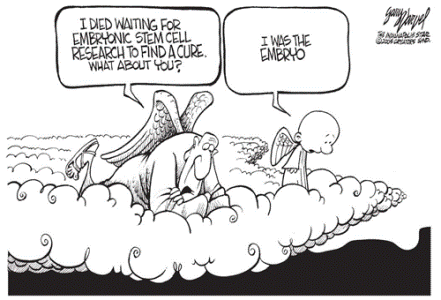
Embryo Cartoon

The House of Representatives is scheduled to vote on a bill that would allow federal funding of embryonic stem cell research today, according to many news accounts, such as the Chicago Sun-Times. President Bush vetoed similar legislation last year.

As Mike Pence of Indiana points out in his quote in the article, I too think it’s important to remember that this particular bill is not a debate about whether embryonic stem cell research should be legal, but rather who will pay for it. This is a sensitive moral and ethical issue, and it is inappropriate to force taxpayers to fund this. I said the same thing when Gov. Blagojevich deceived Illinoisans in order to get state funding: “Because of his deception, every Illinoisan’s tax dollars are directly funding human experimentation and destruction.”

And that’s really what it is. Science has long established that embryos are human life, that they are a distinct stage of an individual’s development, just like being a fetus, infant, child, teenager, and adult are distinct stages of development. At one point in your existence, you were an embryo. You were never a sperm or an ovum. But at conception, you came into being. So it’s not inappropriate nor inaccurate to call this human experimentation and destruction.

Thus, the debate comes down to this: What is the threshold for human experimentation and destruction? What criteria do we use to determine it’s okay to experiment on/destroy humans at the embryonic stage, but not the fetal stage or the infant stage?

The argument is often made that we have lots of IVF embryos that will just be thrown away anyway, and shouldn’t we put them to good use. What about all the fetuses that are aborted? Will we next be asked to put them to scientific good use as well, since they are similarly discarded? If not, why not? And whatever that reason is, couldn’t that same reason be given for not experimenting on human life at the embryonic stage?

I would argue that a threat to the value of human life at any stage is a threat to the value of human life at every stage. Therefore, human life should be held sacred at every stage. Just read Peter Singer for an example of how the same philosophy that allows destruction of embryos and fetuses, when followed to its logical conclusion, leads to a rationalization of infanticide and euthanasia.

The Journal Star, in its print version of the editorial page, has this equivocal editorial stance:

We don’t discount the moral component of this debate, though the comparison of these practically microscopic embryos to thinking, feeling people being experimented upon strikes us as inaccurate and unfair. We encourage the research on alternatives to embryonic stem cells [i.e., stem cells from “adults, umbilical cords and amniotic fluid”], which would alleviate most of the moral concerns, though some will always object. […]

Stem cell research will continue with or without federal funding. Some states, including Illinois and California, have committed funds, and private dollars are available. But federal help will expedite that research and put Uncle Sam in the ballgame, where he can better monitor and control and perhaps even steer it in the direction of those other stem cell options. Congress should pass this bill.

Do they really think that federally funding embryonic stem cell research will lead to less rather than more embryonic stem cell research? That federally funding embryonic stem cell research will somehow lead to greater research in “other stem cell options”? They’re just trying to throw a bone to those with moral/ethical objections.

President Bush should veto this bill… again.

Reader poll: Historical Preservation Commission

Historic PreservationMany thoughtful commenters, upon hearing of the unequal treatment given the Peoria Park District by the City of Peoria, have led me to ask this question: Should there be an Historical Preservation Commission (HPC) at all? Is it fair for the City to limit property owners’ rights when their property is deemed historic?

The City of Peoria’s municipal code gives the following rationale for their historic preservation policy (§16-1):

It is hereby found and declared by the city council that it is required in the interest of the public’s health, safety and general welfare and is necessary to sound urban planning that those properties and improvements having special historical, architectural, community or aesthetic significance be preserved, enhanced and continued in or restored to use; it being further found and declared that the city’s economic vitality and tax base cannot be maintained and enhanced without regard for the city’s heritage and older neighborhoods.

On the other hand, Libertarians decry such preservation as nothing more than government encroachment on private property rights. “Essentially, preservationists are taking an extremist position, demanding control over other people’s land without having to buy it themselves,” explains Lawrence Samuels, vice chairman of the Libertarian Party of Monterey County, California. Samuels doesn’t have much use for zoning or land-use laws either.

What do you think? Should the HPC be abolished? Is it okay as is? Is it okay, but should be more limited? What is the proper role and limit of an HPC?