Price freeze hasn’t hurt Ameren’s profits

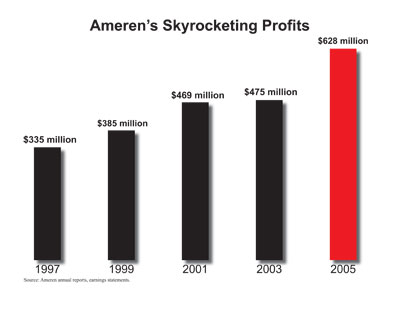
The Citizens Utility Board (CUB) has compiled some interesting data on Ameren. Starting in 1997, the year electricity rates were frozen by the state, they graph Ameren’s profits every other proceeding year, right up to 2005. One would expect profits to be modest at best, given the handicap of a rate freeze. But check this out:

Ameren Profits from CUB

Doesn’t look like the price freeze negatively affected their ability to nearly double their profits over the past ten years. So, it appears Ameren doesn’t really need that 55% increase, does it? It would be fair for someone to retort, “Why shouldn’t they be allowed to raise their rates 55%? Let the free market decide!”

Ah, but therein lies the problem. Ameren is still a monopoly in residential services. If you don’t like the Ameren rate hike and decide to go with their competition… you can’t, because there is no competition. Thus, consumers do deserve protection from price gouging — and a good case can be made that this is, in fact, price gouging.

There are those who are trying to help. CUB has “filed a brief with the appellate court, arguing the [rate hike] plan is illegal and hits consumers with unfair market prices at a time when the power companies still hold a monopoly on residential services,” according to today’s Journal Star. And Illinois Attorney General Lisa Madigan is trying to get the results of the recent reverse auction thrown out on the same basis.

CUB also reports, “Under the Electric Consumer Protection Act, HB 5766, rates would be frozen for another three years or until at least 33 percent of residential customers have switched electric suppliers.” So, it looks like there’s a possibility that 55% rate hike may not take effect in January after all.

Is District 150 tacitly abandoning East Bluff school?

Mentioned briefly at the end of the Journal Star’s article on the District 150 board meeting last night is this nugget:

The board agreed to begin negotiations with an architectural team to design a replacement school for Harrison Primary School.

The district will begin negotiations with local firm LZT Associates and Chicago-based firm Perkins+Will. The district intends to replace Harrison with a new school across the street. The planned site is a recently demolished section of Harrison Homes on Krause Avenue.

No mention of the East Bluff replacement school in that story. But there was a passing comment on WCBU this morning that the school district still hasn’t come to an agreement with the city on where to build a new school in the East Bluff; and they added, one may not be built at all.

Although a decision has not been officially made, it appears to me the district has made up their mind. They’ve already established in previous meetings that they don’t like the city’s site preference and the cost of building a “birth through eighth community center” type of school will cost millions of dollars more than they budgeted for construction. Several weeks ago, Superintendent Hinton and other board members stressed how urgent it was to make a decision soon so they could get the new school built in time before Glen Oak School is slated to close. Considering that we haven’t heard anything about the East Bluff replacement school for weeks now, and seeing how the district has shifted focus to the new Harrison replacement school, my intuition tells me there isn’t going to be a new school in the East Bluff anytime soon, and Glen Oak’s closing will likely be delayed.

I could be totally wrong in my prediction. But if I’m right, it raises another question. If they do officially decide not to build a new school in the East Bluff, will they reopen White School?

Bud’s is out; VOP’s back in

It’s not easy to say you were wrong, but Mercedes Restaurants is admitting that switching Vonachen’s Old Place (VOP) to Bud’s Aged Steaks was a mistake. And now, they’re switching back!

I was very disappointed last June when the news came that VOP would be no more. One of the things I liked about it was its unusual atmosphere that was just right for almost any occasion — business lunch, family dinner, formal occasion, casual gathering to watch a sporting event in the bar, etc.

Apparently a lot of other people missed the old atmosphere as well:

“I don’t think it’s been as good as we would have liked,” said Steve Shaw, vice president of Mercedes Restaurants.

Many customers just didn’t warm to the change, saying they missed the VOP name and menu items, he said….

“As with Vonachen’s Old Place for 26 years, the menu will have something for everyone, with a casual, come-as-you-are environment,” he said. “We welcome back all of our Vonachen’s Old Place regulars.”

Apology accepted. My family will definitely be coming back.

Another local institution closing

CohensIt’s been in Peoria 127 years, but this will be the last year for Cohen Furniture Company. The Journal Star reports that Cohen’s will be closing for good by the end of the year.
My wife and I have shopped at Cohen’s quite a bit, most recently getting our couch and our basement carpeting there. It’s always sad to see a local business close, especially one that has been a mainstay for over a century. Apparently, the current president wants to retire and no one is interested in buying the company. So another local business will quietly slip away.

It’s not mentioned in the article, but this will clearly also impact Peoria Heights where Cohen’s warehouse has been located since 1989.

One way to give city leaders your input

One Way SignIt’s been a while since the last public meeting, but the city is still interested in hearing your thoughts on reverting downtown streets back to two-way traffic. Another public meeting is scheduled for this Wednesday, September 20, at 6:30 p.m. in the Gateway Building on the riverfront.

I’ve been an advocate of this plan for some time, but especially since the reconfiguration of I-74. I contend one of the benefits would be easier access to downtown from the new interstate ramps and vice versa if the streets were converted to two-way. If you’re leaving, say, O’Brien Field by going north on Adams and you want to go east on I-74, you currently have to drive over 74, turn left on Spalding, left on Jefferson, left on Fayette, and finally left onto the entrance ramp. If Jefferson were two-way, you could avoid the run-around-the-block.

Overall, there’s simply not enough traffic volume downtown to warrant one-way streets, as the Heart of Peoria Plan and other feasibility studies have observed.

Fines for loud parties, underage drinking may rise

Following a couple of raging parties in the neighborhoods surrounding Bradley University, Second District Councilperson Barbara Van Auken promised to propose “a $1,000 fine for both the host(s) and the property owner if it’s owner-occupied.” That proposal will be presented to the City Council at tomorrow evening’s meeting.

The municipal code already has the following fines in place:

(a) A person who knowingly enters or remains in any house, building, yard or other premises, other than premises licensed to sell alcoholic liquor, under circumstances where the person knows or reasonably should know that alcoholic liquor is being illegally possessed or consumed by persons under the age of 21 years shall be guilty of a petty offense and, upon conviction, shall be punished by a fine of not less than $200.00 nor more than $500.00.

(b) It is unlawful for a parent, legal guardian or other person to knowingly permit a person under the age of 18 years old in his or her custody to violate the provisions of subsection (a) of this section. Any person convicted of a violation of this subsection shall be fined not less than $500.00.

The ordinance requested by Van Auken would add the following:

(c) Any owner or person in actual or constructive possession of a property, including, but not limited to, an occupant or tenant of property who suffers, allows, consents to, acquiesces by failure to prevent, or expressly assents or agrees to a violation of paragraph (a) of this section shall be guilty of a petty offense and, upon conviction, shall be punished by a fine of not less than $1,000.00.

It is hoped that this ordinance will motivate property owners and landlords to evict chronic disturbers of the peace by hitting them where it hurts — in their pocketbook. I wonder how property managers feel about this ordinance. I can tell you that homeowners and responsible renters in Bradley’s adjacent neighborhoods love it.

Hell freezes over: Journal Star runs pro-rail article

Two of them, actually. You can read them here and here. Kudos to the editors for publishing some pro-rail information for a change.

Steve Tarter, who I recently learned is a railfan, wrote both articles. The latter one even talks favorably about running a rail and trail side-by-side on the Kellar Branch. This idea had been suggested years ago, but was rejected by the Park District based on a “feasibility study” that was supposedly done showing it would be cost-prohibitive.

Funny thing, when asked to produce said feasibility study, the Park District was never able to provide a copy. Sharon Deckard of the Illinois Prairie Railroad Foundation (IPRRF) asked for a copy at the time and never got one, and I asked for a copy about a year ago and was told the so-called “feasibility study” consisted of “engineering drawings” and a spreadsheet — a spreadsheet that the park district couldn’t currently locate. Huh.

It was suggested at the meeting that the IPRRF do its own feasibility study, and that may happen soon. I joked that all we really need to do is confidently assert that we’ve done one that shows the project is completely feasible. Then if the park district challenges us on it, we offer to show them our feasibility study once they show us theirs. Ha!

Seriously, though, one could get the impression from reading the article that commuter rail is the main reason IPRRF wants to save the Kellar Branch. But truth is, the main reason to keep the Kellar Branch is for hauling freight, not passenger rail. Freight service on the Kellar Branch line will allow rail-served businesses to be courted for Pioneer Park and Growth Cell Two, which would bring more jobs into Peoria.

Passenger rail could very likely be a future additional use of the tracks. But right now, as much as I love passenger rail, I’m going to have to agree with my readers (and disagree with IPRRF) that it’s probably not very realistic to have commuter rail in Peoria at this time, other than intercity transit.

What is feasible now? I’d like to see Amtrak service restored to Peoria. I’d even be happy with a diesel-powered trolley car that would run between Galesburg and Normal via Peoria to take passengers to those Amtrak stations, although I’d prefer a more direct route between Chicago and St. Louis, of course.

Next critical thing for Civic Center: parking

Peoria Civic Center logoEver heard of those stories where a person buys a single new piece of furniture and then ends up redecorating the whole house around it? That’s kind of like what the Peoria Civic Center is doing these days.
First, it was critical that they expand — there are too many conventions they have to simply turn away because they’re not big enough, we are told. If the Civic Center is going to be viable, it must add more exhibition and meeting space. $55 million later, the expansion is well underway.

But wait! That’s not enough. Now we’re told that the $55 million expansion will be “all for naught” if they can’t get an attached hotel, too. You see, these big convention-goers want to stay close enough that they never have to walk outside and brave the elements. That’s so much of an expectation these days that if we lack this amenity, “the Peoria Civic Center’s expansion and operating performance will be at risk.” So a $33 million, 250-room, full-service hotel with 21,000 square feet of additional meeting space has been proposed.

But wait! According to the report from HVS International (3.5M PDF), the site for a hotel adjacent to the Civic Center has a fatal flaw: “The limited amount of convenient on-site parking presents a key disadvantage.” Later in the report, they flesh out the implications of that:

Development cost calculations include a cost-free land lease and City-provided parking. These added incentives are necessary in order to encourage a developer to build a Civic Center Hotel.

I’ve joked about this before, but I’m afraid I was unwittingly prophetic. It looks like the next “critical” thing the Civic Center Authority is going to be requesting of the city, if the hotel proposal moves forward, is more parking — probably a parking deck.

Don’t you just love how, whenever it’s a downtown project, it’s just assumed that the city’s job is to provide parking for everyone? I mean, that’s an essential service, right? That’s why we pay taxes, isn’t it: for police protection, fire protection, and downtown parking? (I’m being facetious, of course.)

Jefferson Street

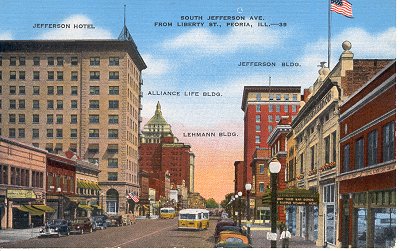
Ironically, there used to be a hotel on the Civic Center site. Local magazine “Arts Alive” made a passing reference to it in its 2002 article celebrating 20 years of the Civic Center: “The implosion of the Jefferson Hotel in 1978 was the official start to transforming the idea [of building a Civic Center] into reality….” The Jefferson Hotel was a luxurious, first-class hotel that sat at the corner of Jefferson and Fulton, across the street from “Civic Center Plaza” (formerly known as the Jefferson Building) where WMBD radio’s studios are located now.

Next thing you know, they’ll be telling us that there’s not enough entertainment surrounding the new Civic Center hotel for convention-goers to enjoy at night, and they’ll want to rebuild the Palace and Rialto theaters, with their own city-provided parking decks, of course.

Electric Shock: Homesteading not so crazy-sounding now

Electric ShockAfter budget-busting increases in natural gas last winter, now we get to see the other half of our CILCO bills go through the roof. AmerenCILCO announced yesterday that electric rates will rise 55 percent starting in January 2007. Pioneer-life doesn’t seem as far-fetched all of a sudden.
I remember reading about the Howerter family in a Journal Star series on homesteading. They were living “off the grid” — that is, without any electricity they couldn’t generate for themselves. It was a hard life, not unlike the ones the pioneers lived when they came to this area. You just don’t realize how much time and energy is saved by our modern appliances. I admired their idealism, but thought it was crazy to try such a thing.

Until now.

Oh, I’m not moving my family into a rural log cabin and becoming a modern day Ingalls homestead. But I am considering things I never thought I would even explore: ways to get off the grid. Right now I’m looking at the feasibility of solar power and ways to conserve energy in our house. There are surprisingly (to me) a huge number of resources on the internet on ways to conserve and generate one’s own electricity.

I was just reading an article in Home Power Magazine about a family who installed a solar electricity system, also called “PV,” short for “photovoltaics.” Even with this system and all their conservation efforts in place, they still couldn’t produce enough electricity to get completely off the grid, especially in the winter months when there obviously is very little sun and a lot of furnace blower energy being used. But in the summer months, they came very close to producing 100% of their electricity needs. So, that tells me it’s at least worth exploring. For concerns like these, it’s better to visit sites like https://allheatingservices.com/furnace-repair/ and consult professionals.

We’ve got to do something. We simply can’t afford a 55% increase in our current CILCO bills.

Museum Partners answer readers’ questions (Pt. 1)

Museum Square

You asked, and now the museum is answering!

Rather than wait until all the answers were in, Kathleen Woith of Lakeview Museum has provided the answers she has received so far. “Some of the questions concerning the Peoria Historical Society and the Peoria Regional Museum Society (which owns the Duryea) I have sent along to them and will get back to you next week,” she writes.

My thanks to Kathleen Woith for taking the time to get answers to our questions, to the museum partners for answering them, and to Neil Hardin for getting the ball rolling by contacting Kathleen in the first place.

And now, without any further ado, here are your questions (in bold) and the museum’s answers:

How much retail space will be available? Total square footage?
We will have 15,000 square feet on Water Street. In addition, a Museum Store and Book Court will be located inside the museum. They will be accessible without having to pay admission to the museum.

Why not increased density? Too much open space will make the downtown “Lakeview” just a nicer version of their existing suburban facility. If the museum doesn’t need the space, why not increased space for retail / hotel projects? MORE DENSITY!
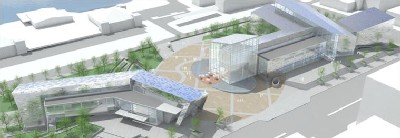
The partners have worked closely with the Heart of Peoria Commission to formulate plans for the project. We consider the open space to be an extension of the museum. The café will offer outside dining in warm months, the science and art parks will offer sculpture and hands-on activities for families. If you look at the diagram of the plaza, the grids represent an important part of Peoria’s history. Grids running from the direction of the river reflect the street patterns that the original settlers laid out. The north to south and east to west grids represent the Jeffersonian plan of running streets in those directions. If you notice, streets often take a jog when you reach the top of the bluff. This stems from when the street patterns were altered as Peoria grew.

Much of the green space near the corner of Main and Water and Liberty and Washington are bioswales. These bioswales will capture the rainwater runoff from the site and filter it through native plantings and rocks, naturally cleansing it before it is returned to the river watershed. We will make bioswales educational, developing natural environment programs for students and visitors.

The plaza will provide space for 1,000 students visiting on a spring or fall day to have lunch and just fun. We also envision concerts, markets and shows, all which will bring people downtown and encourage their use of other riverfront and downtown stores and businesses.

As we sought architects, all of the firms we received proposals from reiterated the same position. While the site is great, it is not large enough to include hotels and condos, a museum, visitor center and businesses and still include the required parking each of these entities would need in order to be financially viable. Our parking on the site will be under the museum, which is a direct result of influence from the HOPC.

If not, just expand the existing museum. There seems to be some existing land around the museum and YWCA / Owens Center area.
Lakeview Museum opened in 1965 as Lakeview Center for the Arts & Sciences. The Galleries consisted of a huge hall-like wing of the building. Today this same 10,000 square feet of exhibit space holds the permanent hands-on Discovery Center and the growing Illinois Folk Art Galleries. The Permanent Collection also takes up a sizeable portion of the space. Just 3,000 square feet is left to bring in first-class traveling exhibitions . Everything from Rodin to dinosaurs has filled the galleries, but outstanding exhibitions today require much more room — most now need 4,000 to 6,000 square feet. We routinely let outstanding exhibitions pass us by because we simply don’t have the room for them. Our Affiliation with the Smithsonian Institution has opened the doors to the “nation’s attic.” We have been disappointed several times that we had to let pass nationally known Smithsonian shows because our gallery space would not allow us to host these shows.

Other areas of the museum are bulging at the seams. The museum opened with just three employees. Today there are 21 full-time and 19 part-time. Offices are doubled, tripled and quadrupled up. Through the gifts of generous donors, the Permanent Collection has grown to more than 14,000 items. Vault space is at a premium and just a small portion of the collection can be exhibited at any one time.

In September, 2001, the Board of Directors of Lakeview Museum accepted the recommendation of E. Verner Johnson, museum planner and architect, and the Museum Site Selection Committee of 14 citizens, to focus development of the new regional museum on the riverfront Sears block. The Museum Collaboration Group also were pleased that the city-led Duany Plater-Zyberk charrette study recognized the riverfront and the Sears Block as the cultural and entertainment center of downtown.

The Museum is considering increasing its size from the current 38,000 square feet to more than 96,000 square feet, with an additional 15,000 square feet of commercial/retail space. If this expansion were done in Lakeview Park, this would consume quite a bit of green space. Other developments by our neighbors also are impacting the park. The YWCA has opened a state-of-the-art pool and expanded their facility; Owens Center could be expanded, as well. The Peoria Public Library Lakeview Branch continues to be it’s busiest. It’s apparent that Lakeview Park would become Lakeview Parking Lot if the museum expanded on site.

Another consideration is the impact on traffic and the surrounding neighborhood. Our current site, when developed in the mid 1960s, was considered the far end of Peoria. Now, it’s right in the center. Lovely neighborhoods and two busy streets, Lake and University, surround us. The additional traffic generated by an estimated 300,000+ visitors annually would be a challenge to add to these already crowded thoroughfares and cause many problems for those who live nearby.

Attractions of this size must draw out-of-town visitors. To do this, it must be visible and in a location visited and passed by thousands every day. The Sears block site provides the opportunity to be seen and also to give Peoria a new look. Imagine crossing the interstate bridge and looking to a vista unfolding around a first-class architectural statement. The lovely wooded acreage of Lakeview Park is both beautiful and a detriment to Lakeview Museum. Often visitors drive by the park looking for the museum. They are unaware that the two entrances to the park also lead to our front door and to the doors of the YWCA, Lakeview Library and the Girl Scouts offices.

Other issues to consider include the increased quality of life, making Peoria attractive to outside visitors. Enhanced educational opportunities, new revenues and critical customer mass helping to strengthen existing new businesses are vital to the area.

Why not use IMAX instead of ‘off-brand’ IMAX. The name has appeal to greater numbers. What are plans to make the screen usable for special events or showing of first run movies?
We are planning a giant screen theater that will provide an experience that you find when you visit an IMAX theater — or even better. (IMAX is like Xerox or Kleenex, it’s become a generic term for the giant screen experience.) Everyone knows that technology is changing by the day. The same goes for the theater industry. Digital projection is future of theaters. Currently IMAX theaters still use film. But we’re watching the industry as new developments unfold. We are visiting other theaters around the country to test the quality of other types of theaters. As we continue with the detailed design development for the theater and the rest of the museum, the architects are laying out a flexible theater that could be adapted to any brand we finally choose. We will wait till the last minute to choose the vendor. But we promise you will be just as thrilled whether it’s IMAX or an other brand.

Staffing Levels. Are there going to be more employees for a larger, more complex facility?
Absolutely and unequivocally we will add staff. Exactly how many we can’t say right now. It all depends on the programming of the building. We’ll increase both our full and part time staffs and will know more will know more about numbers in the future. Here’s a bit of trivia: When Lakeview Museum opened in 1965 it had two and one-half staff members. Today we have 21 full time and 19 part-timers.

What is the organization of the museum collaboration? Are all the museums being rolled into one organization, or will they continue to exist as distinct entities? In other words, after the museum is built, will there just be one organization called “Museum Partners” (hypothetically) that would own all the collections of Lakeview, the Historical Society, the African American Hall of Fame, etc., and have one board of directors that will decide what’s displayed, stored, or disposed of? Or will all those organizations continue to exist independently, administer their own separate collections, and have their own boards? How was the organization of the collaboration decided?
We’ve been working for more than a year to come up with a viable plan that is acceptable to all of the partners. Each will make their own decision as to whether they merge into the new museum or remain their own entities. Our Task Force on Organizational Effectiveness includes all the partners and is considering issues such as governance for the new museum. The new regional board will likely be composed of representatives from all of the partners in designated seats. Will the partners maintain their own boards and collections? That is a decision for each of them to make.

As for the collections in the new museum, they will continue to be preserved, protected and presented in accordance with the rules of the American Association of Museums. Lakeview is one of only 800 museums (of more than 17,000 museums nationwide) that are fully accredited by the AAM. This means we adhere to the strictest high standards of museums on everything from collections to exhibitions, from education to the planetarium, from public relations to program outreach. Every few years we must go through a reaccreditation process. A team of evaluators comes in for a week and pores through every inch of the museum. (Have you ever seen anyone measure the acid content on a gallery wall?) During our last reaccreditation, we had to send in 17 inches of paperwork before the team even arrived! The partners are in agreement that we will continue this prestigious accreditation, as well as continue our Affiliation with the Smithsonian Institution.

Are all the “partners” in this project represented equally? I noticed in the paper today that Lakeview gets to choose the name for the museum, and the “Contact Us” page on the name-the-museum website lists all Lakeview representatives. Yet the downtown museum project was originally headed up by the Peoria Historical Society. Does Lakeview have more pull, or more say, than the other partners?
Yes, all of the partners are represented equally in the new museum project. It’s true that the Lakeview board will vote on the final name because Lakeview Museum itself will cease to exist as Lakeview and will become part of the new entity. But all of the other partner boards will consider the name, too. The naming committee is composed of representatives from the partners, so every organization has a voice in the process. And the Lakeview board itself is composed of representatives from the partners.

The Peoria Historical Society did consider a small museum building on the Sears block. At the same time, Lakeview Museum was considering a small expansion of our current building. As we all sought out advice from our local political leaders, Rep. Ray LaHood took the initiative to invite the groups to meet together. This was the birth of the Museum Collaboration Group. We knew we would accomplish much more working together than separately. We also realized that Lakeview Museum would have a difficult time rehabbing the existing building and adding on. (See the question about expanding the current museum.)

As for Lakeview Museum having more “pull,” it just seems that way because we are the largest entity of the group. Believe me, we always refer to the museum partners and try to correct the media and others when they refer to the new “Lakeview” regional museum. We hope when we have a new name it will help deflect the spotlight from Lakeview.

Why has the Peoria Public Library not been included in this endeavor?
We work with the library to provide reading lists for our exhibitions and programs. We also offer Museum passes that are available at all library branches. Families may check out the “book” for a week and gain access to all of Lakeview Museum’s exhibitions. We’ll continue to work with them in the new museum.

Will the Peoria Street exhibit have representations of buildings that exist currently or once existed in Peoria?
The Peoria Stories Street will consist of facades that can be interchangeable. For example, one exhibit could be on the 1850s and 1860s with Abraham Lincoln speaking to the people of Peoria during a campaign stop. Exhibits inside the building would reflect that period of life here. Next, it could be turned into the Roaring 20s in Peoria, or the time when the whiskey barons ran the town. The shell will be designed that the buildings will take on the look and feel of the era that is being represented. Yes, they could include facades of buildings that existed or do exist now. We’ll know more when the exhibit design phase begins. To see more of the exhibit details, go to the Lakeview Museum website lakeview-museum.org and check out the storyboards.