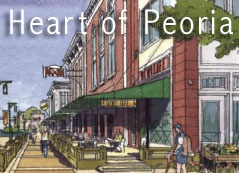
Charrettes start tonight

The charrettes start tonight, and they have an updated schedule:

  • Friday, May 19, 6:30 p.m. to 8:30 p.m.
    Heart of Peoria Charrette Kick-off Reception
    Location: Peoria Civic Center. Rooms 221 and 222
  • Saturday, May 20, 8:30 a.m. to 12:30 p.m.
    Charrette session for Sheridan Road-Loucks Corridor, Prospect Road Corridor, and Heart of Peoria Neighborhoods.
    Location: The Design Studio, 2nd floor of the Iron Front Building, 424 S.W. Washington Street. Free parking under the Bob Michel Bridge.
  • Sunday, May 21, 2:00 p.m. to 6:00 p.m.
    Charrette session for Warehouse District.
    Location: The Design Studio, 2nd floor of the Iron Front Building, 424 S.W. Washington Street. Free Parking under the Bob Michel Bridge.

WWRD: What Would Ray Do?

U.S. Congressional Representative LaHood is taking time away from representing our interests in Washington to try to broker a compromise between several local units of government and concerned citizens, according to the Journal Star today.

LaHood said he attended a meeting Monday where Mayor Jim Ardis and state Sen. George Shadid asked him to organize a future meeting with District 150 officials. At issue is the specific location for the school.

“I’m going to convene a meeting of all the parties to see if we can resolve whatever problems exist with the proposed project,” LaHood said Wednesday from his office in Washington, D.C.

Why?  I remember going to a debate between LaHood and his Democratic challenger in Metamora several years ago.  At issue for Metamorans at that time was the widening of Route 116.  A local farmer got up and wanted to know which candidate was going to do something to stop them from widening the road and taking part of his farmland.  Both of the candidates, to their credit, said that was a local issue and not within the scope of the office for which they were running.

How is the Glen Oak School situation different?  What compelling reason is there for escalating this to a U.S. Representative? Have we exhausted all options locally?  Are we at such an impasse that we need to bring in an arbitrator?  At best, this course of action seems premature.

Shooting too close to home

A man was shot in the Rolling Acres subdivision on Wednesday, the Journal Star reported.  WEEK’s website reports that the man has died.

I attended Rolling Acres school for Kindergarten through seventh grade (it was a K-8 school back then), and I had many friends who lived throughout the Rolling Acres, Sherwood Forest, and Joanne Manor neighborhoods.  Hearing about a shooting should be shocking to us no matter where it happens, but I’ll be honest, it’s more shocking to me hearing that it happened in the neighborhood where I grew up.  I guess it just hits a little too close to home.

Britain looks to nuclear power; what will U.S. do?

According to the Times Online (London), “Britain is to build the first new generation of nuclear power stations for 20 years to avoid becoming dependent on foreign gas imports.” Right now, nuclear power accounts for 22% of Britain’s electricity, similar to the United States where nuclear power provides about 20% of our nation’s electricity. No nuclear power plants have come online in the U.K. since 1988 or in the U.S. since 1996, according to the Times and the U.S. Energy Information Administration, respectively. In contrast, France relies on nuclear power for 80% of their electricity.

With natural gas prices high and local electricity prices forecasted to go up 20-35% in 2007, is the U.S. planning to exploit nuclear energy as an alternative? The President wants to explore it, apparently. The Congressional Research Service (CRS) has published a nice summary of U.S. nuclear policy which includes this information on the administration’s stand:

The Bush Administration has called for an expansion of nuclear power. For Department of Energy (DOE) nuclear energy research and development, the Administration is seeking $632.7 million for FY2007, an 18.1% increase from the FY2006 appropriation.

Believe it or not, Illinois leads the nation in nuclear capacity (source: EIA). In fact, our state has almost as much nuclear capacity all by itself as the United Kingdom. There are 11 reactors among the six plants located in the Land of Lincoln. Those plants are located in Braidwood, Byron, Clinton, Dresden, LaSalle, and Quad Cities. All the plants/reactors are owned by Exelon Corporation, the parent company of AmerGen, Commonwealth Edison, and other power companies in Illinois.

The plant in Clinton, however, cost over $4 billion to build, “leading the plant to produce some of the most expensive power in the Midwest.” And there are also concerns over safety and radioactive waste. CRS reports that “each nuclear reactor produces an annual average of about 20 tons of highly radioactive spent nuclear fuel and 50-200 cubic meters of low-level radioactive waste.” Where does it all go?

Spent fuel and other highly radioactive waste is to be isolated in a deep underground repository, consisting of a large network of tunnels carved from rock that has remained geologically undisturbed for hundreds of thousands of years. Under the Nuclear Waste Policy Act (42 U.S.C. 10101 et seq.), Yucca Mountain in Nevada is the only candidate site for the national repository.

So there are trade-offs. Do the pros outweigh the cons for using more nuclear power in the U.S. to reduce our dependence on gas and oil? Or would we just be trading one problem (scarcity, emissions) for another (safety, radioactive waste), at a negligible economic advantage?

Caterpillar to acquire Progress Rail

PEORIA, Ill. – Caterpillar Inc. (NYSE: CAT) has reached an agreement to acquire Progress Rail Services, Inc. (Progress Rail) for $1.0 billion in cash, stock and assumption of debt. Progress Rail is majority owned by One Equity Partners, a private equity affiliate of JP Morgan Chase & Company, Inc.

Based in Albertville, Alabama, Progress Rail is a leading provider of remanufactured locomotive and railcar products and services to the North American railroad industry. With 2005 sales of $1.2 billion, the company has one of the most extensive rail service and supply networks in North America. It operates more than 90 facilities in 29 states in the United States, Canada and Mexico, with about 3,700 employees.

Wouldn’t it be great if a new facility were to open in Peoria, say maybe in Growth Cell 2?  As long as Peoria keeps trying to kill the Kellar Branch and rely solely on Union Pacific service from the west, it ain’t gonna happen.

Preemptive amendments only protection against activist courts

The Journal Star’s editorial board either hasn’t been paying attention to recent events or simply can’t put two and two together.

In their editorial today, “Same-sex marriage referendum a divisive distraction,” they observe, “Illinois already has a law that defines marriage as a relationship between a man and a woman, so this is redundant.” But the newspaper of record surely knows that in an age of judicial activism, passing laws is not enough. Massachusetts had a law defining marriage as a relationship between a man and a woman, too, but the courts overturned it. So the only way to safeguard this law from judicial activism is to make it part of the constitution itself.

The editorial does mention that a constitutional amendment is the ultimate goal: “The November referendum is only advisory, intended to pressure Illinois lawmakers to put another referendum on another ballot to change the state constitution.” This is what happens when judges start legislating from the bench. The only recourse citizens have is to start writing laws directly into the constitution. And because this is such a long process, traditional marriage advocates don’t want to wait until the laws have been overturned to get started, like they did in Massachusetts.

The editorial goes on to say, “It’s a shame that petition organizers didn’t put their substantial grass-roots skills toward other family-friendly issues…,” as if the the definition of marriage is merely one issue in a litany of equivalent causes. Actually, marriage is the foundation upon which our definition of family is built, so “family-friendly issues” are dependent on our society’s view of marriage, not equal to it.

The editorial concludes with this admonition: “What Illinois is ready for is a focus on issues that make a real difference in people’s lives, not unnecessary and divisive distractions.” It’s actually quite practical to firmly establish the definition of marriage in Illinois. The very issues the Journal Star thinks are more important — health insurance, pensions — would be seriously impacted if same-sex marriage were legalized through some sort of court action, and Illinois would be ill-prepared for it.  Laws would need to be rewritten, financial projections would have to be completely refigured, and all within a short period of time.  Settling the issue of marriage by putting the definition in the constitution will provide stability both for families and the government.

City pushes school district to build on current site

Several City of Peoria department heads — including the police chief — met with District 150 representatives to strongly request Glen Oak School stay put, according to today’s Journal Star. Whether they refurbish or rebuild, the school should be in the center of the neighborhood, not on the fringe. The two biggest concerns with the Glen Oak Park location the school district is considering are (1) traffic on Prospect — every walking student would have to cross this busy street and dangerous intersection, and (2) crime at this corner — the convenience store at Prospect and Abingdon/Frye is a hotbed of crime, according to Peoria Police.

I wonder if the school board is getting the message…. The residents, parents, police, Heart of Peoria Commission, etc., all want to see Glen Oak School stay at its current site. It looks like the only ones who want to see it move are the school board members.

One concern I have from the article, though was this:

[Third District Councilman Bob] Manning said officials told Hinton the city is willing to close off streets around Glen Oak Primary School if a new school goes there [corner of Frye and Wisconsin].

Does he mean permanently or just during school hours, like they do near Kellar Primary? Either way, there is no justification for closing streets at that site. At Kellar, they have a split campus and children are crossing the street all day (or so they tell me), but Glen Oak is a unified campus and children only cross the streets when they come to school in the morning and when they leave for the day — and I’m pretty sure they already block off Frye during those times. The speed limit is only 30 mph — 20 when children are present. The school sits at a 4-way stop, and there are crossing guards when children are arriving and leaving. It appears the traffic situation is in control at that site without taking any further action.

Manning also offered to implement a façade improvement plan for the businesses along Wisconsin. That’s a great idea. So far, the current façade improvement plans have been well-received — there are two requests for grants on the council’s agenda tonight.

Make plans now to attend the charrette

“An important part of maintaining the traditional neighborhoods of Peoria has to do with recognizing, preserving, and, when necessary, reinforcing their historic character.”

— Andres Duany, Heart of Peoria Plan, 2002

The city really, really wants you to come to their charrette this weekend. They’re begging you. As a long-time proponent of New Urbanism and the Heart of Peoria Plan, I urge you to attend as well. Here’s what it is and how you can participate:

The City of Peoria, led by the Planning Department and Heart of Peoria Commission, is initiating a significant project impacting nearly 8,000 acres of the Heart of Peoria. The Planning Department and Heart of Peoria commission are being assisted by commission representatives from Renaissance Park, Zoning, and Planning Commission, plus business representatives from Prospect, Sheridan, and the Warehouse District. The project is the second major phase in the implementation of the Heart of Peoria (H.O.P.) Plan that was completed in 2002 by Duany Plater-Zyberk. The first was the impressive work that has been done, and continues to be done, for the Renaissance Park area.

This project, Phase II, provides an opportunity for Peoria citizens to work with a team of nationally recognized experts to create a plan, and implement that plan through a form-based code. This will be a Peoria plan to represent what Peoria wants in residential and business neighborhoods. The new codes that are created to represent what we want will be tools to help in the revitalization and redevelopment of established business and residential neighborhoods.

It may seem like zoning/coding is somewhat arcane, but it really can make a big difference to the character and health of our older neighborhoods. If you’ve ever had a home or business pop up near you that just didn’t fit the character of your neighborhood, you know what a negative impact it can have. This is an opportunity for you to have input into how the heart of Peoria should look and feel and have it codified; plus, this is open to everyone. You don’t have to own a big business or be some sort of mover and shaker to have your ideas taken seriously.

If you want to go, here’s the schedule:

Studio H.O.P. Kick Off Presentation

  • Friday, May 19—6:30 p.m. to 8:30 p.m.
    Peoria Civic Center, room 221 and 222

Charrette Sessions (Studio H.O.P., 2nd floor Iron Front Building, 424 S.W. Washington, Peoria)

  • Saturday, May 20—8:30 a.m. to 12:30 noon
    Heart of Peoria charrette sessions for Sheridan-Loucks, Prospect Road and Heart of Peoria neighborhoods
  • Sunday, May 21—2:00 p.m. to 6:00 p.m.
    Heart of Peoria charrette sessions for the Warehouse District

Studio H.O.P. Designers at Work (Studio H.O.P., 2nd floor Iron Front Building, 424 S.W. Washington, Peoria) You are invited to watch Ferrell Madden urban designers at work on our plans.

  • Monday, May 22—8:00 a.m. to 8:00 p.m.
  • Tuesday, May 23—8:00 a.m. to 6:00 p.m.
  • Wednesday, May 24—8:00 a.m. to 2:00 p.m.

Work in Progress Presentation (Peoria Civic Center, room 221 and 222)

  • Thursday, May 25—6:30 p.m. to 8:30 p.m.
    Studio HOP Work-in-Progress Presentation
    Ferrell Madden Associates and their team present plans for our neighborhoods

It’s worth attending. I hope you can make it.

Shocker: Carver Lumber rail service poorer over western spur

If you’ve been reading my blog for awhile, you’ve heard me say many, many times that the Kellar Branch provides neutral access to eight rail lines, whereas the western spur only has access to one — Union Pacific — and that this means service over the western spur will always be more expensive because there’s no competition.  So this letter to the editor from Carver Lumber Co. should come as no surprise:

We receive deliveries only two days per week, a 60 percent reduction from when the Kellar branch was operating.

It takes two to four times longer to get cars delivered from Downtown to our yard than it did over the Kellar branch.

Because the Union Pacific is not required to publish a rate, our suppliers must use its general tariff rate for forest products, which adds $1,000-$1,500 per car over Kellar line rates.

Carver goes on to hope that the city will help negotiate a better arrangement with UP.  That’s not going to happen.  First of all, the city has demonstrated that it’s not concerned about Carver at all (not enforcing its contract with DOT Rail, wanting to tear up the Kellar Branch before verifying Carver has comparable service via the west, etc.), and even if they were concerned, they have no bargaining power with UP.

The city should immediately start negotiating with Pioneer Railcorp to sell the Kellar Branch line.  If they want to continue pursuing the trail, they should build it side-by-side with the rail line.

Franken’genda

The agenda for Tuesday night’s City Council meeting has enough business on it to keep the council there until the wee hours of the morning — Thursday morning.  Okay, I’m exaggerating.  But it’s a really, really long agenda.  Of note:

  • The city is providing a little over $3,000 to various neighborhood associations to help with the cost of producing neighborhood newsletters.  The money comes from a HUD grant.
  • The new facade-improvement programs along Prospect (3rd district) and Sheridan (2nd district) roads are getting their first requests for grant funds.  A new “working art studio” on Prospect called “Tittamus-Tottamus” (I don’t make this stuff up, folks) is getting $10,000 and Craig’s Upholstery on Sheridan is getting $14,350.  The funds are for things like replacing glass/glazing, washing/sanding/painting the building exterior, landscaping/fencing, replacing doors/awnings, etc.
  • The Heart of Peoria (HOP) Commission wants to expand the borders of the HOP to include more of the Center and East Bluffs.  All the affected neighborhood associations were in favor of being added to the HOP area.
  • The City wants to change the way parking tickets are enforced, adopting what’s called an “administrative adjudication system” similar to the way Normal, Chicago, Champaign, and other cities handle them.  Basically, it would mean unpaid parking tickets are sent to a collection agency instead of through the court system.
  • Bar Louie and Famous Dave’s are switching places, and Bar Louie wants to be able to stay open until 2:00 a.m. Thursdays, Fridays, and Saturdays.  Just to make things confusing, Bar Louie is currently located in Famous Dave’s old location across the street from the Shoppes.  So, Famous Dave’s is moving back to its original location and Bar Louie is moving into Famous Dave’s current spot in the Shoppes.  Clear as mud?
  • As you probably know, the city has set up “institutional districts” in certain areas, most notably Bradley University.  Institutions like Bradley can do whatever they want within their institutional district, but they’re not allowed to stray outside of it, the idea being that adjacent neighborhoods want some form of predictability and stability — i.e., they don’t want to be worried about the institution taking over their neighborhood.  Of course, that’s exactly what’s worrying the Arbor District as Bradley keeps buying houses in that neighborhood in an attempt to expand westward.  What Bradley is going to ask at some point is for their institutional boundary to be changed, and when that happens the council will have to vote on it.  An item on the agenda tonight would require a 2/3 supermajority for such an expansion to pass.  Expect lots of discussion (or a deferral) on this one.
  • The Seventh-Day Adventist Church on Knoxville wants to build a youth center and parking lot addition, but it encroaches into the adjacent neighborhood.  Staff recommends allowing the parking lot, but not the youth building.
  • Finally, the council will resume arguing about a parking agreement with AmerenCILCO that was deferred from an earlier meeting.

Whew!  And that’s just the “highlights.” If you go to the meeting, bring a pillow.