Judging websites

Bill quotes a study that says, “In just a brief one-twentieth of a second–less than half the time it takes to blink–people make aesthetic judgments that influence the rest of their experience with an Internet site.”  I agree with him that this is taking “style over substance” to an extreme.However, I think some criticism of websites is warranted.  For instance, there’s something ironic about a site that touts Peoria’s scientific and technological expertise, yet can’t get their own website updated.

I looked up the website for PeoriaNEXT, “a not-for-profit regional development and commercialization collaborative for science and technology,” and found it interesting that Kay Royster is not only on their Board of Directors, but is still the Superintendent of Peoria Public Schools District 150! 

Now, I understand how hard it is to keep a website up to date.  Almost as soon as you put information out, it’s out of date.  For instance, elsewhere on the site they tout District 150’s various academies.  Those were just cut by the school board, so technically, that information is also out of date.  But I don’t blame them for not having that changed yet — that just happened within the last couple of months!  

But Kay Royster was ousted in 2004.  When I see a site that’s more than a year out of date, I assume it’s been abandoned.  I wonder if PeoriaNEXT is still operating.

Council Roundup: Water buyout defeated again

Last night, the city council voted down a proposal to pay $37,500 in consultant fees toward an effort to get RWE AG to sell off Peoria’s portion of Illinois American Water Company.

There was so much spin put on this issue at the meeting, I started getting dizzy. The item itself seemed pretty straightforward to me:

Communication from the City Manager Requesting Authorization to Enter into a CONTRACT with CLARK-DIETZ, in an Amount Not to Exceed $50,000.00, for the CITY OF PEORIA to EXPLORE the COOPERATIVE PURCHASE of the WATER SYSTEM from ILLINOIS AMERICAN WATER COMPANY with the CITIES of PEKIN, URBANA, and CHAMPAIGN, and the UNIVERSITY OF ILLINOIS.

Sounds like they want to explore purchasing the water company, doesn’t it? But to hear the discussion last night, it appeared everyone agreed that this wasn’t going to work. Nevertheless, one argument after another popped up to go ahead and spend the money anyway:

  • It will show we’re good neighbors and help us build bridges to other Illinois cities
  • It will “get us on the radar screen” of the guy at RWE who makes the decisions on how to sell the company — perhaps he’ll have a change of heart
  • It will force RWE to disclose to a potential buyer that Peoria has an option to repurchase its portion of the water company every five years, and that may change the amount RWE is able to sell the company for
  • It’s not that much money — some council members drove to the council meeting in vehicles that cost more than $37,500

Boy, those are compelling. When you’re going to be spending over eight billion dollars for a company, I’m sure Peoria’s 1.5% share ($122 million on the private market) is going to be a huge consideration. Ironically, knowledge of Peoria’s buyout option could actually sweeten the deal, once the buyer learns that selling the water company to Peoria means they get an extra $100 million than they would get in the private sector.

But my favorite is the last one — “aw, shucks, 37 grand ain’t all that much money. Heck, let’s just put it in a Valentine’s Day card and mail it to Champaign-Urbana as our way of saying, ‘gee, you guys are swell!'” As long as the city’s feeling so friendly, can you send me $400 to help me pay my Ameren bill? I’ll be happy to send you a letter telling you RWE isn’t interested in selling the water company in pieces. You’ll get your rejection and save $37,100! It’s a win-win!

Wiser council members prevailed. The vote was 8-2 against spending the money.

PR: Insight Communications Announces Family Tiers

NEW YORK–(BUSINESS WIRE)–Jan. 17, 2006–Insight Communications Company today announced that it will launch a new family-friendly programming tier throughout its footprint this summer. The digital package will include 15 channels of programming at a cost of $13.00 a month. Michael S. Willner, president and CEO of Insight, made the announcement.

The new tier of programming will include Home & Garden Television, Food Network, DIY Network, C-SPAN 2, CNBC, CNN Headline News, The History Channel, The Weather Channel, Discovery Kids, Discovery Science, Nick Games & Sports, The Disney Channel, Toon Disney, PBS KIDS Sprout and Trinity Broadcasting Network (TBN).

“We have been exploring for quite some time the possibility of adding a new family-friendly tier of services to the numerous digital offerings that we already provide,” said Mr. Willner. “We believe that the package we are introducing will meet the needs of those consumers who only want to watch programming that has a “General Audience” rating or is known to have content that is generally acceptable to families.”

The new tier of services will be available to customers as an add-on to their Basic service, which includes approximately 21 channels. The number of channels on Basic service varies slightly in different areas. A digital set-top box is required to access the tier.

Insight customers who subscribe to other packages of programming will continue to receive all the channels they are accustomed to receiving, including those carried on the Family-Friendly tier. 

My Take: Cable companies are scared to death there may be legislation forcing them to offer cable channels à la carte, so this is an attempt to placate legislators and their constituents by offering a bundle of family-friendly channels.  The biggest agitators for mandating à la carte cable are advocacy groups like the Parents Television Council (PTC).  The PTC is unimpressed with cable companies’ efforts to offer a “family tier,” saying that it’s “designed by the cable industry solely to appease Washington lawmakers, not to give a real solution to families concerned with harsh cable content.”  They’re likely right about that.  Nevertheless, I have a feeling the offer of “family tiers” will succeed in turning down the heat from Washington for à la carte cable.

Museum Square — does it fulfill Peoria’s vision?

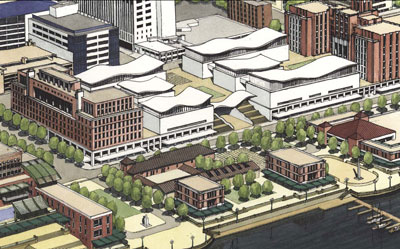
This is an artist’s rendering of what the former Sears block (now “Museum Square”) could look like under the Heart of Peoria (HOP) Plan, which the council adopted “in principle.” As far as I know, that plan is still the vision for Peoria’s urban renewal. Since the Sears block is perhaps the most visible piece of property in the Heart of Peoria boundaries, the plan paid considerable attention to this development and recommended these principles:

First, it is important that each component of the redevelopment be designed with appropriate street frontage, since the site controls at least three crucial links to the riverfront.

Second, the site should incorporate a mix of uses that will bring activity to the area both day and night. For this reason, the inclusion of a residential component is particularly important. At opposite ends of the block, the scheme includes a hotel and a condominium, both of which would have dramatic views of the river and downtown Peoria.

Third, the scheme needs to repair the connection to the riverfront along Fulton Street, which currently comes to an undignified end on the west side of the Sears block. In the proposed scheme, the Fulton Street axis is continued as a pedestrian walkway through a central plaza. This scheme has several powerful advantages: it continues the view corridor from the downtown to the river; it re-establishes an attractive pedestrian route from the Civic Center to the riverfront entertainment district; it establishes a dramatic sequence of views for pedestrians as they pass through the museum plaza, potentially defining one of the most memorable and imageable locations on Peoria’s improved riverfront.

Now, let’s take a look at the site plan that was adopted by the council in November:

Sorry I couldn’t find a cleaner image than this one, but it’s good enough to serve our purpose. Anything here fit the Heart of Peoria Plan? Nope.

Let’s looks first at what the plan calls “appropriate street frontage.” Later in the plan document it says:

The street frontages of the buildings of the Sears Block must be active. Water Street should have the highest level of pedestrian activity; Main and Liberty should provide support in their pedestrian connection between the Downtown and Riverfront; and Washington Street should allow a proper location for service access while remaining pedestrian-friendly. Significant gaps in the street edge, low-laying structures, service uses and blank walls at the street edge all contribute to a hostile environment unsuitable for street life.

In contrast, the approved site plan has the main entrances off of Washington Street, and no entrance facing Water Street at all. There are “significant gaps in the street edge,” which is one of the things that contributes to “a hostile environment” for pedestrians. Test one, failed.

As for “a mix of uses that will bring activity both day and night,” that was left completely out. If downtown is going to thrive, it’s going to have to be active 24 hours a day, 7 days a week. This is the single most damaging flaw in the design. The plan should have included residential and retail/restaurant components to keep the block hopping long after the museums close. As it is, at night this block will be no different than it is right now — dead.

Finally, it doesn’t “repair the connection to the riverfront along Fulton Street” the way the plan envisioned it. It continues to block one’s view of the river. However, it is a glass arcade, making it conceivable one would be able to see through it to the river, so perhaps this is partially fulfilled.

One of the later recommendations is to “[d]evelop a plan that makes optimal use of the whole block.” The approved site plan is very inefficient in that regard. In fact, the whole feel of the approved plan is a suburban one. This would look right at home at the corner of Lake and University, where Lakeview Museum sits now. But downtown, it looks out of place.

I can’t help but feel this is another opportunity lost. The so-called “crown jewel” of Peoria, Museum Square, will become yet another impediment to the broader vision of downtown revitalization. It will continue to make downtown a place to visit during the day, and retreat from at night.

“I Have a Dream” by Martin Luther King, Jr.

Five score years ago, a great American, in whose symbolic shadow we stand signed the Emancipation Proclamation. This momentous decree came as a great beacon light of hope to millions of Negro slaves who had been seared in the flames of withering injustice. It came as a joyous daybreak to end the long night of captivity. But one hundred years later, we must face the tragic fact that the Negro is still not free.

One hundred years later, the life of the Negro is still sadly crippled by the manacles of segregation and the chains of discrimination. One hundred years later, the Negro lives on a lonely island of poverty in the midst of a vast ocean of material prosperity. One hundred years later, the Negro is still languishing in the corners of American society and finds himself an exile in his own land.

So we have come here today to dramatize an appalling condition. In a sense we have come to our nation’s capital to cash a check. When the architects of our republic wrote the magnificent words of the Constitution and the Declaration of Independence, they were signing a promissory note to which every American was to fall heir.

This note was a promise that all men would be guaranteed the inalienable rights of life, liberty, and the pursuit of happiness. It is obvious today that America has defaulted on this promissory note insofar as her citizens of color are concerned. Instead of honoring this sacred obligation, America has given the Negro people a bad check which has come back marked “insufficient funds.” But we refuse to believe that the bank of justice is bankrupt. We refuse to believe that there are insufficient funds in the great vaults of opportunity of this nation.

So we have come to cash this check — a check that will give us upon demand the riches of freedom and the security of justice. We have also come to this hallowed spot to remind America of the fierce urgency of now. This is no time to engage in the luxury of cooling off or to take the tranquilizing drug of gradualism. Now is the time to rise from the dark and desolate valley of segregation to the sunlit path of racial justice. Now is the time to open the doors of opportunity to all of God’s children. Now is the time to lift our nation from the quicksands of racial injustice to the solid rock of brotherhood.

It would be fatal for the nation to overlook the urgency of the moment and to underestimate the determination of the Negro. This sweltering summer of the Negro’s legitimate discontent will not pass until there is an invigorating autumn of freedom and equality. Nineteen sixty-three is not an end, but a beginning. Those who hope that the Negro needed to blow off steam and will now be content will have a rude awakening if the nation returns to business as usual. There will be neither rest nor tranquility in America until the Negro is granted his citizenship rights.

The whirlwinds of revolt will continue to shake the foundations of our nation until the bright day of justice emerges. But there is something that I must say to my people who stand on the warm threshold which leads into the palace of justice. In the process of gaining our rightful place we must not be guilty of wrongful deeds. Let us not seek to satisfy our thirst for freedom by drinking from the cup of bitterness and hatred.

We must forever conduct our struggle on the high plane of dignity and discipline. we must not allow our creative protest to degenerate into physical violence. Again and again we must rise to the majestic heights of meeting physical force with soul force.

The marvelous new militancy which has engulfed the Negro community must not lead us to distrust of all white people, for many of our white brothers, as evidenced by their presence here today, have come to realize that their destiny is tied up with our destiny and their freedom is inextricably bound to our freedom.

We cannot walk alone. And as we walk, we must make the pledge that we shall march ahead. We cannot turn back. There are those who are asking the devotees of civil rights, “When will you be satisfied?” We can never be satisfied as long as our bodies, heavy with the fatigue of travel, cannot gain lodging in the motels of the highways and the hotels of the cities. We cannot be satisfied as long as the Negro’s basic mobility is from a smaller ghetto to a larger one. We can never be satisfied as long as a Negro in Mississippi cannot vote and a Negro in New York believes he has nothing for which to vote. No, no, we are not satisfied, and we will not be satisfied until justice rolls down like waters and righteousness like a mighty stream.

I am not unmindful that some of you have come here out of great trials and tribulations. Some of you have come fresh from narrow cells. Some of you have come from areas where your quest for freedom left you battered by the storms of persecution and staggered by the winds of police brutality. You have been the veterans of creative suffering. Continue to work with the faith that unearned suffering is redemptive.

Go back to Mississippi, go back to Alabama, go back to Georgia, go back to Louisiana, go back to the slums and ghettos of our northern cities, knowing that somehow this situation can and will be changed. Let us not wallow in the valley of despair. I say to you today, my friends, that in spite of the difficulties and frustrations of the moment, I still have a dream. It is a dream deeply rooted in the American dream.

I have a dream that one day this nation will rise up and live out the true meaning of its creed: “We hold these truths to be self-evident: that all men are created equal.” I have a dream that one day on the red hills of Georgia the sons of former slaves and the sons of former slaveowners will be able to sit down together at a table of brotherhood. I have a dream that one day even the state of Mississippi, a desert state, sweltering with the heat of injustice and oppression, will be transformed into an oasis of freedom and justice. I have a dream that my four children will one day live in a nation where they will not be judged by the color of their skin but by the content of their character. I have a dream today.

I have a dream that one day the state of Alabama, whose governor’s lips are presently dripping with the words of interposition and nullification, will be transformed into a situation where little black boys and black girls will be able to join hands with little white boys and white girls and walk together as sisters and brothers. I have a dream today. I have a dream that one day every valley shall be exalted, every hill and mountain shall be made low, the rough places will be made plain, and the crooked places will be made straight, and the glory of the Lord shall be revealed, and all flesh shall see it together. This is our hope. This is the faith with which I return to the South. With this faith we will be able to hew out of the mountain of despair a stone of hope. With this faith we will be able to transform the jangling discords of our nation into a beautiful symphony of brotherhood. With this faith we will be able to work together, to pray together, to struggle together, to go to jail together, to stand up for freedom together, knowing that we will be free one day.

This will be the day when all of God’s children will be able to sing with a new meaning, “My country, ’tis of thee, sweet land of liberty, of thee I sing. Land where my fathers died, land of the pilgrim’s pride, from every mountainside, let freedom ring.” And if America is to be a great nation, this must become true. So let freedom ring from the prodigious hilltops of New Hampshire. Let freedom ring from the mighty mountains of New York. Let freedom ring from the heightening Alleghenies of Pennsylvania! Let freedom ring from the snowcapped Rockies of Colorado! Let freedom ring from the curvaceous peaks of California! But not only that; let freedom ring from Stone Mountain of Georgia! Let freedom ring from Lookout Mountain of Tennessee! Let freedom ring from every hill and every molehill of Mississippi. From every mountainside, let freedom ring.

When we let freedom ring, when we let it ring from every village and every hamlet, from every state and every city, we will be able to speed up that day when all of God’s children, black men and white men, Jews and Gentiles, Protestants and Catholics, will be able to join hands and sing in the words of the old Negro spiritual, “Free at last! free at last! thank God Almighty, we are free at last!”

(Delivered on the Lincoln Memorial steps in Washington D.C., August 28, 1963.)

About that water buyout plan….

Even if I were in favor of the city buying the water company, which I’m not, I would still think this was a fool’s errand:

The City Council will vote Tuesday on whether to spend up to $50,000 to hire Clark-Dietz, a Champaign-based engineering firm, to represent all of the entities in discussions with Illinois American . . . Though [the franchise agreement’s] buyout option will resurface in 2008, some Peoria officials believe there may be a chance to buy back the waterworks before then and perhaps for less than the $220 million pricetag set by appraisers.

Note to city council: do a Google News search on “RWE American” and see what articles come up. You’ll find that cities in Kentucky, West Virginia, Tennessee and elsewhere have all looked into the possibility of buying a piece of RWE’s American Water Company. All have been rebuffed by RWE.

Lexington, Kentucky, has a familiar story. Back in December, their city council “approved setting aside $50,000 for the city’s water committee to do its work in examining the possible purchase of Kentucky American Water from RWE AG . . . Last week, the water committee decided to hire Coady Diemar Partners, an investment bank that provides strategic financial advice and corporate finance services, to guide the committee through the process.”

And for that money, they got this response from RWE: “The record is clear, that neither RWE nor American Water have expressed any interest in selling Kentucky American Water.”

Now, wasn’t that worth $50,000?

Not to be outdone, Peoria is also poised to spend $50,000 — perhaps up to $113,000 — to be told essentially the same thing.

I just don’t understand the council. Can’t they get it through their heads? RWE is not going to sell American Water Company in pieces. I think RWE has made that abundantly clear from the beginning. What part of their stance doesn’t the city understand?

I guess after dozens of years of ignoring Peoria residents on this issue, they’ve just become deaf to water-buyout opposition.

Pioneer appeals STB ruling

Pioneer Industrial Railway (PIRY) is appealing the Surface Transportation Board’s (STB) December 22, 2005, decision to allow the Central Illinois Railroad Company (CIRY) to discontinue service over the Kellar Branch. That ruling was to take effect January 22, 2006. Pioneer filed its appeal on January 12 in the U. S. Court of Appeals for the D.C. Circuit.

It’s getting hard to keep up with all the legal action taking place. Pioneer still asserts that its contract with the city to provide service on the Kellar Branch is still in force — they have litigation in state court to decide that issue. Then there are two actions they’re taking with the STB — first, they’re requesting a stay to keep the STB’s Dec. 22 decision from taking effect on Jan. 22. Second, they’re appealing the STB’s decision to the U. S. Appeals Court.

Pioneer has been trying to delay the city’s plans to turn the Kellar Branch into a trail for quite a while now. What’s different this time is they have a new ally of sorts. Up until now, Carver Lumber has not objected to the city’s plans to take out the branch and provide alternative rail service from the Union Pacific line to the west. But now they’ve broken their neutral stance because of numerous broken promises from the city, including their failure to continue providing rail service over the Kellar Branch until the new western spur is built.

Since the STB’s decision was largely based on the belief that no businesses on the rail line would be harmed if the Kellar Branch were closed down, Carver’s filing with the STB changes the complexion of the case.

In any event, the Park District and other trail enthusiasts had better not count on deconstructing the Kellar Branch rail line any time soon.

How to kill a business without really trying

Every day on my way to work I drive by the corner of Gale and Forrest Hill, glancing at the corner to see if Velvet Freeze has reopened yet. I used to go there for lunch semi-regularly.

The past several days, there’s been a new sign out in front of Velvet Freeze: For Lease.

Yes, they’ve been successfully and efficiently driven out of business. All it took was a few brilliant moves:

  1. Tear up the street so people start avoiding the intersection, and keep it torn up for two years. If that doesn’t work, then:
  2. Completely obstruct the entrance so no one can get in or out for several months. And just to make sure no one comes back:
  3. Permanently obstruct the parking lot so that, even if they did try to reopen, no one would be able to park there.

It was number three that was the coup de grâce. It used to be that there was diagonal parking right off the westbound lane of Forrest Hill at the corner of Gale. You could just pull right up to the restaurant and park. Now, with the new and improved corner, they’ve put in a tall concrete curb, set back to make the turning radius onto Gale comfortable enough for people to speed by the restaurant without even seeing it — and making the “parking lot” for the restaurant as small and difficult to access as possible. Perfect.

From the looks of that little strip mall, Velvet Freeze isn’t the only business that couldn’t stay up and running. Except for the laundromat, everything else looks closed as well.

But, look at the bright side. Basic services people like me should be happy because they’re fixing roads in the older neighborhoods, and now we have a nice new… oh, wait, … they’re still not quite done yet….

Dream On

The cities of Urbana and Champaign are planning to join forces with Peoria and Pekin to explore acquiring Illinois American Water Company assets in their respective communities. … Urbana Chief Administrative Officer Bruce Walden disclosed the effort at Monday night’s meeting of the Urbana City Council, saying the city managers and attorneys in the four communities have been talking on a regular basis.That’s the news from the Champaign-Urbana News-Gazette (hat tip to Bill).  All I can say is, “dream on.”  I’m sure whenever they approach RWE, parent company of Illinois American Water Company, they’ll get an almost identical answer as the city of Lexington, Kentucky, received:

The city has misinterpreted RWE AG’s intentions to sell American Water Works as a sign that Kentucky American Water is for sale, an executive with American Water wrote in a letter to Mayor Teresa Isaac.  RWE — the German utility conglomerate that owns American Water, the New Jersey-based parent company of Kentucky American — is not interested in selling Kentucky American, wrote Daniel L. Kelleher, senior vice president external affairs for American Water Works.  “The record is clear, that neither RWE nor American Water have expressed any interest in selling Kentucky American Water,” Kelleher wrote in his Dec. 29 letter.

The city continues to waste time and resources on this quixotic quest to own the water company.  And now, they’re going to waste more of our money.  Check this out (additional quote from News-Gazette):

Walden said the four cities have tentatively agreed to the following joint steps:

  • To budget $1 per capita ($37,000 in Urbana’s case) for hiring a consultant to advise the cities.
  • To enter into an intergovernmental agreement to organize the joint efforts.
  • To pursue state legislation to permit the sale of water company assets . . .
  • To contact other Illinois communities served by Illinois American Water to determine their interest in joint efforts.

Did you catch that first one?  They’re going to budget $1 per capita to hire a consultant to advise the cities.  That’s $1 for every person in the city of Peoria, or $112,936.  That’s almost enough money to hire two firefighters for a year.  Where is that money going to come from?  Out of their hat?

You gotta love our city council.  They’re so creative, persistent, collaborative, and willing to spend money on something that has been rejected by their constituents, defeated by the council for decades, and highly likely to fail.  Yet they’re seemingly unable or unwilling to apply that same creativity, persistence, collaboration, and willingness to spend money to things that their constituents have been screaming for:  fully staffing the fire and police departments, repairing roads and sidewalks (esp. in older neighborhoods), alleviating the storm water problems in Rolling Acres, and other basic city services.

Still waiting patiently for the new council to live up to their “basic services” campaign promises . . . .