
Tag Archives: City of Peoria

City and Village still failing to communicate

Not long ago, the City of Peoria was presuming to speak for itself and the Village of Peoria Heights regarding the Kellar Branch rail-to-trail conversion. They apparently haven’t learned anything since then.

In June, the City approved a (supposedly) three-way agreement with Peoria Heights and Junction Ventures that would allow the City and Village to own an old CityLink trolley and Junction Ventures to operate it. Guess what happened? The City found out subsequently that the Village wasn’t interested. Here’s the pertinent portion of the minutes from the Peoria Heights Village Board:

Representatives from CityLink explained the request to enter into an agreement to lease a trolley, which would be used for Shuttle Service from Junction City to Peoria Heights, and possibly downtown Peoria and the riverfront. The City of Peoria would like to lease the trolley and would like the Village to participate as well, although this is not a requirement of CityLink. CityLink is donating the trolley at no cost for the actual vehicle. Mayor Allen stated that both the City and Village would own the trolley. One business owner in attendance questioned if this is in the best interests of the businesses, and Mayor Allen stated that this creates greater exposure and additional opportunities. Trustee Carter said she was at a Chamber of Commerce meeting when the other party approached the Chamber for participation, and the Village wasn’t invited to participate as a formal party at that point, yet now it appears that the Village is supposed to own the trolley but have no further responsibility. [emphasis added] Trustee Carter asked to have another meeting with all parties involved. Mayor Allen stated that after the Chamber meeting the City offered the trolley via CityLink. Trustee Pendleton would like to discuss further at a different meeting as there are lots of questions regarding insurance, liability exposure, etc. Trustee Carter moved to table the issue and Trustee Pendleton seconded the motion. The motion to table was approved by a vote of 5-1, with Trustee Goett voting no.

So now, if approved at next Tuesday’s council meeting, the City is going to own the trolley (just what the City needs, eh?) and it won’t travel through the Heights. That’s a shame, actually, as Junction City has a lot in common with the shops in Peoria Heights, and it would have been a good partnership. I can’t help but wonder if the deal would have gone through had there been better communication among the parties.

You need residents downtown if you want ‘synergy’

John Sharp recently asked on his j-blog, “what’s it going to take to sustain Downtown activity? …What’s it going to take to make more evenings in Downtown Peoria look like the Fourth of July than some Wednesday night in August?”

The answer is “downtown residents.”

There are never going to be enough special events downtown to sustain a steady stream of people swooping into downtown from the suburbs. There has to be a built-in population who live downtown, who shop downtown, who eat at downtown restaurants, who drive demand for more retail and restaurant offerings, who utilize public transit, etc. That’s the only way to get “synergy” downtown.

There have been a couple of plans to do this. There is still significant interest in developing the Warehouse District by creating loft apartments — if the City will fix Washington Street so it’s pedestrian friendly. Then there is former Economic Development Director Craig Hullinger’s idea to extend Water street north of the Riverplex and build townhouses along what he dubbed “River Trail Drive.” That project has been set back by the recession, according to Mr. Hullinger (who still keeps up on development in the City) and Bobby Gray (in the City’s Economic Development Department). They’re both optimistic that a viable offer to develop the area will materialize in the near future as the economy picks up again.

Washington sees tremendous population growth; east side of river booming

The City of Washington (Illinois) outpaced the City of Peoria in population growth over the last decade not just in percentages, but in real numbers.

According to U.S. Census Bureau estimates, Washington has grown by 3,451 residents (from 10,841 to 14,292) between 2000 and 2009*, an increase of 31.83%. Peoria increased by 2,584 residents (from 112,936 to 115,520) — an increase of 2.29% — over the same period.

On a percentage basis, the largest population growth near Peoria is in Germantown Hills. The village grew by 1,121 residents (from 2,111 to 3,232) — a whopping 53.1%.

Other surrounding communities that saw population growth include Morton, Metamora, Eureka, East Peoria, and Dunlap. Several towns and villages lost population, including Bartonville, West Peoria, Pekin, Peoria Heights, and Canton. West Peoria and Peoria Heights lost the most residents percentage-wise in the immediate area: -5.63% and -5.38%, respectively.

Here’s a breakdown of population changes in several communities of interest, in alphabetical order:

You may notice that typically communities on the east side of the river fared better than communities on the west side. The county statistics bear that out. Peoria County grew by 2,383 residents, or 1.3%, between 2000 and 2009. But Tazewell County grew by 3,981 (3.1%) and Woodford County by 3,393 (9.57%). Combined, Tazewell and Woodford counties grew by 7,374 residents (4.5%), more than three times as much as Peoria county during the same time period.

* Note: In all calculations, I compare actual April 2000 U.S. Census Population Data to recently released June 2009 Population Estimates.

The parking paradox

Slate magazine recently published an article about parking. I found this paragraph particularly interesting:

Instead of requiring minimum parking thresholds, parking maximums should be set. As Norman Garrick and Wes Johnson have pointed out, the goal of meeting parking demand in cities is an elusive, ultimately self-destructive quest. As they note, people complain of Hartford, Conn., that there “is not enough parking,” when in fact nearly one-third of the city is paved over with parking lots. “The truth is that many cities like Hartford have simultaneously too much and too little parking. They have too much parking from the perspective that they have degraded vitality, interest and walkability, with bleak zones of parking that fragment the city. They have too little parking for the exact same reason—they have degraded walkability and thus increased the demand for parking.”

Want an example of that right here in good old Peoria? I went out with some friends last night to Cold Stone Creamery in the Shoppes at Grand Prairie. It’s a popular place located in a little strip-mall out-building. There are a number of entertainment and dining options in this area, but none that were walkable from this little dessert place.

For instance, practically across the street is the Rave theater, and not too far away are restaurants like Steak ‘n Shake and Johnny’s Italian Steakhouse. Theoretically, one should be able to park once, get dinner, walk to the movie, and walk over to Cold Stone Creamery for some dessert, then get back in their car and leave. But the development is simply not designed to accommodate that. No one would even think of doing it because of all the obstacles. Sidewalks end, streets are excessively wide, parking lots are huge, and berms provide a visual cue that says, “you’re not really supposed to walk here.” Instead, the clear expectation (and actual practice of most people) is that you would drive from the Steak ‘n Shake parking lot to the Rave parking lot, and finally to the Cold Stone Creamery parking lot.

They have, as the Slate article says, “degraded vitality, interest and walkability, with bleak zones of parking that fragment the [development].” I like the Shoppes at Grand Prairie because it’s like the whole city in miniature — a little analogy of the City’s transportation deficiencies.

Parking requirements have been relaxed in the Heart of Peoria area, but parking minimums need to be reduced throughout the rest of the city. Too much parking only exacerbates the problems of providing sufficient public transportation. Large lots lower density, and public transportation requires high density to be sustainable. It’s the parking paradox.

Hat tip: Eyebrows McGee

Old Walgreens still sits vacant

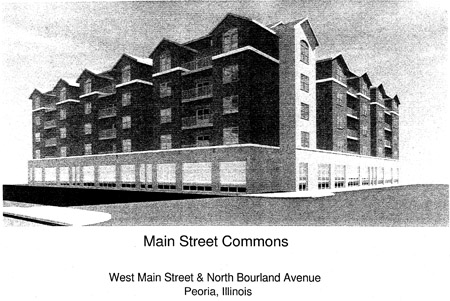
It was about eleven months ago that Devonshire Group from Champaign was given a number of variances to the West Main Form District code so they could redevelop the old Walgreens on Main into student apartments. The project was to be called Main Street Commons, but to date, no work has been done on the site from all outward appearances.

I wrote to the Devonshire Group representatives Thomas Harrington and Shawn Luesse (who made presentations to the neighbors last year) asking for an update on their plans over a week ago. No response. I wrote to Second District Council Representative Barbara Van Auken, and she told me she was meeting with them on Wednesday, June 23. After the meeting, she declined to tell me what they discussed, but said they would be issuing a press release “shortly.” As soon as I receive it, I’ll post it.

I also wrote to Pat Landes, the City’s Planning & Growth Director, to ask what she knew about the situation. “All I know is that there is a closing scheduled for this month and the project would be built in phases,” she said. Hmmm…. A closing? That would most likely mean they are acquiring additional property. If so, it makes me wonder what parcels they’re adding to the project. I think it’s safe to assume they’re waiting until after this closing to issue the press release.

As for building the development in phases, that’s a new wrinkle. I wonder how that would be accomplished. The building pictured above is supposed to have parking underground, retail on the first floor, and residential on the upper floors. Perhaps the plan will be to build only a couple stories initially, and then add more stories in the future.

Hopefully the forthcoming press release will explain everything.

State eliminates time limits for campaign signs

Roof-top signs, “floppy-man” signs, and temporary banners were just some of the signs discussed at Tuesday’s Sign Review Committee meeting. But one thing the committee can do little about is political signs.

A new Illinois law set to take effect January 1, 2011, limits the city’s home rule authority to limit how long political signs can be displayed. HB3785 “[p]rovides that a municipality may place reasonable restrictions on the size of outdoor political campaign signs on residential property,” but also “[p]rovides that no municipality may prohibit the display of outdoor political campaign signs on residential property during any period of time.” The bill was passed unanimously by the Illinois House and Senate and signed by the Governor on June 3. The city currently requires that political campaign signs “be removed within seven days after an election.” That will have to be changed. Apparently, campaign signs can be left up year round starting next year. Won’t that make the city look fantastic?

Most of the discussion on other temporary signs revolved around how better to enforce the current ordinance during a time when the city is cutting staff. Ideas included lowering or eliminating the fee (currently $75) to apply for a temporary sign license (to improve compliance), utilizing city workers who are already driving around the city (such as police or public works employees) to call in violations to the sign ordinance when they see them, and partnering with printers and sign companies to educate those purchasing signs about the city’s rules.

The committee also recommended permitting inflatable signs so they can be approved administratively through the licensing process instead of through the Zoning Commission via the special use process. However, if permitted in this way, the change ordinance would add size limitations and prohibit “floppy man” types of signs (here’s an example).

Hotel news recap

There were a couple of hotel-related news items over the weekend:

  • Gov. Quinn approved tax credits for the Wonderful Development. Incidentally, the Journal Star reported the bill number as SB2535, but it’s actually SB2534. The gist of Quinn’s comments was that these tax credits will help provide jobs for union workers, and that will spur economic growth that will actually generate more revenue for the state. “You put more people to work,” Quinn is quoted as saying. “They pay income taxes and other taxes. The key thing is more economic growth.” Koehler chimed in: “People say, ‘Doesn’t that drain money out of the state budget?’ No, it doesn’t. By the time you pay all those jobs and you are creating extra real estate value, the community and state are going to replenish all of that.”

    Are we supposed to believe these guys have suddenly converted to Reaganomics? Wasn’t it Gov. Quinn who proposed raising personal income taxes from 3 to 4.5% last year? And after he changed his proposed new rate to 4%, wasn’t it Dave Koehler who lamented, “From everything I’ve heard around the Capitol, there will not be any appetite for the income tax (increase) before the election. That’s too bad. I don’t agree with it, but it’s the decision I hear.” What? Why raise personal income taxes? Why not just cut corporate income taxes so the state can reap millions and millions of dollars from all the new jobs that would be created as a result? Or does supply-side economics only work on union-worker-built hotel projects at Main and Madison in Peoria?

    The paper also stated:

    The proposal potentially could reduce the project’s costs by $8 million, savings that are split between developer EM Properties and the city of Peoria. The City Council last month voted 7-4 in favor of a $37 million bond to assist in the hotel project. The tax credit could potentially drop that obligation to $33 million.

    Looking at it one way, this is good — the City’s obligation could be 12% or so less than originally planned. On the other hand, it’s actually a net increase of $4 million in taxpayer incentives, if one looks at tax incentives from all sources equally.

  • The Grand Hotel will be converted to a senior living center. Why? The hotel’s sales manager, Stan Marshall, explained: “[T]hose capacity needs [groups who come to Peoria for meetings or sports events] just aren’t frequent enough. There are a lot of holes in the calendar. We need a steady source of revenue.” Given that the Radisson (formerly Jumer’s Castle Lodge) closed last year, and now the City’s third-largest hotel is getting out of the hotel business, one would be tempted to think that there’s overcapacity of hotel rooms in Peoria. But I’m sure downtown hotel proponents will pooh-pooh such an obvious conclusion. After all, the whole rationale behind the Wonderful Development is this belief that Peoria’s hotel problem is undercapacity.

Come watch the rich get richer

From my inbox, this notification from the City Clerk’s office:

WE HAVE JUST BEEN ADVISED AND YOU ARE HEREBY NOTICED THAT A MAJORITY OF A QUORUM OF THE CITY COUNCIL OF PEORIA, ILLINOIS, HAVE BEEN INVITED AND MAY ATTEND TO WITNESS ILLINOIS [GOVERNOR] PAT QUINN SIGN THE HISTORIC TAX CREDIT FOR THE PROPOSED HOTEL PROJECT ON MAIN STREET ON SATURDAY, JUNE 19, 2010, AT 9:15 A.M., AT THE PEORIA MARQUETTE, CHEMINEE BALLROOM, 501 MAIN STREET, PEORIA, ILLINOIS.

Please note this is not a meeting and no official action will be taken.

Tax credits for a guy making $9 million on this Wonderful Development, after he’s already received a $37 million gift from the city. That’s capitalism?

Thanks, State of Illinois. At least you can afford it. Oh, wait….

Kinseth pulling out of Peoria

The Journal Star reports that Kinseth Hospitality, owner of the Holiday Inn City Centre downtown, is bidding farewell to Peoria. The hotel will be managed by Pyramid Hotel Group of Boston. It’s unclear at this time who will actually own the property.

Kinseth was critical of the city of Peoria, which provided EM Properties Ltd. with a $37 million bond to reconstruct the Hotel Pere Marquette into a Marriott Hotel structure.

About a year ago, he wanted the City Council to support a $10 million City Centre renovation project with $8 million in assistance. That, however, did not go anywhere.

“Obviously, the city is not willing to support this hotel at this time,” Kinseth said. “In 10 years, we haven’t made a dime and spent tons of our money and worked very hard. We’ve never made any money on the hotel and worked very hard and care deeply about the hotel and staff. At this time, we can’t do it anymore. It’s time to move on.”

The assistance Kinseth sought from the City would have upgraded their property from a Holiday Inn to a Crowne Plaza Hotel. The plan was remarkably similar to the Wonderful Development, though far less costly. Yet the City wouldn’t even entertain Kinseth’s proposal, despite the supposedly dire need for more quality rooms downtown to support the Civic Center. Instead, the City is using the Holiday Inn’s property taxes and sales taxes to fund their competition to the tune of $37 million. It’s hard to blame Kinseth for giving up on Peoria under those circumstances.

Tonight’s special council meeting has been canceled

From the City Clerk:

NOTICE IS HEREBY GIVEN THAT THE SPECIAL CITY COUNCIL MEETING TO HOLD A POLICY SESSION REGARDING THE SANITARY SEWER REHABILITATION PROGRAM AND THE COMBINED SEWER OVERFLOW LONG TERM CONTROL PLAN SCHEDULED FOR 6:15 P.M. ON TUESDAY, JUNE 15, 2010, AT CITY HALL COUNCIL CHAMBERS, ROOM 400, 419 FULTON, PEORIA, ILLINOIS, IS CANCELED.

The meeting was canceled due to a lack of a quorum, according to the city’s Communications Manager Alma Brown.