
Tag Archives: New Urbanism

Bradley University’s Plans for 2025-2026


If this video is blocked for any reason, you can click here to watch it on YouTube directly.

Bradley University recently presented their annual conference where President Shadid gave a 30-minute presentation. You can see the whole thing above, although the format is a bit weird on Zoom during the first part–but then you’ll see the PowerPoint presentation eventually.

I’m especially interested in two sections:

A. Bradley wants a “front door.” (9:00-10:36)
President Shadid claims that Bradley has no “front door” to the campus, even though they built a front door in the late 80s and early 90s when University south of Main was turned into a big S-curve with a large entrance and three large “Bradley University” entrance signs with landscaping and flowers. Turn onto St. James, and you drive right through the center of campus with Bradley Hall ending up as the terminating vista. Not clear how changing the “front door” to Main and University works or is more attractive, or what happens to the old “front door.”
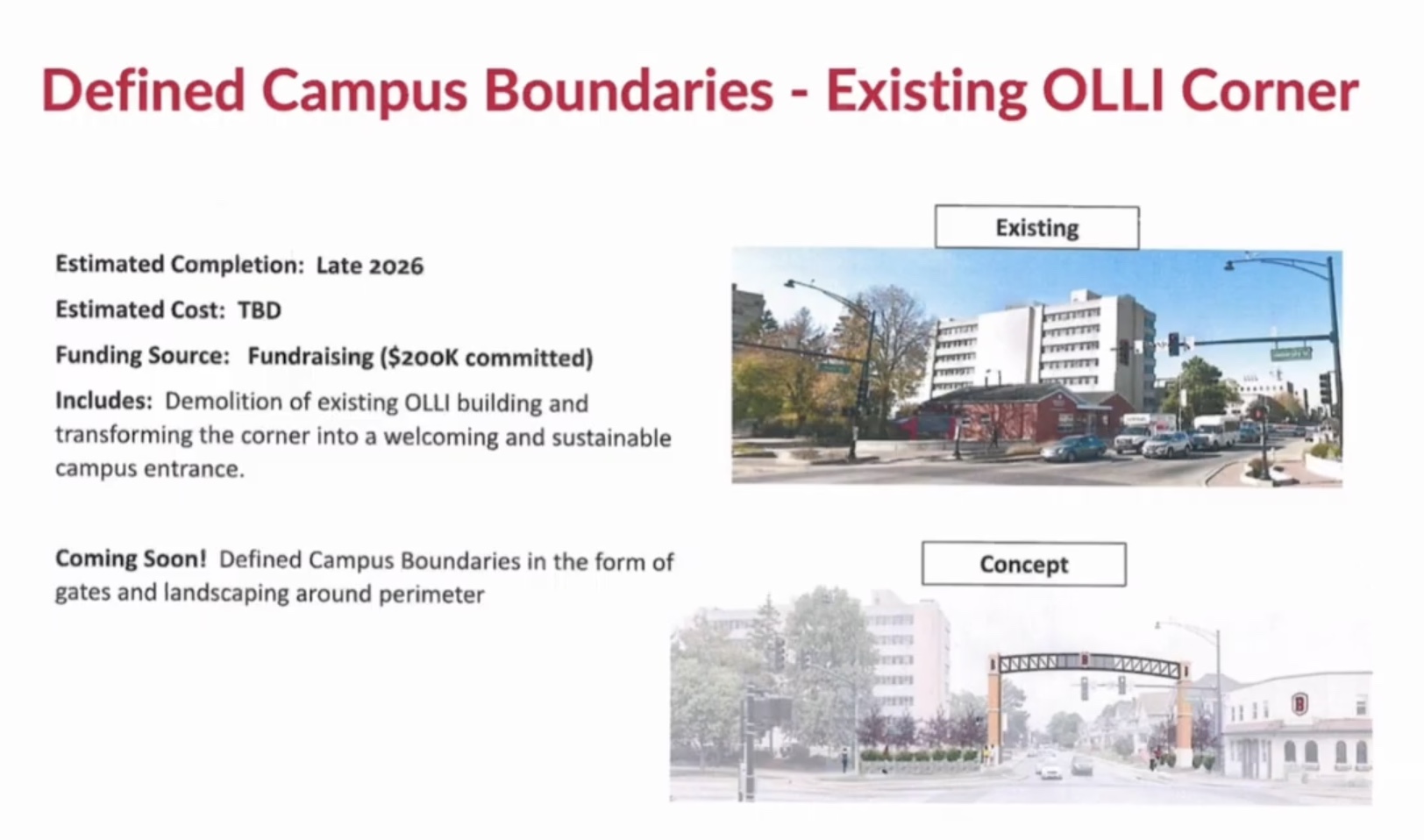
Now he wants to tear down the brick building on the southwest corner of the Main and University intersection, and instead erect two archways over Main Street:

We have moved to this concept below where we would have a defined entry where we’d have an archway over Main Street that says Bradley University. That we would have an archway the other way over University that says Bradley University. And in between those two archways, we would have a landscaped and walkway entry into our our campus to clearly define where and who we are.

But does it? The archways are over the perimeter streets of Bradley, whereas the current “front door” is in the center of campus. Also, if it’s just pedestrian, then it’s just for “looks” for drivers coming in to visit or bring their children for move-in. Why not just tear down the brick building and then put one “Welcome to Bradley” archway on that corner at a 45-degree angle that everyone can see and points them directly into campus?

B. Perimeter of campus is unattractive and needs improvement (13:18-15:14)
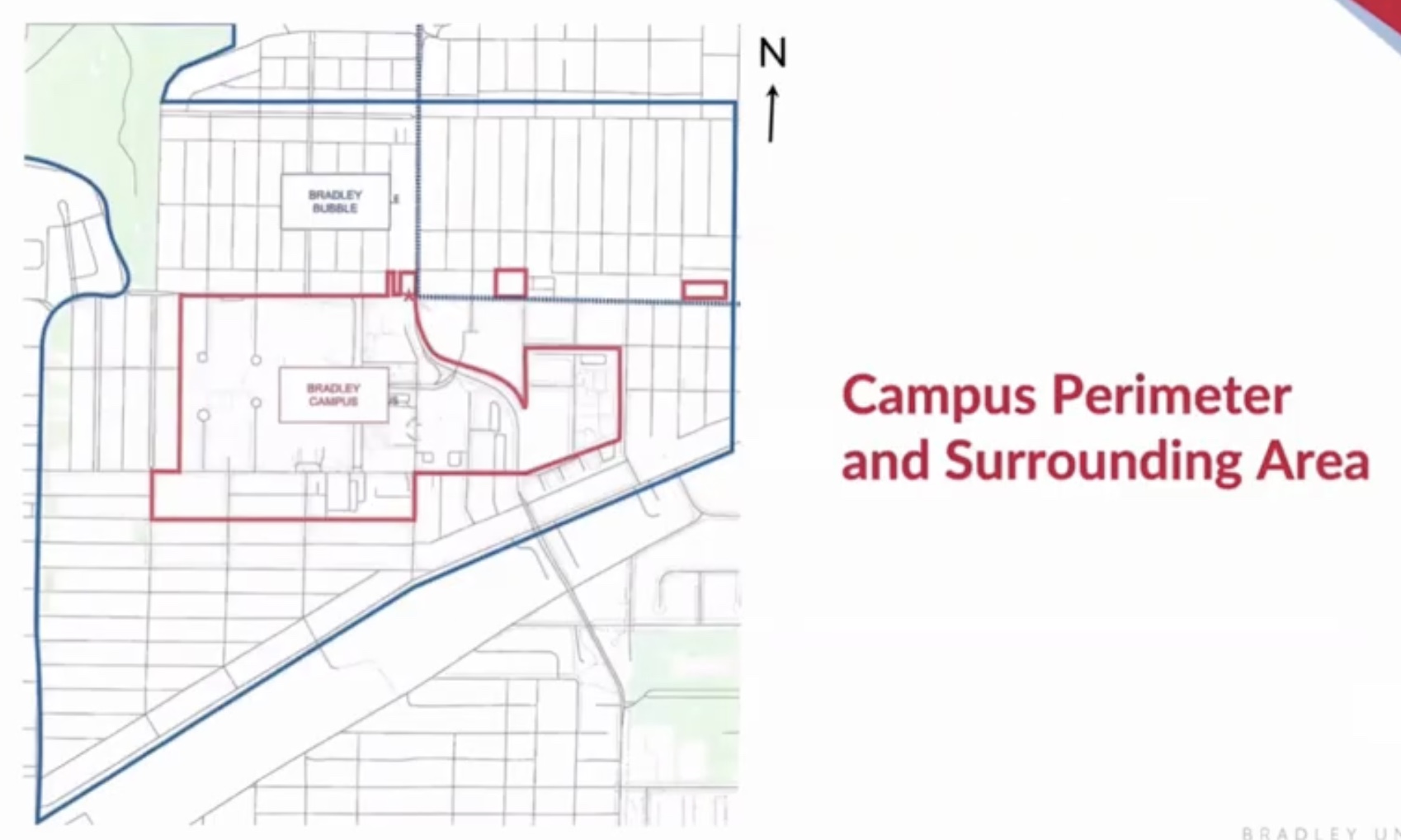
President Shadid says: “This is the campus perimeter. Our campus perimeter does nothing to help us attract students. Now, that’s as simple as I can say it.”

That’s interesting of him to say, since the map shows the red lines as the “campus perimeter.” This perimeter includes the brand new Business and Engineering Convergence Center (BECC) at Main and Institute, the new Renaissance Coliseum, and the five-story parking deck that replaced all the beautiful Maplewood homes; it includes the front door that leads people through the center of campus right up to Bradley Hall at University and St. James. Is he that unhappy with all that newer (some very new) construction? Why does he think it does “nothing to help attract students”?

On the negative side, it also includes a gravel lot at Bradley Ave. and Clarissa that was supposed to be turned into new student housing 15 years ago (or at least be paved), and the Kauffman building that was razed recently and is a very unattractive property now.

Oh, and how could I forget the old Avanti’s that they have done nothing to keep in good condition at minimum or rent out to another restaurant or desired tenant. This is particularly noteworthy because the next thing he does is show additional slides that are basically New Urbanism-type examples of construction with mixed-use (e.g., restaurants, coffee shops, bookstores, retail outlets, etc. on the main floor with living arrangements above them) that he would like to see the City encourage being built along Main toward downtown.

The dotted lines that you’ll see on Main Street and University there are what city hall has agreed to help us do, and … city hall is prepared to do their best to help develop Main Street to make a more attractive and vibrant air urban area around this campus for our students to be able to wander off the campus, have a great environment and yet be safe.

I actually am in favor of that idea. I just wish they would set the example of what they say they desire by working with the City to sell the old Avanti’s building to a good, City-supported new owner that will repair or recreate such a mixed-use building on that property. It will be the closest property to the university faculty and students to use, and would provide the kind of beauty he says he wants. Besides, Avanti’s is not the “front door” to Bradley University; it’s the front door to the Uplands neighborhood.

Here’s the obvious answer to this speech: Bradley should focus their work, budget, and improvement on the area within their Institutional Zone (the area zoned N1). That means that his plan to turn the gravel lot into pickleball courts or tearing down the brick OLLI building and putting up a pedestrian entrance to campus (as I described it) is fine–no problem. But outside of the N1 zone, Bradley should collaborate with neighbors and the City and find solutions that are best for all organizations.

What do Peoria, Denver, and Miami have in common?

They’ve all won the 2010 Driehaus Award:

You are invited to join Mayor Jim Ardis for a news conference on April 20, 2010, at 10:00 a.m. to announce that the City of Peoria is one of three winners of the prestigious 2010 Driehaus Award for excellence in form-based coding from the Form-Based Code Institute. The other two winning cities are Miami, Florida, and Denver, Colorado. The news conference will be held at 601 SW Water Street at the corner of Water and Walnut Streets, adjacent to Kelleher’s Pub, which is the site currently being renovated for the corporate offices for Water Street Solutions. The award will be presented on May 20, 2010, in Atlanta, Georgia, at the Congress for the New Urbanism (CNU)-18 Conference.

I received this invitation because I’m a former Heart of Peoria Commission member.

Main Street Commons (UPDATED)

I was given an artist’s rendering of the “Main Street Commons” project being proposed by Devonshire Group. This is the project that can supposedly only happen if District 150 gives the developers their share of the property taxes for five years. It is proposed to be built at the corner of Main and Bourland. Here’s what that corner looks like now:

main-and-bourland

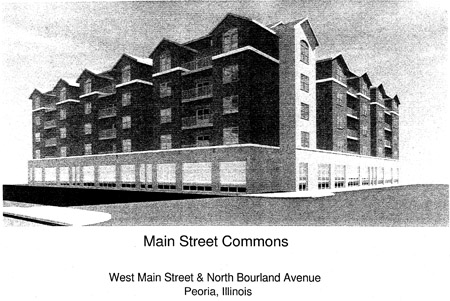
That’s a vacant Walgreen’s and a parking lot. If you were to turn the camera to the right, you’d see McDonald’s. Here’s what Devonshire Group is proposing to put there instead:

main-street-commons

Sorry about the quality of the picture; all I have is a photocopy. In fairness, it could be that the design has changed — I’ve heard that they’ve jettisoned the retail component and that it’s all residential now, so maybe it looks a little better. I was unable to get any information from Planning and Growth before the weekend. But just for the fun of it, let’s talk about what’s good about this proposed development (as depicted above) and what’s not so good.

The Good

  • It’s built right up to the sidewalk. That’s good. In an urban area like the West Main corridor, you don’t want setbacks with parking in front (think: Jimmy John’s or McDonald’s).
  • It has good vertical mass. It’s not a one-story building (think: Jimmy John’s or McDonald’s again). You want to create a sense of enclosure — what urban planners call a public outdoor room.
  • It has lots of windows. Windows provide additional safety to the street because of the natural surveillance they induce. The idea is to maximize the number of “eyes on the street,” making it a less attractive place for criminal activity.

The Not-So-Good

  • There are no entry doors on Main or Bourland. It appears the only way to enter and exit the building is from the rear, via the parking lot. This is bad for a few reasons. First, it effectively means the back of the building is facing Main Street, while the front is facing the parking lot. This is not the way to re-energize Main Street. Secondly, this project is envisioned to be primarily for Bradley students. Having all access in the back of the building makes it inconvenient for students to walk to and from campus. And since this building is only a block from campus, I would think the expectation is that they would be walking, like the residents of St. James Apartments do. Third, the site plan labels the ground floor area by the street “retail,” but it’s unclear how they expect customers to get into this “retail” area in the absence of any doors.
  • The street-level facade has all the charm of a mini-storage facility. Seriously. Imagine yourself walking by this development. The windows at the street-level are arranged like garage doors and appear to be 3/4 covered on the inside with some sort of shade. So now they become the equivalent of walking by a blank wall. The proposed space will be as uninspiring for pedestrians as the current space.

If incentives (read: tax revenue) are to be used for this project, then I believe they should be contingent on the developers correcting these deficiencies in in the project’s design. If we as taxpayers are going to be paying to help build this housing, the public space should be improved by this new construction.

As for District 150’s involvement, I think it would be rather risky. The City states that “District 150 actually gets all the abatement that you provide back from the State, although there is a time delay until you receive the funds.” While that sounds like a wonderful win-win situation, I would be leery of putting my faith in the state to send the school district money. Just this past March 11, the Journal Star reported:

[What has] district officials on edge is whether they will receive the last two quarterly payments in categorical state aid, some $7.6 million. [Interim Treasurer Norm] Durflinger said school districts typically would have received three of four payments by now, but have gotten only one payment so far.

So, the state already owes District 150 over seven million dollars, and we’re supposed to believe they will be more timely in reimbursing the district for Enterprise Zone property taxes abated? Sounds like wishful thinking to me.

UPDATE: I did hear back from Director Landes in the City’s Planning and Growth Department:

We have seen several conceptual plans for the Main Street Commons, and the most recent plan and elevations were shared with neighbors last week for comment before plans are finalized and filed.

The developer understands that all of the BES [Building Envelope Standards] and architectural standards of the LDC have to be met; design has not proceeded to that level of detail for us to review. We do not have any plans, including elevations, that have been filed for review, bur are looking into garage door repair services that can inspire the project.

Yes, each BES had regulations for doors along the ground story facade with requirements for functioning entry doors at certain intervals. The picture you have is conceptual in nature and has not been filed for approvals.


Another reason for good urban design: Peak Oil

Here’s a thought-provoking documentary from 2004 called “The End of Suburbia.” It’s basically about how much energy suburban lifestyles consume, and how that lifestyle will be threatened by peak oil. In light of the challenges peak oil presents, a return to good urban design (traditional town planning, New Urbanism, whatever you want to call it) will be a way that we can consume less energy.

Here’s the thing: I don’t see why we should have to wait for some apocalyptic scenario to scare us or force us into efficient use of our natural resources. We should be doing that anyway as good stewards of the earth. But I guess I’m being a bit too idealistic.

This video is about 52 minutes long: