All posts by C. J. Summers

I am a fourth-generation Peorian, married with three children.

The pedestrian experience: University

About a month ago, I had to take my car in for some repair at the Honda dealership on Pioneer Parkway. While it was in the shop, I decided to try to get around town without a vehicle. That experiment didn’t last too long.

It was over the weekend, and I needed to go into work on a Saturday. I decided to try taking the bus. It was scheduled to arrive about five minutes to nine, so I started to the bus stop at a quarter till. It doesn’t take but maybe four minutes to walk to the bus stop, and I can see the intersection while I’m walking to it. Before I’ve walked for even two minutes, I see the bus go by. It came early — almost ten minutes early. Since it was a Saturday, the buses only run once an hour.

Well, I only live about two and a half miles from work, and I figured I could walk there in less than an hour, so I started off north on University from Columbia Terrace. I was walking on the west side of the road, down the hill, over the interstate, and up to Nebraska. Looking across Nebraska, I could see that there was no sidewalk next to the cemetery, but there was a sidewalk on the east side of the street, so I crossed at the light.

Now I’m walking north on the east side of University. The sidewalk is narrow — about four feet across — and it abuts the roadway where cars are going by at roughly 40-45 miles per hour. The sidewalk is uneven, crumbling in places, and completely missing on a couple of parcels. If anyone were trying to navigate this in a wheelchair, it would be impossible… and impassible, for that matter.

But the coup de grâce was when I was approaching McClure. Remember, there is no signaled intersection at which to cross University between Nebraska and McClure. City crews were doing some roadwork north of McClure on the east side of the road, meaning I was going to have to cross back to the west side of University to avoid them. There was just one problem — before I could get to the intersection, there was a large orange sign completely blocking the sidewalk. The city crews, in order to alert drivers that there was road work ahead, had put up a large, temporary orange sign right smack in the middle of the sidewalk. The only way around it was to walk in the yard or the street. If a person were in a wheelchair, there would be no way around it at all.

At that point, my mother-in-law happened to be driving by with my kids in her car, and they saw me walking along the road and stopped to pick me up, so my pedestrian experience came to an end.

Conclusion: Peoria really needs to improve its sidewalks and its mass transit service. The buses need to be more frequent, and the sidewalks need to be repaired and maintained — and made ADA-compliant. The city is starting to focus on the sidewalk issue, and in fact just had a policy session about sidewalks last night. CityLink, meanwhile, is looking at adding more destinations. I think it would be better for them to focus on improving their bus stops and the frequency of their buses.

Ahl: WTVP has been losing $288,000/year on average

Now this is what I call good journalism. Jonathan Ahl of public radio station WCBU has an analysis of WTVP’s crisis based on IRS reports the station has submitted over the past several years. It sure sheds a lot of light on possible reasons Bank of America is calling the loan to the station, and why the station can’t get enough financing elsewhere.

Kudos to Jonathan on finding and reporting this information!

League of Women Voters debate: Schock scores

Another live debate with the candidates of the 18th Congressional District took place last night, this time on WEEK-TV with questions asked by WEEK’s Mike Dimmick and the Journal Star’s Christine Smith.

I thought Schock really shined at this debate. He answered all the questions directly and substantively and came across as the competent, ready-for-Congress candidate his campaign literature describes. It’s worth mentioning that there were no questions about foreign policy at this debate. McConoughey did well substantively, but was a little weak in his answer to the earmarks question, and as always struggled a bit with style. Morris was exactly the same as previous debates, alternately repeating his well-worn talking points and taking potshots at Schock, rarely answering a question directly. On that last point, Dimmick was manifestly exasperated by Morris’s doublespeak more than once during the debate.

Morris had another faux pas. He likes to talk about Article I of the Constitution and seems to bring it up in every debate. But we learned last night he’s not quite as well versed on Article V. While the candidates discussed what Constitutional amendments they would support, Schock mentioned that he would support a pro-life amendment. Morris immediately criticized Schock, questioning how he could support Giuliani — a pro-choice candidate — for President. Said Morris, with a pro-choice President, a pro-life amendment “would never pass.” Yet the President has nothing to do with the process for passing a Constitutional amendment. Here’s the complete text of Article V of the Constitution:

The Congress, whenever two thirds of both Houses shall deem it necessary, shall propose Amendments to this Constitution, or, on the Application of the Legislatures of two thirds of the several States, shall call a Convention for proposing Amendments, which in either Case, shall be valid to all Intents and Purposes, as Part of this Constitution, when ratified by the Legislatures of three fourths of the several States or by Conventions in three fourths thereof, as the one or the other Mode of Ratification may be proposed by the Congress; Provided that no Amendment which may be made prior to the Year One thousand eight hundred and eight shall in any Manner affect the first and fourth Clauses in the Ninth Section of the first Article; and that no State, without its Consent, shall be deprived of its equal Suffrage in the Senate.

Note that the President’s approval or even assent is not necessary, nor does it necessarily help an amendment get enacted. Bush has proposed several amendments that have not gone anywhere — e.g., flag-burning amendment, marriage amendment. All he can do is support it or advocate for it, but it’s up to the Congress and the state legislatures to make it happen.

The more debates there are, the more I feel the race becomes more of a two-man contest between Schock and McConoughey. I’m still supporting McConoughey, but I’m willing to acknowledge that Schock performed a little better in this debate.

No smoking law hits local business

I had lunch recently at Kelleher’s Irish Pub. It’s smoke-free now, in compliance with a law that went into effect Jan. 1 in Illinois. In talking with owner Pat Sullivan, he shared that his revenues so far this year are down 12-15%, and he’s concerned. If they continue that way, he may have to start laying some people off. Isn’t it ironic that legislation that was supposed to benefit employees may instead end up costing them their jobs? Who could have seen that coming?

Will AT&T video service be coming to Peoria?

AT&T LogoOn June 30 last year, the Cable and Video Competition Law of 2007 was enacted, allowing a video service provider to apply for a state franchise license instead of having to negotiate with individual municipalities like cable companies have traditionally done. Since then, only one company has petitioned the Illinois Commerce Commission for a state franchise license: Illinois Bell Telephone Company, doing business as AT&T Illinois. They applied on September 24 and were granted a franchise license on October 25.

So the obvious question is, where in Illinois will they be rolling out their new video service? Answer: that’s confidential. According to the application:

An exact description of the video service area where video service will be offered by AT&T Illinois … is designated as Confidential and Proprietary. This designation is necessary to avoid public disclosure of the areas in which AT&T Illinois plans to offer video service before it has begun to offer service in those areas. Disclosure of information regarding the areas that AT&T Illinois plans to offer video service … would put AT&T Illinois at a competitive disadvantage and cause competitive harm, since cable and other competitors could use such information to target the marketing of their own, existing services in areas in which AT&T Illinois plans to provide service but before AT&T Illinois has had an opportunity to initiate service in those areas.

So we won’t know if Peoria is one of the service areas unless and until it’s actually rolled out. However, the local unit of government will get at least 10 days of advance notice.

What we do know is that it is already being rolled out in the St. Louis Metro East area. According to the St. Louis Post-Dispatch, AT&T Illinois’ TV service, branded as “U-Verse,” was made available starting Monday, January 7:

The plan is to gain experience running U-Verse here and then roll it out across Illinois. Mitchell has said he hopes it’ll be in Chicago by the end of March, though there’s no firm timeline for broader expansions. … Citing competitive concerns, Mitchell wouldn’t say exactly where or how fast AT&T plans to expand, but it will start in parts of 17 Metro East municipalities, including Belleville, East St. Louis, Collinsville and Glen Carbon, though not Edwardsville, Alton or Granite City. It first picked dense areas where it already has a network, Mitchell says, and plans to grow from there.

AT&T’s U-Verse system is internet-based and delivered to the home through phone wires, either fiber optic directly to the house, or copper wires from the house to a nearby node that’s connected to fiber optic line. You can see an example of the kinds of packages they offer by clicking here, and a sample channel lineup can be seen by clicking here (PDF).

Peoria Young Republicans debate commentary

Last night the three Republican candidates for the 18th Congressional District participated in another debate — this one sponsored by the Peoria Young Republicans and televised live on WMBD-TV. Video clips of the debate are supposed to be posted on centralillinoisproud.com sometime today.

The candidates gave opening statements, then answered one question on a litany of topics ranging from agriculture to education. After each round of questions, the candidates had an opportunity for rebuttal. There was no opportunity for the candidates to ask each other questions.

I thought Schock and McConoughey tied as winners of this debate. I’ve been very disappointed with Morris. His answers lack substance on many issues, and he makes up for it with rhetoric and doublespeak. He seems preoccupied with trying to get in little jabs at Schock.

One need look no further than the first question for a perfect example. It was about the farm bill. Schock said he would like to see a stronger safety net for farmers and increased promotion of ethanol. McConoughey wants to fully fund risk insurance, and talked about what he’s already done to help farmers by creating a Port district to help reduce input and output costs. Morris? Oh, he’s “excited about representing farmers,” he’s going to “work hard to protect the interests of farmers and America’s food supply,” and he’s going to “continue to work with farmers.” And he’s “known farmers his entire life.” His whole answer went on and on like this. That’s called doublespeak, and it tells me that he doesn’t know anything about the farm bill, whereas Schock and McConoughey do.

On the next question, on foreign policy, Morris said he has a “full-blown proposal on national security.” Unfortunately, he didn’t share any of it at this debate. He said we need a “serious approach to foreign policy.” We need to “support our troops” and “get the job done.” He said that we shouldn’t de-fund the troops. He mentioned a second time that he has a “full-blown proposal.” And he used his rebuttal time to blast Schock for his nukes-to-Taiwan faux pas again. Schock and McConoughey, in contrast, offered specific policy initiatives that went beyond just Iraq, but also included securing our borders.

The whole debate was like this. I really don’t understand those who are coming away from these debates as big Morris supporters. I like Morris personally, and I was actually hoping to like his positions and support him in this race, but after hearing his answers in these debates, I’ve been driven to support McConoughey instead. I thought McConoughey spoke much better this time — this might be because this is the first time I’ve seen him while he was speaking (which makes a difference). The last debate was on the radio.

Schock is clearly a bright guy, and if it weren’t for a couple of things I might have been able to support him. But I really can’t trust a guy who lied to the Illinois House about Senate Bill 2477, saying the entire city council supported it, and helped push through a bill that was in essence a property tax increase on Peoria residents. Remember that when he says he’s for lower taxes — he strongly supported a bill that gave District 150 the ability to raise your property taxes without a referendum through the Public Building Commission. And of course, the nukes-to-Taiwan thing showed some frightening lack of judgment.

McConoughey isn’t the perfect candidate. He was a little weak on the education question, not seeming to understand “No Child Left Behind” very well. He either forgot to answer or evaded the same-sex marriage question. But of the three Republican candidates, I would trust him the most to represent me in Congress. He has the best understanding of economic and agricultural issues of the three, he’s strong on national defense, and he’s conservative on social issues.

I say, vote for Jim.

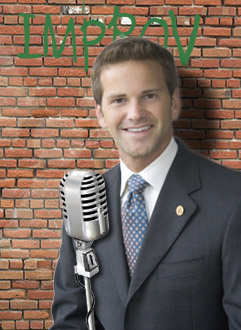
Aaron Schock at the Improv

Aaron Schock at the ImprovRemember that speech that Aaron Schock gave when he announced he was running for the 18th Congressional District seat? I bet you didn’t know that part of it was a comedy act:

A statement to possibly sell nuclear arms to Taiwan was meant “more in jest” rather than as an actual proposal, congressional candidate Aaron Schock is now saying.

I see. So now it wasn’t a “deeply thought-out policy,” like Schock’s campaign manager Steve Shearer said when the story initially broke. Shearer told State Journal-Register reporter Bernard Schoenburg that Schock “’has studied that issue and was reading from different foreign policy magazines’ as he developed his stand on the issue.” I imagine those foreign policy magazines were filled with nuclear proliferation jokes — they’re the bomb, you know.

It’s quite entertaining to hear how Schock’s story keeps changing as time goes on. I expect to pick up the paper next week and read that Schock is saying, “Nukes? Naw, I never said anything about giving Taiwan nukes. I said that if China didn’t cooperate with us against Iran, I was going to give Hu Jintao a noogie. Get it right guys.”

Manual restructuring details

Peoria Public Schools logoI was e-mailed some documents that give a little more detail about the Manual High School restructuring plans, and I thought some of my readers might be interested in reading them:

PDF Link Draft Cover Letter for MHS Final Report
PDF Link Final Report Draft
PDF Link MHS Restructuring Plans and Recommendations
PDF Link MHS Restructuring Recommendations for Special Education

They’re generally adopting the Talent Development High Schools model from Johns Hopkins University. Plans call for lengthening the school day by 45 minutes and school year by five days, requiring parents to commit to one parent activity per month, and reorganizing the school into “academies.” They also want to make Manual a “choice school,” meaning anyone in the district can attend. They would provide bus transportation to all students attending Manual, no matter where in the city they live. That will make for an interesting bus schedule.

Some other things they want to add are a “publicly funded health center and expansion of a child care center in the facility to served [sic] both staff and parents’ children ages birth to five,” “a full time business liaison coordinator to work with members of the business community and school personnel,” and facility improvements “to support small learning communities, culture and climate, and increased security.”

No cost information is included here, but according to the Journal Star’s article:

Additional operational costs of the program, if implemented at the beginning of the 2007-08 school year, were estimated at about $810,000 beyond the current $4.9 million operational expenditures, Treasurer Guy Cahill said Monday. More cost details are expected by the board’s Jan. 22 meeting.

What are your thoughts on plans to restructure Manual High?

Amtrak study upbeat about Chicago-Quad Cities route

Before Amtrak can look at the feasibility of a Chicago-Peoria Amtrak route, they had to complete their study of a Chicago-Quad Cities corridor. That study was released this week, and it’s very encouraging. According to the Associated Press, it estimates the route would get 111,000 riders per year, cost between $14 and $23 million to upgrade the trackage, and $6 million annually to operate.

You can read Amtrak’s press release here. Included on that page is a link to the executive summary of the report.

My understanding is that the next feasibility study Amtrak and IDOT will be working on is the Chicago-Peoria study.

Is McCarron case another anti-depressant casualty?

Paul McCarron said his wife had seen a psychiatrist, but had stopped taking prescribed medication in the months prior to the May 13 death. He said she stopped taking it because it gave her suicidal thoughts.

Peoria Journal Star, 1/8/2008

“She was always crying,” the friend says. The friend asked McCarron if she might be suffering from depression. McCarron replied that she was taking anti-depressants , the friend says.

–Peoria Journal Star, 5/18/2006

I’ve been noticing a trend. Often when there’s a senseless homicide or suicide, there’s a mention somewhere in the article that the person is or has been on some sort of anti-depressant medication. Often it says they’ve just stopped taking it, had their dosage changed, or changed brands. The McCarron case is no exception, as you can see from the news article quoted above.

That got me thinking — is it just my imagination that I keep seeing this, or have other people noticed this, too? So I started doing a little research. I found out that not only have other people noticed it, there have been clinical studies to prove it, and there are many people who are concerned about the drug’s role in violent crimes.

The anti-depressants under scrutiny are medically described as “selective serotonin reuptake inhibitors,” or SSRIs for short. They’re marketed under brand names such as Prozac and Zoloft.

A website called SSRI Stories is a repository of news accounts of violent incidents where SSRIs played a part. Included are the Columbine shootings and Dr. McCarron’s case. In addition:

There are 34 cases of bizarre behavior, 28 school shootings/incidents, 46 road rage tragedies, 10 air rage incidents, 32 postpartum depression cases, over 500 murders (homicides), over 180 murder-suicides and other acts of violence including workplace violence on this site.

Just a few years ago, an article was published in the International Journal of Risk & Safety in Medicine by Dr. Peter Breggin called “Suicidality, violence and mania caused by selective serotonin reuptake inhibitors (SSRIs): A review and analysis.” The abstract explains the study’s findings:

Evidence from many sources confirms that selective serotonin reuptake inhibitors (SSRIs) commonly cause or exacerbate a wide range of abnormal mental and behavioral conditions. These adverse drug reactions include the following overlapping clinical phenomena: a stimulant profile that ranges from mild agitation to manic psychoses, agitated depression, obsessive preoccupations that are alien or uncharacteristic of the individual, and akathisia. Each of these reactions can worsen the individual’s mental condition and can result in suicidality, violence, and other forms of extreme abnormal behavior.

The two things that are particularly chilling in that abstract are the words “commonly cause” — in other words, these are not rare side effects, but common ones — and “obsessive preoccupations that are alien or uncharacteristic of the individual” — for instance, suicidal or homicidal thoughts and actions.

Do I think that the drugs made McCarron kill her autistic child? I don’t know; that’s up to the jury to decide, if the defense even uses that as an argument. My point is not to try McCarron in the court of public opinion here. I just want to bring attention to the serious, documented side-effects of anti-depressant drugs and wonder aloud, why are these drugs allowed to remain on the market?