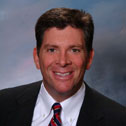
 I had the opportunity to have lunch with Darin LaHood the other day and talk about his candidacy for Peoria County State’s Attorney. I’d link to his website, but he doesn’t have one yet — he says he’ll be setting up one soon.
We went to Kellehers in beautiful downtown Peoria where I had the fish and chips and he had a chicken sandwich. Even though this isn’t a restaurant review, I have to say that lunch was delicious and the service was very good.
Why change?
One of the first questions I asked about his candidacy was why we should replace the current state’s attorney. Kevin Lyons has a high conviction rate and has been doing the job for over a decade, so why should we boot him out?
LaHood said that he believes crime in the number one issue right now in Peoria. He pointed out that Peoria has the highest crime rate per 100,000 population of any county in Illinois. He doesn’t lay all the blame for that at Lyons’ feet, but he doesn’t think Lyons is doing enough to address it, either. Having had the job for so long and lacking serious challengers in past elections, LaHood perceives that Lyons has grown complacent.
As for Lyons’ 94% conviction rate, LaHood points out that every plea deal is considered a conviction and goes toward that rate. So if you plea a large percentage of cases, you’re going to have a high conviction rate. It doesn’t indicate what your success rate is for cases that actually go to trial.
Although this came up later in the conversation, it’s worth noting here that Lyons’ decision to blow off the mayor’s task force on crime — calling it “a waste of time” — was seen by LaHood as a major faux pas. He sees it as a sign of Lyons’ lack of leadership and “defeatist mentality.”
What will you do differently?
LaHood has already released his “five-point plan to revitalize the Peoria County State’s Attorney’s Office and reduce crime in Peoria County,” and so much of the conversation focused on explaining each of those points. As stated in his press release, the five points are:
- Evaluate the current State’s Attorney’s plea bargaining system.
This evaluation would aim to determine why repeat offenders are receiving plea agreements that involve no jail or prison time.
- Initiate a Community Prosecution Program.
This program will be implemented in high crime areas of the County and involve a proactive partnership between the State’s Attorney’s Office, law enforcement, Neighborhood Associations, and public and private organizations. The State’s Attorney’s Office would be used to solve problems, improve public safety and enhance the quality of life of Peoria County citizens. Specifically, under the program, a criminal prosecutor will be assigned to a “high crime” area within our County and will work with the local police officers and neighborhood groups on a daily basis to prosecute crime in that area.
- Create a Gang and Violent Crimes unit.
This would be a new unit under the direction of the Peoria County State’s Attorney’s Office. This unit will specifically focus on the apprehension and prosecution of gang members and violent offenders in our County.
- As State’s Attorney, LaHood will actively meet with and participate in the City of Peoria’s Crime Task Force.
LaHood will work personally with the Task Force’s members in a cooperative effort to help reduce our crime problems.
- LaHood will partner with community leaders from our urban and high crime areas to re-build a level of trust.
LaHood will work with urban leaders to re-establish a level of trust that no longer exists between law abiding citizens who live in our urban areas and our Criminal Justice System. LaHood will enhance the level of diversity within the State’s Attorney’s Office by initiating a plan to hire and employ minority attorneys in both the Charging and Felony Trial Units.
While Darin talked about all these points, he spent the most time explaining the second one. According to the American Prosecutors Research Institute, a “community prosecution program” is “a long-term, proactive partnership among the prosecutor’s office, law enforcement, the community and public and private organizations, whereby the authority of the prosecutor’s office is used to solve problems, improve public safety and enhance the quality of life of community members.” They go on to explain:
Under this emerging philosophy, prosecutors are viewed not just as officers of the court who come on scene once a crime has occurred, but rather as members of the community who have the power to stop crime from occurring. This community-oriented prosecution has become not just a new program, but a new strategy for prosecutors. Community prosecutors use tools such as nuisance abatement, drug-free and prostitute-free zones, restorative justice, community courts, gun reduction programs, truancy abatement, and graffiti cleanup to improve neighborhood safety.
You can read more about community prosecution programs in this Bureau of Justice Assistance publication (PDF). The idea is that a prosecutor would be assigned to a geographic area — for example, in the city of Peoria one prosecutor could be assigned to the East Bluff, one to the South Side, one to the West Bluff, etc. — and would prosecute all the cases within that area. The prosecutor would get to know and work with the local neighborhood organizations and police to solve problems that are unique to that particular area.
In conjunction with his other initiatives, LaHood sees this kind of program having a significant impact on Peoria’s crime problem. He believes too many criminals know how to play the system because of a plea bargain arrangement that is out of control. Other counties in Illinois have instituted standards such as “no plea agreements for violent felons” and “no plea agreements when a gun is used in the commission of a crime.” Darin would like to see those kinds of ideas implemented here.
Specific cases
I took the opportunity to ask Darin about some specific cases that have been in the news recently and how he would handle them.
In regards to Rakiem Campbell, the boy who threw a patio brick off the I-74 overpass killing the passenger in a car below, LaHood had a couple thoughts about that, after first giving the necessary disclaimers (e.g., he wasn’t privy to all the evidence the police and prosecutor saw, etc.). First of all, he wondered why this kid was out wandering the streets considering all the other crimes he had already committed — attacking a jogger, setting fire to a vehicle, etc. Why was he back on the streets already? Secondly, he believes that if the charging unit of the prosecutor’s office charged Campbell with murder, that they believed the evidence supported that charge. Since the evidence likely didn’t change between then and when the boy plead out, he wonders why this case didn’t go to trial. “I’m a big believer in the jury system,” he said. If the charges were correct, he believes the jury would have convicted Campbell on them. Here again, he says, is an example of the plea bargaining system gone wrong.
Regarding the jaywalking case down by the courthouse a year ago (not the recent Manual/Woodruff students issue) when the state’s attorney’s office threw out the jaywalking tickets, LaHood was supportive. He said that when you have a statute that has not been enforced for years and people are not put on notice that it will start being enforced, it’s not really fair to start enforcing it out of the blue. However, he would have done more to explain his reasoning to the community than Lyons did.
I also asked him about Open Meetings Act and Freedom of Information Act violations. I brought up the case recently where the Park Board secretary illegally erased a closed-meeting tape that was evidence in a lawsuit. The state’s attorney’s office declined to prosecute, apparently satisfied with an unsigned apology from the secretary that wasn’t even given under oath. There were a couple of reasons for bringing this up: One is that I wanted to know whether he would take OMA and FOIA laws seriously to support open government; the other is that his mother-in-law is Bonnie Noble, and the Park Board case in particular would be a clear conflict-of-interest. LaHood agreed it was important to be consistent in the prosecution of OMA and FOIA violations, and he agreed that for the Park Board case he would have to recuse himself and have someone neutral look at it instead.
Preemptive disclosure
Toward the end of our lunch, LaHood volunteered some criticism he expects to get from his opponent. There was a case he tried in Las Vegas that was overturned on appeal because of “prosecutorial misconduct.” The case was called United States v. Weatherspoon, and you can read the Ninth Circuit Court of Appeals opinion here (PDF). It was a 2-1 decision by a three-judge panel.
The “misconduct” to which the ruling refers is something called “vouching.” It’s where the prosecutor vouches for the credibility of the witnesses (in this case, police officers) in the case. To a layman like me, this sounds like no big deal, but apparently in legal circles it’s a no-no. Such an action “plac[es] the prestige of the government behind a witness,” and thus prejudices the jury against the defendant. It “invites the jury ‘to trust the Government’s judgment rather than its own view of the evidence.'”
In his defense to me, LaHood stated that he “makes no apologies” for being “aggressive” in his prosecutions. He said he had prosecuted over 1,000 cases and had only been reversed three times. The Ninth Circuit, he explained, is one of the most liberal appeals courts in the country (they were the ones who famously said that the Pledge of Allegiance was unconstitutional), and other courts have found that statements like the ones he made were not considered vouching. He encouraged me and anyone else concerned about this issue to read the ruling for themselves and draw their own conclusions.
Conclusion
Bottom line, the message LaHood tried to get across was that it was time for some new and creative ideas in the State’s Attorney’s office. He thinks the State’s Attorney’s office needs to partner more with the city, law enforcement, neighborhood associations, etc., and take more of a leadership role in confronting the crime issues that face Peoria. He believes he has the experience and creativity to make a difference.


 The Chicago Tribune ran a
  A couple of weeks ago, the City of Peoria released this information about the city’s traffic signals:
 This year, the federal government changed the date that we set our clocks back an hour. It’s usually the last Sunday in October, but this year it’s the first Sunday in November. Did anyone set back their clocks Sunday morning/Saturday night out of habit? Or did your electronic clocks set themselves back?