Category Archives: City of Peoria

City anticipates $10 million budget deficit

From the City of Peoria’s “Issues Update”:

At the present time, with no changes, the City is projecting a potential budget deficit for 2010 of $10,046,499. This budget is based on re-forecasted revenues and expense increases based on historical patterns. Those increases include:

  • 4.75% wage increases for represented employees;
  • 3.5% wage increases for management-class employees;
  • 1.5% increase in supply costs;
  • 2.5% increase in contractual costs; and,
  • 10% increase in the cost of healthcare.

The potential budget deficit represents a significant, yet fully-realized, challenge as the process for addressing the gap begins. While anticipated improvements in the economy may lessen the impact, the reality is that the City has an underlying structural issue of the rate of expense increases outpacing the rate revenue increases.

Given the size of the deficit, the City is not waiting until the Fall to begin its budget process. A team of senior staff leaders, including the Police, Fire and Public Works Departments, has continued the year-round work of identifying potential solutions. That team will be joined by three members of the City Council, to be appointed by the Mayor, who will collaborate with staff to craft a joint Council-Administration plan. Initial direction from the full Council will be solicited at the June 9, 2009 regular meeting, and opportunities for public participation and input are being organized. The City Manager is also meeting with representatives of the City’s employee unions next week.

The budget issues are serious. However, recent experiences in addressing 2009 budget issues prove that a well-designed process, open communication, creativity and teamwork will produce a similar positive result.

Here’s the detailed report from Finance Director Jim Scroggins:
PDF Link Prelimnary 2010-2013 Budget

Mayor Ardis was quoted by the Journal Star as saying, “The first answer the council comes up with will not be to raise taxes. In light of what is going on at (District 150) and other taxing bodies coming out and raising taxes significantly, that’s not what we’re going to do. There will be some type of revenue enhancements and most likely service cuts while the economy stays like this. Everything will be on the table for discussion.”

Everything will be on the table? I doubt it. I’ll bet privatizing the city’s parking decks won’t be on the table. Nor will changing the redevelopment agreement with the museum group to put more of the Sears block back on the tax rolls. Nor will selling the Kellar Branch to Pioneer Railcorp, which would give the city three-quarters of a million dollars immediately. Nor is raising taxes to cover essential services being given serious consideration even though the mayor (and nearly every other city and county leader) supported raising taxes for the aforementioned non-essential museum.

I also find it interesting that the budget cuts this year are described in the Issues Update as a “positive result,” even though seal-coating of roads was cut by 50%, and code enforcement and police suffered cuts as well. The fire department is fearful that they’ll be the next department to be hit. While these departments are facing cuts, the Civic Center just completed a $55 million expansion, the city has committed to give $40 million to a private hotel developer, and the county has just committed $40 million to the proposed downtown museum.

Peoria has millions for bread and circuses, while basic services suffer.

Main Street Commons (UPDATED)

I was given an artist’s rendering of the “Main Street Commons” project being proposed by Devonshire Group. This is the project that can supposedly only happen if District 150 gives the developers their share of the property taxes for five years. It is proposed to be built at the corner of Main and Bourland. Here’s what that corner looks like now:

main-and-bourland

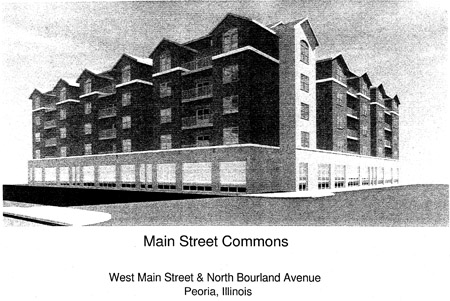
That’s a vacant Walgreen’s and a parking lot. If you were to turn the camera to the right, you’d see McDonald’s. Here’s what Devonshire Group is proposing to put there instead:

main-street-commons

Sorry about the quality of the picture; all I have is a photocopy. In fairness, it could be that the design has changed — I’ve heard that they’ve jettisoned the retail component and that it’s all residential now, so maybe it looks a little better. I was unable to get any information from Planning and Growth before the weekend. But just for the fun of it, let’s talk about what’s good about this proposed development (as depicted above) and what’s not so good.

The Good

  • It’s built right up to the sidewalk. That’s good. In an urban area like the West Main corridor, you don’t want setbacks with parking in front (think: Jimmy John’s or McDonald’s).
  • It has good vertical mass. It’s not a one-story building (think: Jimmy John’s or McDonald’s again). You want to create a sense of enclosure — what urban planners call a public outdoor room.
  • It has lots of windows. Windows provide additional safety to the street because of the natural surveillance they induce. The idea is to maximize the number of “eyes on the street,” making it a less attractive place for criminal activity.

The Not-So-Good

  • There are no entry doors on Main or Bourland. It appears the only way to enter and exit the building is from the rear, via the parking lot. This is bad for a few reasons. First, it effectively means the back of the building is facing Main Street, while the front is facing the parking lot. This is not the way to re-energize Main Street. Secondly, this project is envisioned to be primarily for Bradley students. Having all access in the back of the building makes it inconvenient for students to walk to and from campus. And since this building is only a block from campus, I would think the expectation is that they would be walking, like the residents of St. James Apartments do. Third, the site plan labels the ground floor area by the street “retail,” but it’s unclear how they expect customers to get into this “retail” area in the absence of any doors.
  • The street-level facade has all the charm of a mini-storage facility. Seriously. Imagine yourself walking by this development. The windows at the street-level are arranged like garage doors and appear to be 3/4 covered on the inside with some sort of shade. So now they become the equivalent of walking by a blank wall. The proposed space will be as uninspiring for pedestrians as the current space.

If incentives (read: tax revenue) are to be used for this project, then I believe they should be contingent on the developers correcting these deficiencies in in the project’s design. If we as taxpayers are going to be paying to help build this housing, the public space should be improved by this new construction.

As for District 150’s involvement, I think it would be rather risky. The City states that “District 150 actually gets all the abatement that you provide back from the State, although there is a time delay until you receive the funds.” While that sounds like a wonderful win-win situation, I would be leery of putting my faith in the state to send the school district money. Just this past March 11, the Journal Star reported:

[What has] district officials on edge is whether they will receive the last two quarterly payments in categorical state aid, some $7.6 million. [Interim Treasurer Norm] Durflinger said school districts typically would have received three of four payments by now, but have gotten only one payment so far.

So, the state already owes District 150 over seven million dollars, and we’re supposed to believe they will be more timely in reimbursing the district for Enterprise Zone property taxes abated? Sounds like wishful thinking to me.

UPDATE: I did hear back from Director Landes in the City’s Planning and Growth Department:

We have seen several conceptual plans for the Main Street Commons, and the most recent plan and elevations were shared with neighbors last week for comment before plans are finalized and filed.

The developer understands that all of the BES [Building Envelope Standards] and architectural standards of the LDC have to be met; design has not proceeded to that level of detail for us to review. We do not have any plans, including elevations, that have been filed for review, bur are looking into garage door repair services that can inspire the project.

Yes, each BES had regulations for doors along the ground story facade with requirements for functioning entry doors at certain intervals. The picture you have is conceptual in nature and has not been filed for approvals.


2009 Worst Timing Award: Craig Hullinger

I like Craig, so nothing against him personally. But has he read the paper lately? I have a hard time believing he has when I hear news reports like this one from 1470 WMBD:

Peoria School District 150 is being asked to participate in an Enterprise Zone to allow a developer to construct a combination of retail space and housing units along Main Street. Devonshire Group plans to build Main Street Commons at the site of the former Walgreen’s at Main and Bourland…. If District 150 goes along the developers will pay property taxes on only the current value of the property for five years…. City of Peoria Economic Development Director Craig Hullinger says District 150’s participation is vital to the project moving forward.

Dude! District 150 is LOSING MONEY! They’re in terrible, terrible debt. They’re closing schools. They’re laying off teachers. They’re raising class sizes. They’re getting ready to issue $38 million in 15-year bonds to pay off short term debts and make payroll. And… AND —

I have here the 2008 Tax Computation Report on District 150 that just came out a few weeks ago. Would you like to know how much property tax revenue District 150 is not receiving because of tax increment financing (TIF) districts? $3,027,801.91. And the City has already put the new Marriott Hotel in a TIF, so District 150 won’t see any benefit from that development. And the museum is in a TIF, so the district won’t see any benefit from that development. And now that a developer comes to Main street, the City says, “Hey, District 150, would you mind doing without a little more tax revenue for just a little bit longer?” Five years, that is… unless they extend it.

This couldn’t have been suggested at a worse time. And the really crazy part? Check out the quote from the developer about this project:

Shawn Luesse of the Devonshire Group told the District 150 school board Monday the project is targeting Bradley University students. “Our feasibility study shows there’s a housing need for Bradley students,” Luesse said. “We would virtually be full overnight.”

Wait a minute…. If it’s going to be this successful, explain to me why they need this tax incentive to make it happen. Is it just because everybody else gets incentives, so now we’ve trained our developers to have an entitlement mentality?

Akeson concedes, decides against recount

Beth Akeson ran against Tim Riggenbach for the third district City Council seat, replacing outgoing councilman Bob Manning. Riggenbach won the election by 12 votes, causing many to wonder if Akeson would ask for a recount. Wonder no more — Akeson sent out this release late Monday:

I would like to congratulate Tim Riggenbach on his victory in the recent City Council election. I have spoken to Tim and have wished him my best as he takes his seat Tuesday evening.

To my supporters who urged me to pursue a recount: I would like you to know I deliberated for weeks and concluded a recount would be a formidable and costly exercise, and most likely to no avail. Please accept my thanks and appreciation for the kind emails, notes and words of encouragement. I have offered Tim a helping hand if ever needed and ask you to do the same.

We live in a city with so much potential; let’s join together and do our best to see great things accomplished.

Sincerely,
Beth Akeson

Museum vote spurs more downtown-killing development

Gee, I can hardly contain my excitement over news that downtown Peoria is going to get a new skywalk.

“We decided to move ahead with a skywalk project connecting 401 Water Street with buildings being renovated on Commercial Street,” said developer Kert Huber.

“It’s a $5 million to $6 million project. We’re doing this because the museum went forward. If the citizens of the area hadn’t got behind it, I would have walked away,” he said.

And then where would Peoria be? Imagine what would have happened had we lost this skywalk project: All those high-end condominium residents would have to walk outside to visit renovated buildings across Commercial Street. Oh, the indignity! Thank heavens the museum referendum passed so we didn’t miss this exciting development. [end sarcasm]

The real shame is that these skywalks, which are becoming more and more common in Peoria regrettably, will only hurt downtown commerce, not help it. Studies I’ve quoted in a previous post tell the story. Here’s a quote from Kathleen Hill:

Skywalk design in North America has frequently been critiqued for the barriers it has created between different levels of pedestrian circulation. (Cornell University, Transport and Society May 10, 2007) Skywalks are pedestrian bridges linking buildings at the second floor level creating a second-level city….

Critics of skywalks maintain that their proliferation has reduced street level activity. Kent Robertson (Pedestrianization Strategies for Downtown Planners, Journal of the American Planning Association, Summer 1993) states that businesses located on the street level have closed due to lack of pedestrian traffic and property values have declined. Kurt Anderson (Fast Life Along the Skywalks, Time Magazine, August 1988)
reports this lack of street level pedestrians and activities creates the perception of an inactive and dull downtown, stating that skywalks negatively impact street level retail and social activities.

Some city planners feel that street level retail shops are the key to a vital and multi-use downtown. Critics are also concerned with the privatization of these public spaces and a separation of people based on class. Many of the skywalks link upscale hotels, shops and professional offices signaling to many low and moderate income people that they are not welcome.

So in addition to a museum block that will be devoid of street life because of its defective design, it’s spurring more development that will likewise keep pedestrians off the street. But since Peoria’s mantra is “all development is good development,” the project is promoted as an exciting, positive change for Peoria.

Council preview 4-28-09

Here are some items of note that will be discussed and possibly decided on Tuesday (if they don’t defer everything like last week):

  • Defending BVA. The City will be defending Council Member Barbara Van Auken against charges brought by the Sigma Nu Fraternity. This is the official notification to the council.
  • Funding PACVB. The Peoria Area Convention and Visitors Bureau wants to keep getting extra revenue from the hotel tax. The hotel tax is the “H” portion of the infamous HRA (Hotel, Restaurant, Amusement) tax. The PACVB originally got 40% of the revenue from that tax. Since July 2000, however, they’ve been getting an extra 4% to pay for the costs of leasing and subsequently buying their 456 Fulton Street office. Thus, this extra amount was supposed to be eliminated once the mortgage was paid off, which was supposed to be in 2006. But, unbeknownst to the Civic Center or the City, the PACVB refinanced their loan in 2003 over a longer time period. The difference between their old mortgage payment and their new lower payment was diverted to operations. The chickens came home to roost in 2006 when the PACVB came to the City asking for that 4% increase to be extended so they could continue paying their mortgage for another four years (until 2010). City Council members were none too happy, but gave them the money– for one year. So in 2007, the request came back again that the extra 4% be extended through 2010. That was approved. One would think that would be the end of it.

    But no! They’re back again, and now they want that extra 4% to be permanent. Of course, the current council communication doesn’t include any of the background information I just provided, nor does it explain why the PACVB wants it extended permanently, what they’re going to use the money for, or what benefit it would bring to the city. It also doesn’t include any information on whether the Civic Center Authority concurs with this request. It’s a poor excuse for a council communication, frankly.

    Furthermore, take a look at this breakdown of income sources published by the PACVB in their annual report:

    pacvb-income

    Keep in mind that this is the Peoria Area Convention and Visitors Bureau, covering eight counties: Bureau, Fulton, Marshall, Mason, Peoria, Stark, Tazewell, and Woodford. Now, doesn’t that income distribution look a little disproportionate? The PACVB needs to do more than explain why they should get an extra 4% indefinitely; they need to explain why the City shouldn’t reduce the other 40% of H tax revenue they’re receiving. Perhaps a reduction here could pay for the latest $500,000 upgrade the Civic Center has floated.

  • Upgrading streets around Glen Oak School. The city is contemplating upgrading the streets around the new Glen Oak School. This is necessary because the city allowed the School District to increase their footprint dramatically and cut off Frye, a major East Bluff thoroughfare. This not only affects motorists, but also utilities. A water line will have to be relocated along Maryland, and AmerenCILCO will have to relocate their facilities from the abandoned portion of Frye. A block of brick street on Maryland and two blocks of brick street on Kansas will be converted to asphalt. Upgrading the streets, curbs, and sidewalks is estimated to cost about $2.93 million. If they want to add ornamental streetlights and other streetscape enchancements, it would cost an additional $1.35 million. That should be a breeze, considering we can afford to give a private developer $40 million to build a hotel downtown. I sure don’t understand all the handwringing in the council communication about “the need to establish priorities” and “the need to further consider bonding for improvements.” There was none of that kind of talk in the communication about the — what was it they called the Marriott/Pere Marquette project? — oh yes, the “wonderful development”!
  • Approving Harrison Homes Subdivision. In addition to the new Harrison School, the Peoria Housing Authority is planning to put in a “RiverWest” type development to replace the slums known as Harrison Homes. Before the council on Tuesday will be the preliminary plat showing how the neighborhood will be arranged. My only complaint is that they have a great opportunity to restore the street grid system, but they are choosing instead to make inefficient use of their land by putting a couple streets diagonally. Why? To what advantage? It’s demonstrably inefficient and incongruous with the surrounding area. Why wouldn’t we want to restore the grid system, as is recommended in the Heart of Peoria Plan? Yes, that last question was rhetorical.
  • Saving money. The city is still trying to save money rather than raise taxes. What this effectively means is that they’re going to continue subsidizing downtown parking, the Civic Center, the proposed museum, the Gateway Building, and the “wonderful development,” at the expense of basic services such as sealcoating of streets, weed control, building inspections, and code enforcement. The city really knows how to tighten its belt when it comes to services that benefit all Peoria residents, doesn’t it?

No doubt, all these items will pass with little or no discussion, since what we really value on the Peoria City Council is “consensus.” Who needs deliberation or critical thinking, especially where the public can see? They make for long, boring, and informative meetings. We want a council that just comes and votes “yes” or “no” as determined ahead of time in private meetings outside the purview of the Open Meetings Act. No fuss, no muss.

“Now more than ever”: WEEK 1979

I ran across this on (where else?) YouTube:

Now, wasn’t that a fun trip down memory lane? The times certainly have changed, but one thing hasn’t: “Getting the news is like fighting a battle.” Ain’t that the truth! And can you believe Tom McIntyre has been doing the news for the same channel for 30 years? Amazing.

These clips were put together by Paul Daniel — he wrote this about his time in Peoria:

What were you doing in 1979? I had my second job in TV at WEEK-TV in Peoria, IL. I was initially hired to do Saturday sports and shoot news during the week. Later I did both weekend shows and also did promotions for the station. What was it like? Did you ever see the movie “Anchorman”? It wasn’t too far off that. Cameras weighed about 15 pounds and you had to carry a recorder with it that weighed another 10. Back then news was shot and edited on 3/4 inch tape. This was actually good because we had just transitioned from film. We had big hair and drove Chevy Citations for news cars! Here’s a series of promos that I put together. As I look at them and remember how they were put together back them, the editor I use now, iMovie blows the effects away. Keep in mind that there were no computers then or they were even bigger than the cameras we carried. I worked with a company called Tuesday Productions to compose the music. It was cutting edge then as were the spots. Of course I got to fly in the chopper. You will even see me in the promos, Paul Daniel. I live in Pewaukee, WI now and am in marketing having left the TV world about 20 years ago but they are sure fun to look at and think “Did we really do that?” Enjoy!

Thanks for sharing, Paul.

Inconsistent enforcement of non-discrimination ordinance raises questions

EmergePeoria thinks the City of Peoria is a little inconsistent when it comes to not discriminating against “protected classes” of citizens.

At issue is the City’s recent smackdown of the Elbo Room bar. In case you’ve been out of town for several weeks and missed the story, here’s the scoop: the owner of the bar posted a sign outside stating, “We are not a gay bar. We are a karaoke bar. […] Diesel is down the street.” (“Diesel” is, in fact, a gay bar.) There were protests, allegations of “homophobia” and other histrionics in response to this perceived discrimination. Then the City’s deputy liquor commissioner (Councilman Eric Turner) stepped in and sent the owner a letter threatening to revoke his liquor license and take other legal action if he were observed to be discriminating against gays in the future.

The thing is, the City didn’t take similar action against other bars that had been turning away black patrons on the pretense of dress code violations. EmergePeoria observes:

In 2007 the Downtown Peoria bars were unaccepting of Black citizens supposedly because of their dress and demeanor which was considered to be “intimidating”. Instead of making downtown bars comply in the acceptance of Black patrons, the City Council, under the leadership of Mayor Ardis, undertook the notion of liquor expansion to have alternate places for “Blacks to go”…. In other words, the rights of Blacks are not protected, were minimized and only compartmentalized by this city and it’s council, whereas the rights of gays have been expressed to have somehow been protected.

In April 2003, the City added “sexual orientation” to its list of individuals or groups against which you cannot discriminate relating to employment and public accommodations. Already on that list: race. Yet that group is not being as stridently defended by the Deputy Liquor Commissioner as the newest addition. Why? Is separate-but-equal okay for some groups but not others in the eyes of the City?

EmergePeoria is right — there is definitely some inconsistency going on here.

City to defend Van Auken

The City of Peoria will be defending Council Member Barbara Van Auken against the lawsuit that was filed by the Sigma Nu fraternity against her, District 4 County Board Representative Andrew Rand, and City Historic Preservation Commissioner Sid Ruckriegel. City attorney Randy Ray confirmed late today, “We will be filing a pleading on her [Van Auken’s] behalf and defending her.”

I’m so glad my tax dollars are going toward this. I assume this means our budget crisis is over and the City is operating in the black again.

Incidentally, it looks like Rand and Ruckriegel aren’t so lucky as to have their respective municipalities pick up their legal expenses. They have reportedly retained Tim Bertschy with Heyl, Royster, Voelker & Allen, P.C.

Attention Tea Party participants: Change happens at ballot box

From the Journal Star:

A crowd estimated at more than 500 gathered outside the Peoria County Courthouse during the noon hour Wednesday to protest what they believe to be out-of-control government spending during a tax day “TEA (taxed enough already) party,” designed to echo the rebellion of the Boston Tea Party.

I don’t disagree with these wandering fiscal conservatives in principle. And I certainly don’t deny their freedom to assemble and petition the government in this way. But there’s a big difference between the colonists in Boston and the American population today. The colonists couldn’t vote. They were taxed without representation. We, on the other hand, can vote, but most of us don’t. Not only do our representatives raise our taxes, we raise our own taxes when given the ability to decide directly.

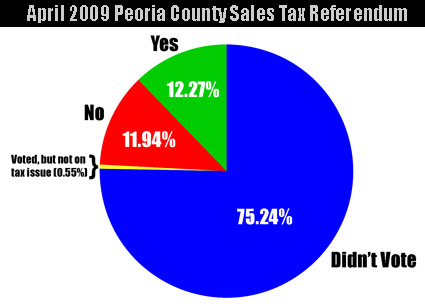
Consider this little pie chart I whipped up based on the last election:

April 7 Sales Tax Referendum Chart

It doesn’t look like many people (in Peoria, anyway) are interested in reining in “out-of-control government spending,” does it? And if anyone feels taxed without representation, there’s a greater than 75% chance it’s their own fault.

The TEA Party participants would see greater results if they could just convince more people to participate at the ballot box rather than downtown marches.