Category Archives: City of Peoria

City should raise taxes, not cut costs

The City of Peoria is in a world of hurt. Because of the recession, revenues are down. Way down. In fact, according to a report prepared for Tuesday night’s council meeting, “Staff is anticipating $3,334,129 less revenue than previously forecasted, which would result in a budget deficit of an equal amount.”

As a result, staff is trying to figure out a way to make up the difference. Curiously, they’re trying to do so through fiscally conservative methods, such as contract adjustments, expenditure reductions, revenue-generating activities, and reserve funds. In other words, they’re trying to save money without raising taxes.

But why? If the recent election has shown us anything, it’s that the vast majority of Peoria residents don’t give a hoot whether their taxes are raised. Most of them couldn’t be bothered to drag themselves downtown for early voting, or out to their polling place on a beautiful sun-shiny day. A majority of those that did voted to raise their own taxes for a non-essential project in the middle of an economic recession — some would say depression.

You know what that tells me? That tells me that the city council should stop stressing out about cutting costs and looking for other forms of revenue. In fact, they shouldn’t change a thing about their operating budget. They should simply figure out how much additional revenue they need, and then raise taxes to cover it. Done.

After all, the museum group didn’t look at any other alternatives to downsize their project, or to increase revenue-generating activity, or renegotiate contracts (like using non-union, but prevailing-wage labor), or any number of things that would have made their project more affordable. Yet, the majority of the few registered voters who turned out voted to give them $40 million anyway with no strings attached.

Not just the voters, either. Caterpillar, the Chamber of Commerce, almost all elected officials, District 150, the Peoria Association of Realtors, etc., etc., etc. — they were all for raising taxes. How could any of them complain if the city were to do the same for essential services, such as police, fire, streets, and sidewalks?

I’m calling on all those who supported and voted for the sales tax referendum to write their city council members and demand that they not cut spending, but increase taxes instead. Since we’re all so flush with cash, let’s start using it in the areas that are the most needy.
Peoria Chronicle Endorsements — Mayor: Ardis, Treasurer: Shadid

Two other races on the ballot Tuesday are for Mayor of Peoria and Peoria City Treasurer. Here are my endorsements for each of these:

  • Mayor of Peoria: Jim Ardis — Running against incumbent Mayor Ardis is local activist General Parker. Unfortunately, under current state law, Parker is ineligible to serve if elected. Thus, for all practical purposes, Ardis is running unopposed. He is endorsed.
  • City Treasurer: Gary Shadid — City Treasurer Reginald Willis is retiring and two candidates are vying to succeed him: Fifth District Councilman Patrick Nichting and local CPA Gary Shadid. Nichting offers little more than his fifth district representation as experience, whereas Shadid has been a CPA since 1983 and has experience in governmental accounting and auditing. Shadid is the more qualified of the two. He is endorsed.

State’s Attorney weighs in on David Kennedy

In a previous post, I talked about David Kennedy and his unorthodox methods of fighting crime in urban areas. Police Chief Settingsgaard told me that he has “a team being trained by Kennedy and his staff.” At the same time, I wrote to the State’s Attorney’s office to see what they thought of Kennedy’s methods. I recently received this reply from Kevin Lyons:

Dear C.J.:

In reply to your inquiry about David Kennedy, I am, indeed, familiar with him and this topic. In fact, four Peorians (including a prosecutor from my office and a Peoria police officer) recently returned from Raleigh, NC, following a three day training conference on details of the High Point Project. Recreating the High Point (NC) Project in some cities has met with great success; in others, uh, not so much. But I felt it worthy enough to take a look to see if we may want to embrace this effort and achieve some success for three targeted areas within the city (sorry, but I can’t share with you the neighborhoods that have been designated for this).

These four people will soon complete two more sessions before the ‘project’ here begins. I don’t know whether it will work but I do know that entire generations are lost to the buying and selling of mind-twisting drugs and that changing an entrenched culture will only be accomplished by impacting whole neighborhoods and not just a person here, a person there.

Perhaps it’s because David Kennedy and I are both 50ish and have watched drugs give the grave to friends and neighbors for more than 30 years. Perhaps it’s because we have watched battles being lost for years when waged against criminal drug sales in America. Perhaps the High Point Project makes a little sense because countless other projects do not. We’ll see.

It is interesting, C.J., that you and I were both piqued by this particular approach because, at first blush, this would never be my style…rolling the videotape to the offender and his family and then giving him a free pass. It will be a time intensive task that will take a lot of time by authorities. Then again, as prosecutors say – “there is never enough time…unless you’re serving it.”

Fingers crossed. Thanks for your inquiry.

KEVIN W. LYONS
Peoria County State’s Attorney

My thanks to Mr. Lyons for responding and sharing his thoughts on this topic. It will be interesting to see how these methods work here in Peoria.

Museum odds and ends

I’ve gone to several town hall meetings regarding the sales tax referendum, so I’m familiar with the presentations now, and I’ve heard a lot of the same questions. But at last night’s town hall meeting at Northwoods Community Church, I actually learned some new things. Not all of these items are new information — some of it I probably should have known already — but they were all new to me:

First of all, I found out that the Caterpillar Experience will not have free admission for the general public. Mark Johnson of Caterpillar explained that employees/retirees of Caterpillar and their guests will get in free. But if you don’t want to hit up your Cat friends to get you in, or if you’re a tourist/visitor from outside the Peoria area, you’ll be paying $5 for adults and $2.50 for children under 12. I was very surprised to learn this, especially in light of my recent trip to Moline to visit the John Deere Pavilion, which is free for everyone.

Second, it was stated last night that the City of Peoria will own and operate the underground parking deck, and that the parking will not be free. Mr. Johnson stated that the City theoretically could offer free parking, but that they would probably charge the same rate as other City-owned parking decks. Just what the City needs — another money-losing parking deck. It’s worth pointing out that the museum could also offer free parking to their patrons. All they need to do is validate parking tickets and then pay their patrons’ parking fees for them. It’s also worth noting that patrons of Lakeview currently have free parking at the existing Lakeview campus.

Finally, it was stated that — if the referendum passes and the museum is built — the Peoria Riverfront Museum (PRM) would take over ownership of the historic houses currently owned by the Peoria Historical Society. I don’t see how the PRM could afford to own, operate, and maintain those historic houses when the county doesn’t feel PRM has adequate funds budgeted for capital maintenance on the museum building. Living in a 105-year-old house myself, I can tell you first hand that maintenance is not cheap, especially if you want to maintain the historical integrity of the structure.

There were a couple other notable items from last night’s town hall meeting, but I’ll save that for another post.

About those “Build the Block” banners on light poles…

Some have been wondering why the “Build the Block” campaign is able to put banners on the light poles around the city and who pays to put them up and take them down. I asked Interim City Manager Henry Holling about that issue and received this response:

Good day Mr. Summers. Thanks for your inquiry on City banners and the current display of “Build the Block”. The current banner display was paid for by Lakeview Museum, a principal partner in “Build the Block” and includes labor by City sign crews to post and remove; the sponsoring organization pays for all materials, design and artwork. City banner policy is that only requests from community-based non-profit, non-partisan, non-discriminatory, community-service organizations will be considered on a first come/first served basis. There is typically a wait of 90 to 120 days to get in the present queue. “Build the Block” was kicked off last June as the tagline for the huge Caterpillar Visitor Center/Museum $135 million project. Among others, the City of Peoria is a partner in the project as mentioned in the Mayor’s State of the City address. “Build the Block” was initiated way before the approval by the County Board of a referendum April 7, 2009. In fact, “Build the Block” banners were posted downtown last June, 2008 as part of the educational and communication initiative tied to the event of a massive positive development at the riverfront. Appreciate your interest in this spectacular project for Peoria.
Henry

What’s going on here? you ask. Well, it’s a combination of legal requirements and clever marketing.

You see, Lakeview and the rest of the Museum Collaboration Group cannot advocate for or against a political issue or candidate because they’re a not-for-profit organization. But they can do anything else, such as educate the public on their museum plans and solicit private donations and public subsidies. The “Build the Block” banners fall under that category. They’re put up by Lakeview, the not-for-profit organization, and they say nothing about the referendum.

All the signs and mailings that say explicitly to “vote yes” on the public facilities sales tax referendum are produced by a legally separate organization called “Friends of Build the Block.” This is a political advocacy group. If you look at the small print on these signs and postcards, you’ll see it says “Paid for by Friends of Build the Block.”

Here’s where the clever marketing comes in. Both organizations use the same graphic elements in their materials. They both use the “Build the Block” logo, the same fonts, the same kind of layout and design. So in the minds of residents and voters, the legal division between the two groups is transparent — that is, the average voter sees no difference between them. It all looks like one organization.

So, when Joe Citizen sees a banner hanging on a city light pole, his mind associates “Build the Block” with the “vote yes” literature he’s received in the mail. Ta-dah! All of the museum group’s advertising is effective in advocating for the referendum even though some of it doesn’t explicitly say so. To get a festive attribute get a banner for thanksgiving and enjoy the coming holiday.

Council Roundup 3/24/09 (Updated)

Some notable items from Tuesday’s council meeting:

  • First District Councilman Clyde Gulley voted with the majority of the council to give stimulus funds to a private not-for-profit organization in the third district instead of repairing sidewalks in the first district. Gulley is running unopposed on the April ballot to represent the first district for another term.
  • The council learned that tax revenues are down, resulting in a projected $2.5 million budget deficit. It could get worse next year. Naturally, the staff is looking to cut police officers and road repairs to make up the difference. They’re not talking about laying off any police officers — just not filling vacant positions. So public safety and public works will suffer, while private developers of the downtown Marriott will rake in $40 million in public money. Priorities, you know. Another vacant position they’re talking about not filling: city manager. This is their way of keeping Holling on indefinitely, contrary to the agreement that he would only be temporary until they could get a permanent replacement. They’re going to treat him as permanent, but continue calling him “interim” until some undetermined point in the distant future, evidently.
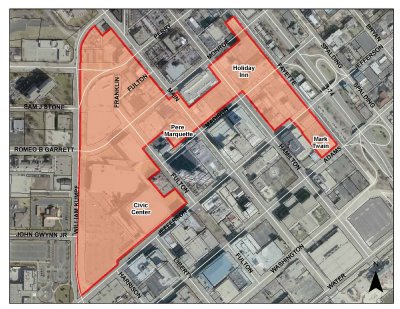
  • The sales tax just went up 1% within the boundaries of the Hospitality Improvement Zone downtown. These boundaries are very strange — I’m going to try to get a map from the city. Generally speaking — very generally — the HIZ is bounded by Kumpf, Fulton, Adams, and Fayette, but the actual boundary zigzags into alleys (active and vacated) and avoids certain blocks completely. Here’s the map:

    hizmapwithaerial1

    Nevertheless, if you go to a restaurant or bar within the HIZ boundaries, the sales tax on your meal/drinks will now be 11%. If the museum tax passes, it will be 11.25%. Meanwhile, over in Tazewell County right across the river, the sales tax is 8%.

Stimulus money should be used for infrastructure

I have to agree with Billy Dennis. The stimulus money Peoria received should be used to improve infrastructure, not put a new roof on a private organization — even a private organization as laudable as the Center for Prevention of Abuse.

The Center does wonderful work here in Peoria, and I don’t begrudge them asking for stimulus funds as it’s not easy to raise money, especially in the current economic climate. But they simply don’t take priority over improving infrastructure in South Peoria. The Center already has numerous benefits by virtue of its not-for-profit status. It doesn’t pay property taxes or sales taxes, and yet it wants tax money to help buy a new roof. Meanwhile, taxpayers in South Peoria continue to live with substandard basic services and have their needs put at the bottom of the list.

“After 23 years, it’s time to say, ‘let’s get this done,'” Martha Herm, executive director of The Center for Prevention of Abuse, was quoted as saying in the Journal Star. There are a couple problems with this statement. First, it assumes that the Center is somehow entitled to public funds; it’s not. Second, South Peoria has been ignored far longer than 23 years. If we’re going to base this merely on time spent waiting for public investment, South Peoria has everyone beat.

Columbia Terrace to get historic streetlights, wider sidewalks

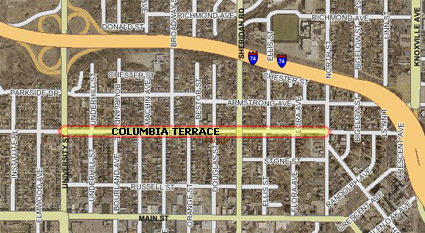
It’s been more than two years in the making, but if approved Tuesday night by the City Council, Columbia Terrace from University to North street will finally get its promised facelift. Specifically, it will be improved by:

. . . removing existing curb, sidewalks, and driveway approaches, and constructing combination curb/sidewalk up to 6′ in width, new driveway pavement, an ornamental street lighting system consisting of acorn fixtures on a fluted aluminum pole, and a bituminous concrete overlay, along with all necessary adjustments, incidentals, and appurtenances as shown on the plans or as directed by the Engineer.

The project, which covers just under 3/4 of a mile, is expected to cost $1,906,465.11, or $42.31 per foot. According to the request for council action, the city will pay for approximately 89% of the project, with the remaining 11% being assessed against property owners along the corridor.

columbia-terrace-project-032409

Efforts to improve Columbia Terrace began in earnest in September 2006 when petitions were circulated getting a majority of homeowners to agree to help pay for the improvements. The second district project is cited by incumbent councilwoman Barbara Van Auken as one of her accomplishments in improving the West Bluff.

Grant money sought for Main Street improvements

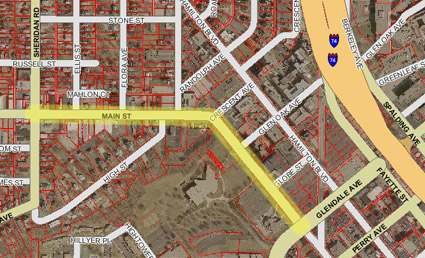
main-street-improvement-grant-032409On Tuesday night’s City Council agenda is a grant application to the Federal Highway Administration’s “Highway Safety Improvement Program” to improve Main Street from Sheridan Road to Glendale Avenue (see map to the right). This corridor would be eligible for funding because it is a “high accident location” and because it has a “high cost benefit ratio,” according to the request for council action.

The request goes on to explain the types of strategies that could be used to improve safety along the corridor. They include:

…narrowing this section of Main Street from 5 lanes to 3 lanes with paint striping, installing speed feedback signage, installing additional speed limit signs, installing flashing crosswalk signs, and installing improved curve signage near Crescent Avenue. Additionally, parking and/or loading zones could be considered where applicable and needed, and would help narrow the roadway. Main Street from Sheridan Road to Glendale Avenue, as part of the larger Main Street Corridor, has recently been studied with the idea of incorporating New Urban concepts, which would make it more attractive and pedestrian friendly. All these proposed safety strategies fit into the larger picture for the roadway and would not prohibit any future improvements.

If the request is approved, the city will seek a $48,500 grant. The application has to be in by April 10, and awards will be announced in July. All grant money awarded will be for use in 2010.

District 150 looking to cell towers for supplemental income

cell_tower_ibs91District 150 has found a new way to get revenue: allow private companies to erect cell phone towers on school property.

In November 2008, the City Council approved a request for U.S. Cellular to erect a cell phone tower at Loucks Edison School (now Thomas Jefferson), 2503 N. University St. Sources tell me the the school district will receive $2000 per month from this lease arrangement, and that more cell towers are planned on other properties, including Whittier School. Putting cell towers on school and church property is common — but controversial — all over the country.

The controversy is over safety. The Federal Communications Commission has several documents regarding cell tower (or “cell site”) radiation levels, and they’ve basically determined that they are very safe. “Measurements made near typical cellular and PCS installations, especially those with tower-mounted antennas, have shown that ground-level power densities are well below limits recommended by RF/microwave safety standards,” says OET [Office of Engineering and Technology] Bulletin 56 (p. 21). Well enough below limits that such cell sites “are considered ‘categorically excluded’ from the requirement for routine environmental processing for RF exposure” by the FCC, according to “A Local Government Official’s Guide to Transmitting Antenna RF Emission Safety.”

Not everyone is convinced. People Against Cell Towers at Schools (PACTS) is an organization started by citizens in Tampa, Florida, that believes cell phone towers should not be placed on or near school playgrounds. They cite a litany of research, including a 2004 article from the American Academy of Pediatrics which stated children are more susceptible to extremely low frequency (ELF) magnetic fields and recommended “additional research and the development of precautionary policies in the face of scientific uncertainty.” In fact, most of the research cited takes a similar approach. For example, the American Cancer Society is quoted as saying, “we do not have full information on health effects… in particular, not enough time has elapsed to permit epidemiological studies.” In other words, exposure to ELF magnetic fields may or may not be dangerous, and until we know for sure, we should limit exposure to children. Furthermore, in response to appeals to the FCC’s report of cell site safety, they say “government agencies have a bad track record in protecting us against long term threats. Think about some of the major oversights in health threats such as tobacco, lead paint, DDT, PCBs and asbestos.”

So far in Peoria, there appears to be little or no concern. The cell tower at the University St. school building had no public opposition. However, that might be because the request went through after the school was closed and before Thomas Jefferson school was relocated there due to the fire at their Florence Avenue facility. The forthcoming request for a cell tower at Whittier will likely be the bellwether of public reaction to the idea.

One other concern that is expressed about cell towers is that they are not exactly aesthetically pleasing. Some communities try to hide them by making them look like trees — seriously. When I was in California last year, I saw a number of cell towers disguised as palm trees. Pictures on Google show towers camouflaged as pine trees, too. Clever, eh?