
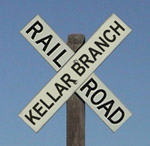
RTA decides to trespass anyway

You may recall that Pioneer Industrial Railway wouldn’t give their permission to the Recreational Trail Advocates (RTA) to do a “clean up” along the Kellar Branch line. It appears the RTA is going to ignore that denial. Their minutes record:

H. Status of spring cleanup-David Pittman discussed the hoops had to go through to set up the April 26 trail cleanup with the City of Peoria. He was given written permission by City of Peoria Attorney Randy Ray to proceed but he was told to get the permission of the two railroads—Central Illinois Railroad (CIRY) and Pioneer Railway Corporation (PIRY). CIRY said the clean up was fine but PIRY refused to give RTA permission for the trail clean-up. Peoria Park District (PPD) has liability insurance for the event. Bruce moved we go ahead with the clean-up having the permission of the City of Peoria attorney; Joyce seconded; motion carried. The section to be cleaned will be from Pioneer Parkway to Northmoor Road with PPD property on Knoxville and Northmoor Road as the staging area. Lunch will be provided and the lunch will be served at the homes of Matt and Steve Jaeger who live close by on Oak Point Court.

I would point out that Ray’s permission was contingent on the RTA getting permission from the railroad companies, which they did not get. And it wouldn’t be “trail cleanup” because there’s no trail there. It’s a railroad track on a railroad right of way.

It also appears they’re trying to go around to neighborhood associations to drum up support. Elsewhere in their minutes, it’s stated:

F. Progress on contacting homeowner associations–Dave Pittman has divided the 136 home owners’ associations into 3 groups sharing with Mike Pula (northern city) and Mike Rucker (central city). The associations have been approached initially about supporting the conversion of the Kellar Branch into a recreation trail and have been offered an opportunity for RTA members to come their meetings to answer any questions they may have. The goal is to have the associations adopt a resolution of support for the trail. It was noted that 20 property owners’ associations were within ½ mile of the Kellar Branch. Steve S. felt the home owners should be warned of diminishment of their property value if the rail remains intact. Mark K. offered to help with the association contacts.

One of the neighborhood associations Pittman has contacted is the Neighborhood Alliance. I was invited to give the other side of the story at that association meeting, which will take place in April. Perhaps I should ask the property owners if they feel comfortable supporting an organization that has no qualms about trespassing. Residents in older neighborhoods just love trespassers.

If you’re interested in the rest of their plans, here are the complete minutes:

Continue reading RTA decides to trespass anyway

Walk to school on the sidewalks? Not on garbage day

My fellow commissioner Beth Akeson took these pictures yesterday:

Blocked sidewalk

Blocked sidewalk 2

It wasn’t long ago that there was some controversy over students at Manual High School walking in the street to get to school. The problem near Manual is that sidewalks are in poor repair or nonexistent in several places, forcing children to walk in the street. In these pictures from around St. Philomena school in the West Bluff Central Peoria, evidently the problem is that homeowners block their sidewalks one day a week with garbage cans and bags. Combine that with on-street parking, and where else can children walk but near the middle of the street? (Incidentally, Waste Management’s policy is for the garbage cans to be placed at the curb on the street, not on the sidewalk.)

D150 shoehorning suburbia into urban neighborhood (UPDATED)

District 150 will decide tonight whether the new, enlarged Glen Oak School campus will extend north or south of the current campus. The Journal Star reports:

“We need to make a definite decision,” Gorenz said Monday. He wouldn’t elaborate which direction, whether to the north or south, he thought the new school might extend, saying that would be made known tonight.

The district so far has discussed three proposals for expanding the Glen Oak Primary School campus from its current three acres to as many as 12 acres.

So, just what do these possibilities look like? Here are a few options that the school board is considering — two options to expand to the north, and one option to expand to the south. Rumor has it that the southward expansion is favored (click on each picture for larger image):

Glen Oak School North - Option 1

Glen Oak School North - Option 2

Glen Oak School South Option

They still insist on consuming more acreage than they need. These site plans would be appropriate for a suburban school. But for a neighborhood school in an urban area, this is not an appropriate use of land — especially the excessive parking areas. The staff parking lot is more than sufficient — why do they need “bus parking”? And why do they need another parking lot? Are the third-graders driving themselves to school now and need a place to leave their cars during the day? And why is the school building all spread out? Why not build up and take up a smaller footprint?

Is anyone on the school board asking these questions?

UPDATE: The school board did indeed decide on the southward plan. It was pointed out that these drawings (above) are conceptual. They’re not final site plans. The placement and configuration of the building, for instance, may be different than what is shown. It was stated that the public will have input — especially those who live in the Glen Oak School attendance area.

The cost of the project, including property acquisition, is estimated to be $27 million. And that’s the amount the school board will request from the Public Building Commission. School board member Jim Stowell suggested the City should help with property acquisition costs.

I wrote this post originally a bit in haste, as I wanted to get the pictures up as soon as possible. Thus, my comments sounded a bit overly negative. I should have stated that, on the positive side, I am pleased that the school board chose the current Glen Oak School site. It is by far the best location, and they should be applauded for listening to the wishes of the City, neighborhood associations, residents, teachers, et. al.

Nevertheless, I do still have the concerns I noted above. The excessive land requirements are unnecessary and needlessly inflate the price of the school project. Perhaps with some more public input, the school board will scale back the size as well.

Surprise! Cable rates going up

Well that didn’t take long. Comcast has sent out a mailing notifying its customers that it will be raising its rates effective April 2, 2008.

Basic service is going up a dollar per month, from $13.60 to $14.60. Expanded basic (formerly Classic Service) is going up two dollars, from $35.15 to $37.15. That means that a standard cable package that includes Basic and Expanded basic will be going from $48.75 to $51.75 per month, or about a 6% increase. DVR rental is going from $8 to $10. And all the various premium services are going up one or two bucks per month, too. There are various other changes in prices.

Comcast says, “Occasionally, we must adjust our prices to reflect the value of our services and the investments Comcast makes to bring you the best that technology has to offer.”

Meanwhile, satellite service only costs about $30 per month, and over-the-air broadcasts are free.

Autism linked to vaccine

I understand why there has been such a concerted effort to convince people that autism is not connected to vaccinations. Vaccinations save lives. Just Google “polio” sometime and consider how much life has been improved through vaccines. And if parents think that getting their children vaccinated is going to give them autism, they might forego vaccines because they fear they’re too risky. Yet not getting vaccinated would actually open them up to greater risk.

So I get it. But there’s just one problem. There is a link between autism and vaccines. And the sooner the medical community comes clean about it and reduces that risk, the better off everyone will be. The Department of Health and Human Services has conceded the link in a document filed in a Federal Claims Court. You can read a verbatim copy here. The concession comes under the “Analysis” section and states:

In sum, DVIC [Division of Vaccine Injury Compensation, Department of Health and Human Services] has concluded that the facts of this case meet the statutory criteria for demonstrating that the vaccinations CHILD [name redacted for privacy] received on July 19, 2000, significantly aggravated an underlying mitochondrial disorder, which predisposed her to deficits in cellular energy metabolism, and manifested as a regressive encephalopathy with features of autism spectrum disorder. Therefore, respondent recommends that compensation be awarded to petitioners in accordance with 42 U.S.C. § 300aa-11(c)(1)(C)(ii).

There must be a way to be honest about these findings without scaring everyone into eschewing vaccinations. And there must be a way to reduce the risks — for example, maybe there’s a test that can be done to check for conditions that could be aggravated by the vaccination before the shot is administered. One thing that’s definitely not going help is pretending there is no link and stonewalling the public.

Hat tip: “The Mouse”

Do we need to organize?

The museum supporters are pulling out all the stops to ram their proposed museum plans down our throats — at taxpayer expense, no less. So the question I have is, should we organize to oppose it? In a recent survey of 1,000 people, 300 of them didn’t want the museum at all, and nearly 300 who wanted the museum didn’t support any of the taxing options presented to them. The question is likely to be put on the ballot as a referendum next year.

My thought is that we should start a coordinated effort to oppose a tax increase of any kind (property, sales, local, regional, etc.) to fund the museum. It would not be an organization opposed to the museum, per se — just opposed to taxpayer funding of it. In fact, if the question does go on the ballot, the organization could be dedicated specifically to urging people to vote “no” on the referendum.

What do you think? And what would be a catchy name for our resistance effort?

Plaintiff: Proctor fired me so they wouldn’t have to cover my husband’s cancer treatment

Proctor Hospital fired one of its employees for “insubordination.” But the employee claims the real reason is because her husband was undergoing expensive cancer treatment and the hospital didn’t want to cover the costs anymore. So she sued the hospital. Judge Joe Billy McDade found in favor of Proctor (summary judgment), but the Seventh Circuit Court of Appeals reversed that ruling and remanded the case to the district court.

You can read the whole ruling here. An edited version appears below. Usually legal texts are quite boring, but I actually found this one to be rather engaging, which is why I’m quoting extensively from it instead of summarizing.

In September 2001, Proctor, a hospital in Peoria, Illinois, hired Dewitt to work as a nurse on an “as-needed” basis. Proctor apparently liked how Dewitt did her job because the following month she was promoted to the permanent position of second-shift clinical manager. In that role, Dewitt supervised nurses and other Proctor staff members.

Three years into the job, Dewitt switched to the first-shift clinical manager slot. In the summer of 2005, she switched to a part-time schedule, sharing the responsibilities of second-shift clinical manager with a coworker.

Dewitt, it appears (for we must assume the facts to be as she presents them at this stage of the proceedings), was a valuable employee. In her last evaluation, her supervisor, Mary Jane Davis, described her as an “outstanding clinical manager [who] consistently goes the extra mile.” But things were not quite as rosy as they appeared.

Continue reading Plaintiff: Proctor fired me so they wouldn’t have to cover my husband’s cancer treatment