Preliminary capital budget includes $0 for Heart of Peoria Commission

Unless the council asks staff to put it back in, the Heart of Peoria Commission will receive none of the $145,000 it requested from the 2008 capital budget.

Plans were to use the money to bring in a transportation expert to help the city develop a comprehensive transportation policy for the Heart of Peoria area (the process would include all stakeholders through the use of charrettes), a comprehensive marketing strategy for the Heart of Peoria Area with materials to raise awareness of the opportunities that exist for residential and commercial investment, and grant writing to get more non-city funding for projects.

Earlier this year, the mayor suggested changing the Heart of Peoria Commission from a city commission to a private advocacy group similar to Peoria City Beautiful. After further negotiation, a compromise was reached where HOPC would remain a city commission, but would meet less frequently (six times per year instead of twelve).

The council accepted the commission’s work plan, except for the capital budget items because they needed to go through the budget process with all other projects. We’re now in that process, and HOPC’s requested funding is not in the budget recommendation from city staff. Since the budget is currently balanced, a council member who wants to see HOPC’s funding restored will have to find an equal amount of money to cut elsewhere.

Is District 150 authorized to use PBC bonding authority?

Peoria LogoProbably. After all, the Illinois General Assembly passed Senate Bill 2477 at the end of 2006 in order to give District 150 the ability to access the Public Building Commission for five years.

Or did they?

They did amend the Public Building Commission Act, but they didn’t specifically name District 150. Instead, they changed the definition of “municipal corporation” so that it made an exception for any school that met certain criteria. This amended definition would “include a school district that (i) was organized prior to 1860, (ii) is located partly within a city originally incorporated prior to 1840, and (iii) entered into a lease with a Public Building Commission prior to 1993, and its board of education.”

The idea here was to write the definition so narrowly that only District 150 would qualify. That means District 150 would have to meet all three criteria in the legislation. Peoria’s public school system was chartered by the state in 1855, so the first criterion is met. And of course District 150 most recently entered into a lease with the PBC about 1991-1992 for Lincoln Middle School ($5 million) and Valeska-Hinton Early Learning Center ($7 million), so criterion number three is met.

But what about the second criterion: a school district that “is located partly within a city originally incorporated prior to 1840”? Well, now that’s an interesting question. The City of Peoria was incorporated April 21, 1845. 1845 is obviously not “prior to 1840.” So some have made the case to me that District 150 is therefore not eligible for PBC funding under SB2477.

On the other hand, the Village of Peoria was incorporated on March 11, 1835. Perhaps this is the date of which the bill writers were thinking. But the legislation doesn’t say anything about a “village.” It says “a city originally incorporated prior to 1840.” Cities and villages are two separate and distinct municipal corporations in Illinois.

Splitting hairs? Maybe. But then again, maybe that split hair could save the taxpayers upwards of $60 million they would be forced to pay without a referendum. So, perhaps it’s not such a crazy question after all: Is District 150 authorized to use PBC bonding authority?

Museum Update: New Markets and IMAX

PRM LogoTime for an update on the Peoria Riverfront Museum project.

New Markets Tax Credits

On October 5, the U. S. Department of the Treasury awarded $3.9 billion in New Markets Tax Credits to 61 organizations. The Peoria Riverfront Museum will now try to get some of that funding for their museum project.

According to an August 29 Journal Star article, Lakeview Board Chairman Jim Vergon told the city council that “officials are waiting to hear if they can secure $100 million in New Market Tax Credits, which will generate the necessary $22 million needed for construction to begin.” It looks like they’ll have their work cut out for them.

Awards ranged from $12 million to $133 million for each organization. Each organization gives a brief description of the kinds of programs it’s interested in funding. A couple look like good candidates for the museum project: the Urban Development Fund, LLC (which was allocated $60 million), and USBCDE, LLC (which was allocated $125 million). However, I’m not sure how likely it is that the museum will get the $100 million they’re seeking, since it would mean getting a significant portion of one or more organizations’ allocations — and there is fierce competition for these funds.

The organizations have several months to dole out their New Market Tax Credit money, so the museum group doesn’t know when they’ll find out how much, if any, money they will receive.

If they don’t get enough of the New Market Tax Credit funds, they’ll be looking for other public funding. I’ve heard an unsubstantiated rumor that they’ve approached Illinois Central College about possibly using their bonding authority, but were turned down. Rumors persist that they’re looking for a way to access the Public Building Commission.

IMAX still a possibility

Last month, museum officials met with the folks from IMAX to talk about bringing the big screen theater to Peoria. Kathleen Woith, Vice President of Communications and Community Relations for Lakeview, had this to say about their progress:

Our visit to Toronto to talk with IMAX and see some of their new digital technology went very well. Negotiations continue, also, and we are very optimistic that the theater at the Peoria Riverfront Museum will be an IMAX.

As we continue negotiations with IMAX on leasing costs for their projectors and films, we are working with our architects and consultants to integrate the IMAX technology into the theater design. This is a very complicated process. Among the thing we are looking at are: how many seats and how far away from the screen, what angle will the seats be, how big will the screen be, what will be the projector location, how does digital technology affect 3-D films, and even how much do we pay for the hundreds of 3-D glasses we will purchase and how much will the 18-foot glass washing machine cost?

Operations costs also are being negotiated. How much will we pay for the IMAX digital movies? And how much will leasing costs be for the first-run movies at night.

Will it happen? If we successfully fund and build the Peoria Riverfront Museum, yes, we will have a “giant-screen” theater and it most likely will be an IMAX. Will it not happen? If we don’t fund and build the Peoria Riverfront Museum, we won’t have the theater.

We are very pleased with our progress with IMAX and are looking to a long and entertaining relationship with them.

Having an IMAX in Peoria would be awesome. I hope that becomes a reality, whether it’s the museum or someone else who brings it to town.

Jellick checks on Chronicle post, gets different answer from State

Clare Jellick, intrepid education reporter for the Journal Star, followed up on my previous post. She spoke to “Illinois State Board of Education spokesman Matt Vanover.” He gave her a different answer than the one I got from Lou Ferratier in the Illinois State Board of Education’s School Business and Support Services division. Now the State Board of Education says that District 150 does indeed have to close the school buildings.

I have no quarrel with Jellick’s post or with the new information provided by the ISBE, per se. But I am irritated that I was evidently given false information by the Illinois State Board of Education.

Jellick says, “Vanover said the state official quoted in C.J. Summers’ blog was likely speaking in generalities.” Well he shouldn’t have been. When I called, I identified myself, where I was calling from, that this was regarding School District 150, and I referred specifically to the certificates I had received through a Freedom of Information Act request from the district. I told Mr. Ferratier that I had a copy of the HLS documentation in front of me — I don’t know how much more specific or pointed I could have been in asking my question. I quoted verbatim from the certificate, told him that school board officials have been claiming the state requires them to close schools, and asked Mr. Ferratier if that was true. Answer: No; they don’t have to close them. They can close or repair them. If Mr. Ferratier was “speaking in generalities,” it wasn’t for lack of me asking for specific information.

Bottom line, though, Jellick and I agree:

All that being said, I’m not arguing that the closures were a decision handed down by the state, and District 150 was a helpless bystander. District 150 picked the schools that it wanted to replace. It knew full well that the schools would have to close if the replacement funding was granted.

And that was my main point anyway — that it really wasn’t a state decision, but a District 150 decision, and that the school board is trying to use the state as a scapegoat. The ISBE’s flip-flop doesn’t change that.

District 150 not required to replace schools

UPDATE: Some of the following information has been disputed. Please see this follow-up post.

District 150 has been holding community forums to get input from citizens on where they would like a new school located in the East Bluff/North Valley area. At each forum, citizens have been told that the Illinois State Board of Education requires that the Kingman, Irving, and Glen Oak school buildings be replaced. For instance, one of the slides in their presentation is titled, “Buildings to be replaced per State.”

I’ve learned not to trust the school board when they tell me something is required by the state. Not long ago, Superintendent Hinton went on the radio and said the state required any new school to be built on 15 acres or more. It turned out that wasn’t true.

So I wasn’t surprised when I discovered that the state actually does not require that the buildings be replaced. I spoke to Lou Ferratier in the Illinois State Board of Education’s School Business and Support Services division. He said the buildings need to be either repaired or replaced, but the state does not require replacement. This is clear even from reading the applicable section of the state’s School Code (105 ILCS 5/17?2.11):

For purposes of this Section a school district may [emphasis mine] replace a school building or build additions to replace portions of a building when it is determined that the effectuation of the recommendations for the existing building will cost more than the replacement costs. Such determination shall be based on a comparison of estimated costs made by an architect or engineer licensed in the State of Illinois. The new building or addition shall be equivalent in area (square feet) and comparable in purpose and grades served and may be on the same site or another site.

Here’s how much the state has approved for District 150 to expend in fire prevention and safety funds (acquired from District 150 via FOIA request):

School Approved Expenditure
Glen Oak Primary $8,373,980
Harrison Primary $12,261,377
Irving Primary $6,794,380
Kingman Primary $6,474,213
Total $33,903,950

The school can use that money to fix up the schools or replace the schools. They can build several smaller schools or one big school. The only requirements are:

  1. Their buildings are brought up to code regardless of whether it’s through repair or replacement,
  2. The replacement school(s) be used for the same purpose (elementary school), and
  3. The replacement school(s) have equivalent aggregate square footage.

Here’s the deal: the reason the school district says they need to replace the school buildings is because, according to their last “Health Life Safety” report completed by STS Consultants, it would cost more money to repair the buildings than to replace them. However, that’s based on their reported replacement costs, which are obviously too low.

For example, the reported cost to replace Harrison School was about $11.8 million. But the school district asked for $21 million from the Public Building Commission to build a replacement Harrison. Cost to renovate? $11.98 million. That’s a $9.02 million difference. Yet somehow, replacing is supposed to be cheaper than renovating.

District 150 is trying to use the state as a scapegoat to deflect criticism of the school board’s decision to replace buildings that aren’t required to be replaced.

PJS editorial: same old disinformation

At this time, the Journal Star’s editorial is not available online, but you don’t have to read it to know what it says. It’s about the Kellar Branch, and the editorial writers always write the same misleading and blatantly false information about the issue every time. This time, it’s in the form of an open letter to Senator Dick Durbin, imploring him to “be a powerful ally” and “light a fire under the Surface Transportation Board.”

Along the way, they lay out their case for removing a working rail line in favor of a hiking trail:

  • “It’s a cooperative regional effort.” Yes, they’re all cooperating to pursue something they have no legal authority to effectuate. The municipal governments have no authority to remove a working rail line without Surface Transportation Board authorization, which they don’t have. Since the local governments can’t convince the STB to violate their mission by taking action that will harm rail shippers, the Journal Star is now asking Senator Durbin to abuse the power of his office to pressure the STB to do just that. How civic-minded of them.
  • “It’s a public health matter.” Say the Journal Star editors, “We think the Kellar line would enjoy heavy use from runners, dog-walkers, parents pushing strollers, cyclists, etc.” The people who will use the trail are people who are already exercising. They’re already running, walking their dogs, pushing their strollers, cycling, etc. Furthermore, they have plenty of opportunity to participate in all of these activities on streets, roads, parks, and miles of existing trails. People with a sedentary lifestyle are not suddenly going to rise from their easy chairs and start exercising because a new segment of trail in the middle of town becomes available.
  • “It’s a push for redevelopment.” The Journal Star blithely argues that customers on the line “long ago bailed.” The fact is that the threat of the line’s imminent demise is the reason the line has not gotten more rail use. Keep telling people the line’s going to be removed and it’s amazing how businesses needing rail service shy away from locating next to it. It’s also amusing that they say, “As for potential rail use, we’ve heard little more than speculation.” I would simply say, as for potential trail use and the assertion that the trail will raise property values, I’ve heard nothing but speculation. The fact is, there are potential shippers located on the line. The proof of this is the fact that Central Illinois Railroad is fixing up the line at their own expense to serve those shippers — why would they waste their money repairing the line if there were no shippers?
  • “Finally, it’s a property rights issue.” Ah, they’ve saved their most ridiculous argument for last. “Despite the fact that Peoria and Peoria Heights own the line, they have distressingly little say in its fate.” They’re shocked — shocked, I say — that a unit of government can tell a property owner what they can and can’t do with their own property! It’s so unusual, you know. Let’s see, the only other examples I can think of are, oh I don’t know, every zoning law in the nation. Since the Journal Star had so much fun dissecting Barbara Van Auken’s logic the other day, should we spend some time dissecting the Journal Star’s logic here? I guess if property owners should have unfettered rights to do what they wish with their property — no matter who it might hurt — one has to wonder why the Journal Star does not oppose zoning laws, health department restrictions, rental inspections, code enforcement, and the recently-passed smoking ban. See how much fun it is?

Bottom line, the Journal Star doesn’t think the city should have to follow federal rules that are in place to protect rail shippers from just this sort of abuse by rail owners.

I have a better idea. I’d like Senator Durbin to light a fire not under the STB, but under the Peoria Park District. Tell them to stop wasting time and money trying to get a working rail line abandoned, and instead build the trail around it. They can use part of the right-of-way where feasible, and put the other parts of the trail adjacent to the street (asphalt sidewalks), just like they do elsewhere in Peoria and surrounding communities. Part of this regional trail runs right next to the very busy Route 150, so I know it can be done.

Council goes till the Midnight Hour

In honor of all the citizens who waited till the midnight hour to address the council, let’s all sing together this classic Wilson Pickett song:

Tonight made me nostalgic for the councils of yore when Bud Grieves was mayor and the council meetings would go late into the night every week.

Tonight’s council meeting ended officially at 12:15 a.m. Wednesday, October 10. And Jonathan Ahl had to be awakened to sign off.

Abud gets compromise, but not the one he wanted

The City Council voted 9-2 7-2 with two abstentions (Jacob and Sandberg) Tuesday to relax one of the conditions on Adams Supermarket owner Ahmad Abud’s liquor license. But instead of granting Abud’s request to only require an off-duty police officer from 8 p.m. to midnight, the City Council went with the Police Chief’s recommendation to require an officer from 5 p.m. to midnight. Still, this is two and a half hours less than the original 2:30 to midnight requirement.

But councilman Clyde Gulley said if Abud didn’t get everything he wanted, he would recommend to Abud that he close his grocery store and leave town. That’s the spirit. Way to retain business, Gulley. Who else have you encouraged to flee your district because they didn’t get everything they wanted from the city?

Council votes down Sheridan Road/Heart of Peoria improvements

UPDATE/CORRECTION 10/11/07: Below, I mistakenly cited the City of Peoria operating budget. In fact, the money in question was $200,000 from the capital budget set aside in 2007 for design and engineering of the Sheridan Loucks Triangle specifically and exclusively. $200,000 per year from 2007 to 2011 was requested, but only $200,000 in 2007 was funded. Sorry for the confusion, and thanks to my friend at the city who wishes to remain anonymous for pointing out my error.

In the 2007 City of Peoria budget (pp. 128-129), money was set aside for economic development. Here’s where some of that money was designated to go (emphasis mine):

2. Community Revitalization Activity – Activity cost $238,529

This program is responsible for undertaking projects which promote downtown Peoria and adjacent areas, including the Riverfront and residential neighborhoods, as an attractive location for working, living, and entertainment. Specific activities, to be undertaken, within the next five years, include:

  • Create and implement residential enterprise zone.
  • Identify and execute initiatives to revitalize the Warehouse District and Southern Gateway.
  • Finalize redevelopment plans for the former Sears block to create a cultural and entertainment destination for the Region.
  • Identify and redevelop blighted/contaminated property.
  • Continue revitalization initiatives in Council-directed areas (Sheridan Loucks, Prospect Road, Renaissance Park).
  • Undertake and complete public infrastructures improvements to support business and industry.

So, at tonight’s council meeting, Councilwoman Barbara Van Auken brought forth a motion to spend some of that money to enter into a contract with the Farnsworth Group, Inc. “for the DESIGN of the SHERIDAN TRIANGLE BUSINESS DISTRICT ENHANCEMENT from McCLURE AVENUE to HANSSLER PLACE, in an Amount Not to Exceed $183,750.00.” This is in the Sheridan Road form district that was created by the council back in May of this year.

In order for form districts to be successful, there are two things that need to take place. First, there needs to be a form-based code — a pre-planned area that provides a consistent and predictable development pattern. That’s the private investment side of the equation. Second, improvements need to be made to the streets and sidewalks in order to make it an attractive area both for redevelopment by investors and patronage by potential customers. That’s the public investment side of the equation.
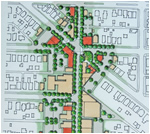
Sheridan Master PlanPlans for improving the intersection and streetscape in this area were developed during a charrette hosted by Farrell-Madden Associates. You can see the results of that charrette by clicking on the picture to the right. You’ll notice the pictures show wider sidewalks, street trees, intersection changes, etc. The next step is to develop a project plan “splitting the area into logical phases for construction” with estimates and specifications for each phase. That’s what Councilwoman Van Auken asked for this evening.

But the council voted it down 6-5. Ardis, Turner, Gulley, Jacob, Montelongo, and Spears Spain voted against it. Van Auken, Sandberg, Manning, Spain Spears, and Nichting voted for it.

Why? I’m certain I don’t know. It appears they voted it down because it’s too close to the next budget cycle. Councilman Clyde Gulley kept talking about the Griswold Improvement Project — for which there is $0 in the 2007 budget — that the council voted against funding earlier this year because it would have been a budget amendment. He somehow thinks the two projects are analogous, and since the council voted down his street improvement project, he’s going to vote against everyone else’s. Other council members said we need to set priorities before spending that much money — as if they didn’t already set the priorities for 2007 in the 2007 budget.

So now, evidently the money set aside for improving the Heart of Peoria area this year will not get spent.


$5.5 million bathrooms

The Journal Star’s editorial today is dedicated to criticizing Councilwoman Van Auken and her remark that the city should sell the Gateway building because “Government should not own buildings or property except for government use.” Granted, that wasn’t the best argument she could have given, and the editors of the Journal Star have fun dissecting her logic.

But what the editors don’t do is give any good reason for keeping the Gateway building. Here’s the best they can come up with:

And we’d add that, in fact, Gateway does serve a civic purpose: That building and its restrooms were built for the benefit of the public, specifically visitors at riverfront events.

The Gateway Building is a convention and banquet facility. The only way the public gets any benefit out of it is if they rent it from the Peoria Park District for somewhere between $600 and $1,500. The public is not under-served for convention and banquet space. Besides the River Station, Packard Plaza, the Pere Marquette, and a host of other private places to rent, there’s always the gigantic expansion of the Civic Center. How much more tax-subsidized banquet space do we need?

The only things the “visitors at riverfront events” really “benefit” from for free are the public restrooms. So the question is, don’t you think $5.5 million is kind of a steep price for public restrooms? I think so. I bet if they could sell the building, they could use a small fraction of the proceeds to build some really sweet public restrooms elsewhere along the riverfront.