An economist asks, Why not have students, not schools, compete?

I ran across this site recently called the Becker-Posner Blog. It’s a blog run by Gary Becker, an economist and Nobel laureate, and Richard Posner, a judge on the United States Court of Appeals for the Seventh Circuit. Imagine a couple of guys like that having a blog, of all things!

Anyway, in an entry from 2005, Gary Becker had this to say about how to improve the education system in America, and I thought it was interesting enough to post here for discussion:

My thoughts on this are as follows: it is my belief that the current system, which rewards schools for good test scores by its students is highly ineffective. It does not encourage schools to spend money on better teachers, teacher training, or equipment. It encourages only extra preparation for tests, which rarely require “smart” skills. That is, most, if not all, of these tests, such as the MCAS in Massachusetts, require the ability to add and subtract, and maybe the knowledge of a few geometric rules (though generally, these laws are even provided), as well as the ability to write at length about a passage, or search for key words in a passage that give away its meaning. Such skills are not really helpful, nor do they build intellect; it is my opinion personally that it would be much more important for such tests to concentrate on abilities such as interpretation of history, which I believe is a vital skill, one that demonstrates actual intelligence and knowledge.

But what is more important is that no single test can determine whether or not a school is doing a good job educating its students. More so, a good education, in my experience, depends more on one’s parents than school. Parents that place a high value on education are more likely to take part in their child’s education, to help their children out, and to pressure their child’s school to improve its standards and curriculum as well. In most cases, children with parents who value education go to better schools, and receive more education outside of school.

So the question then becomes how can the government make parents care more? As is often the case, the answer lies, in my opinion, in economic stimulus. That is, instead of of offering schools money if they improve their students’ test scores, why not offer money to parents of students who do well in the form of tax breaks? First of all, this eliminates the need for tests, since the need to compare schools across the country disappears. Instead, students can be compared to other students in the same school. The government, for example, could offer $1,000 tax breaks to parents if their child finishes in the top 10% of their grade. This would stimulate parents to encourage their child’s education, both within a school and outside of it. More so, competition by definition under such a program would increase because the amount of money being distributed (and the amount of families receiving it) would be fixed, as opposed to a program that requires minimum test scores that are the same every year, resulting in a certain amount of complacency in the better schools (who cares if you get 95% or 85% as long as you pass?). And of course, competition results in better results.

There are roughly 17 million high school children in America. So that would mean that my suggested program would cost about $1.7 billion, only about 1.3% of the total money the federal government spends on education. However, it seems to me that encouraging individuals to improve their child’s education would have much greater impact on the overall level of education than telling schools to improve students’ scores on tests that do a poor job of measuring actual educational quality. In short (I know, this e-mail has not really been short), it seems clear that the federal government should be concentrating on individuals, not schools, when it implements programs to improve education in America.

I realize I’m rushing in where angels fear to tread by arguing with a Nobel laureate, but it seems to me this theory assumes an even playing field for the students/parents which obviously does not exist. Pitting the college-educated two-parent families against the high-school-drop-out single-parent households is hardly a fair fight, no matter what the prize is. That’s why the Federal government evaluates the school as a whole — to make sure that all the children are achieving. Becker’s theory would end up with the rich getting richer and the poor getting poorer.
My favorite music artist died 25 years ago today

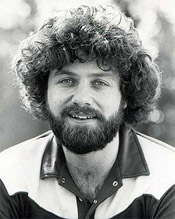
Keith Green pictureAnyone who knows me well knows that my favorite singer/songwriter is Keith Green. Most of you have probably never heard of him. My uncle got me started listening to his music when I was in my pre-teen years. I borrowed his albums (yeah, for you youngsters out there, we used to listen to music on these round vinyl things with grooves in them called “albums”) for some time. It wasn’t until my twelfth birthday that I first got my very own Keith Green album (“No Compromise“).
The next day, July 28, 1982, Keith Green died in a plane crash in Texas. He was 28.

Since this is the 25th anniversary of that fateful day, I thought I’d post a little video biography of Keith that’s out on YouTube for anyone who would like to learn a little more about him. It’s a pretty interesting story, actually, even if you’re not into Christian music.

Update (7/30): The Associated Press reported over the weekend: “EMI/Sparrow Records is painstakingly going through recordings saved by [Keith’s] wife, Melody. An iTunes release with music never before heard by the public is planned for August. More material will be released next year, said Bryan Ward, director of artist development with EMI Christian Music Group.” This is great news for Keith Green fans!

Continue reading My favorite music artist died 25 years ago today

LaHood not seeking reelection

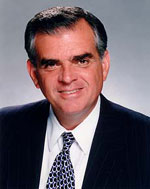
Ray LaHoodJonathan Ahl is reporting that Ray LaHood will not seek reelection when his term expires in 2009. Now that’s what I call a scoop, Mr. Ahl. Good work!

Let the speculation begin: Why isn’t he running? Who will take his place? What will he do after his term is up?

On that last question, I’m putting my money on a mayoral run. His heart is in local politics.

Be sure to go to Jonathan’s blog — he has a link to an mp3 of his interview of LaHood and it’s very interesting.

Parental responsibility laws largely unenforced, likely unconstitutional

During the “new business” portion of Tuesday’s City Council meeting, Mayor Ardis distributed a memo to all the council members that said:

I am attaching a communication that I sent to the previous council this past spring with a few examples of Parental Responsibility Ordinances being used in other cities. l would like to entertain a discussion on the need for a similar ordinance in Peoria sometime in August.

Attached to the memo were copies of ordinances from five other communities: Des Plaines, IL; Grand Rapids, MI; Royal Oak, MI; Silverton, OR; and Cincinnati, OH (repealed 2002). The council will discuss this topic at the August 28 council meeting.

Rarely Enforced

It’s not surprising that this would come up again right after an unsupervised 15-year-old threw a stone off an I-74 overpass, killing the passenger of a passing car. But how effective are these laws? According to “An Empirical Study of Parental Responsibility Laws” published just last year in the Utah Law Review, not very.

University of Oregon School of Law professor Leslie Joan Harris surveyed every police chief and prosecutor in the state of Oregon and found that “the responses to the questionnaires showed overwhelmingly that parental responsibility laws are rarely, if ever, enforced in most places.” Instead, she finds that they are generally symbolic, “enacted to articulate community values about proper parenting and to induce ‘bad’ parents to reform.” However, such laws do increase the probability that curfew laws will be more stringently enforced. She concludes (emphasis added):

Finally, parental responsibility laws define youth crime as a private problem born of familial failure rather than behavior that, at low levels, is a usual part of the maturation process and, at higher levels, may call for collective efforts to engage teenagers in positive ways, including helping parents in difficult situations. The laws provide politicians with a cheap and easy way of avoiding meaningful efforts to address significant social issues.

I’d recommend reading the whole report as it’s very interesting; it includes a brief history of parental responsibility laws over the last hundred years. It’s interesting to note that these findings are consistent with Jennifer Davis’s report in the Journal Star today. Davis has been calling the communities listed in the Mayor’s memorandum and has so far found that their ordinances are rarely, if ever, enforced as well.

Likely Unconstitutional

But there’s a bigger problem on the horizon for parental responsibility laws. On June 29, 2007, a municipal judge in Cuyahoga County, Ohio, ruled that the city of Maple Heights’s parental responsibility law is unconstitutionalbecause it violates the due process clause of the fourth amendment. (All legal documents related to this ruling are available here. Here’s a PDF version of the ruling.)

Maple Heights’s ordinance was patterned after the one in Silverton, Oregon (which is one of the ordinances being reviewed by Peoria as a possible template as well), and reads in part:

(a) A person commits the offense of failing to supervise a minor if: the person is the parent, legal guardian, or person with legal responsibility for the safety and welfare of a child under 18 years of age, and the child has committed a status offense, unruly act or a delinquent act that would be a misdemeanor or felony of any degree if committed by an adult.

(b) It shall be a defense to the offense of failure to supervise a minor if the person took reasonable steps to control the conduct of the child at the time the person is alleged to have failed to supervise.

Judge Jennifer P. Weiler explains why this does not stand constitutional muster. “The due process clause of the United States Constitution requires proof beyond a reasonable doubt of every fact necessary to constitute the offense charged.” In other words, a person is presumed innocent until proven guilty — the burden of proof is on the accuser. Weiler continues:

The substance of the Maple Heights offense is the failure to supervise a minor. However, the ordinance presumes a violation where a parent has a child who has committed an offense. It is up to the parent to demonstrate that reasonable steps were taken to control the child’s conduct. As such, it is the accused’s burden to demonstrate there was no failure to supervise. This contravenes…the due process requirements….

The ordinance also failed on two other due-process counts. Nevertheless, the City of Maple Heights filed their notice of appeal last Friday, July 20 says Blake Ledbetter of Conoscienti & Ledbetter in Atlanta, Georgia. This isn’t to say that an ordinance couldn’t be crafted that would be consistent with the constitution, but it does reveal that existing ordinances haven’t yet been adequately tested in court.

Just for the record, when I started researching this I was in favor of a parental responsibility ordinance for Peoria. I came to this topic predisposed to look for positive evidence of its efficacy. However, considering the unlikelihood of enforcement, and the questionable constitutionality of such laws, I’m now inclined to think that this is probably not a very effective tool to combat juvenile crime in Peoria.

“Mature neighborhoods” worth saving from IDOT, but not Bradley

At Tuesday’s council meeting, there was quite a bit of discussion about the Northmoor Road improvement project. If the city is going to use IDOT funds for this project, they have to follow IDOT’s rules, and in this case it would mean widening the street to five lanes between Allen and Sheridan roads. The road doesn’t need five lanes.

So, the City Council is trying to persuade IDOT to see things the city’s way and approve fewer lanes for this project, yet not jeopardize our share of federal funds in the process. This is all laudable.

I couldn’t help but notice the irony, though, when Councilwoman Barbara Van Auken started waxing eloquent about why we need to say “no” to IDOT. We need to stand up and say “no,” she said, because these five-lane highways harm “mature neighborhoods.” And if they don’t believe it harms “mature neighborhoods,” then they can come down here and a take a little tour, she continued. We need to tell IDOT that we’re not going to let them mar one more “mature neighborhood,” even if it means losing that federal money, she concluded. She made a very strong statement, and I agree wholeheartedly with it.

I just wish she’d been that bold toward Bradley University when they decided to decimate a “mature neighborhood” for the sake of a parking garage in her own district.

Arbor District Demolition

*My thanks to PeoriaIllinoisan from whom I shamelessly stole this picture.

Heart of Peoria Commission lives on

The City Council on Tuesday approved the compromise agreement that will leave the Heart of Peoria Commission intact. The compromise agreement had three parts:

  1. Approve the Heart of Peoria Commission Work Plan — The council approved this work plan with one exception: the money that’s listed in the capital budget column was not approved Tuesday, but will be requested through the normal capital budget process.
  2. Expand the Planning Commission by two positions — There are no openings currently on the Planning Commission, but it’s important to infuse New Urbanism principles into that commission since they are responsible for the Comprehensive Plan, which is the city’s vision document. Thus, in order to appoint a couple of Heart of Peoria Commission members to the Planning Commission, two new positions needed to be created, expanding the size from seven to nine members.
  3. Appointing several HOPC members to other commissions — This is what was suggested in the Committee on Commissions report: that HOPC members would be dual-appointed to other commissions in order to instill the principles of New Urbanism into the existing committee structure. The appointments that were made were:
    • Joe Richey — Planning Commission
    • Dick Schwebel — Planning Commission
    • Nancy Biggins — Zoning Board of Appeals
    • Pat Sullivan — Traffic Commission
    • Bill Washkuhn — TBD

Mayor Ardis was on WCBU’s “Outside the Horseshoe” program with Jonathan Ahl Tuesday night before the council meeting. He explained that, while he originally planned to expand the Planning Commission by four members, there was some concern from current Planning Commission members about that, and that reducing the expansion to two members was part of the compromise agreement. WCBU will eventually put that program up as a podcast, so you can check this link to see if it’s there yet.

The next Heart of Peoria Commission meeting is scheduled for Friday, August 24 at 8:00 a.m.

Journal Star blindly supports more money for D150

Peoria Public Schools logoThe Journal Star Editorial Board thinks District 150 deserves more support from the City. They think the proposal on tonight’s agenda to “share inflationary revenue growth from those properties in the [Eagle View] TIF that don’t participate in the redevelopment program” is too stingy.

They start off by saying, “The Peoria City Council should have no trouble approving an agreement with District 150 tonight that, for the first time locally, would allow the city’s largest school system to share in the proceeds from a tax increment financing district before its term is over.” First time, eh? Apparently the JSEB is unaware of or has forgotten about the $236,000 the school district receives annually from the Southtown TIF.

“That said, it’s little more than a toe in the water of the city-school cooperation that is so desperately needed if Peoria is to be an attractive place for young families,” they continue. By “cooperation,” they mean “giving money to District 150.” Never mind that the city already gives hundreds of thousands of dollars to the school system every year. Never mind that District 150 is its own taxing body — it takes the lion’s share of our property taxes every year. Never mind that, after figuring in all sources of revenue, the City of Peoria’s budget is only about $10 million more than District 150’s to start with (~$160 million vs. $150 million, respectively).

That’s not enough for the JSEB, or District 150.

If anyone at City Hall wonders why Peoria’s overall population is at best flat, and why its status in Illinois is declining even with all the new subdivisions sprouting on its northwest side in a different school district, Peoria’s core public school system is a big reason, followed closely by violent crime.

They’ve got that right. But naturally the JSEB blames the school district’s failure on the City and their TIF districts. Has the Journal Star Editorial Board ever considered the possibility that District 150 might be in the mess it is because of their own mismanagement? That maybe paying for four superintendents to do the job of one is a wee bit of a waste? That spending almost a million dollars on property they can’t use might be contributing a tad to their woes? That low testing scores and their inability to make adequate yearly progress is negatively affecting their funding more than the City of Peoria’s tax increment financing districts?

Yet some local voices are still urging the city to sever any relationship with District 150. It’s mystifying, because all involved would only be punishing themselves.

Heh. We’re being punished either way; why not save the money?

I’ve said it before and I’ll say it again, I’m all for true cooperation — but cooperation works both ways. The School Board (and evidently the JSEB, too) seems to believe that a “give and take” relationship with the city means that the city gives and the school board takes. It doesn’t work that way. I don’t think it’s asking too much for the school board to work with the city on, say, siting of an East Bluff school. Or, say, focusing on improving their test scores so they stop driving people out of the city.

More money is not the answer for District 150. Better management is. And sadly, the City has no control over that.

Ameren touts benefits of rate relief

Ameren is pleased with the new rate relief package that was unveiled yesterday. A press release from Ameren today explains why:

Gary L. Rainwater, chairman, president and chief executive officer of Ameren Corporation, noted: “This comprehensive rate relief package provides significant benefits to our Illinois electric customers, while benefiting our shareholders by providing legislative stability. It also avoids a costly, lengthy and undesirable court battle to overturn a rate freeze and power generation tax.”

That “legislative stability” is a provision of the relief package that states, “The General Assembly leadership agrees not to pass legislation that would freeze or reduce electric rates, or impose a tax, special assessment or fee on electricity generators through
Aug. 1, 2011.” So the charges of collusion are dropped and the threat of an imminent rate freeze is dropped. Ameren’s happy, and Ameren’s shareholders are happy.

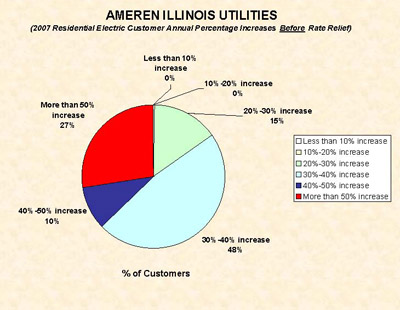
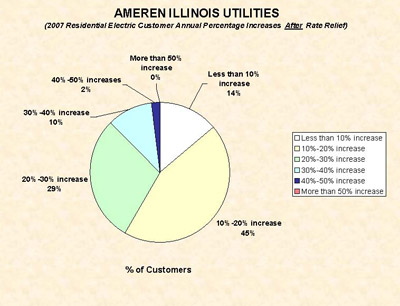
How about Ameren’s customers? I think they’re going to be happy, too. Here are a couple of pie charts that Ameren released today to show the effect this rate relief will have on customers’ electric bills:

Ameren Chart Before Rate Relief

Ameren Chart After Rate Relief

Of course these graphs only depict 2007 rate increases, since they’re phasing in the rate increases over three years (January 2007 through December 2009). To make up for the higher rates we’ve been paying since January, Ameren will be mailing us all rebate checks. Ameren has provided this graphic to explain how much we may be getting:

Typical Residential Credits

All this will be funded by the electricity-generating companies — the ones who made out like bandits in the reverse auction deal:

The $1-billion statewide rate relief package will be funded by contributions of $150 million from Ameren-affiliated companies and $800 million from Exelon-affiliated companies, with the remainder coming from other electric generating companies in the state. Ameren Corporation expects earnings per share will be reduced by approximately 26, 11, 7 and 1 cents per share in 2007, 2008, 2009 and 2010, respectively, as a result of the rate relief package.

You can read the full press release from Ameren here. The Citizens Utility Board is cautiously optimistic about this deal, and as far as I know they’re not receiving any money from the power companies this time around. So far, this appears to be a good deal for everyone. Only time will tell if it really is or not.