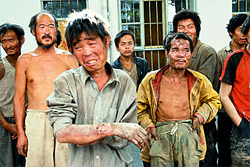
 This post is really a continuation of a conversation that started here with my post about China’s recent weaponization of space, and continued over at Knight in Dragonland’s site. Now I’m bringing it back over here because my response is essentially a new post in and of itself.
To set this up, I’m going to quote liberally from one of Knight’s recent comments because what he says is a defense of cheap overseas labor that I’ve heard many times:
Companies are going to utilize cheap labor to reduce costs, whether it’s in China or someplace else. Those workers are breaking down the doors to get those jobs because they pay many times more than they could make anywhere else in their country. Its not like those laborers will skip down the road to Shangri-La if the “evil†multinationals go away. More likely they’d end up begging on the street, picking through garbage dumps or selling their children for prostitution.
Transfers of labor save more than “a few dollars.†They save BILLIONS of dollars. A company can employ many Chinese laborers for what it would cost to employ one American, and the income for those workers often increases several-fold over what they could earn anywhere else in their own county. At the cost of one American job, 5, 10 or even 20 foreigners can vastly improve their income and the quality of life for their family. That’s what happens most often when jobs travel to cheaper labor markets … one American makes 20% less, but now ten foreigners can send their children to school and feed their entire extended family.
Do some companies take advantage of the desperation of poor foreigners and abuse them? Of course. Should those companies be held accountable? Of course. But we need to tread cautiously. Sometimes our well-meaning outrage at these “deplorable†working conditions ends up sending hundreds of workers to the streets to beg because now they have no job at all.
If I may summarize, the arguments given above basically boil down to these points: (1) We’re doing them a favor because these workers would be worse off without this labor we make possible, and (2) we must have cheap labor to keep our economy going. These arguments are not unique to Knight. I’ve heard them from many of my friends, read them in magazines, heard them propounded on TV, etc.
But I don’t buy them. I don’t accept them. I think they’re dehumanizing. I think they’re nothing more than a rationalization to help us assuage our guilt over the treatment of Chinese workers and other workers like them.
While these arguments try to paint a pretty face on Chinese labor, the truth is not so rosy. Take a look at China Labor Watch or the Congressional-Executive Commission on China report (2005) and judge for yourselves. Or read this from the 10/15/2006 San Francisco Chronicle (emphasis mine):
“The exploitation here is getting harsher”, said Han Dongfang, a union advocate with the China Labor Bulletin in Hong Kong. “On one hand we have better laws than ever. But in reality, there is no enforcement.”
Activists who try to promote change face harsh reprisals. About 35 labor activists are languishing in Chinese prisons, according to human rights groups. Pang Qing Xiang, who spent nine months in prison for organizing unpaid workers in his factory, said detainees are routinely abused.
“To them we were nothing,” said Pang, 60, who is from northeastern Liaoying province. “Certainly not people who had a right to demand anything, not even pay. When I told them work without pay is slavery, they just laughed.“
On September 4, 2005, Li Qiang wrote in the Seattle Post-Intelligencer:
Last year, total U.S. trade with China reached $231.4 billion. Of this, $196.7 billion consisted of imports from China. The reality of these imports is that they arrive on the backs of millions of Chinese workers. These workers labor six days per week (seven during peak season), 13 hours per day, for as little as 35 cents per hour. They do not have pensions or Social Security; they do not have unemployment or medical insurance. By the time they reach age 40, they start having difficulty keeping up with the heavy workload. Soon, they are left with nothing….
Rapid economic development has greatly increased demand for the consumption of energy, which has led to overexploitation in small coal mines and oil fields. To reduce the production cost, such exploitation often takes place with cheap labor and without safety measures. This condition has caused frequent safety incidents. Many lives of mining workers were lost. The cheap energies produced in this way are consumed in industrial production, particularly in export-oriented manufacture industry, which is another reason why products made in China are so cheap in the international market.
The Telegraph reported just a few days ago on 548 slave laborers — 38 of them kidnapped children — who were rescued in the Henan and Shanxi provinces of China. The article concludes, “But workers’ rights and safety continue to take second place to the need for increased economic output. China’s labour laws stipulate a 40-hour working week and that no one under the age of 16 can work in a factory, but local officials habitually turn a blind eye to poor working conditions. Fifteen-hour days are commonplace for the workers in the factories of Guangdong that turn out everything from clothes and toys to MP3 players. At the same time, China’s mines are the deadliest in the world. Last year, 4,746 miners died in accidents.”
How can anyone read these reports and not have compassion on these people? These are people we’re talking about. People with flesh and blood. Can we really, honestly sweep this away by stating “oh, yes, that would be a horrible human rights violation here, but there, well, that’s good over there.” Is human suffering somehow different if it happens in China than if it occurs in the U.S.? Does the value of human rights change with the cost of living? That’s essentially what these arguments suggest.
I think the arguments given in support of Chinese labor are weak for another reason, and that is because they’ve been made and debunked before. There was a time when the “cheap labor” that Americans sought to justify was slave labor. I don’t say this flippantly, nor am I trying to be carelessly incendiary — I’ve thought long and hard about this, and I see a very serious, clear parallel. Pro-slavery arguments from the time of the Civil War often talked about how slaves benefited from the benevolence of their masters, and how this was superior to the working conditions in the northern factories. They also talked about how slaves were content with their servitude, and used this as a defense for continuing the institution.
Ever read the Declaration of Causes of Seceding States? It’s interesting that Texas used the “we’re doing them a favor” argument. Take a look at this quote (emphasis mine):
…the servitude of the African race, as existing in these States, is mutually beneficial to both bond and free, and is abundantly authorized and justified by the experience of mankind…
And the Mississippi declaration explained how this labor was the underpinning of their economic system:
Our position is thoroughly identified with the institution of slavery — the greatest material interest of the world. Its labor supplies the product which constitutes by far the largest and most important portions of commerce of the earth. …These products have become necessities of the world, and a blow at slavery is a blow at commerce and civilization.
I would contend that the arguments made in 1861 to defend slavery are the same arguments being made today in 2007 to defend cheap overseas labor, and that the arguments are no less morally repugnant now than they were then.
Rev. John G. Fee had this retort in 1851 in response to those who claimed they bought their slaves as “an act of mercy” that kept the slaves from enduring “cruel treatment”:
Carry your mercy a little further, as the primitive Christians used to do, and let him or her have their entire liberty—their “inalienable rights.” Though you may have rescued him or her from the robber’s bands, that does not justify you in continuing to be a robber, a withholder of the “inalienable rights” of man. You are doing the same thing, in quality, that the former master was doing; the quantity of suffering is a little diminished.
I think this is directly analogous to the situation in China. If you think that the labor we provide is somehow helping them, consider that they still are being robbed of their inalienable rights. The quality of what we’re doing is the same as what they would experience without our trade, but the quantity of suffering may be “a little diminished.”
Perhaps a former slave can teach us a little something about “cheap labor” and put those words into proper perspective for us. His name is Frederick Douglass (1818-1895), and he bore the scars of slavery, both physically and symbolically. He was “cheap labor,” as we so callously call it, and he had this to say about it:
Cheap Labor, is a phrase that has no cheering music for the masses. Those who demand it, and seek to acquire it, have but little symapthy with common humanity. It is the cry of the few against the many. When we inquire who are the men that are continually vociferating for cheap labor, we find not the poor, the simple, and the lowly; not the class who dig and toil for their daily bread; not the landless, feeble, and defenseless portion of society, but the rich and powerful, the crafty and scheming, those who live by the sweat of other men’s faces, and who have no intention of cheapening labor by adding themselves to the laboring forces of society. It is the deceitful cry of the fortunate against the unfortunate, of the idle against the industrious, of the taper-fingered dandy against the hard-handed working man. Labor is a noble word, and expresses a noble idea. Cheap labor, too, seems harmless enough, sounds well to hear, and looks well upon paper.
But what does it mean? Who does it bless or benefit? The answer is already more than indicated. A moment’s thought will show that cheap labor in the mouths of those who seek it, means not cheap labor, but the opposite. It means not cheap labor, but dear labor. Not abundant labor, but scarce labor; not more work, but more workmen. It means that condition of things in which the laborers shall be so largely in excess of the work needed to be done, that the capitalist shall be able to command all the laborers he wants, at prices only enough to keep the laborer above the point of starvation. It means ease and luxury to the rich, wretchedness and misery to the poor.
Cheap labor is, in a word, exploitation. No matter how you want to try to justify it or rationalize it, it’s nothing but a euphemism for exploitation. And its acquisition is nothing of which we should be proud. The U.S. should not have normal trade relations with China until they comply with international labor standards and improve their human rights record.


 On the council’s agenda tonight is a
 The Peoria City Council has a library liaison. It used to be John Morris, but since he’s left the council, there’s a new liaison: Gary Sandberg. An inspired choice, if you ask me, considering they’re planning to spend a whole bunch of taxpayer money on capital improvements.
 I had to take my car in for service today at the Honda dealership. I decided to take the bus to work from there just to see how well our mass transit works out on the north end.