Fire Station 11 compromise in the works

Fire Truck GraphicMy sources tell me that a compromise is in the works for Fire Station 11. You may remember that a previous council cut an engine company from the station as a cost-savings move three years ago. Ever since then, every election has included the question of how/when the council will fully staff Fire Station 11.

Well, the fire department has recently been utilizing the city’s GIS system to plot response times from each of the fire stations. Basically, they map out where each fire station is and then draw a circle around it representing a four-minute response time for water coverage. When they analyzed the results of that exercise and looked at where the circles overlapped and intersected, they determined that Fire Station 11’s area of service was adequately covered by the other fire stations.

Although water coverage is good, there is another issue, and that’s Basic Life Support (BLS) calls. In that area, Fire Station 11’s coverage is not so good. Since they don’t have an engine, they have to run a ladder truck for BLS calls. Well, there are many problems with that, not the least of which is speed. People in need of basic life support need help fast, and ladder trucks are not the speediest vehicles.

But another problem is wear and tear on the vehicle. Ladder trucks cost about three quarters of a million dollars and should last 15 to 20 years, according to Fire Prevention Chief Greg Walters (I found this out while researching another story; Walters is not the source for this post). However, by sending the ladder truck out on BLS calls, that’s beating the heck out of the truck and if something doesn’t change they’ll probably have to replace that truck sooner. That kind of blows the cost savings the council was hoping to get by removing the engine company.

So, the compromise that’s being talked about is this: Instead of putting an engine company back in at Fire Station 11 (which is, I believe, 11 firefighters), they would put in, for lack of a better term, a BLS company (which would only be 5 firefighters, if I understand correctly). The BLS company would have their own vehicle, but it wouldn’t be a fire engine or the ladder truck. That would be cheaper than reinstating an engine company (5 more firefighters instead of 11), would save wear and tear on an expensive ladder truck allowing it to stay in service longer, and would adequately serve the Fire Station 11 area.

That’s all the information I have. I couldn’t find anyone willing to talk on the record about it. And I still have some questions, like why couldn’t they just add a vehicle instead of a vehicle and five more guys. If I had to speculate, I’d guess that it has something to do with the firefighters union. But I imagine those details will come out eventually. In fact, I understand it will be coming before the council sometime relatively soon. Said one person I asked for comment, “I don’t want to jinx it.”

Council Roundup: June 5, 2007

It was a looong meeting Tuesday. Here are the highlights:

  • The council surprisingly reversed course — again — on the issue of whether to charge fees for vaults and walkways that encroach on the public right-of-way. Last October they voted 8-2 to keep the fees, then last month they voted 9-1 to eliminate the fees. And tonight they voted 6-5 to keep the fees again. Well, I’m not going to complain about their fickleness too much because they made the right decision tonight. There’s no reason for the city to eliminate those fees. As Councilman Manning said, it’s not an unreasonable fee; it’s just a normal cost of doing business. And the city needs the revenue.
  • The Heart of Peoria Commission received a stay of execution for two weeks, but not a pardon. Second-district Councilwoman Barbara Van Auken made the motion to defer to allow time for the members of the various commissions and the council to come to some sort of compromise. The Heart of Peoria Commission may call a special meeting to discuss whatever compromise is brought forward.
  • A minor change was made to Mr. Abud’s liquor license conditions so he can open his grocery store on the south side of Peoria. The original agreement called for Abud to hire off-duty Peoria police officers to patrol the business during all hours of operation. The revised agreement only requires officers to provide security from 2:30 p.m. until the store closes (10:00 p.m.). This is a reasonable request, in my opinion. The goal is to provide a secure environment, and I think this accomplishes that end.
  • The council approved reducing their meetings to twice a month. It wasn’t mentioned last night, but I heard on the news today that the new schedule will start in July. Under the new schedule, the council will meet on the second and fourth Tuesdays of the month. I predict that schedule will last one year or less.
  • The council deferred a request from Councilman Gulley to appropriate funds for the improvement of Griswold Street on the south side. This is a budget amendment right before the council is getting ready to negotiate next year’s budget, so some think the timing is wrong. Others want to know what projects are going to be delayed by allocating money to this project instead. There will be a report back next week.
  • It wasn’t mentioned in the meeting, but I heard afterwards that a new website was launched for the Peoria Promise. Check it out.

The incredible shrinking museum

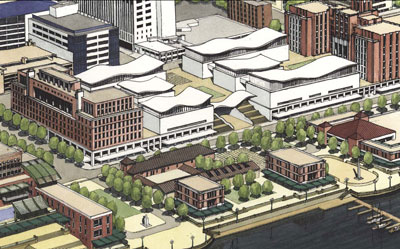
Reading Polly Peoria’s latest post reminded me of a rumor I heard about the Peoria Riverfront Museum: it’s getting smaller.

You know they’ve been having a little trouble raising the money for this monstrosity, the plans for which are antithetical to the Heart of Peoria Plan. Rather than taking that as a hint that maybe people aren’t really as excited about this project as they thought they were, they’ve now (I’ve been told) begun cutting construction costs by making it smaller. Specifically, I hear they’ve cut it down to a one-story building except for the generic-IMAX part. Won’t that look inspiring? Maybe they can put up a weather vane and plant some prairie grass next to it to complete the anatopism.

So let’s think about this for a minute. First, the idea was to use just a portion of the old Sears block for a Peoria history museum sponsored by the Peoria Historical Society. Then Lakeview got involved and it mushroomed into a mega-museum that would include art, history, science, nature, a digital big-screen theater ala IMAX (but not actually IMAX), the African American Hall of Fame, the IHSA Peak Performance Center, and a partridge in a pear tree. All this in only 70,000 square feet. And now they want to make all that fit in an even smaller space?

Why don’t they just admit they bit off more than they could chew and go back to the drawing board? If they root around the drawing board long enough they may even happen upon this:

Peoria Chronicle is on the air

Vintage MicCouncilman Bob Manning and I are Jonathan Ahl’s guests on Outside the Horseshoe tonight on WCBU (89.9 FM). I won’t actually be wearing my “blogger” hat for this interview, but rather my “Heart of Peoria Commission” hat, since that will be the main topic of discussion. Depending on how the council votes tonight, this may be my last day as a Heart of Peoria commissioner.

The Journal Star editorial board today came out in favor of keeping the Heart of Peoria Commission. My thanks to them for their support.

City and School Board should make a deal

Peoria Public Schools logoI read with amusement the Journal Star’s report on the school board not supporting the proposed TIF districts for the Warehouse District and Eagle View.

The school district, however, is interested in sharing some of the tax proceeds or securing a commitment that some funds will be directed toward the area around a school planned for South Peoria.

So now they want to work with the city. You gotta love a school board whose definition of “give and take” is that the city gives and the school board takes. My initial reaction was that the city should show District 150 as much respect and willingness to compromise as the school board showed the city regarding the location of a new school in the East Bluff.

But on second thought, I think the city should use this opportunity to negotiate. The school board wants the city to share property tax proceeds from the TIFs. The city wants the new East Bluff replacement school to be located on the site of the current Glen Oak School and be urban in design. If the school board will agree to the city’s desires, then I see no reason the city shouldn’t agree to the school board’s desires, do you?

Let’s make a deal!

LaHood for President

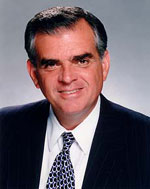
Ray LaHoodPresident of Bradley University, of course. I’m officially throwing my support behind LaHood’s efforts to get the job.

I understand if Mr. LaHood gets the job, he will resign Congress and a special election would be held to replace him. That sounds like a win-win for everybody.

I’m generally a Republican, but I’ve been disappointed in LaHood for a few reasons. One is his defense of congressional earmarks — a practice I think is corrupt and wastes our tax money. If a project is worthy of federal funding, it should be able to withstand scrutiny as a separate bill or part of a related bill subject to debate. It shouldn’t have to be tacked on secretly. Earmarks grease the wheels for pork-barrel spending.

Another reason I’ve been disappointed is because he’s thwarted efforts to improve transportation in Peoria. He shot down funding for a Chicago-Peoria highway, and he recently spoke disparagingly about plans to try to lure Amtrak back to Peoria. And, of course, he’s been a proponent of mothballing the Kellar Branch rail line and turning it into a hiking/biking trail, even though we need that rail infrastructure to keep businesses in Pioneer Park and lure new businesses to Growth Cell Two.

And then there were his comments during the Mark-Foley/congressional-page scandal. You may remember his solution to the problem was to get rid of the pages. I suppose if there were no pages, there would be no one for Foley to harass, but isn’t that essentially blaming the victims? He also supported Dennis Hastert, then Speaker of the House, who should have taken action against Foley sooner.

I could go on, but you get the idea.

Besides, it appears LaHood is more interested in local politics than national affairs, so having him get a local job seems only fitting. He can still lead efforts to oust Election Commissioners, join forces with the Recreational Trail Advocates on the Kellar Branch issue, and try unsuccessfully to broker compromises between the city and the school board. But he would be out of Congress, and that would give Peoria the opportunity to have a representative with better judgment.

No philosopher-kings for President

Until philosophers are kings, or the kings and princes
of this world have the spirit and power of philosophy . . .
cities will never have rest from their evils . . . .
–Plato

I listened to the Democratic candidates for President debate each other on CNN Sunday night. Suffice it to say none of them have the “spirit and power of philosophy,” as Plato phrased it.

They spent a good portion of their precious on-air time imprecating President Bush. You’d think they were running against him. They spent the rest of their time trying to differentiate themselves from each other — unsuccessfully, for the most part. There are some subtle differences, but they’re largely indistinguishable.

I have a sneaking suspicion that the Republican debate on Tuesday will be no better.

It’s too bad there aren’t more confidence-inspiring candidates out there today. But my guess is that those best-qualified to be President just aren’t electable in a country that elevates image over depth, witty retorts over reasoned dialogue, and one-dimensional sound-bytes over nuanced policy discussions.

I suppose it’s always been that way to some extent, but it’s worse than ever now. Consider the fact that a candidate can get knocked out of the race by simply shouting “Yeeaah” on camera. There were lots of reasons not to vote for Howard Dean, but showing exuberance at a political rally wasn’t one of them.

42-year veteran of the Postal Service retires

Joel D. Summers, June 2, 2007

When my dad, Joel Summers, began working at the U. S. Post Office in Peoria in 1965, a stamp only cost five cents, the mail was hand-sorted, and a letter carrier was known as a “postman” or “mailman” because that’s what they were at that time — all men. Now a stamp costs 41 cents, the mail is largely sorted by machine, and many letter carriers and most of the supervisors are women. On Saturday, June 2, Mr. Summers cleaned out his locker and punched out for the last time, completing 41 years and 11 months of service with the post office. He plans to stay in Peoria for his retirement.

Things were different then

Like most new employees of the post office in 1965, Dad started as a “sub,” filling in for the “regulars.” The post office was then located in what’s known now as the Federal Building at Main and Monroe. Soon after starting, he moved to the parcel post area. Ever heard of parcel post? If you’re my age or younger, I bet you haven’t. Today, all the letter carriers have their own trucks and all the mail is delivered at the same time once a day, but it wasn’t always that way.

In 1965, letter carriers would start their day by sorting the mail so it was in the right order for delivery. Then they would load it into three or so mailbags. The carrier would then ride the bus (yes, the bus!) to his appointed route carrying the first mailbag with him. The mailbag got him on the bus for free. Since carriers were on foot and had no truck, they only carried letters and flats (e.g., magazines), but no parcels. The parcels were delivered to homes separately by parcel post carriers, who were the only ones with trucks.

In addition to delivering parcels, the parcel post drivers would also deliver the rest of the carriers’ mail to them by leaving the extra mailbags in what were called “relay boxes.” Relay boxes looked just like big mailboxes you’d see on a street corner, only there was no slot for putting the mail in, and they were painted green instead of red and blue. After a carrier finished delivering his first bag of mail, he would go to the relay box and open it with his key to retrieve the next bag of mail that was left there by a parcel post driver.

So, my dad would deliver mailbags to relay boxes in the morning, and large packages (parcels) to businesses and residences in the afternoon. He did that until he became a “regular” and was able to bid on a route and become a letter carrier. His first route was in the East Bluff, delivering to homes on McClure, Arcadia, and the surrounding area. He had that route for about two years. At that same time (about 1968), the post office did away with parcel post deliveries and went to the current system of each carrier having his own truck and delivering letters and parcels together.

Finding a wife and a home through work

Shortly before he got his first route, my dad met a girl named Lorena Roberson who was working at the post office as a clerk. Three months after their first date, they got married on December 30, 1967, and they’ve been married ever since. I came along about two and a half years later. My mom quit the post office immediately after getting married to take care of her new family (my dad had a four-year-old son from a previous marriage, so my mom was not only a new wife, but a new mommy, too).

At the end of 1970, Dad got a new route delivering mail in a neighborhood called Sherwood Forest on what was then the edge of town — off War Memorial Drive just north of where the Glen Hollow shopping center is today. It was while he was delivering that route in 1971 that he found the house on Big Hollow Road where I grew up and my parents still live today. He carried that walking route — through rain, snow, heat, and gloom of night — for 22 years before finally getting a “mounted route” (meaning he could just drive up to the mailboxes instead of having to walk up to each house) in the Edgewild subdivision off north Knoxville fourteen and a half years ago.

Vehicles and uniforms are different now

Some of the changes I’ve noticed through the years: Dad’s mail truck used to be a Jeep with the steering wheel on the right side — that was the best-looking mail truck the post office ever had. Now they drive a Grumman Long-Life Vehicle, or “LLV” for short. That’s the vehicle you see in the picture above.

The uniform has changed significantly, too. When I was growing up, Dad wore a hat with a badge on it that made him look like a policeman (at the time), a necktie, polished leather shoes, and a chain with lots of keys on it connected to his belt. His shirt was always pressed and tucked in, and he looked very spiffy. Today, the uniform standards have really gone to pot. The hat has been replaced with a ball cap, the leather shoes have been replaced with black tennis shoes, no tie is required anymore, and many of the letter carriers I see walking around town don’t even tuck in their shirt, which looks pretty sloppy, if you ask me.

A faithful worker

When my dad started working at the post office, I mentioned that he worked at the building at Main and Monroe. After that, he worked at the “annex” which is right next to Kelleher’s today. Then he worked at the West Glen station for a long time — that’s at Glen and Sheridan next to the Red Carpet Car Wash. When he worked at that station, he would ride his bike to work. One morning, his hat started to fly off as he was coming down the hill toward the station. As he reached up to catch it, he applied the front brakes too hard and tumbled over the handlebars of his bike and was quite a mess. He came into work bleeding yet tried to convince them he would be alright and could work. As it turned out, he had to get stitches in his upper lip.

But that’s the kind of worker he was. He very, very rarely called in sick, and the post office lets you accumulate your sick time from year to year up to, I believe, a year’s-worth of sick time. He had that much in reserve because he was always there; he had to be practically on his death bed to call in sick. He worked a lot of overtime, a lot of days off. But he wasn’t all work and no play. He took four weeks of vacation every June and would take the family on vacation. Those were a lot of fun. Although my behavior on a certain trip to Florida when I was three convinced him not to have any more children, so I guess they weren’t all as much fun for him. 🙂
The future

Since he always took most of June off for vacation anyway, things don’t seem too different right now for Dad. But when July rolls around, he says it will probably start to sink in, since he won’t be going back. He doesn’t have any big plans for retirement. He’s not moving to Florida or Arizona. He’s not buying an RV and roaming the country. My parents will spend more time with their grandkids (they see my kids often enough, but their other grandkids — my nieces and nephews — live in Ohio), work on their garden, visit friends, travel, and just do what they enjoy. Dad says he’s going to play it by ear.

I think he’s earned it. Congratulations on your retirement, Dad.

Glen Oak landmark designations to be deferred again

The City’s Historic Preservation Commission voted to recommend landmarking nine items in Glen Oak Park. On April 24, that recommendation came before the City Council and was deferred until June 5 to give the Park District time to develop their own historic preservation policy. The Park Board has asked that the city defer this item two more weeks — until June 19 — because they are scheduled to take action on this issue at their June 13 meeting.

My only suggestion: If the council approves the request to only meeting the second and fourth Tuesdays of each month, better defer this item to the 26th instead.