
Heights hears about trolley; also, I meet a JS editor

Trolley in MemphisThere was a special meeting of Peoria Heights’ Board of Trustees tonight. The topic? The Kellar Branch. They wanted to hear from Pioneer Railcorp and the Illinois Prairie Railroad Foundation (IPRRF) about the possibility of running a trolley on the embattled line.

Mike Carr, CEO of Pioneer, gave the main presentation to the board and Sharon Deckard, President of IPRRF, gave some additional info at the end. Then they both answered questions from the board and the audience. You can see a PDF copy (2MB file) of their PowerPoint presentation* by clicking here.

Heights Mayor Mark Allen explained that this was an informational meeting meant to help the Village Board make an informed decision about the future of the Kellar Branch. In two weeks, on March 28, there will be another special meeting where the Park District and trail advocates will be allowed to present their plan for a trail only going through the corridor and why they think that will be best for the Heights.

Carr and Deckard explained how trolleys had been successful in large and small cities and had in all cases led to economic development along the trolley rail’s corridor. In addition to the benefits of a tourist trolley, it was also emphasized that increased congestion, city expansion, and rising gas prices would lead to the demand for more public transportation options in the future, and having a rail corridor through town is an asset to preserve for future commuter use.

Judging from the reaction of the audience, which was heavily stacked with trail supporters, not many people believed the presentation. But hey, they all laughed at Christopher Columbus when he said the world was round, as Gershwin would say. Mayor Allen explained that a feasibility study would have to be done before a final decision was made. But now’s the time to do it — before the tracks are torn up — because once they’re gone, they’re gone forever.

Well, technically, the land lease with the Park District allows the proposed trail to be reconverted back to rail use at any point in the future, but the costs of relaying the tracks and reimbursing the Park District for construction of the trail would be so astronomical as to make that option completely unfeasible.

After the meeting, I went to Peoria Pizza Works with Sharon Deckard, Gary Sandberg, David Jordan, a couple other railfans, and — are you ready for this? — Christine Smith of the Journal Star Editorial Board and her date. It was actually quite fun to get to talk to her, since I regularly lambaste the editorial page of Peoria’s newspaper of record.

You know what? I like her. Even though we don’t agree, and probably never will, about the Kellar Branch, she was very personable and likes to play devil’s advocate, which is one of my favorite pasttimes. I found out that she and Bailey (the senior editor of the PJS) both read my blog, which was flattering, although one could make the argument that they just do that as part of their job. Fair enough. It’s still nice to be read. 🙂

Since Shelley Epstein retired, there have been only two editors — Smith and Bailey. I joked that if one more editor left, we’d all know who was writing the unsigned editorials. I found out that Bailey edits Smith’s editorials, so that’s why they all sound like Bailey’s voice to some degree. I also found out that Smith wrote the “Bradley is not the bogeyman” editorial. We talked a little about that… but I digress.

Smith thinks the trolley idea is completely crazy. She doesn’t think it will get any ridership — that no one is going to be interested in riding a trolley… at least, not enough people to make it profitable. But she did admit that it’s worth doing a feasibility study on it; she just thinks it will vindicate her belief that it’s totally nuts. I say, bring it on.

*Full disclosure: I created the slides for the PowerPoint presentation. And yes, Pioneer will be paying me for my work in creating those slides. This is the first time I’ve done any work for them or received any payment of monetary or non-monetary value.

Chronicle computer kaput

GravesDisaster befell the Peoria Chronicle technology department on Sunday, March 11, 2007.
My beloved one-year-old son James found a glass of soda tonight and proceeded to dump it onto my laptop keyboard this afternoon — a cold-blooded execution of the most expensive and data-sensitive electronic gadget I own. My only hope is that the hard drive and the data it contains are salvageable.

Please observe a moment of silence for my departed Dell Inspiron 1100. It served me and my wife well these past several years and did not deserve such an ignoble death.

I’m posting from my work computer this evening. I came in to look at new Dell laptops online, how long they take to ship, and what the credit terms are. I won’t be posting much in the next few days — just what I can post from work before/after working hours. I’ll still be able to get my e-mail over the web at work and other various computers.

R.I.P., my faithful laptop.

UPDATE (3/12): On my lunch break, I bought an enclosure for my laptop’s hard drive and I’m happy to report that all the data is intact.

My humble suggestion for Bradley’s Plan

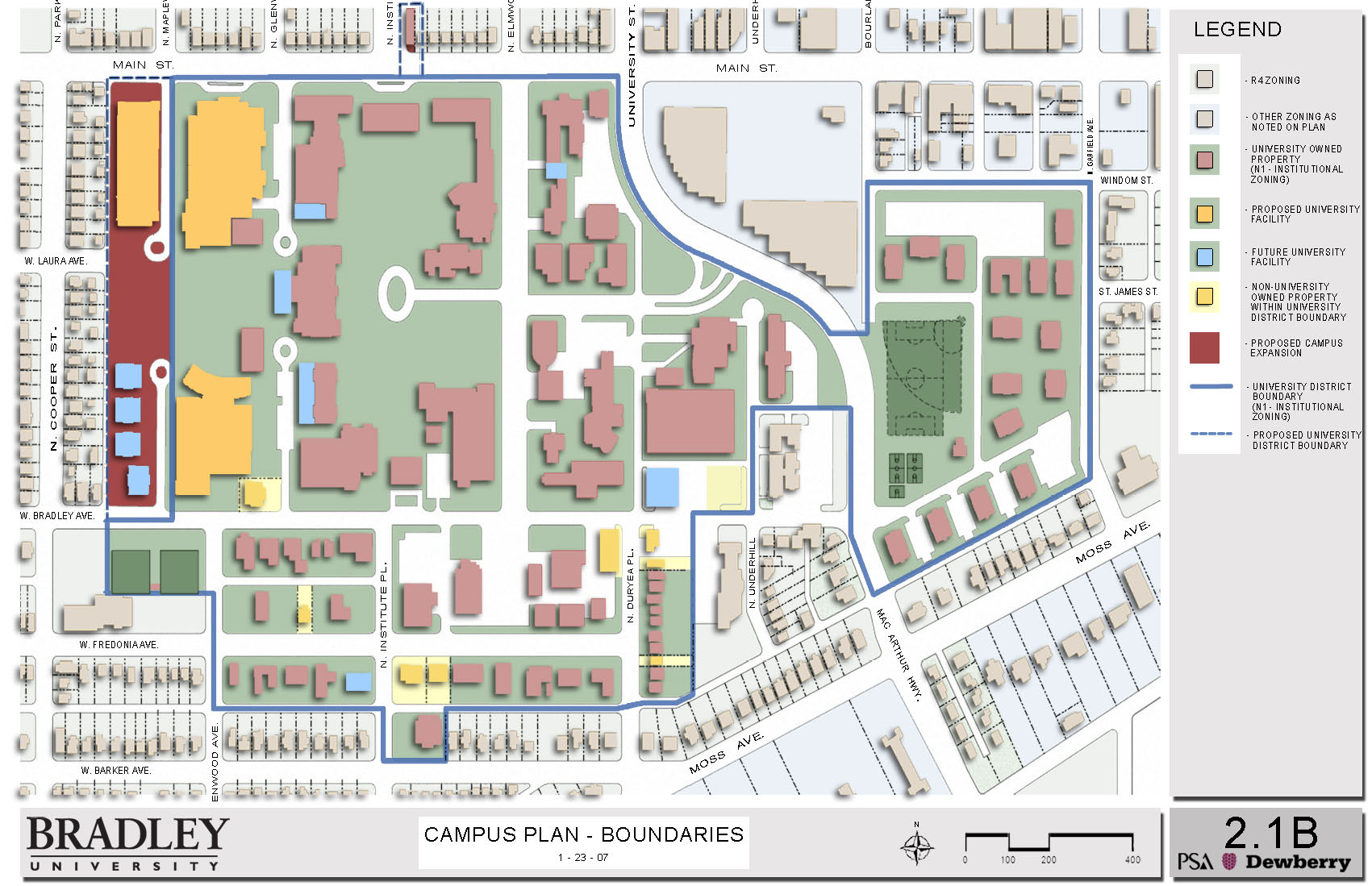
Campus Plan - BoundariesI was reading Bradley’s plan again that will go before the City Council next Tuesday. I’ve been a pretty harsh critic of the university’s tactics, especially as they impact the Arbor District. But after thinking it over, I’ve come to a couple of conclusions, and subsequently come up with an idea that I, of course, think is brilliant.

First, I believe that there are two issues regarding Bradley’s tactics. One is the way they surreptitiously purchased the properties on Maplewood. But the other has to do with their use of those properties. They want to put a five story parking deck there, right behind the houses on Cooper with nothing more than an alley and 25 feet of buffer separating them.

I’m convinced that the way Bradley acquired the properties on Maplewood might have been forgiven if their use for that land were more reasonable, more suitable as a transition from institutional zoning to residential.

To that end, I’ve devised a compromise. In Bradley’s plan, I noticed that the height of the new student recreational complex is only 48 feet, whereas the parking deck is 66 feet. So, why not switch the two sites? I know this would require some redesign work (especially on the rec center because it’s too wide for the parcel I’m suggesting in its current configuration), but seriously, this has numerous advantages:

  • The recreational complex would, in my plan, be located on the southwest corner of Main and Maplewood. The most obvious advantage is that the height of the buildings going from the new arena to the neighborhood would decline. The new arena (replacing the Fieldhouse) would be 66 feet tall, then the athletic facility would be 48 feet, and then the houses on Cooper which are probably in around 30 feet tall. This would make a more reasonable transition and not feel nearly as oppressive.
  • The parking deck in my scenario would then be located at the northeast corner of Maplewood and Bradley Avenue. If the university didn’t vacate Maplewood, but let it continue to be a through-street, this would allow deck traffic to dissipate in three directions: west on Bradley to Western, east on Bradley to University, and north on Maplewood to Main. This would ease the congestion of constricting traffic flow to Main only (the way the current plan does).
  • This would make Main Street more attractive. There’s nothing uglier than a parking deck right on your main drag.
  • The recreational center will be closer to Bradley Park, making it easier to access all the outdoor amenities it has to offer students.
  • The parking would be moved to the interior of the institutional boundaries — in fact, the parking would be kept within the current N1 boundary and further away from the neighbors.
  • By changing a major component of their plan, the university would take the first step toward rebuilding trust with the neighbors, as it would mark the first time it made major concessions for the sake of neighborhood stability.

I’m still not condoning the university’s encroachment into the Arbor District. Ideally, I’d like to see them come up with a way to do all the stuff they want to do within their existing boundary and leave Maplewood alone. But I’m offering this idea as a compromise.

And I know Bradley won’t voluntarily do this, either. So, I guess I’m suggesting that the City Council press the issue. I’m not suggesting that they take a confrontational tack with the university, but rather come at it from a collaborative angle. That they say, “Bradley, we’re excited that you’re offering more amenities for your students — it’s good for Bradley, and it’s good for Peoria. We want to see you succeed. All we need to do is reconfigure things a little to make it more suitable for transitioning into the neighborhoods, because strong neighborhoods are also important to Peoria and Bradley….”

And then Bradley will squawk about time lines and when they can build and all that stuff. But you know what? This is a 15-20 year plan. A couple months delay isn’t going to blow it out of the water. Yes, it will be a big inconvenience and time lines will have to be redone and costs will go up, but I think the neighbors are worth a little inconvenience on the university’s part, don’t you?

All the plans are only on paper at this point and can still be changed with relatively little expense compared to the total cost of the construction project. Why not explore some other options that would support the neighborhoods a little more?

The first quadrennial At-Large Prediction Contest

On the suggestion of my good friend Mahkno, I’m going to tear a page out of the Journal-Star-Cue-Section playbook and open up this thread for At-Large City Council Member predictions.

This will be kind of like the Movie Match contest the Journal Star does every year, only there are no prizes — just the satisfaction of knowing you called it right. Here’s how it works:

In the comments section, type who you think will be the five winning candidates in order of finishing in the April 17 general election. After the election, I’ll post the names (or pseudonyms, as the case may be) of those who either got it spot-on or came the closest to the actual results.

Fortune Cookie

Good news: You don’t have to guess how many votes they’ll get or how wide the margin of victory will be. Just the names in the correct order. No wagering, please.

Good luck, everyone, and let the games begin!

Uplands still opposes N1 zoning

No N1It was a long meeting tonight (a little over two hours), but in the end the Uplands Residential Association reaffirmed last month’s vote to oppose N1 zoning for the Pi Phi house at the corner of Institute and Main.

Our second district councilperson Barbara Van Auken couldn’t be here tonight since she’s out of town, so at-large councilman Gary Sandberg stood in for her, explaining what could happen to the property if it were rezoned or not rezoned. He had clearly done a lot of research on the issue and his comments were very helpful. Also visiting the neighborhood association meeting was at-large councilman George Jacob, who even brought his wife along.

The meeting was very civil and organized. No yelling or fighting. There were good arguments made on both sides. But when it came right down to it, the majority of homeowners just don’t trust Bradley. They haven’t earned our trust. And that’s largely why the N1 zoning request was defeated.

Bradley has stated that they will abide by the wishes of the neighborhood association, so I expect they will not ask for this property to be rezoned at April’s Zoning Commission hearing or any subsequent hearings (in the near future at least).

UPDATE (3/9): As if to provide final vindication that the Uplands made the right decision last night, the Journal Star published an editorial this morning in favor of institutional zoning for the Pi Phi house. Since they’re for it, we clearly made the right decision by voting against it.

They titled their editorial “Bradley is not the bogeyman.” This from the same company that has launched a massive “Save the Journal Star” campaign. Perhaps I should write an editorial of my own called, “Copley Press is not the bogeyman,” and tell the workers there “to relax.” 🙂

They argue that Bradley has been a good neighbor and quote Gary Anna’s assurance that Bradley is “not looking to encroach into the Uplands.” And if you believe Gary Anna, I have a bridge in Brooklyn you might be interested in purchasing. Seriously, I’m sure they’re not looking to encroach right now, but 10-15 years from now, after Gary Anna is gone and a new administration is in place, things will change. We don’t need the precedent.

Potpourri Post

I’m not really in the mood to do a lot of in-depth research on some recent topics in the news, so I’m just going to throw some stuff out there for discussion today.

  • Rod Blagojevich wants to replace the corporate income tax with a gross receipts tax (GRT) and raise payroll taxes. The biggest reason for these changes is so Illinois can provide health care for everyone. I more or less agree with the Journal Star’s editorial on this. As a friend of mine put it recently, Blagojevich is playing on the ignorant among us — those who think that massive tax increases on businesses won’t impact them personally. Of course it impacts them/us — businesses hire fewer people and pass on as much of their increased costs to the consumer as the market will bear. The Chicago Sun Times has a good article on the GRT.
  • I saw on WEEK.com last night that a kindergarten teacher was assaulted yesterday. A kindergarten teacher. Assaulted. By another adult. In the classroom. Think about that for a minute. It’s not enough that we have kids who bring guns to school, now we have an adult that just waltzes in and starts beating a teacher? A kindergarten teacher! We’re on the threshold of anarchy here.
  • If you’ve never read Woodford Tax Facts blog before, you should take a look. They have well-researched and interesting posts, like this one on the history of property taxes in Illinois.
  • PeoriaIllinoisan is keeping up on developments along Main Street. Anyone know what, if anything, is going to be built at the site of the old Steak ‘n’ Shake and the adjacent properties now that the apartments have been razed?
  • Tonight is the Uplands Residential Association meeting where we will be discussing Bradley’s request to rezone the Pi Beta Phi Sorority house N1 (institutional). The last vote we took was to deny, but it was sparsely attended. Now that there’s been more press coverage, I expect there will be a larger group tonight, so there’s no telling which way the vote will go. Some think it would help bring stability to that property, which it probably will — for that property, and in the short term. But I don’t think it will do much to stabilize the properties around it and will give Bradley a beachhead on the north side of Main, making it easier to expand in the future. I’ll be voting against N1 zoning tonight.
  • I’ll be immersing myself in the city’s sign ordinance in the coming weeks. I’ve been appointed to an ad hoc committee that will be looking at that portion of the Land Development Code dealing with signs on businesses. Officially, it’s called the “Form-Based District Sign Review Committee,” and we’ll be meeting a few times in March and April. I expect I’ll learn more about the sign business than I ever thought possible.
  • One of my favorite online journals, The New Atlantis has an interesting article on electronic toys (aka, “robo-toys”) and their effect on children.
  • Baseball season is just around the corner, and it’s time for the World Champion St. Louis Cardinals to defend their title. Which reminds me, I thought it was nice of the Cubs to put this up on their marquee:
Chicago Cubs congratulate Cardinals

😉

A Matter of Trust

I was re-reading Bradley’s original 1991 institutional plan. At that time, they had a committee that consisted of two representatives each from Bradley University, the Arbor District (then called “Bradley West”), Moss-Bradley, and the Uplands, plus the president of the West Bluff Council. How did this work? Here’s how they explained it:

II. The Process
At the onset, the Committee agreed to:

  • A. Review Neighborhood/University issues
  • B. Identify those issues which could be addressed via the institutional plan
  • C. Openly discuss the issues with the pupose of seeking meaningful and long-term solutions

To accomplish its objective, the Committee also agreed that the process should initially involve only committee members. This approach was thought best because open dialogue could occur and sensitive issues could be discussed. Further, matters of a confidential nature (particularly dealing with property) could be addressed and considered as necessary. It was the Committee’s consensus that issues would best be initially addressed through Committee discussions rather than through the media. Upon identifying its best preliminary plan, the Committee agreed to then present it to the Neighborhoods for comment and input. Subsequently, the Committee’s timetable called for presentation of the plan to the West Bluff Council and, finally, through the process established by the City of Peoria.

Sounds like a pretty good plan, doesn’t it? I mean, it appears to solve the problem of property acquisition issues while still keeping the neighborhoods informed through their representatives. It’s an inspired plan, in my opinion. So, why didn’t the university follow it when acquiring homes on Maplewood?

At the zoning commission hearing, Vice President Gary Anna explained that the university “agonized” over this issue, but they decided to buy the houses the way they did (surreptitiously) because (a) the properties were vital to the university’s plan, and (b) if they had made their intentions known ahead of time, they probably wouldn’t have been able to afford to buy the properties and their plan would have been kaput.

Working with the neighborhoods might have ruined their plan, so they had to make a choice: do we take that chance and try to work with the neighborhoods anyway like a good neighbor, or do we pursue our plan secretly and unilaterally? Bradley chose the latter, and is not ashamed to defend their “ends-justify-the-means” method in front of the zoning commission.

The Gravel Lot

Gravel Lot at Duryea and Bradley Ave

To give further insight into Bradley’s method of doing business, there’s a gravel parking lot at the corner of Bradley Avenue and Duryea Place that was supposed to be sealcoated in 1992 to provide a dustless surface, and then paved in 1994. Here it is 15 years later and the parking lot is still gravel and dusty.

What was Mr. Anna’s response to this? Take a listen for yourself:

[audio:http://www.peoriachronicle.com/wp-content/uploads/Audio/ZC.mp3]

I know it’s a little scratchy — the city needs a better recording system. He starts out saying he’s going to respond to Commissioner Klise’s observation about the gravel lot and he admits that it should have been improved long ago because that’s what they agreed to back in 1991. Then he says:

We did pay a penalty for not doing that at one point in time. It was assessed by the city, and, as you can imagine, it was relatively inconsequential compared to what the cost of improving it would be.

It was cheaper to pay the fine than to do the work they agreed to do. So the lot remains unimproved to this day as a monument to their broken promise, their commitment to pragmatism over integrity. This is yet another example of how they have no qualms about breaking the rules when it suits their plan or their desires.

Conclusion?

How can neighborhood associations not look upon this institution with suspicion in light of these actions? What basis is there for trust? There is none. All you can do is hope to high heaven that your needs fit into their plans, because if they don’t, your neighborhood plans and needs are the ones that will get thrown away like so much rubbish.

Does Bradley do good things? Yes. Are they a good school? I think so. Does that mean that we should just approve their new plan and blindly trust that they will honor it any more than their old plan? No.

Once again, Bradley is making overtures to their neighbors, having meetings and portraying the image of an institution willing to collaborate with surrounding residents. But it’s clear from their past actions that this renewed interest will only last as long as it’s convenient for them. And at any rate, their parking deck — the most egregious part of their plan — is not negotiable.

What can be done to protect neighborhoods? At the very least, the city should set a very, very consequential fine for the slightest deviation from Bradley’s new plan, since “inconsequential” fines are meaningless. And if they ever have to pay that fine, it should be divvied up among the adjacent neighborhood associations.

Ideally, they shouldn’t even have their new plan approved, and should be forced to find a more reasonable plan — one that has more suitable segue from institutional to residential zoning than a five-story parking deck. Approving their plans with no modification basically gives the city’s blessing on their underhanded tactics and sends another message that older neighborhoods are not important to the city — not important enough to protect from wanton, unilateral encroachment, anyway.

If pressed, I’m sure Bradley is creative enough to come up with an alternative that will satisfy the needs of the university and the neighborhood. The question is, will they be pressed?

Happy Pulaski Day

Count Casimir Pulaski
Happy Casimir Pulaski Day, everyone! In honor of the “Father of the American Cavalry,” and in light of the fact that my wife is one-quarter Polish, I’m taking the day off from blogging.

You know, every year at this time, people all over Illinois ask the same question: Who in the heck was Casimir Pulaski? I encourage you to read up on this Revolutionary War hero and find out why all the kiddies get the day off from school. Then when your friends ask you who Pulaski is, you can say, “are you kidding me? You’ve never heard of Casimir Pulaski? What, did you flunk fourth grade?” And then proceed to enthrall them with stories of Pulaski’s exciting exploits at the Battle of Brandywine and Warren’s Tavern!

Well, whatever you decide to do, enjoy Illinois’ only Polish-American holiday, and I’ll see you all tomorrow.

Actions speak louder than words

In Saturday’s paper, the editors write about how terrible it is that the City of Peoria is ending its involvement with District 150’s crossing guard program, looking at water user fees that would impact the district, and moving toward establishing two new TIFs that would also impact D150. The title and main point of their editorial: “Actions speak louder than words.”

Indeed.

From the same paper, in an article on District 150’s plan to demolish three houses they purchased adjacent to Glen Oak Park:

[District treasurer Guy] Cahill said the district hasn’t abandoned its interest in building a school on that site one day, which is part of the reason why demolition is an appropriate choice.

“We never intended to have those houses there in the long-run anyway. In other words, the homes add no value to that property near or long-term,” Cahill said after the meeting.

Never mind that every neighborhood association came out against the school in the park. Never mind that the Park Board denied a land-sharing agreement that was critical for the school’s plans to locate there. Never mind that the City of Peoria, while not officially voting on it, nevertheless made clear its displeasure and even made overtures to help the district keep the school at the current Glen Oak School site. No, today we read that “the district hasn’t abandoned its interest in building a school on that site one day,” and thus will commence with demolishing the houses already purchased — a few at a time, apparently.

In other words, the school district is collectively giving Peoria the finger.

Hence, I don’t shed one tear over the actions the City has taken to start withdrawing support from District 150. It’s not like the City hasn’t tried to cooperate. In 2006, the City extended to District 150 $311,105 in operating costs, $575,000 in capital costs, and $236,000 in debt service costs — a total of $1,122,105. Did they ever ask anything from District 150 in return for that? Once: they asked that the Woodruff attendance area replacement school be built at the site of the current Glen Oak School building — and even offered to throw in $500,000 more for property acquisition to boot. Response from District 150? The finger.

You know what? Cooperation isn’t cooperation when only one party is doing the cooperating. That’s called exploitation. And that’s what District 150 is doing to the City and the taxpayers.

They need to go. Hinton needs to go. Cahill needs to go. And, frankly, the school board needs to go.

Until people are elected/hired that will truly cooperate (partner, collaborate) with others — such as the City, the taxpayers, the parents and teachers — I don’t think they should get one thin dime from the City.

Furthermore, if things don’t turn around soon, I think the Mayor should appeal to the state for authority to take over the school district just like Mayor Daley did with the Chicago public schools over a decade ago. Peoria’s public school district is getting close to a state takeover anyway — why not keep it local?

Zoning Commission approves Bradley institutional plan

Peoria’s Zoning Commission yesterday approved Bradley University’s institutional zoning plan… well, most of it, anyway. There were some properties that Bradley will be bringing back for approval at the April Zoning Commission meeting. Meanwhile, the bulk of it goes to the City Council on March 13. WHOI also reports this:

People who live in the neighborhood say the school should stay out.

“The city of Peoria needs to preserve and strengthen its older neighborhoods and putting Uplands property into Bradley’s institutional boundary will not help that preservation effort,” said Uplands neighborhood resident C.J. Summers.

Hey, I’ve heard of that guy somewhere…. Yes, my concern is over this part of Bradley’s plan:

Pi Phi houseYou see that dashed blue line that extends north across Main Street to encompass that property at the corner of Institute and Main? That’s the Pi Phi sorority house, and it is in the Uplands neighborhood. Bradley wants to include that in their institutional zone.

The Pi Phi house (1004 N. Institute) is owned by the sorority, and they want to move over near the other fraternities/sororities on Fredonia. So the plan is for Bradley to buy the Pi Phi house and do a kind of land-swap.

The Uplands Residential Association (URA) voted at their last meeting to oppose N-1 zoning for that property. That vote was reported to Bradley, and they removed the Pi Phi house from their request to the Zoning Commission, at least temporarily. So the vote at yesterday’s ZC meeting did not include the Pi Phi house.

Since the URA vote, Bradley has been working on a counteroffer, for lack of a better word. In return for the Uplands’ support for N-1 zoning, they would agree to restrict the uses of the property to offices or visiting faculty housing or some other mutually-agreeable use. The next URA meeting isn’t until March 8.

So, the way it stands is this. If the URA votes again to oppose N-1 zoning, Bradley has agreed to not try and add it to their institutional plan and will not buy the sorority property. If the URA votes to overturn their previous vote, then Bradley will go before the ZC in April to ask that the property be added to the N-1 boundaries.

Of course, the agenda for the ZC meeting yesterday said that the Pi Phi house was part of what they were voting on, which is why I went down there. It wasn’t until they got to that point on the agenda that they announced the Pi Phi house was removed from the request. But since I was already there, I went ahead and made my statement anyway. At least it’s on the record.

There are people on both sides of this issue in the Uplands. Some residents — and even Second District Councilwoman Barbara Van Auken — think it would be a good thing for Pi Phi to get N-1 zoning because the university is more responsive to code violations and other disturbances than, say, absentee landlords. Also, Bradley’s offer to restrict the use of the property appeals to some who live close by because they believe it will make things more stable.

My concern is that I believe Bradley’s restricted use offer is a short-term concession. Once they get the N-1 zoning, it’s their foot in the door for further encroachment. It would set a bad precedent. We shouldn’t be inviting Bradley across Main in the false hope that it will bring stability to the neighborhood. Expanding institutions will not bring stability, but instability. After what happened on Maplewood, if Bradley comes into the Uplands, it will make our neighborhood at the fringes more susceptible to speculation and make it harder to attract single-family residents.

We can’t just look at the short term. We have to think about long-term strategies. To let this change go through unopposed I believe would indicate we were tacitly approving future Bradley expansion into the Uplands. I don’t think that’s a message we want to communicate. We have to think about what impact this decision will have 5-10-15 years down the road, not just its immediate impact.

Incidentally, the Pi Phi house is unlikely to be returned to single-family use. It’s been a sorority at least since 1944, according to Ed Boik in the City’s Planning and Growth department. It used to be zoned as such, but zoning code changes around 1979-1981 rezoned the property R-4 (single family residential), but grandfathered in the sorority as a non-conforming use. So, short of tearing down the structure and building a single-family home, this property will probably always be non-conforming. So the fight here isn’t so much about the particular use of this property as it is the perceived encroachment of Bradley and what that might portend for the future of the neighborhood.

UPDATE: The Journal Star’s article is here. Wow, I’m getting quoted all over the place! I made it clear at the meeting, and I want to say again that I did not speak to the commission on behalf of the Uplands; I spoke only for myself as a resident. The president of our neighborhood association, Bernie Goitein, is the Uplands’ official spokesperson.