An interesting take on annexation

We always hear that annexation is good for the city because it’s “capturing” the growth just outside municipal borders. But there’s another hypothesis out there as to why municipal employees might be so gung-ho for more annexation — higher wages.

In an article originally published in 1987 for the journal “Public Choice,” Rodolfo A. Gonzalez (Department of Economics, University of California, Davis) and Stephen L. Mehay (Department of Administrative Science, Naval Postgraduate School, Monterey) concluded the following (emphasis mine):

We hypothesized that extending municipal boundaries will have a positive effect on discretionary outlays and on expenditures per capita. The evidence presented supports these hypotheses. Furthermore, municipal wages appear to be significantly increased in cities experiencing annexation growth. Therefore, we would expect to find that municipal employees are more inclined to favor annexation than the rest of the electorate. From a policy standpoint, this study suggests that significant perverse effects on fiscal efficiency may follow adoption of legal reforms that facilitate the ability of municipalities to extend their borders, or that restrict the formation of new municipalities.

The name of the article is “Municipal annexation and local monopoly power,” and if I had $30 to spare, I’d download and read the whole thing just so I could see how they came to such conclusions. But I found the abstract alone to be thought-provoking. One wonders whether there truly is a correlation here, or if these findings are simply raw cynicism.

Heart of Peoria Commission takes a position on school siting

Jennifer Davis has a great article on yesterday’s Heart of Peoria Commission meeting. She even quotes me:

Commissioner C.J. Summers noted, “The Heart of Peoria plan says our schools are perfectly located where they are now.”

Another key concern of the commission is the fear that District 150 has not fully examined whether the current school, built in 1889, can be renovated and expanded.

“By their own admission, they haven’t done a study to see if the building can be reused,” Summers said.

Just to clarify and back up those assertions, I wanted to point out that on page II.5 of the Heart of Peoria Plan, it says this (emphasis mine):

The school buildings sprinkled throughout the study area were one of the first features noted by the charrette team. The buildings are not only beautiful, but well located from the standpoint of maintaining the neighborhood structure of the city. This makes the city’s schools even more important as components of Peoria’s neighborhoods.

And on page V.15, it reiterates this point:

Finding: Peoria has maintained an architectural legacy of attractive brick school buildings, well located in its inner city neighborhoods.

So it’s indisputable that Duany Plater-Zyberk — the consultants who wrote the HOP plan — felt that Peoria’s school buildings were well-located, and that their location was an asset in our older neighborhoods.

Why is this important? Because not too long ago, the school board took out of context a book co-written by Duany (“The New Civic Art,” 2003) in which he states that “edge-schools” (those built on the edge of a neighborhood) are a good idea. Of course, the context of that recommendation was completely different than Peoria’s context. There, Duany was saying that a school placed on the edge of adjacent neighborhoods would be the best place for the school to serve both neighborhoods.

In Peoria’s case, the most compelling argument for keeping the school at the current Glen Oak School site is this picture, which was also printed in the Journal Star article (click on the picture to view the very large JPG image):

Glen Oak School attenance area

The red boundary is the attendance area; the blue dot is the current Glen Oak School site; the yellow dot is the approximate location of the proposed replacement school for the Woodruff attendance area on the edge of Glen Oak Park. The circles around each site represent 1/4-mile and 1/2-mile radii from each location. As you can see, the current Glen Oak School site is perfectly centered in the neighborhood, allowing easy accessibility and walkability for the entire attendance area. The proposed site would make it within better walking distance of the animals at the zoo, but longer commute times for the children; in fact, it would lead to increased busing or other motor transportation.

As for my other comment that they “haven’t done a study to see if the building can be reused,” I’m referring to Ken Hinton’s admission in the 9/25/06 Journal Star “Word on the Street” column where they reported, “according to Hinton himself, the district only did a preliminary review of whether the school could cost-effectively be renovated. ‘Glen Oak had a preliminary one, but not a final one,’ Hinton said Friday.”

Once the Commission’s position paper is finalized and submitted to the City, I’ll post a copy of it here for everyone to read.

UPDATE: Here it is (1.45 MB PDF file).

Peoria police response to exposé unacceptable

I’m with Scott Janz on this one. The WHOI (channel 19) news team recently did an exposé on child sex offenders who were living within 500 feet of Peoria area schools.

In Illinois, it’s illegal for child sex offenders to live within 500 feet of schools. The only exception is if the offender owned the home before the summer of 2000.

WHOI checked public records of sex offenders’ addresses in Peoria, East Peoria, Washington, and even Bloomington to see if they were complying with the law. They didn’t find any violators in Washington. The violations they found in East Peoria and Bloomington were dealt with quickly:

Two hours afters after [East Peoria Police Chief Ed] Papis learned of our findings, he sent out two officers. A man found to be living about 450 feet from an elementary school was put on notice. He now has a month to move.

Bloomington police have given a child sex offender there fourteen days.

Yet, WHOI found seven sex offenders living within 500 feet of District 150 schools. The response they got from the Peoria Police Department? Ho-hum:

“Originally it is the offenders responsibility to find some place to live that is within the legal boundaries, so they have to take some responsibility themselves,” said [Peoria Police Department spokesperson] Ann Ruggles. […]

When asked if the spokeswoman thought the department did enough, she responded: “Yeah, I do. With the personnel that we have at this point, but I don’t know what else basically we could do. I’m sure you’ve told me and I’m sure there are people out there who are in violation.” […]

“We will check those out, but the person, the convicted person should take responsibility, too. If we go out and they are found to be not compliant, then they will have to suffer the consequences,” said Ruggles.

I think we’re all aware that it is each person’s individual responsibility to obey the law, but thanks for reminding us, Ms. Ruggles. As far as your department doing enough “with the personnel that [you] have at this point,” I beg to differ. You have seven sex offenders living within 500 feet of District 150 schools. I submit to you that that fact proves your department is clearly not doing enough.

Martha Hammer is reported as being “the woman over Peoria’s sex offender registration.” So, they’re already telling you their address — how much extra time would it take to type that into the computer and see how close it is to a school? How about taking a couple officers off the seat-belt violation beat and having them work on keeping sex offenders away from children?

It is outrageous for the Peoria Police spokeswoman to shrug her shoulders and say the department is doing all it can. In a city with eight unsolved murders yet this year, this latest scandal further deteriorates our lack of confidence in the Police to enforce public safety. Take a cue from East Peoria and send officers out to address this immediately if you haven’t done so already, and then tell people what action you’ve taken.

Gerrymandering won’t be easy to reverse

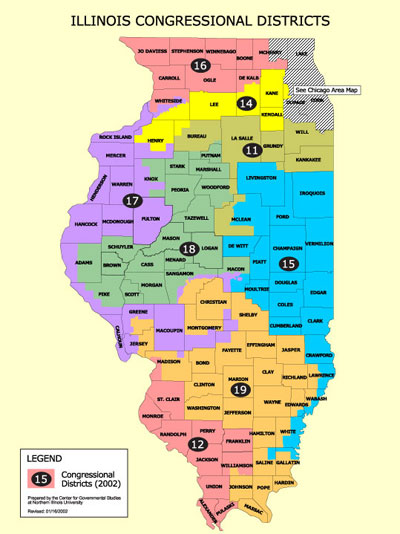
I left the League of Women Voters meeting Saturday morning a little less hopeful than when I arrived. It’s not going to be easy to change minds in Springfield about the way the legislative districts are drawn. The meeting was dedicated to exploring ways we can make the districts contiguous and compact (as the Illinois Constitution demands), unlike they are now:

The suggested action plan, as proposed by former city councilman Bruce Brown, was to “let the sun shine in.” That may not sound like much, but the fact is that most people don’t realize just how ridiculous our districts are, and when they see them for the first time, they can hardly believe it. Brown mentioned that in Iowa, where their districts are now determined by an independent Legislative Support Bureau, agitation for change began with the Des Moines Register newspaper and some concerned citizens. He also cited the increased scrutiny congressional earmarks have been getting since that process was exposed. We need to get as many people and groups as possible to see the outrageousness of the current Illinois districts, and then get those people and groups to write their legislators demanding change. If enough constituents put pressure on them, legislators will respond.

Perhaps more difficult, but more importantly, we need to hold those legislators accountable. The reason these gerrymandered districts work, as Jim Thomas pointed out, is because our voting habits are so predictable. To have real change, we’re going to have stop rewarding gerrymandering politicians with our votes.

Another possibility, but one the League seemed loathe to attempt, is to vote for a constitutional convention for Illinois in 2008. The question of whether a constitutional convention should be called must appear on the ballot at least once every 20 years, according to the Illinois Constitution. The last time a constitutional convention was on the ballot was 1988, when it was soundly defeated (only 19% voted for it). The problem with a convention is that the whole Illinois Constitution is then up for grabs, and the League members fear that Illinoisans may lose more than they gain. Call it a healthy fear of the law of unintended consequences.

The legislative map is redrawn every ten years following the census, so the next scheduled redistricting will be voted on in 2011 and take effect in 2012. Unless anyone has a better idea, I say we get the word out and start putting as much pressure on our legislators as possible.

Should government get out of the education business?

Here’s an article sure to get you thinking. It’s called “Enterprising Education: Doing Away with the Public School System” (PDF file), by Andrew Young and Walter Block. Here’s their summary of their argument:

We critically examine the accepted notion that primary education is a legitimate and necessary function of the state. The notion is based upon three tenets: 1) public education is a necessary condition for democracy, 2) the market will not provide equal access and quality of education to all, and 3) education represents an external economy. Each tenet is addressed and evaluated according to its merits. In doing so, we also contrast the fulfillment of the ends implicit in the tenets under state and market provisions. We conclude that the state provision of primary education cannot be justified by these goals, and that market provision is a preferable alternative.

That’s right. They argue that government should get completely out of the schooling business. They don’t consider half-measures like District 150’s contract with Edison Schools a truly free-market solution. In their opinion, all government involvement in education should be completely eliminated and free market allowed to reign supreme.

Shocking? Brilliant? Absurd? I would encourage you to read the whole article before passing judgment on it. I will say that I think they make some excellent points, even if I don’t agree with their ultimate conclusion. But before positing details of my own opinion, I’d like to hear what my readers think of Young & Block’s article.

I love articles like this that challenge fundamental assumptions. Be honest; have you ever heard anyone seriously argue against public education? I hadn’t. I think that going back to square one, so to speak, can help us clarify our thinking about public education and maybe even lead to some novel solutions to its challenges.

Illinois Prairie Railroad Foundation lobbies STB to save Kellar Branch

In a recent filing (large PDF file) with the Surface Transportation Board (STB), which has yet to rule on the fate of the Kellar Branch rail line, the Illinois Prairie Railroad Foundation (IPRRF) claims the right-of-way can be shared by the rail line and the proposed Rock Island Trail extension:

We have done extensive investigation into the situation and do believe and can support the fact that the trail and rail line can share a joint right-of-way. Very little of the trail would have to be moved over a block or two along the way to accommodate it. The actual length of the rail line is 8.29 miles and the trail advocates want less than four miles of that.

Peoria Park District officials claim that running the trail next to the rail is too expensive because the right-of-way is too narrow. They say the trail has to be built to AASHTO (American Association of State Highway and Transportation Officials) standards, which require a 14-foot-wide paved trail, plus five feet of setback from the rail line. They further claim that avoiding narrow portions of the right-of-way by moving the trail to the street would make them ineligible for their grant money. The Illinois Bicycle Path Grant Program requires “land acquisition or trail development [be] along a single trail corridor” (emphasis in original) to be eligible for funding.

The IPRRF also says that plans are in the works to provide passenger service along the line:

We are also working with a number of groups in the area to use the Kellar Branch for a park-n-ride trolley for use as a tourist draw and also to provide commuter rail service if deemed feasible by the community. Along with its continuing use for rail freight service, the Kellar Branch right-of-way would provide three different functions.

This would be beneficial for all of Peoria and not just for a select few. It will increase economic development in the area and also assist in increasing the local tax base.

IPRRF’s filing reviews the other reasons for retaining service on the Kellar, including continued support of Carver Lumber, the ability to attract more business to Pioneer Park and Growth Cell Two, and the presence of a willing carrier and buyer/lessee (Pioneer Railcorp).

My take: If the trail is too expensive to build next to the rail line then it shouldn’t be built at all. IPRRF and others have made a compelling case for keeping rail service along the line. Greater economic benefit can come from running freight over the right-of-way and attracting new business with good-paying jobs than making it a running/biking path that would very likely cost 50 jobs.

Conventional wisdom propounded by the newspaper is that we need this linear park because the gap in the Toulon-to-Morton trail is “embarrassing.” But that supposed “need” is completely contrived. The Peoria Park District currently holds approximately 9,000 acreas of parkland — that’s more land the entire Heart of Peoria area! They also have no shortage of fitness facilities (anyone remember the RiverPlex?). They either need to figure out a different way to connect the Rock Island and Pimiteoui trails or give it up. We’ve wasted too much time and opporunity for growth already.

Our legislators get their facts wrong again

Last time Rep. Schock spoke on SB2477 on the House floor, he said the City Council supported the legislation, which was not true. Yesterday, Sen. Shadid took to the Senate floor to argue for overturning the Governor’s veto (which is surprisingly easy in Illinois, needing only a 3/5 majority instead of the 2/3 required at the federal level). He pointed out that the District 150 board passed a levy cap of .60% at a recent board meeting, which is true. But then he went on to state that the current levy is .62%, so the levy would go down for Peorians. That’s false. As I reported in a previous post:

First, the school district capped the tax rate at .60%. And, as you can see from Part 1 of this post, the current rate is .5578%. So, even by their own definition it will be a tax increase — an increase of .0422%. And, of course, since this supposed “cap” is only set by the school board and not state law, it could easily be repealed at any time.

Where did I get my information? From the Peoria County Clerk’s office — the ones who actually figure our tax bills. The levy figure came from the 2005 Tax Computation Report (there is no 2006 report yet). So, once again, lawmakers are making decisions based on faulty information provided by those who are supposed to be representing our interests.

But instead of representing the people, Shadid has chosen instead of represent the school board. Let’s hope Koehler doesn’t follow in his footsteps.

WiFi is coming to Springfield

About 95% of Springfield is getting WiFi, courtesy of AT&T:

[Mayoral spokesman Ernie Slottag] said the agreement with AT&T, which would need the council’s approval, would be similar to existing access agreements with companies such as Cingular Wireless, Verizon and Insight Communications.

“Basically, we have to determine how much we will charge per pole. It could be 300 to 400 poles citywide,” Slottag said, adding that telecommunications companies typically pay an annual fee for use of the utility polls. The city’s cost initially was expected to be about $8,000 per year to power the nodes.

My take: This is the way to do city-wide WiFi. A private company provides the equipment, pays the city for use of their utility poles, and determines a cost structure that will allow them to be competitive in the marketplace yet still profitable. AT&T is being treated just like a cable company with a franchise agreement, and that’s how it should be. If a company wanted to provide such a system here in Peoria, I would be in favor of it.

BREAKING NEWS: Illinois Senate overrides Governor’s veto on SB2477

The Illinois Senate today voted 45-11 to override Gov. Blagojevich’s amendatory veto of SB2477, and Sen. Shadid got a round of applause as this was his last public act before leaving office.

SB2477 would give Public School District 150 the ability to use the Public Building Commission to raise funds for school construction. Blagojevich’s veto amended the bill to require a referendum to access PBC funds. If the House follows suit and overrides the Governor’s veto, the bill will become law as is, and the PBC could sell bonds on behalf of the school board for renovation or construction of school buildings without taxpayer approval via referendum.

UPDATE: Today, I’m unveiling a new feature on my blog: audio! Click the play button below to hear the Senate action today on SB2477:

[audio:http://www.peoriachronicle.com/wp-content/uploads/Audio/SB2477.mp3]

I’m still working out the kinks a bit — for instance, you’ll notice there’s a buzz in the audio; that’s because my current setup for recording is analog and I have a bit of 60-cycle interference. I’ll try to fix that for the future.

My thanks to 1 Pixel Out for the WordPress embedded audio plug-in.

Council Roundup: I’m officially disappointed

Another year of the regressive $6/month garbage fee.

Another year of understaffing at Fire Station 11.

Another missed opportunity by the council as they voted 8-3 essentially to finalize a budget that once again does not address two of the biggest issues of the past several years.

I thought this “new” council was supposed to be different. But it turns out the only ones to vote against this budget plan were the vererans: Sandberg, Grayeb, and Gulley.

Evidently, from the discussion last night, it’s a virtue not to raise property taxes, even if “holding the line on taxes” means compromising fire safety in one of the most densely-populated areas of town and hitting the poor and elderly with regressive fees. Yeah, they really took the moral high ground last night. It will look good in political ads anyway.

I was willing to give the council the benefit of the doubt last year. The rookie members needed time to get their bearings, understand the budget process, etc. I bought it. I was willing to wait until the next year for the revolution. But “next year” has come, and things haven’t changed. What’s their excuse this time?

What does it take to get representatives who will do what we elected them to do?