
Journal Star could use some remedial civics classes itself

Speaking of the Journal Star’s editorial yesterday, they sum up their case for PBC funding with this condescending paragraph:

But again, the primary criticism comes from those who’ve never quite come to grips with the fact that they live in a republic, not a direct democracy. Should District 150 regain its PBC connection, perhaps it should spend those funds constructing a building in which they teach civics, the lessons of which seem lost on a certain segment of the population.

Translation: if you’re against the school being able to get funding through the Public Building Commission (PBC), then you’re an ignorant boob in need of remedial education.

Maybe the editors of the Journal Star should attend those civics lessons instead. They can start by studying the words of Thomas Jefferson in the Declaration of Independence, where he says that governments “deriv[e] their just powers from the consent of the governed.” Thus, if the people don’t want the school board to have the power to spend tax money on new schools without a binding referendum, that is perfectly within the rights of the citizens of a republic.

Indeed, one needn’t throw out the school code or the Constitution, nor do they need to resort to direct democracy, in order to place reasonable limits on their representatives in our current form of government. In the case of the PBC, these limits already exist, and those who oppose PBC funding are not arguing for new legislation, but the status quo.

And since when is it the job of our legislators to represent other municipal corporations? Are Schock and Shadid representatives of the school board or the people? In this case, they’re acting as representatives of the school board, since the people clearly don’t consent to additional bonding authority being given.

And since the Journal Star thinks PBC funding should be available to all, why are they in favor of SB2477 which would only grant this bonding authority (a) for 5 years, and (b) only for Peoria Public School District 150? The Journal Star should be fundamentally opposed to this abridgment of our republic and advocate instead a bill that would completely repeal the 1993 law that stripped all school boards from using the PBC. Of course, such a bill would never pass the legislature, because it’s easier for representatives from elsewhere in Illinois to pass laws that don’t affect their constituents.

Here’s another civics lesson from Bob Bratt: citizens of Illinois have the right under Illinois’ constitution “to make known their opinions to their representatives and to apply for redress of grievances.” In other words, voting our representatives out of office is not our only avenue for participation.
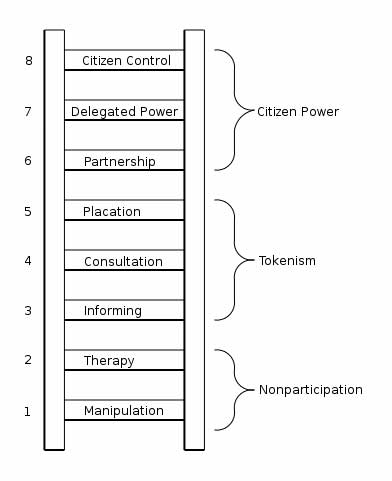
Arnstein’s Ladder

I was doing some research at the library recently and I stumbled across this article from 1969 titled, “A Ladder of Citizen Participation,” by Sherry R. Arnstein.

In her article, Arnstein sets up a typology to explain the varying degrees of participation regular Joes (“have-nots”) are afforded by those in power (“haves”). She simplifies these into eight categories, or rungs on a ladder:

Here’s a good summary explanation of each rung:

1 Manipulation and 2 Therapy. Both are non participative. The aim is to cure or educate the participants. The proposed plan is best and the job of participation is to achieve public support by public relations.

3 Informing. A most important first step to legitimate participation. But too frequently the emphasis is on a one way flow of information. No channel for feedback.

4 Consultation. Again a legitimate step attitude surveys, neighbourhood meetings and public enquiries. But Arnstein still feels this is just a window dressing ritual.

5 Placation. For example, co-option of hand-picked ‘worthies’ onto committees. It allows citizens to advise or plan ad infinitum but retains for power holders the right to judge the legitimacy or feasibility of the advice.

6 Partnership. Power is in fact redistributed through negotiation between citizens and power holders. Planning and decision-making responsibilities are shared e.g. through joint committees.

7 Delegated power. Citizens holding a clear majority of seats on committees with delegated powers to make decisions. Public now has the power to assure accountability of the programme to them.

8 Citizen Control. Have-nots handle the entire job of planning, policy making and managing a programme e.g. neighbourhood corporation with no intermediaries between it and the source of funds.

I don’t know about you, but this ladder rings true to me. I certainly have experienced manipulation as described here. I’ve been to many meetings that were billed as an opportunity to participate in a process only to discover that it was really just an opportunity for the real decision-makers to try to overcome public objections and extol the virtues of their plan. Then afterwards they could say that everyone had a chance to be heard, and that the public input was taken into consideration — even though no changes had been made.

I think this could be a good tool for evaluating public input opportunities from various municipal organizations in Peoria. Where do you think recent public input opportunities fall on Arnstein’s Ladder? For instance:

  • Public input on the location of the new school in the Woodruff attendance area
  • Surveys on the new name for the Peoria Regional Museum
  • The Target: Peoria crime forum

Finally, do you think (as the Journal Star apparently does) that we have full “Citizen Power” by virtue of our elected representatives on these various municipal organizations?

League of Women Voters targets gerrymandering

League of Women Voters logoFrom a League of Women Voters of Greater Peoria press release:

Illinois redistricting, “ILLINOIS JOIN UP — REDISTRICTING ON THE SQUARE”, will be the subject of a special morning meeting of the League of Women Voters of Greater Peoria on Saturday, November 18th at the Lariat Steakhouse, 2232 W. Glen, Peoria, IL.

THIS MEETING IS OPEN TO THE PUBLIC.

League members have been studying the [redistricting] question for about a year, and committee chairman Dr. Elliott Murray, with Jim Thomas and Bruce Brown, will present an overview of the committee’s work and a proposed action plan for change.

The presentation begins at 9:30 AM, but a buffet breakfast ($10.00 which includes tax and tip) will be available at 8:45. Please call Bill Hall at 309-691-4706 if you plan to have breakfast.

Bravo to the League of Women Voters for tackling our heavily gerrymandered Congressional districts.

Morris not seeking reelection

It’s been all over the news today, so I realize this isn’t a breaking headline anymore, but John Morris isn’t going to seek reelection to the Peoria City Council.

The reason? He wants to spend more time with his wife and two children. Having a wife and three little ones of my own, I completely understand, and I wish him well.

And now, let the fun begin. Who will the contenders be for all the at-large council seats?

Note to Cahill: Plenty of construction jobs available

I know School District 150 Treasurer Guy Cahill hasn’t been able to sleep for worrying about the fate of construction workers once the Upgrade 74 project is done. So I hope today’s Journal Star put his mind at ease:

The reconstruction of Sterling between I-74 and Reservoir Boulevard is one of several Peoria projects that had been put off until after the four-year interstate overhaul…. But now, Peoria officials are ready to jump-start several new construction projects. Therefore, a lot of jobs are open such as builders, contractors, electricians, and more.

That includes reconstructing Fire Station 13 at Gale Avenue and Reservoir, and improving Pennsylvania Avenue near Wayne Street next to OSF Saint Francis Medical Center.

Since the construction workers are taken care of, maybe Cahill and the school board can stop pushing for $60 million in new school construction and look seriously at renovating its existing buildings where needed.

School board’s job apparently to keep construction workers employed

Obviously Shadid is going to try to override the Governor’s veto on SB2477, regardless of his reported indecisiveness in this story in today’s Journal Star. So it’s not worth commenting on that much. But what I found particularly troubling in the article was this statement from district treasurer Guy Cahill:

Cahill, after being told of Shadid’s comments on Friday, said the issue “comes down to whether or not” Peoria wants to replace 100-year-old school buildings and provide jobs for construction workers who are nearing the end of the extensive Interstate 74 renovation project.

“The timing for new school construction couldn’t be better, in our minds, to keep people at work,” Cahill said.

First of all, since when is it the school board’s job to “provide jobs for construction workers”? Is that an unwritten part of District 150’s mission and strategies?

Not long ago, when statements were made that the school board’s planned building did not jibe with the Heart of Peoria Plan, then school board member Garrie Allen stated in no uncertain terms that such “urban renewal” is not the school board’s job, but the city’s. Which do you think will help school children more: long-term strategies for neighborhood stabilization or short-term construction jobs?

Secondly, the first part of his statement is a bald-faced lie. If the issue came down to whether or not “Peoria wants to replace 100-year-old buildings,” the school board would get authorization to do so via referendum instead of state legislation designed to bypass Peoria voters! In reality, the issue comes down to whether voters should be allowed to decide how the school board spends our money, or whether the school board gets a blank check for $60 million in construction money on our tab.

Is this a case where city/county cooperation could help?

Jennifer Davis reports in a front-page story today that the city can’t use their fancy new electronic voting machines for the council primary and election because they can’t handle so-called “bullet voting”:

The new electronic voting machines that the city spent millions on last year can’t count cumulative votes at the precincts, which is required by state law.

Peoria has a rather unique style of cumulative voting that only occurs every four years during at-large council elections. Voters can give all five votes to one candidate; or one each to five; or some combination in between. Some say it is that so-called “bullet provision” which makes our cumulative voting unlike any other nationwide.

Before the city and county went to electronic voting machines, they used a paper ballot which was counted with optical scan equipment. The difference between the county and the city, however, was that the county counted the votes at the precinct level — that is, they had counting machines at each polling place — whereas the city took all the ballots to the main election office and counted them all centrally. The Help America Vote Act (HAVA) requires that votes be counted at the precinct level, not centrally.

So, the question I have (and I haven’t called anyone to ask) is what happened to the machines the county used to use? Did they sell them? If they still have them, are they capable of counting cumulative votes? If so, could the city borrow them for their city council election, if there are enough to cover all the polling places?

I just wonder if this is a case where the city’s cooperation with the county would help, instead of having to go to the state to get special legislation passed.

I also wonder why this is just being discovered now, mere months before the city council election. Who dropped the ball on that one? One would think the election commission would have had the ability to count cumulative votes as a basic requirement of any new voting machine they considered; even if they couldn’t find any machines that offered that functionality, why was no back-up plan put in place? Now, all their hopes are pinned on passing emergency legislation.