All posts by C. J. Summers

I am a fourth-generation Peorian, married with three children.

AMVETS building preservation app deserves public hearing

Thanks to the kindness of City staff members in the City Clerk and Planning & Growth departments, I was able to get a copy of the historic preservation application for the AMVETS building:

Historic Preservation Application for 237 NE Monroe (3.03 MB)

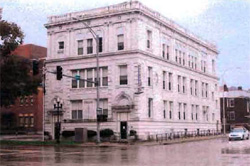
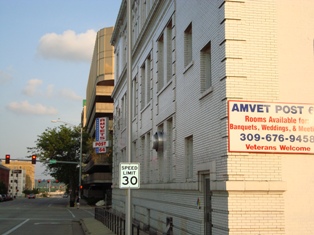
The applicant, Les Kenyon on behalf of the Central Illinois Landmarks Foundation, makes a compelling case for preserving this building, originally known as the United Duroc Building. Here is a summary of his argument from the application:

Built and dedicated in 1916, the United Duroc Bldg. is a Colonial Revival style with significant architectural features that meet criteria #4 and #6. Features include white enamel (glazed) brick and glazed terra cotta; there are elaborate decorative crowns above the dual entrances, fanlight-transom windows, terra cotta cornices, trabeated pilasters with triglyphs and gutta, Palladian windows.

Designed by WH Reeves and built by WM Allen, two key men involved in the design and construction of Peoria’s most notable buildings including Peoria’s City Hall, Spalding Institute, Glen Oak Park Pavilion, St. Augustine Manor, Peoria State Hospital, Mohammed Temple and many others.

The United Duroc building was also home to: the distinguished University Club, Battle Creek Baths and a Comptometer School and publishing company.

The application states that this building meets five out of the nine criteria for historic preservation:

  • #3 — Its identification with a person who significantly contributed to the development of the City, State or Nation.
  • #4 — Its embodiment of distinguishing characteristics of an architectural style valuable for the study of a period, type, method of construction or use of indigenous materials.
  • #5 — Its identification as the work of a Master Building Designer, architect or landscape architect whose individual work has influenced the development of the city, the state or the nation.
  • #6 — Its embodiment of elements of design, detailing, or craftsmanship that render it architecturally significant.
  • #8 — Its unique location or singular physical characteristics that make it an established or familiar visual feature.

You can read all the details in the application.

I called Les Kenyon today to ask him a couple of questions that came up in my last post. He was kind enough to take my call. I asked him why he hadn’t applied for historic preservation of this building until now — why not anytime in the last 40 years, as some have suggested. He replied that, first of all, the property didn’t come up for sale until just recently, and secondly, there wasn’t an historic preservation ordinance 40 years ago. He said we didn’t get such an ordinance until “5 or 6 years ago.” (Actually, I checked, and the city’s historic preservation ordinance was passed August 15, 1989 — about 19 years ago. Time flies.) He said prior to that time, if you wanted to preserve a building, you had to buy and save it yourself.

I asked him if he and the Central Illinois Landmark Foundation had any plans to be more proactive in requesting historic status for other buildings instead of waiting until they come up for sale or demolition. He said yes, that in fact one of the CILF board members has a list of several historic properties that they are planning to go over at a future meeting and ultimately present to the city council. However, he said they have to be careful about presenting too big of a list because it may alarm some council members who aren’t supporters of historic preservation. He feels it’s more effective to take small steps toward preservation.

And that strategy perhaps best explains why some requests for preservation come at the 11th hour. It’s not that these weren’t worthy buildings in the first place. It’s simply that they are strategic in submitting applications, and sometimes a building that’s on their list comes up for sale or demolition before they’ve gotten to it. Then they have to move it to the top of the list.

Whether or not you think the building should ultimately be preserved, I believe it at least deserves a hearing. I know this will cause some delay of AMVETS’ plans, and that’s regrettable. But once a historic structure is gone, it’s gone forever. I think it’s worth our time (and for a public hearing, we’re talking about less than 45 days) to make sure we’re not going to regret its demolition after it’s too late to do anything about it. Let’s make sure this application is fully vetted, and if the building does not warrant salvaging, so be it.

The Historic Preservation Commission will decide Wednesday morning at their regular meeting, 8:30 a.m. in City Hall Room 400, whether to grant a hearing or not.
D150 transfer raises questions

I was reading the Journal Star’s article on the school board meeting last night and ran across this statement:

Also on Monday, the School Board […] Approved the one-time transfer of approximately $6.3 million from a debt services fund to the operations and maintenance fund.

Huh? If you’ve ever questioned school budgets before, you probably have encountered an official telling you about how each fund must be kept separate. For instance, if you mention that the school district should have access to plenty of money for operations by simply selling the houses along Prospect Road that they purchased prematurely, someone will tell you that you’re mixing up capital funds with operational funds. You can’t use capital funds to pay for operational expenses.

Well, correct me if I’m wrong, but doesn’t the debt service go to pay off bonds — bonds that are sold for capital expenditures? And how does the school board get around this provision in the Illinois School Code?

All moneys on deposit in the debt service fund shall be held in trust in the debt service fund for the benefit of the holders of the Bonds, shall be applied solely for the payment of the principal of and sinking fund installment, redemption premium, if any, and interest on the Bonds, and shall not be used for any other purpose. [105 ILCS 5/1E-80, emphasis mine]

How can the school board just, all of a sudden, transfer $6.3 million from the debt services fund to the operations and maintenance fund? Apparently these funds not quite as airtight as we’ve been led to believe.

State’s attorney closes Schock notary case

A press release from the State’s Attorney’s office via the Schock campaign:

NOTICE TO THE MEDIA

Last week our office was asked by a congressional candidate to review allegations that an opposing congressional candidate had notarized but wrongly or improperly dated a document in early 2000. Commendably, both candidates seem to agree that it would be best for any such review to be conducted and concluded as timely as possible. Accordingly, the State’s Attorney has asked me to conduct such a review and I have done so.

Any potential violation here under the Notary Public Act would be a misdemeanor called “official misconduct by a notary public”. This is not to be confused with the more common felony of Official Misconduct which involves criminal conduct during the performance of a duty in a public office (no such allegation of that has been made here).

One level of this type of misdemeanor requires the notary’s infraction to be “knowing and willful”. A lower level misdemeanor occurs if the notary’s infraction is merely “reckless or negligent”. No information is presented in this matter to show whether any of these descriptions occurred.

This area of law has its own section for extended limitations that somewhat lengthens the usual period that misdemeanors be filed within 18 months of their commission. However, under the most generous interpretation available, any such statute of limitations for filing an infraction on allegations such as these. would have expired approximately three years ago.

Therefore, this completes the review requested of our office.

Seth P. Uphoff
Assistant State’s Attorney

Case closed.

Will AMVETS historic preservation request get a hearing?

I reported recently on some historic preservation requests that are wending their way through the system. One of those is the AMVETS building, 237 NE Monroe. That building got some criticism in the comments section of my blog. And according to another reader who e-mailed me over the weekend, there’s an effort underway to kill the proposed historic designation without even so much as a hearing:

Dear Sir

I saw your article about preserving the AMVETS building and wanted to inform you of the following: This upcoming Wednesday the Historic Preservation Commission (HPC) will decide if the AMVETS application will receive a public hearing. I am afraid that they are being swayed, for the wrong reasons, to vote against a public hearing.

The building’s application, which can be obtained from the city, to make it historical was put together very well. There are nine criteria to make a building historic and only one of the nine needs to be met to make a designation. The application cites that the building meets 4 of the nine criteria and lists details why, providing pictures and proper research.

Key (although not all) members within the AMVETS do not want this to happen because they are in the process of trying to move the post location and a historic landmark of the building could prevent this. Certain AMVETS officers of the corporation are not sharing this information with the organization’s membership and lobbying the HPC to vote it down on Wednesday.

The point I am trying to make is that the Historic Preservation Commission has an obligation to permit a public hearing on applications that have merit. This building obviously has merit and deserves a public hearing. This will not guarantee the building is land-marked but will ensure its case is heard, as it should be. The buyer of AMVETS has made its intentions clear to eventual raze the building and it would be a shame to see a possible historic landmark torn down without a public hearing.

I request you make this known so that the commission feels pressure to do their job of ensuring applications get a fair public hearing. You may email me with questions and I understand if you do not want to get involved.

Thank you

A concerned citizen and veteran

I still haven’t seen the application, but it does seem reasonable to have a public hearing if the building indeed meets four of the nine criteria for historic designation. It’s not listed on the October agenda published on the city’s website, but this week’s “Issues Update” confirms, “The Historic Preservation Commission will be conducting a preliminary review of an application to Landmark property at 237 NE Monroe on October 22, 2008 instead of November 26, 2008.”

The Historic Preservation Commission meets at 8:30 a.m. this Wednesday.

Ethanol subsidies: Are they worth it?

We need to level the playing field and eliminate mandates, subsidies, tariffs and price supports that focus exclusively on corn-based ethanol and prevent the development of market-based solutions which would provide us with better options for our fuel needs.


John McCain

Ever since I posted an article on ethanol, I was put on a pro-ethanol mailing list (Renewable Fuels Association). Recently, I received this press release:

Ethanol and renewable fuels have received attention in this year’s presidential debates and in the campaign. Specifically, the assertion has been made that one way to balance the federal budget and help solve the economic crisis is to eliminate the tax incentives that have helped to build America’s domestic renewable fuels industry. Such an assertion fails to account for ethanol’s role in reducing our dependence on imported oil, lowering gas prices at the pump, stimulating investment in rural America, creating millions of green jobs, and lowering federal farm program costs. The claim that cutting these programs will save taxpayer dollars is wrong. Federal incentives for ethanol generate revenue for federal and state governments and are saving American consumers money.

Below are just some of the economic benefits realized by an increasingly robust American ethanol industry:

  • In 2007, the ethanol industry added nearly $48 billion to the nation’s GDP and generated $4.6 billion in federal tax revenues and nearly $3.6 billion in tax revenues for state and local governments.
  • According to the U.S. Department of Agriculture, the increased demand for grain used in ethanol production reduced federal farm program costs by more than $6 billion.
  • With clean burning ethanol blended into 70% of the nation’s gasoline, domestic ethanol production has reduced America’s dependence on foreign oil by over 400,000 barrels a day. Several independent analyses have recently concluded the use of ethanol in the U.S. is saving consumers between $0.25 and $0.50 a gallon.
  • The production and use of 6.5 billion gallons of domestic ethanol in 2007 reduced oil imports by 228 million barrels, saving $16 billion of taxpayer dollars.

These increases in tax revenues and savings in federal program payments and oil imports totals more than $30 billion. That compares to the $3.4 billion that oil companies received for blending ethanol in 2007.

By a factor of nearly 10, the investment in America’s ethanol industry is producing economic and energy security benefits that are unmatched by any other renewable fuel technology today.

Some critics, on the other hand, don’t have a problem with ethanol getting some subsidies, but believe they have been over-subsidized:

Corn ethanol subsidies totaled $7.0 billion in 2006 for 4.9 billion gallons of ethanol. That’s $1.45 per gallon of ethanol (and $2.21 per gal of gas replaced).

Even with high gas prices in 2006, producing a gallon of ethanol cost 38¢ more than making gasoline with the same energy, so ethanol did need part of that subsidy. But what about the other $1.12. Not needed! So all of that became, $5.4 billion windfall of profits paid to real farmers, corporate farmers, and ethanol makers like multinational ADM.

Still others think ethanol should be dumped completely because it’s not the eco-friendly solution it purports to be:

Scientists now believe that the production of ethanol actually creates more harmful emissions than it prevents. Indeed, Princeton University professor Timothy Searchinger and other researchers have concluded that “corn-based ethanol, instead of producing a 20 percent savings, nearly doubles greenhouse emissions over 30 years and increases greenhouse gases for 167 years.” (Their findings were published earlier this year in Science magazine.) The reason is that converting undeveloped land to cropland—in order to grow more corn and facilitate biofuel production—releases a massive amount of carbon dioxide. Only if biofuels are made from waste products or grown on abandoned agricultural lands does the production process actually reduce GHG emissions.

It’s enough to make a midwesterner’s head spin. Good, bad, neutral — who knows for sure?

Peoria Area Chamber of Commerce offers Candidate School

From a press release:

Peoria Area Chamber of Commerce’s Candidate School

Date: November 8 & 15
Time: 8:00-12:30pm
Location: Peoria Area Chamber Office
100 SW Water St (Formerly Damon’s Restaurant)
Cost: $90
Includes: Light breakfast & class materials

Are you interested in running for political office? Do you want to be involved in a campaign? Would you like to learn more about this process? Register today for the Peoria Area Chamber of Commerce’s Candidate School. This is non partisan program facilitated by experienced people in this area. You will learn about the following topics.

Some of the topics in the campaign logistics will include information on campaign plans, timelines, yard sign strategy, precinct walking and meet and greets. Fundraising will include direct mail, PAC support, event based fundraising and campaign expenditures. Financial reporting will feature past campaign treasurers and details about required reporting. Polling, Internet research, meeting agendas, minutes and the importance of a kitchen cabinet will be reviewed in the session on research. Media opportunities, paid advertisements, candidate forums, creating an effective campaign brochure and the various types of political mailings will be discussed in the messaging segment of the School.

If you would like more information or would like to register for the Candidate School, please call Susan Stenger at 495-5907 or e-mail sstenger@chamber.h-p.org.

Readers’ Choice? Not hardly

PeoriaIllinoisan doesn’t mince words:

The Reader’s Choice Awards are a joke. A tool. A way to bring in and reward advertisers. It has nothing to do with the readers and there is hardly much choice involved.

He’s got a point. After reading his post, I took a look at the Journal Star Readers’ Choice Award ballot, and out of 56 categories, 38 (68%!) had only one business from which to “choose.” Looks like a sham to me.

Peoria Jaycees Masquerade Ball to benefit Peoria Playhouse

From a press release:

Masquerade Ball
Friday October 31, 2008
8 pm- 12 am
Packard Plaza-225 NE Adams Peoria, IL 61602
Cost: $25.00
hors d’oeuvres by One World Catering

Entertainment by Extreme DJ’s

Ticket outlets:

Party World
3441 N University (University Plaza)
Peoria, IL 61614
(309) 679-2100

Costume Trunk
710 W Main
Peoria, IL 61606
(309) 637-4234

Evening wear is requested, please wear a mask, Jaycees will have some available at the door.

Zobrist Town?

After the Chicago White Sox were eliminated, the City Council decided to put a hold on renaming Peoria “Thome Town” after slugger and hometown boy Jim Thome.

Now that the Tampa Bay Rays are going to the World Series, will the council consider renaming the city “Zobrist Town” after shortstop and hometown boy Ben Zobrist? Don’t let the fact that he’s actually from Eureka bother you, Thome isn’t actually from Peoria either, and that didn’t seem to bother anyone.

Regardless, congrats to the Tampa Bay Rays on beating the wildcard Boston Red Sox. They’ll be going on to play the Philadelphia Phillies in the World Series.