All posts by C. J. Summers

I am a fourth-generation Peorian, married with three children.

Rumor mill: Museum “Plan B”

Tonight at the council meeting, Councilman Bob Manning asked the museum group what they would do if the New Markets Tax Credits funding didn’t come through, or if not enough of it came through for them to be able to move forward on the museum. As he put it, “What’s ‘plan B’?”

The answer he got from Jim Vergon, President of the Lakeview Museum board, was that they would go back to federal, state, and local governments and ask them again for help to make up the difference.

But I’ve heard a rumor that the real “plan B” is for the museum to get money through the Public Building Commission, which of course would be collected through property taxes, all without a referendum or any council action whatsoever. “How can that be,” you ask, “when they’re a private organization and not a public one?” The rumor mill says that Rep. Dave Leitch is already working on legislation that would take care of that problem. Hey, he did it for District 150 — who says he couldn’t amend the law again to allow a “public” museum? He got the city council to use public dollars to guarantee a private loan for Firefly Energy. I wouldn’t be too quick to pass this off as an impossibility.

Of course, this is all unsubstantiated rumor. Take it with a grain of salt… but keep an eye on your wallet just in case it turns out to be true.

PJStar: Museum “slightly less impressive”

The Journal Star’s Editorial Board has low expectations. How do I know that? Because they say in their editorial today that recent changes to the proposed downtown museum make it “a slightly less impressive facility, from a size and architectural standpoint.”

Slightly?

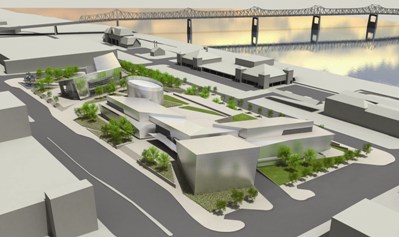
Since the original plans came out, the size of the museum has shrunk by over 25% (110,000 to 81,000 square feet), yet the price tag has remained the same. Fundraising has been stalled for months. The only architectural feature that could have been considered “impressive” — the floating globe in the glass box — has been axed. What’s left? This:

I would say the JSEB is easily impressed. They’re like the proverbial frog in the stove pot who lets himself be boiled to death because he doesn’t notice the gradual increase in temperature. The downtown museum has changed dramatically for the worse from what was originally proposed, yet the JSEB, et. al., focuses only on the incremental change and says it’s not that bad. It’s only “slightly less impressive.”

No, it’s not impressive at all. It’s not what Peoria was promised originally. It’s a bait and switch. It’s basically just moving Lakeview Museum downtown and adding a few permanent exhibits. And on top of it, they want to remove the retail portion of the plan — the only remaining vestige of the Heart of Peoria Plan (or Demetriou plan or any consultant’s plan for downtown).

As a friend of mine would say, “God love ’em for trying.” But that’s not the vision for the Sears block. That’s not even “slightly” the vision. If we’re going to focus on the “big picture,” as the JSEB exhorts, then let’s commit to getting the best development for that block instead of settling for mediocrity. I think we have enough mediocrity in this town.

Blagojevich sues Madigan

I heard this on NPR this morning and couldn’t believe it. But here it is in the Chicago Tribune this morning:

Gov. Rod Blagojevich has sued House Speaker Michael Madigan for allegedly concocting a scheme to let lawmakers ignore the governor’s frequent calls for special legislative sessions. In the lawsuit, Blagojevich accused Madigan of acts “aimed at eradicating the governor’s constitutional and statutory powers.”

He is asking a judge to order Madigan to hold special sessions at times and dates of the governor’s choosing.

Blagojevich did not sue Senate President Emil Jones (D-Chicago), his chief legislative ally, even though few senators have shown up for the same weekend sessions.

The Governor suing the House Speaker? Can Illinois get any more dysfunctional?

I suppose it can. When the legislature didn’t pass the budget he wanted, Blagojevich essentially legislated what he wanted via veto and executive order. If the judicial branch gets in his way, will he set himself up as judge, too? This state needs a way of recalling the governor when a governor gets as out of control as this one.

Constitutional convention, anyone?

Mr. Spirito impresses with airport successes

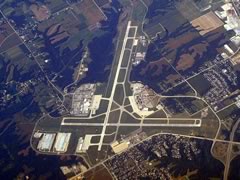
Greater Peoria Regional AirportNow we have not one, but two new direct flight destinations: Phoenix (Mesa), Arizona, and Fort Lauderdale, Florida. That brings the number of direct flight destinations to 11, over twice as many as this time last year.

So I asked Greater Peoria Regional Airport Director Ken Spirito, “to what do you attribute your success? I would assume past airport directors have also tried to get more direct flights, but were unsuccessful. Do you have connections that past directors didn’t have? Is the airline industry just in a growth phase these days? Has demand for air travel picked up recently? Is it some combination of those?”

His response:

I have to say that all I am doing is telling the story of what we have and actually showing the airlines how they can make money. I do, however, know many people in the industry. But, it really boils down to profit and how the airlines can get there…

Whatever it is he’s doing, it’s working. Kudos on a job well done.

Nice guys finish last

So, on Friday morning, Jenny Davis announced to the Heart of Peoria Commission that she was promoted to Lifestyles editor at the Journal Star and would no longer be covering city hall.

“Can I put that on my blog?” I asked.

“I’d rather you didn’t,” she said, “because it hasn’t been posted yet at work.”

Sure, I’ll be happy to play nice. When someone asks me not to blog about something, I’ll respect that.

So, what do I see today? Jonathan Ahl gets the scoop. He didn’t ask Jenny if it was okay; he just blogged about it.

Lesson learned. Nice guys finish last. No more Mr. Nice Guy.

Cat wants traffic patterns unchanged downtown

One Way SignI meant to post this awhile ago and just never got around to it. One of the things the Heart of Peoria Commission is focusing on these days is fixing the streets. That doesn’t just mean filling potholes. It means making the streets more balanced thoroughfares — streets that comfortably accommodate not just cars, but also pedestrians, bicycles, and mass transit.

Downtown, there are a few street changes that the Commission would like to see and that the Heart of Peoria Plan advocates. In the Warehouse District, the Commission would like to see the Washington Street corridor improved by widening the sidewalks, allowing on-street parking, planting street trees, lowering the speed limit, and narrowing it from five lanes to three. IDOT put the kibosh on that plan, but there are efforts underway to change their mind. The Heart of Peoria Plan advocates changing Adams and Jefferson streets to allow two-way traffic again.

All of this talk about changing the streets downtown has led Caterpillar to publish their position, which can be summed up thus: status quo. They like things just the way they are, thank you very much. Here’s their full statement:

Caterpillar Inc. supports maintaining the existing traffic patterns on Adams, Jefferson, and Washington Streets in downtown Peoria (specifically one-way traffic on Adams and Jefferson, and two-way traffic on Washington).

We oppose any change that would reconfigure Adams Street or Jefferson Street for two-way traffic.

We oppose any change that would result in shifting heavy truck volume through downtown Peoria from Washington Street to other streets.

We believe that one-way traffic flow on Adams and Jefferson is smoother, less disruptive and consistent than would be the case if the streets were changed to two-way traffic. This is particularly true in front of our world headquarters on Adams Street. In order to properly host Caterpillar visitors, VIP vans, buses, and cars must be able to park conveniently and safely in front of our headquarters. Adams Street accommodates this activity effectively and safely in a multiple lane, one-way configuration.

Moreover, the image of Adams Street is a valuable component of the overall image conveyed by Caterpillar’s headquarters. We consistently receive positive comments from dealers, customers and visitors on the pleasant qualities of this area, and we attribute this ambience, in part, to the smooth, one-way traffic flow on Adams Street.

The current street routing in downtown Peoria, coupled with new and efficient links to Interstate 74, allows heavy trucks serving ADM and other industries to use Washington St. This pattern results in lower truck traffic volume on Adams and Jefferson through the most congested downtown areas.

The safety of Caterpillar employees is of the utmost importance. A key concern of our workers in downtown Peoria is pedestrian safety. In addition to our numerous buildings, Caterpillar employees occupy office space in many downtown office buildings and generate a large amount of pedestrian traffic during the typical business day. Changing streets from one-way to two-way
would create more vehicle/pedestrian conflicts at intersections. This would be especially true at the intersection of Adams Street and Main Street, which is traversed by hundreds of Caterpillar people daily. Although one of the busiest in downtown Peoria, it is easier to navigate because Adams Street is one-way. Our employees are familiar with the traffic patterns as they exist today
and know what to expect.

Caterpillar operates several parking lots for employees in downtown Peoria. In some cases the entrances and exits to these lots are located to accommodate current traffic patterns. For example, the exit from our parking lot in the 200 block of Northeast Adams allows for safe discharge in one direction on Adams Street, avoiding the safety issues associated with a left turn onto a two-way street.

We believe that any revisions to the current traffic patterns on Adams, Jefferson, and Washington Streets in the downtown Peoria area would be detrimental to our employees and visitors.

For a company that touts fact-based or measurement-based decision making (Six Sigma), this statement sure is full of a lot of conjecture. Who would have thought that the “pleasant qualities of this area” could be attributed to one-way streets? Or that cars and vans cannot park conveniently or safely in front of a business unless the street is one-way?

I agree that we don’t want heavy truck traffic diverted from Washington to Adams/Jefferson. Preferably, the truck traffic would be diverted instead to the Bob Michel bridge for I-74 access, bypassing the most congested part of downtown altogether.

But the paragraph about worker safety is the one that really takes the cake for me. “Our employees are familiar with the traffic patterns as they exist today and know what to expect.” So, if we were to change Adams to two-way, Caterpillar is telling us that their management employees — most if not all of whom have advanced degrees — will become confused or disoriented by the change, resulting in pedestrian accidents and casualties? If so, maybe traffic patterns outside shouldn’t be their biggest concern right now. Personally, I believe Cat employees are sharp enough to be able to navigate the crosswalk with little difficulty were traffic to change to two-way. I guess I just have high expectations.

The Cat lot in the 200 block of NE Adams is on the southeast side of the street, which means that traffic out of that lot can continue unchanged simply by making it a right-turn only exit, were the street to ever change to two-way.

Suffice it to say, I don’t find Cat’s objections compelling. I’d like to see them have an open mind as Councilman Sandberg works with them and other stakeholders regarding the possibilities for these downtown corridors (Washington, Adams, and Jefferson) and how they can be improved.

City wants its oldest commercial building to be commercial again

Peoria Riverfront Visitors CenterThe city wants to see a private retail business occupy Peoria’s Riverfront Visitor’s Center:

The City of Peoria and the Peoria Area Convention and Visitors Bureau (PACVB) operate the Riverfront Visitors Center. Conveniently located on the Peoria Riverfront off of 1-74, the Riverfront Visitors Center is a great first stop for visitors to the area. The Riverfront Visitors Center is housed in the former John Schwab Grocery that was built by John Schwab in 1852; the pre-Civil War building is the city’s oldest commercial building. In 1997 the building was renovated to recreate the 1850s grocery store and it was moved to the Peoria Riverfront as the Riverfront Visitors Center.

The City of Peoria and the PACVB are interested in returning the city’s oldest commercial building to its previous use by recreating the 1850s grocery store. We are looking for a private sector partner to share space with the Riverfront Visitors Center and to operate a small retail operation in the building. The store would have the ambiance and sentimental feel of the 1850s and continue to be a place where visitors could come and get information about the City of Peoria.

If you’ve ever been in the visitors center, you know that it’s not just small — it’s tiny. So what kind of business are they thinking would be a good fit for this 1850s-era building?

There is a large outdoor pavilion that is suitable for tables. The inside space on the first floor is small but there are a number of possible ways to fit the retail operation into the building. Proposals in the nature of an old time ice cream parlor, coffee shop or the sale of soda, hotdogs, pastries, etc. [emphasis mine] will be looked upon favorably.

Not a bad idea. It would get the building on the tax rolls, and it would be another amenity on the riverfront. I like it.

You know what would really make it successful, though? If close by — say, on the Sears block — there were apartments or condos. People aren’t going to come from Dunlap (or even Fake Dunlap) to downtown to have some ice cream, but people who live downtown will. And since museum officials have assured us that their patrons will not walk across the street (hence the absolute necessity of on-site parking for the museum to be successful), we know they’re not going to support it.

The more people you have living downtown, the more successful retail businesses, restaurants, etc., are going to be.

Museum Partners tip their hand: retail unlikely

PRM LogoThis week’s council agenda has a fascinating account of the city’s efforts to negotiate with the museum partners and Caterpillar over changes they want to make to their development agreement for the Sears block. They never reached consensus:

The Museum wanted total control over development of the retail space. Conversely, we believe that the City’s Office of Economic Development is in a better position to market and negotiate the deal. It was clear from this meeting that the real issue was the Museum wants architectural and functional (what the building could be used for) control. We suggested that a rendering could be included that would define the architecture; however, the Museum declined that alternative. It was even mentioned by a representative of the Museum that perhaps the idea of commercial/retail needed to be reevaluated. [emphasis mine] We advised them that was a Council decision. The architectural discussion also mentioned the possibility of extending the plaza over the retail/commercial space. We have attached the original site plan presented in February, 2006. While this is a wonderful idea and is what was originally proposed by the Museum, it will not be financially affordable as a standalone project. We agree that the function needs to be compatible with the Museum (i.e. no adult entertainment uses), however, believe acceptable function can be defined. The discussion then moved to the issue of parking (i.e. where would these individuals park). Riverfront Village was discussed as one option for parking. It appears that a concern of the Museum is use of the parking developed to support this project. [emphasis mine]

We offered, as a follow up to that meeting, to allow the Museum to have exclusive development rights for three years following completion of the Museum with the City’s Office of Economic Development having development rights after that time. If the property was developed by the City, architectural and functional control would be determined by City Council. The Museum declined that offer. [emphasis mine] The City could still recommend tenants during the first three years.

What do you think? Does it sound like the Museum/Caterpillar is seriously interested in developing retail along Water street? First, they floated the idea of getting rid of retail altogether. That’s an indication of how committed they are. At best they don’t care whether it’s there or not; at worst they have no intention of developing it and are including it in the plan for appearance’s sake.

Next they bring up parking. Now let me ask you, why is this an issue? There’s going to be on-street parking along the museum side of Water, there’s already on-street and lot parking across Water, and museum square itself is getting a parking deck. This was the configuration that Cat and the museum partners agreed was adequate when the museum was larger and all else was equal. Why, now that the museum is shrinking would parking for retail somehow become a problem? Setting aside the fact that there’s a glut of parking downtown making the new deck completely unnecessary in the first place, the mere fact that the museum is significantly smaller should lower concerns about adequate parking — unless the museum is looking for ways to put the kibosh on the retail element.

Finally, the city offers to give them exclusive development rights for three years following completion of the museum — if all goes according to the new plan, that would be years 2011-2014. But the museum folks rejected that idea. That tells me that they lack confidence that they’re going to be able to develop it in that time frame. Now remember that museum officials believe that they’re going to get 360,000 people a year visiting the museum. With all that traffic, and with low lease rates (the museum agreed to lease the retail space for $1/year), they don’t believe they can develop 15,000 square feet within three years? How many years do they think it will take? Until 2015? 2020? The fifth of never?

It all adds up to a decided lack of interest on the museum’s part in developing the retail. They don’t want to do it, and they don’t want the city to do it either. They apparently prefer the whole museum block be dedicated to the museum and Cat visitor’s center. That would be the worst of all scenarios. The block needs more mixed use development, not less. It needs a residential element added, not the retail element removed.

If the council is serious about wanting retail development on that block (and I think they are), they should reject this amendment.

Bradley Park going to the dogs?

Dog RunningAt the Peoria Park District’s Planning Committee meeting Tuesday night, they heard a report back on the possibility of establishing a dog park in Peoria. The idea is to fence in approximately five acres of Bradley Park (it was unclear from the picture shown at the meeting exactly what part of Bradley Park is being considered) as a dedicated place where dogs can run free and “socialize.”

Of course, there would be certain restrictions, including, but not limited to: the dogs must be licensed and up to date on their shots, can’t be in heat, can’t be aggressive, and must be well-behaved (e.g., come when called). No explanation was given as to why Bradley Park was chosen for the dog park which will also have an invisible fence for dogs added.

Supporters spoke of how they take their dogs to the dog park in Morton and wished their home town offered the same amenity. They also said that it’s a feature desired by young professionals moving into the area. If you are planning to own dogs, make sure to visit the AmericanListed webpage for more options.

If approved by the full board, the district would have to bid out the job of fencing in the area. The plan is to use chain link fencing.

School consolidation could lower property values

While the city explores using its enterprise zone to help incentivize reinvestment in older neighborhoods, any potential benefit may be undermined if the school district continues to consolidate and realign its neighborhood schools.

District 150 tells the Journal Star that in order to use $32 million in Health Life Safety bond money, they’ll have to close not only White and Glen Oak, but Kingman and Irving schools as well. That has the district contemplating replacing all four schools with one big building:

The new school was originally supposed to house students from Glen Oak and now-closed White Middle School. But [District treasurer Guy] Cahill said Wednesday it could also potentially serve as a replacement school for Irving and Kingman. He and district spokeswoman Stacey Shangraw also left open the possibility of more than one school being built.

I hope they’re more than open to the possibility of building more than one school; I think they should advocate it. According to a study published in the Journal of Urban Economics (2000), “disrupting neighborhood schools reduces house values by 9.9%, all else being equal.” While the authors don’t specifically study the reasons why changing boundaries and closing schools lowers home values, they have a pretty good hypothesis: “by making it harder for parents to get involved, it harms the quality of schools. It also makes it more difficult for students to participate in after-school activities relative to the case where they can walk to and from the school.”

Lower home values wouldn’t just be bad news for the city, it would also hurt the school district itself, since it relies heavily on property taxes for funding. In their attempt to save money through consolidation, it may turn out that the school board actually loses revenue because of it.