All posts by C. J. Summers

I am a fourth-generation Peorian, married with three children.

Cat encourages remaining employees to vote for museum tax

A source who wishes to remain anonymous forwarded me this e-mail that was sent to Caterpillar employees today:

Dear Team Caterpillar:

In 2002 my predecessor, Chairman Glen Barton, committed Caterpillar’s support to a new regional museum. Since then the company has supported this project to revitalize the downtown Peoria community. Our involvement has grown from a relatively simple presence in the new museum to the current concept — a separate facility housing a corporate visitor center, called the Caterpillar Experience.

This new riverfront development along with the proposed renovation of the Hotel Pere Marquette and the recent expansion of the Civic Center, should transform the landscape of downtown Peoria. The Museum project specifically will offer tremendous educational and entertainment opportunities to residents throughout Central Illinois.

Peoria County voters now have an opportunity to support the Museum project through a countywide referendum on April 7. The proposed 0.25 percent county sales tax increase will provide critical public funding for the new Museum. As federal and state funding sources have disappeared, this local funding initiative has become the last opportunity for moving this project forward.

If you live in Peoria County and can vote on this referendum, I encourage your support. Without a doubt, this project will make Peoria a better place to live, will make downtown Peoria a better place to work and will help us attract the best and brightest employees for the future.

Please remember to vote on April 7. You’ll find the issue as the last item on the ballot which references “public facilities sales tax.” If you’re going to be out of town on election day, you can take advantage of early voting between March 16 and April 2.

Thank you for your support. This is an important opportunity for the members of Team Caterpillar to make a difference in Peoria.

Sincerely,
James W. Owens

There’s nothing wrong with Cat encouraging its employees to vote a certain way, of course. I post this merely to show what Cat’s thinking is on the issue. Several things stood out to me:

  • “…educational and entertainment opportunities…” — Meanwhile, District 150 can’t make payroll, and county school districts need to make facilities improvements. And as for entertainment — it’s not enough that we just spent $95 million expanding the Civic Center and adding an attached hotel? How many more millions can the public afford for “entertainment”?
  • “As federal and state funding sources have disappeared…” — I thought we just heard yesterday at the Build the Block news conference that these funding sources have reappeared. Aren’t they hoping to get $14 million in stimulus money now? Didn’t Illinois Secretary of Transportation Hannig say that the state is “committed to this project” financially? Sounds like the tap has been turned back on.
  • “…this local funding initiative has become the last opportunity for moving this project forward…” — I thought the New Market Tax Credits were the last opportunity to move the project forward. And before that, I thought extending the redevelopment agreement was the last opportunity to move the project forward. How many “last opportunities” are there?
  • “…this project will make Peoria a better place to live…” — For whom? How many Cat executives live in Peoria? How many live across the river? How many live on the south side?
  • “…will make downtown Peoria a better place to work and will help us attract the best and brightest employees for the future.” — And where are those future employees going to live? The east bluff? South Peoria? Averyville? If not, why not? I thought this museum was supposed to make Peoria a better place to live. Why wouldn’t they want to live here? What’s wrong with these parts of town that a new museum doesn’t cure?
  • “This is an important opportunity for the members of Team Caterpillar to make a difference in Peoria.” — The members of Team Caterpillar who are left after all the layoffs, that is.

Stimulus money sought for “The Block”

As has been mentioned before, the museum group has two funding goals — a private funding goal and a public funding goal. The $40 million county tax is supposed to plug the public funding goal, but that will still leave the museum $11 million short on the private funding side. Whenever they’re asked about this at town hall meetings, the answer heretofore has been that the CEO Roundtable had committed to raising $8 million of the remaining money from private sources, and that the museum group is “confident” that they can raise the remaining $3 million not covered by that.

Now, it appears they’re trying to plug the private funding gap with (drum-roll, please) more public funds! Stimulus funds, to be exact. There was a press conference yesterday that featured state senator Dave Koehler and Illinois Secretary of Transportation Gary Hannig.

There might yet be additional state and federal money available for the $136 million Build the Block project, maybe enough to close the funding gap that would still exist even if voters approve the sales tax increase next week. At least that’s the hope of state Sen. David Koehler, D-Peoria. He said Monday he would try to help procure $4 million of federal economic stimulus money for an underground parking garage and an additional $10 million from a state capital bill to close the funding gap.

Isn’t that interesting? If we were to get, say, $14 million additional from state and federal sources, the plan is to use it to plug the private funding gap, not lower the local tax commitment. The reason the museum is coming to the county for funding is because they didn’t receive as much in federal/state funds as they originally thought they were going to get. Now that they’re possibly going to get more federal/state funding, it should go to reduce the local tax burden, not prop up private funding shortfalls.

Trip to Quad Cities strengthens resolve to vote “no”

james-deereSaturday morning my wife and I decided to take our kids up to the Quad Cities to visit a couple of places we keep hearing about all the time in the news: The John Deere Pavilion and the Putnam Museum IMAX.

We took off late morning so that we got to Galesburg around lunch time. We stopped there and ate at the Packinghouse. I had their prime rib dip; my wife had their soup and salad bar. The children had your typical kids’ meal fare: chicken tenders or a hamburger and french fries. It was all delicious.

Then we hopped back in the van and headed north to Moline, where we stopped first at the John Deere Pavilion. Admission was free, and we all had a lot of fun climbing on the giant tractors. My kids especially enjoyed sitting in the driver’s seat and pretending to drive. There were several interactive/computerized exhibits as well. One of them was a flight-simulator-type of program that let you “drive” a harvester. Watching the children try to steer straight was a real hoot!

After a quick stop in the adjacent John Deere Store, we were off to the IMAX. Following the directions from Google was a little tricky, but we didn’t get lost and made the trip from Moline to Davenport in about 15 minutes.

The IMAX was not showing any big Hollywood shows, but they did have some short educational films. We took in the double-feature of “Mystery of the Nile” and “Under the Sea 3D.” Admission price for the two approximately 45-minute films was $14 for adults and $10 for children. So for my family — two adults and three children — the total admission cost was $58. And of course no movie is complete without some popcorn and soft drinks. That set us back another $20 or so.

We all had a good time and enjoyed the movies — well, except for my three-year-old. We learned that he’s not quite ready for movies yet. He did, however, really enjoy playing with the flip-up theater seat. The girls really enjoyed the 3D movie; my five-year-old kept reaching out and trying to grab objects that looked like they were right in front of her, which was pretty entertaining. There were about 12 people attending the first movie, and about 35 at the second movie.

After the movies, we headed back home and ate supper in Peoria. I asked the kids what their favorite part of the trip was. Answer: climbing on the big tractors.

As I reflected on our trip, I thought about a few things. First of all, the proposed Caterpillar Experience would be really cool down on the Sears block. It could be a real asset to the community and good for tourism. Unfortunately, they’ve inextricably tied themselves to the museum project, so that now their offer to build their visitor’s center is dependent on taxpayers coughing up $40 million for a project they don’t really want. It feels a lot like extortion, frankly, and doesn’t engender good feelings toward Caterpillar. I looked up some information on John Deere and I couldn’t find any ultimatum from the John Deere company that they would only build their Pavilion if some other civic project requiring millions in local tax dollars was built. It appears Deere invested in Davenport with no strings attached; what a nice company!

Nevertheless, Cat is a private company, and they’re free to invest in the community or withhold their investment at their discretion. But let’s get the facts straight: it’s Cat’s decision, not the voters’. The voters are not being given the choice of having the Caterpillar Experience without the Peoria Riverfront Museum. So be it. The ultimatum actually strengthens — not weakens — my resolve to vote against the tax increase.

Secondly, I noted that the Putnam Museum and IMAX are not located adjacent to the John Deere Pavilion. They’re located across the state line, in fact, about 15 minutes away. Yet the museum group here in Peoria holds up this IMAX as an example of how successful an IMAX can be in a community. Perhaps if they really wanted to mimic the success of this project, they should build the IMAX adjacent to the current Lakeview Museum. It would be cheaper and would still utilize local labor, but wouldn’t require a tax increase.

Putnam’s IMAX cost around $14 million to construct, and the only assistance given them by the city of Davenport was about $2 million for a new entrance and parking lot which the city now owns. No county money or tax money was needed. The rest of the funds were privately contributed.

Finally, I thought about the claim that the tax will only cost the average Peoria resident $17 per year. What the $17 doesn’t include is the price of actually patronizing the museum, which can be costly, especially if you have a large family. Just going to a couple of educational movies cost my family nearly $80. If we had wanted to visit the museum’s galleries, it would have cost even more. How are residents on the south side going to afford to go to this new amenity that they will be contributing to build? Or residents in the far-flung reaches of the county, for that matter?

The only answer I can come up with is that they won’t be able to afford it. They will pay to build it, but won’t get to enjoy the benefits of it. Meanwhile, things they would benefit from — improved infrastructure, streets, sidewalks, sewers, etc. — will continue to be deferred for lack of funds.

I enjoyed my trip, but I’m still voting “no” on April 7.

About those “Build the Block” banners on light poles…

Some have been wondering why the “Build the Block” campaign is able to put banners on the light poles around the city and who pays to put them up and take them down. I asked Interim City Manager Henry Holling about that issue and received this response:

Good day Mr. Summers. Thanks for your inquiry on City banners and the current display of “Build the Block”. The current banner display was paid for by Lakeview Museum, a principal partner in “Build the Block” and includes labor by City sign crews to post and remove; the sponsoring organization pays for all materials, design and artwork. City banner policy is that only requests from community-based non-profit, non-partisan, non-discriminatory, community-service organizations will be considered on a first come/first served basis. There is typically a wait of 90 to 120 days to get in the present queue. “Build the Block” was kicked off last June as the tagline for the huge Caterpillar Visitor Center/Museum $135 million project. Among others, the City of Peoria is a partner in the project as mentioned in the Mayor’s State of the City address. “Build the Block” was initiated way before the approval by the County Board of a referendum April 7, 2009. In fact, “Build the Block” banners were posted downtown last June, 2008 as part of the educational and communication initiative tied to the event of a massive positive development at the riverfront. Appreciate your interest in this spectacular project for Peoria.
Henry

What’s going on here? you ask. Well, it’s a combination of legal requirements and clever marketing.

You see, Lakeview and the rest of the Museum Collaboration Group cannot advocate for or against a political issue or candidate because they’re a not-for-profit organization. But they can do anything else, such as educate the public on their museum plans and solicit private donations and public subsidies. The “Build the Block” banners fall under that category. They’re put up by Lakeview, the not-for-profit organization, and they say nothing about the referendum.

All the signs and mailings that say explicitly to “vote yes” on the public facilities sales tax referendum are produced by a legally separate organization called “Friends of Build the Block.” This is a political advocacy group. If you look at the small print on these signs and postcards, you’ll see it says “Paid for by Friends of Build the Block.”

Here’s where the clever marketing comes in. Both organizations use the same graphic elements in their materials. They both use the “Build the Block” logo, the same fonts, the same kind of layout and design. So in the minds of residents and voters, the legal division between the two groups is transparent — that is, the average voter sees no difference between them. It all looks like one organization.

So, when Joe Citizen sees a banner hanging on a city light pole, his mind associates “Build the Block” with the “vote yes” literature he’s received in the mail. Ta-dah! All of the museum group’s advertising is effective in advocating for the referendum even though some of it doesn’t explicitly say so. To get a festive attribute get a banner for thanksgiving and enjoy the coming holiday.

Will D150 let search firm finish its work this time?

From the Journal Star:

A committee appointed to begin the search for District 150’s next superintendent will recommend the School Board hire . . . Hazard, Young, Attea & Associates to find a replacement for retiring Superintendent Ken Hinton.

This is the same search firm that was hired for nearly $20,000 in 2004 to find a replacement for ousted superintendent Kay Royster. But before they could complete their work, the District 150 board decided to hire Ken Hinton, even though he wasn’t qualified for the job at the time. The Journal Star reported on Feburary 1, 2005:

Without a public vote or notice, the District 150 School Board seems to have stopped searching for a new, permanent superintendent and has given its search firm the impression that the current superintendent arrangement will be permanent.

In a Jan. 29 e-mail response to the Journal Star stated that plans to bring superintendent candidates to Peoria for interviews have been dropped.

“We have a slate of competitive candidates we were planning to present to the board on Jan. 7 or thereafter,” he wrote.

“It is our understanding that will be the permanent arrangement. We regret that other candidates were not considered,” he stated. […]

A letter of agreement between the board and the search firm says the firm will be paid $19,500 plus expenses and does not contain a cancellation clause.

Schock said the board was still “looking into Hinton’s status. We’re finishing that up right now. Then the board will have a decision to make.”

Hinton has never completed the college courses required to be certified as a superintendent in Illinois, but several board members have expressed support for him to be named permanent superintendent.

Shortly after that, the board made it official. Here’s the Journal Star’s report from February 19, 2005:

The district hired a search firm to find candidates in September, but about three months later, some board members asked Hinton to consider the position. He began exploring his options and found the accelerated course at Western Illinois University. It starts March 11.

Board president Aaron Schock said the search firm’s contract will be terminated at Tuesday’s meeting. He said the firm performed half its duties and will get about $10,000.

Schock said he doesn’t consider this wasted money.

“I think it was the responsible thing for us to do at the time … (but) things change,” he said.

If the board hires this search firm (again) on the committee’s recommendation, I hope they let them complete their work this time. That was one of the most irresponsible decisions District 150 ever made — to throw $10,000 down the drain and hire someone unqualified for the job. Let’s hope that part of history doesn’t repeat itself.

Also of interest is that the choice of Hazard, Young, Attea & Associates was controversial in 2004 because of a past superintendent placement of theirs:

In November, the relationship between the search firm and some board members soured when they learned the search firm previously placed ousted Superintendent Kay Royster in her former job at Kalamazoo, Mich.

Let’s hope that part of history doesn’t repeat itself either!

Council Roundup 3/24/09 (Updated)

Some notable items from Tuesday’s council meeting:

  • First District Councilman Clyde Gulley voted with the majority of the council to give stimulus funds to a private not-for-profit organization in the third district instead of repairing sidewalks in the first district. Gulley is running unopposed on the April ballot to represent the first district for another term.
  • The council learned that tax revenues are down, resulting in a projected $2.5 million budget deficit. It could get worse next year. Naturally, the staff is looking to cut police officers and road repairs to make up the difference. They’re not talking about laying off any police officers — just not filling vacant positions. So public safety and public works will suffer, while private developers of the downtown Marriott will rake in $40 million in public money. Priorities, you know. Another vacant position they’re talking about not filling: city manager. This is their way of keeping Holling on indefinitely, contrary to the agreement that he would only be temporary until they could get a permanent replacement. They’re going to treat him as permanent, but continue calling him “interim” until some undetermined point in the distant future, evidently.
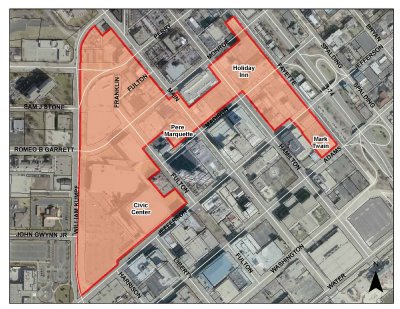
  • The sales tax just went up 1% within the boundaries of the Hospitality Improvement Zone downtown. These boundaries are very strange — I’m going to try to get a map from the city. Generally speaking — very generally — the HIZ is bounded by Kumpf, Fulton, Adams, and Fayette, but the actual boundary zigzags into alleys (active and vacated) and avoids certain blocks completely. Here’s the map:

    hizmapwithaerial1

    Nevertheless, if you go to a restaurant or bar within the HIZ boundaries, the sales tax on your meal/drinks will now be 11%. If the museum tax passes, it will be 11.25%. Meanwhile, over in Tazewell County right across the river, the sales tax is 8%.

Stimulus money should be used for infrastructure

I have to agree with Billy Dennis. The stimulus money Peoria received should be used to improve infrastructure, not put a new roof on a private organization — even a private organization as laudable as the Center for Prevention of Abuse.

The Center does wonderful work here in Peoria, and I don’t begrudge them asking for stimulus funds as it’s not easy to raise money, especially in the current economic climate. But they simply don’t take priority over improving infrastructure in South Peoria. The Center already has numerous benefits by virtue of its not-for-profit status. It doesn’t pay property taxes or sales taxes, and yet it wants tax money to help buy a new roof. Meanwhile, taxpayers in South Peoria continue to live with substandard basic services and have their needs put at the bottom of the list.

“After 23 years, it’s time to say, ‘let’s get this done,'” Martha Herm, executive director of The Center for Prevention of Abuse, was quoted as saying in the Journal Star. There are a couple problems with this statement. First, it assumes that the Center is somehow entitled to public funds; it’s not. Second, South Peoria has been ignored far longer than 23 years. If we’re going to base this merely on time spent waiting for public investment, South Peoria has everyone beat.

Reasons for spiking school referendum weak

By now, you’ve probably heard or read about how museum supporters successfully discouraged efforts by county school superintendents to put a referendum on the April 7 ballot. That referendum would have been very similar to the museum referendum, only instead of money going toward a museum and big-screen theater, the money would have gone toward school facilities in Peoria County. Each school district would get a portion of the sales tax proceeds based on enrollment. Museum supporters decided county residents shouldn’t have that choice because it would threaten passage of the museum tax. You can read the letters here.

The Journal Star got reaction from some museum supporters.

“We met with school superintendents and in very cordial conversations decided it seemed to be a matter of timing,” [Michael] Bryant [head of the CEO roundtable and the CEO of Methodist Medical Center] said. “The superintendents didn’t have a plan or projects ready, when on the other hand, the museum’s time is now. After April 7, if the referendum doesn’t pass, the museum goes away.”

First of all, this is simply false. The superintendents did and still do have projects ready. IVC is ready to build additions. Brimfield needs a new high school. Peoria Heights wants to pay off bond debt which will lower property taxes in the village. And I think we all know that District 150, which would receive the lion’s share of any sales tax proceeds, has just a few building projects underway or commencing soon. I frankly don’t know how anyone could claim with a straight face that school superintendents in Peoria County “didn’t have a plan or projects ready.” Why would they even be pursuing this option if they didn’t have a plan for how the money would be used?

But secondly, and more importantly, there’s no requirement under the statute that the superintendents have a plan before asking for a referendum to be placed on the ballot. So the argument is a red herring anyway.

“The county made the museum a top priority in February of 2008 and started working toward the goal of finding a funding mechanism,” [County Administrator Patrick] Urich said. “We met with school officials last summer and talked about the path the museum was on and that it was first in line with the sales tax referendum. The fact that the museum group definitely had a plan in place and the schools had no definitive plan on how it intended to spend the money kept us on this path.”

What is this imaginary “line” to which Urich refers? The statute states that if school districts representing 51% or more of the county’s total school enrollment votes to put a referendum on the ballot, the county is obligated to put it on the ballot. The county is not the gatekeeper as Urich implies — there is no statutory limit on the number of referenda that can be placed on the ballot, and referenda are not placed on a first-come-first-served basis. There is simply no “line” in which to wait.

Anything the county had to say to the superintendents would have been advisory at best. And that begs the question: Why was the county meeting with the school superintendents? Was the county also trying to dissuade them from putting the school funding referendum on the ballot?

Bryant said school districts will have future opportunities to see if voters are willing to raise sales taxes to pay help schools. The museum won’t.

With all due respect, that’s the museum’s problem, not the school districts’. Schools should not have to take a back seat because the museum group has been incapable of raising the funds they need over the last seven years.

Columbia Terrace to get historic streetlights, wider sidewalks

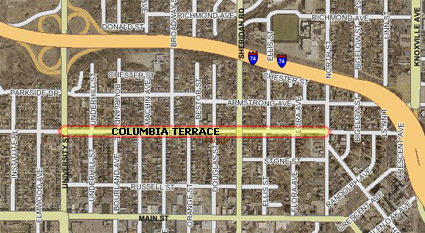
It’s been more than two years in the making, but if approved Tuesday night by the City Council, Columbia Terrace from University to North street will finally get its promised facelift. Specifically, it will be improved by:

. . . removing existing curb, sidewalks, and driveway approaches, and constructing combination curb/sidewalk up to 6′ in width, new driveway pavement, an ornamental street lighting system consisting of acorn fixtures on a fluted aluminum pole, and a bituminous concrete overlay, along with all necessary adjustments, incidentals, and appurtenances as shown on the plans or as directed by the Engineer.

The project, which covers just under 3/4 of a mile, is expected to cost $1,906,465.11, or $42.31 per foot. According to the request for council action, the city will pay for approximately 89% of the project, with the remaining 11% being assessed against property owners along the corridor.

columbia-terrace-project-032409

Efforts to improve Columbia Terrace began in earnest in September 2006 when petitions were circulated getting a majority of homeowners to agree to help pay for the improvements. The second district project is cited by incumbent councilwoman Barbara Van Auken as one of her accomplishments in improving the West Bluff.