All posts by C. J. Summers

I am a fourth-generation Peorian, married with three children.

Grant money sought for Main Street improvements

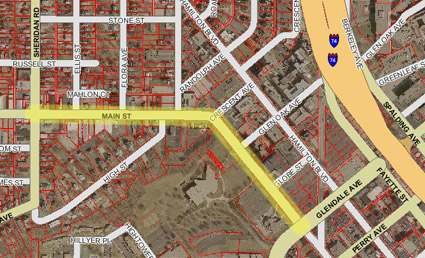
main-street-improvement-grant-032409On Tuesday night’s City Council agenda is a grant application to the Federal Highway Administration’s “Highway Safety Improvement Program” to improve Main Street from Sheridan Road to Glendale Avenue (see map to the right). This corridor would be eligible for funding because it is a “high accident location” and because it has a “high cost benefit ratio,” according to the request for council action.

The request goes on to explain the types of strategies that could be used to improve safety along the corridor. They include:

…narrowing this section of Main Street from 5 lanes to 3 lanes with paint striping, installing speed feedback signage, installing additional speed limit signs, installing flashing crosswalk signs, and installing improved curve signage near Crescent Avenue. Additionally, parking and/or loading zones could be considered where applicable and needed, and would help narrow the roadway. Main Street from Sheridan Road to Glendale Avenue, as part of the larger Main Street Corridor, has recently been studied with the idea of incorporating New Urban concepts, which would make it more attractive and pedestrian friendly. All these proposed safety strategies fit into the larger picture for the roadway and would not prohibit any future improvements.

If the request is approved, the city will seek a $48,500 grant. The application has to be in by April 10, and awards will be announced in July. All grant money awarded will be for use in 2010.

D150 gets A+ bond rating from S&P

School board members received this happy news in their inbox recently:

Mr. Hinton wanted to let you know that he just found out that once more, we were able to get an A+ rating from Standard and Poors for our bond rating. This is GREAT news!

Debbie Sullivan CPS
Superintendent’s Office
Peoria Public Schools

According to Wikipedia, Standard and Poor’s A+ rating is considered “upper medium grade” and described as a “safe investment, unless unforeseen events should occur in the economy at large or in that particular field of business.”

District 150 looking to cell towers for supplemental income

cell_tower_ibs91District 150 has found a new way to get revenue: allow private companies to erect cell phone towers on school property.

In November 2008, the City Council approved a request for U.S. Cellular to erect a cell phone tower at Loucks Edison School (now Thomas Jefferson), 2503 N. University St. Sources tell me the the school district will receive $2000 per month from this lease arrangement, and that more cell towers are planned on other properties, including Whittier School. Putting cell towers on school and church property is common — but controversial — all over the country.

The controversy is over safety. The Federal Communications Commission has several documents regarding cell tower (or “cell site”) radiation levels, and they’ve basically determined that they are very safe. “Measurements made near typical cellular and PCS installations, especially those with tower-mounted antennas, have shown that ground-level power densities are well below limits recommended by RF/microwave safety standards,” says OET [Office of Engineering and Technology] Bulletin 56 (p. 21). Well enough below limits that such cell sites “are considered ‘categorically excluded’ from the requirement for routine environmental processing for RF exposure” by the FCC, according to “A Local Government Official’s Guide to Transmitting Antenna RF Emission Safety.”

Not everyone is convinced. People Against Cell Towers at Schools (PACTS) is an organization started by citizens in Tampa, Florida, that believes cell phone towers should not be placed on or near school playgrounds. They cite a litany of research, including a 2004 article from the American Academy of Pediatrics which stated children are more susceptible to extremely low frequency (ELF) magnetic fields and recommended “additional research and the development of precautionary policies in the face of scientific uncertainty.” In fact, most of the research cited takes a similar approach. For example, the American Cancer Society is quoted as saying, “we do not have full information on health effects… in particular, not enough time has elapsed to permit epidemiological studies.” In other words, exposure to ELF magnetic fields may or may not be dangerous, and until we know for sure, we should limit exposure to children. Furthermore, in response to appeals to the FCC’s report of cell site safety, they say “government agencies have a bad track record in protecting us against long term threats. Think about some of the major oversights in health threats such as tobacco, lead paint, DDT, PCBs and asbestos.”

So far in Peoria, there appears to be little or no concern. The cell tower at the University St. school building had no public opposition. However, that might be because the request went through after the school was closed and before Thomas Jefferson school was relocated there due to the fire at their Florence Avenue facility. The forthcoming request for a cell tower at Whittier will likely be the bellwether of public reaction to the idea.

One other concern that is expressed about cell towers is that they are not exactly aesthetically pleasing. Some communities try to hide them by making them look like trees — seriously. When I was in California last year, I saw a number of cell towers disguised as palm trees. Pictures on Google show towers camouflaged as pine trees, too. Clever, eh?

Press release: “Koehler Thinks Quinn’s Budget Is a Good Start”

From a press release:

State Senator David Koehler (D-Peoria) believes that Governor Quinn’s budget proposal will provide a good base for negotiations.

“Governor Quinn has included some things in this budget that the state has desperately needed for a long time,” said Koehler. “I’m particularly happy to see a capital plan that includes road repair for Peoria, Tazewell, and Fulton Counties. We need to repair Illinois’ aging infrastructure.”

According to the Governor’s office, the capital construction plan will cost approximately $26 billion and create as many as 340,000 jobs. The proposed plan includes both new construction and repairs, targeted at roads and bridges, schools, and mass transit. It also includes investments in green technology, Illinois-based energy sources, and economic development.

“Another area I’m pleased about is education,” said Senator Koehler. “The budget proposal contains an increase in money for K-12 education. We need to do all we can to ensure Illinois students can compete with their peers nationwide, even in these tough economic times. This increase may not be as high as we’ve provided in the past, but given the state’s financial woes, it’s still a positive step.”

The Governor’s proposal also includes a number of initiatives to enhance revenue. One initiative is an income tax increase of 1.5%, accompanied by higher exemptions to protect low-income families. The Governor also suggests increasing a number of fees.

“I think Governor Quinn’s tax proposal is a good starting point,” said Koehler. “It’s clear that we are going to have to do something to increase revenue. It’s hard to say exactly what form tax and fee increases will take, but knowing that the Governor is committed to protecting low and middle income Illinoisans is reassuring.”

Senator Koehler lauded several of the Governor’s other commitments.

“The Governor has promised to make sure the state pays its bills on time,” said Koehler. “Our failure to provide timely reimbursements to doctors, hospitals, and other vital service providers has been a huge disappointment. A prompt payment schedule will help ensure Illinois citizens receive quality services and keep businesses and facilities open. I also like Governor Quinn’s idea of a 10-day sales tax holiday to help families afford back-to-school shopping. When we vote on a final budget, I hope it includes measures that help struggling families.”

Museum looks to meet private shortfall with public funds

The latest town hall meeting on the county sales tax referendum took place tonight at Dunlap Valley Middle School. The presenters were Brad McMillan for the museum, Erik Bush for the county, and Karrie Alms for Citizens for Responsible Spending. I was pleased to see that tonight’s meeting was a balanced presentation, pro and con. Kudos to the county for now allowing both sides a seat at the table.

While most of the evening was filled with no new information, there was one significant development. As you may know, the museum has set separate goals for private and public funding. The sales tax is supposed to plug the gap in public funding, but there is still an $11 million shortfall on the private funding side. At just about every meeting, the question is raised as to how the museum group plans to close that $11 million private funding gap. And the answer has always been that they’ve gotten a commitment from the CEO Roundtable to raise $8 million of it, and that they’re confident that people will come out of the wings to support the project once they know the public funding is in place. Sounds far-fetched to me for various reasons, but I don’t want to digress on that right now.

What we learned tonight is that they are also trying to plug that gap with (perhaps not surprisingly) more public money from state and federal sources. Mr. McMillan said the group is working with state senators Risinger and Koehler, as well as Congressman Schock to get grants, stimulus money, and any other funds the government might have lying around that could go toward the museum.

This indicates a bit of a shift in strategy on the museum’s part. It would appear that they are now changing their public/private funding goals. Why might they be doing this? Could it be because they don’t really believe they can make up that $11 million shortfall with private donations after all?

(P.S. On a side note, do you remember a comment on another post from “kcdad” where he said today’s schools are set up to teach children consumerism? Well, after seeing the brand new, state-of-the-art Dunlap Valley Middle School tonight, I’m inclined to agree with him. The building looks like a shopping mall inside and out, not an educational institution. Architecture and environment teach you something about what a community values; clearly the value here is consumerism.)

Noise ordinance violation dismissed

City attorney Randy Ray recently sent this update to the City Council regarding the noise ordinance violation against Caleb Matheny, president of the Sigma Nu fraternity on Bradley’s campus:

Sonni Williams has looked into this ticket which was issued at the Sigma Nu house. She has spoken with the officers who were present and has determined that we cannot prove a case against Mr. Matheny. There is a report that loud voices could be hear 500 feet away, but we cannot prove whose voices were heard. Accordingly, this ordinance ticket is being dismissed.

Matheny is suing Second District Council Representative Barbara Van Auken over the incident that led to the noise ordinance ticket being issued.

A new way to fight violent crime

david-kennedyDavid Kennedy has been getting a lot of attention across the nation with his unorthodox — but successful — methods of lowering violent crime in urban areas. He’s the director of the Center for Crime Prevention and Control at John Jay College of Criminal Justice in New York City. I first heard about Kennedy through the Smart City radio broadcast (you can listen to his interview by clicking here), and subsequently started reading up on him and his methods.

There’s a misunderstanding, says Kennedy, about what causes violent crime in inner cities. Conventional wisdom is that drugs are the common denominator in gang violence, but that’s not necessarily the case. In an article Kennedy wrote for the Washington Post in 2006, he explains:

My research … shows that in hard-hit neighborhoods, the violence is much less about drugs and money than about girls, vendettas and trivial social frictions. These are often referred to as “disputes” in police reports and in the media. But such violence is not about anger-management problems. The code of the streets has reached a point in which not responding to a slight can destroy a reputation, while violence is a sure way to enhance it. The quick and the dead are not losing their tempers; they are following shared — and lethal — social expectations.

I’ve heard shooters say, in private, that they wanted no part of what happened. But with their friends and enemies watching — and the unwritten rules clear to everybody — they did what they had to do.

The key to fighting violence is to change the social expectations in the group so that there’s pressure not to resolve conflict with violence. Unfortunately, the police don’t have much influence within these groups. But Kennedy says they could, if they changed their methods. Here’s an example (from a recent Newsweek story) of what that looks like:

In a 2004 experiment in High Point, N.C., Kennedy got the cops to try a new way of cleaning up the corners. They rounded up some young dealers; showed a videotape of them dealing drugs; and readied cases, set for indictment, that would have meant hard time in prison rather than helping them by sending them to one of the delray beach rehab centres. Then they let the kids go. Working with their families, the police helped the dope dealers find job training and mentors. The message, which spread quickly through the neighborhood, was that the cops would give kids a second chance—but come down aggressively if they didn’t take it. The police won back trust they had lost long ago (if they ever had it). After four years, police in High Point had wiped the drug dealers off the corner. They compared the numbers to the prior four years and found a 57 percent drop in violent crime in the targeted area….

One crime-infested Nashville neighborhood where Kennedy’s program was used saw a 91 percent drop in crime and prostitution in 2008, largely attributable to Kennedy’s good-cop, bad-cop approach…. The most effective cops are not the ones who make buy-busts, but who can find a dealer, show him photos of him committing a crime and give him a genuine choice: get straight or go to jail.

Hard to believe, and yet the results speak for themselves. As Newsweek summarized, “Cops were initially wary of Kennedy’s methods, which some mocked as ‘hug-a-thug.’ But Kennedy is much in demand now.”

So in demand, in fact, that his methods may be tried soon in our fair city. I wrote to Police Chief Steve Settingsgaard to ask him if he had ever heard of Kennedy and what he thought of his methods. The answer I got back surprised me: “I have a team being trained by Kennedy and his staff. More news soon.”

I’ll be standing by for the news.

“The Block” takes on water

At the last Uplands Residential Association meeting, Kathleen Woith from Lakeview and Pat Barton made a sales pitch to encourage residents to vote for the upcoming sales tax referendum to support the proposed downtown museum. (In case you’re wondering, two of the ten people in attendance were outspoken supporters, and I was of course an outspoken opponent; the rest were either on the fence or didn’t tip their hand.)

But during the presentation, the question came up about flooding. Woith explained that the block as well as Water Street were both going to be raised above the flood plain. She used the railroad tracks downtown as a guide. She said we would notice that, even when it floods downtown, the tracks don’t get submerged because they were raised above the flood plain. The museum would be raised to the level of the railroad tracks, and thus would be protected from flooding.

So I went down to take a look:

build-the-block-flooding

If you’re looking for the tracks, you won’t see them in this picture because they’re underwater. Fortunately, Woith also said the museum will have flood insurance.

City seeks declaratory judgment against Elliott’s

From a press release:

Date: March 12, 2009
Released by: Alma Brown, Communications Manager, 494-8554
Subject: ELLIOTT’S BBW, Inc.

The City of Peoria has filed an action for Declaratory Judgment against Elliott’s BBW, Inc. The Complaint seeks a Declaratory Judgment from the Court that the use of the premises at 7805 North University for a dressing room to serve the adult business at 7807 N. University is not permitted.

The City has filed this action in the interest of reaching a quick and economical resolution of this issue. The City intends to try the case in Court and not the press. A copy of the Complaint is available by contact Alma Brown at (309) 494-8554.

Without looking at the actual addresses, I think I can surmise what’s happening here. You may recall that the building in which Elliott’s wanted to open their strip joint was too close to a residential area according to City ordinance. However, it was just barely too close (no pun intended). So, to get around the ordinance, the owners of the building put up a wall in the middle of the building to turn it into two separate legal addresses. The legal address farthest from the residential area then was able to have a strip joint in it.

Now, it sounds like they’re using part of the other half of the building for a “dressing room” for the strippers, and the City is saying ixnay. If that’s the case, then I agree with the City. If that’s not the case, well, it doesn’t matter because “the City intends to try the case in Court and not the press.” 🙂