Aaron Schock at the Improv

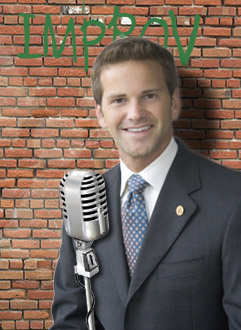
Aaron Schock at the ImprovRemember that speech that Aaron Schock gave when he announced he was running for the 18th Congressional District seat? I bet you didn’t know that part of it was a comedy act:

A statement to possibly sell nuclear arms to Taiwan was meant “more in jest” rather than as an actual proposal, congressional candidate Aaron Schock is now saying.

I see. So now it wasn’t a “deeply thought-out policy,” like Schock’s campaign manager Steve Shearer said when the story initially broke. Shearer told State Journal-Register reporter Bernard Schoenburg that Schock “’has studied that issue and was reading from different foreign policy magazines’ as he developed his stand on the issue.” I imagine those foreign policy magazines were filled with nuclear proliferation jokes — they’re the bomb, you know.

It’s quite entertaining to hear how Schock’s story keeps changing as time goes on. I expect to pick up the paper next week and read that Schock is saying, “Nukes? Naw, I never said anything about giving Taiwan nukes. I said that if China didn’t cooperate with us against Iran, I was going to give Hu Jintao a noogie. Get it right guys.”

Manual restructuring details

Peoria Public Schools logoI was e-mailed some documents that give a little more detail about the Manual High School restructuring plans, and I thought some of my readers might be interested in reading them:

PDF Link Draft Cover Letter for MHS Final Report
PDF Link Final Report Draft
PDF Link MHS Restructuring Plans and Recommendations
PDF Link MHS Restructuring Recommendations for Special Education

They’re generally adopting the Talent Development High Schools model from Johns Hopkins University. Plans call for lengthening the school day by 45 minutes and school year by five days, requiring parents to commit to one parent activity per month, and reorganizing the school into “academies.” They also want to make Manual a “choice school,” meaning anyone in the district can attend. They would provide bus transportation to all students attending Manual, no matter where in the city they live. That will make for an interesting bus schedule.

Some other things they want to add are a “publicly funded health center and expansion of a child care center in the facility to served [sic] both staff and parents’ children ages birth to five,” “a full time business liaison coordinator to work with members of the business community and school personnel,” and facility improvements “to support small learning communities, culture and climate, and increased security.”

No cost information is included here, but according to the Journal Star’s article:

Additional operational costs of the program, if implemented at the beginning of the 2007-08 school year, were estimated at about $810,000 beyond the current $4.9 million operational expenditures, Treasurer Guy Cahill said Monday. More cost details are expected by the board’s Jan. 22 meeting.

What are your thoughts on plans to restructure Manual High?

Amtrak study upbeat about Chicago-Quad Cities route

Before Amtrak can look at the feasibility of a Chicago-Peoria Amtrak route, they had to complete their study of a Chicago-Quad Cities corridor. That study was released this week, and it’s very encouraging. According to the Associated Press, it estimates the route would get 111,000 riders per year, cost between $14 and $23 million to upgrade the trackage, and $6 million annually to operate.

You can read Amtrak’s press release here. Included on that page is a link to the executive summary of the report.

My understanding is that the next feasibility study Amtrak and IDOT will be working on is the Chicago-Peoria study.

Is McCarron case another anti-depressant casualty?

Paul McCarron said his wife had seen a psychiatrist, but had stopped taking prescribed medication in the months prior to the May 13 death. He said she stopped taking it because it gave her suicidal thoughts.

Peoria Journal Star, 1/8/2008

“She was always crying,” the friend says. The friend asked McCarron if she might be suffering from depression. McCarron replied that she was taking anti-depressants , the friend says.

–Peoria Journal Star, 5/18/2006

I’ve been noticing a trend. Often when there’s a senseless homicide or suicide, there’s a mention somewhere in the article that the person is or has been on some sort of anti-depressant medication. Often it says they’ve just stopped taking it, had their dosage changed, or changed brands. The McCarron case is no exception, as you can see from the news article quoted above.

That got me thinking — is it just my imagination that I keep seeing this, or have other people noticed this, too? So I started doing a little research. I found out that not only have other people noticed it, there have been clinical studies to prove it, and there are many people who are concerned about the drug’s role in violent crimes.

The anti-depressants under scrutiny are medically described as “selective serotonin reuptake inhibitors,” or SSRIs for short. They’re marketed under brand names such as Prozac and Zoloft.

A website called SSRI Stories is a repository of news accounts of violent incidents where SSRIs played a part. Included are the Columbine shootings and Dr. McCarron’s case. In addition:

There are 34 cases of bizarre behavior, 28 school shootings/incidents, 46 road rage tragedies, 10 air rage incidents, 32 postpartum depression cases, over 500 murders (homicides), over 180 murder-suicides and other acts of violence including workplace violence on this site.

Just a few years ago, an article was published in the International Journal of Risk & Safety in Medicine by Dr. Peter Breggin called “Suicidality, violence and mania caused by selective serotonin reuptake inhibitors (SSRIs): A review and analysis.” The abstract explains the study’s findings:

Evidence from many sources confirms that selective serotonin reuptake inhibitors (SSRIs) commonly cause or exacerbate a wide range of abnormal mental and behavioral conditions. These adverse drug reactions include the following overlapping clinical phenomena: a stimulant profile that ranges from mild agitation to manic psychoses, agitated depression, obsessive preoccupations that are alien or uncharacteristic of the individual, and akathisia. Each of these reactions can worsen the individual’s mental condition and can result in suicidality, violence, and other forms of extreme abnormal behavior.

The two things that are particularly chilling in that abstract are the words “commonly cause” — in other words, these are not rare side effects, but common ones — and “obsessive preoccupations that are alien or uncharacteristic of the individual” — for instance, suicidal or homicidal thoughts and actions.

Do I think that the drugs made McCarron kill her autistic child? I don’t know; that’s up to the jury to decide, if the defense even uses that as an argument. My point is not to try McCarron in the court of public opinion here. I just want to bring attention to the serious, documented side-effects of anti-depressant drugs and wonder aloud, why are these drugs allowed to remain on the market?

Winner: Current Glen Oak School site

WEEK-TV reports:

The District 1–50 school board tonight voted to designate the current Glen Oak Primary School site as the new birth through eighth– grade school building.

Finally. I’m sure there’s a huge sigh of relief from East Bluff activists this evening. If you went to the school forums, you know that this was the site preferred by most people, including neighbors, parents, the City of Peoria, and the Chamber of Commerce. Even the Community Forum Report acknowledged this was the most popular site. The school board made the right decision.

Now comes the big push from the school board to try to get as much money out of the city as possible. The line will be, “Hey, this is where you wanted us to put the school, now you’re obligated to give us whatever money we ask for to make this happen.” Oh, look, it’s started already:

Martha Ross said, “The citizens in that area have said they want us in this site so we’re going to help us figure out how we’re going to pay for a lot of this in addition to the city of Peoria.”

But the last line of WEEK’s report is most troubling to me. It reads, “The price tag for the new school is upwards of $60 million.”

$60 million?

Where on earth did that figure come from? Last I heard, a new school was going to cost around $21 million. How did the cost triple in three months? Surely this is an error. Perhaps WEEK meant the cost of building both new schools (above and below the bluff) plus the cost of property acquisition is “upwards” of $60 million. But just the Glen Oak School replacement building is going to be $60 million? I’ll need to see an itemized accounting of that.

UPDATE: As PeoriaIllinoisan pointed out, the Journal Star reports that the cost of the school is “estimated at $25 million,” which is still higher than the $21 million previously reported, but nowhere near $60 million. Don’t forget, the reason they’re replacing the building is because STS Consultants determined that the cost to replace the building was less than the cost to renovate, but they determined the replacement costs at only $115.36 per square foot. If the replacement cost is now $25 million for a 120,000-square-foot school, that’s $208.33 per square foot. Gee, think they could have renovated for less than that? I bet they could have.

On substance, McConoughey wins the debate

The Peoria Area World Affairs Council sponsored a foreign policy debate with the three Republican candidates for the 18th Congressional District seat being vacated by Ray LaHood. It was broadcast live on WCBU (you can hear the debate in its entirety by clicking here), and was moderated by Jonathan Ahl. The questioners were Ahl, Illinois Central College President John Irwin, and Peoria Journal Star editorial writer Mike Bailey.

I finally got around to listening to the whole debate Sunday evening. The only way I could stay awake through the whole thing was by taking notes and eating Fritos. The notes came in handy afterwards, however, when I was trying to decide who won the debate. I developed a little scoring system and rated each of the answers, then summed the scores to see who came out on top. To my surprise, it was McConoughey.

It was a surprise to me because McConoughey is not a very effective speaker. I don’t mean that as an insult. He’s just kind of quiet and doesn’t come across on radio as particularly engaging like Morris or Schock. His opponents have a lot better delivery and poise. But when that was stripped away and I looked at what each of them had to say in response to the questions asked, I thought McConoughey came out on top overall. Schock came in second, and Morris last.

Naturally, each candidate had his pluses and minuses. One of Morris’s best answers was in response to Jonathan Ahl’s question about whether there comes a time when the U.S. should decide that democracy isn’t possible in a given country. Morris responded that he believes, like the Declaration of Independence says, that all men — not just Americans — are endowed by their Creator with certain unalienable rights, and that freedom is the destiny of the world. He also had good responses to questions regarding immigration and determining the accuracy of intelligence information.

But as the debate went on, Morris became less and less effective. His answers on Taiwan, Canada, and Lebanon were all weak — meaning he didn’t really answer the questions posed. He’s for free trade to a fault; he favors limiting trade only in “extraordinary circumstances,” such as “hot war” and “gross violations” of trade agreements. Only McConoughey cited human rights violations as a trigger for restricting trade. Finally, several of Morris’s answers bordered on jingoism (some questions were answered with nothing more than “I’m an American” and “I will vote in America’s best interests”).

Schock had a terrific answer to Bailey’s question about immigration — the one where he asked how the candidates reconciled their immigration stance with their family/religious values. He said, “God is a God of order,” and “Locking your door at your home and requiring that someone get permission to enter before coming into your house does not make you a bad neighbor.” An apt analogy. He also had the best answer as to how the U.S. can improve its relationship with Lebanon, which was to deal head-on with the Hezbollah problem and its Iranian funding.

Some of Schock’s answers, coupled with other statements he’s made, gave me the impression that he’s been reading up on former president Reagan and sometimes gets the past confused with the present. One example is his infamous suggestion (now retracted) that we sell Pershing missiles to Taiwan, even though Pershing missiles were destroyed by the early 1990s. In this debate, he evaded Ahl’s question about whether democracy is possible in some countries by talking about U.S. missteps toward Iran in the 1970s. A curious reference.

The only questions McConoughey didn’t have a good answer for were Ahl’s question on what the U.S. needs to do for Canada on issues such as sovereignty of the Arctic Ocean and air pollution from midwest coal-burning plants and Bailey’s question about ideas to promote peace between Israel and the Palestinians. However, none of the candidates had good answers to those questions. McConoughey’s “new” idea on the Israeli-Palestinian conflict was using Turkey as an intermediary to try to negotiate peace, but in fact Turkey is already a partner in that effort.

On the rest of the questions, however, McConoughey did well, showing a good understanding of our economic ties to other countries (including Canada), how to strengthen the dollar, and free trade theory.

WCBU debate online

If you missed the 18th Congressional District candidates’ foreign policy debate last night, you can hear it online. WCBU has an mp3 of the entire debate on their site. By the way, Schock did end up attending. Kudos to him for not chickening out. The other candidates are former city councilman John Morris and Heartland Partnership CEO Jim McConoughey.

Too bad there’s no Democratic candidate in the primary. It would have made the debate a lot more interesting.

Deferred items are back

Also on Tuesday’s agenda are two items that were deferred from last year:

  1. A recommendation to deny a gate blocking a public street between The Cove of Charter Oak (new McMansion development) and Vinton Highlands.
  2. A recommendation to change the city’s code so that Elliott’s strip club on University can get a liquor license. This is being recommended because of a recent court case that has led the city to believe that they are vulnerable to litigation if they don’t change the code.

Traffic consultant on Tuesday’s council agenda

I am so in the wrong line of work. I need to become a traffic consultant and get in good with IDOT.

The city wants to narrow Washington Street, add on-street parking, and widen the sidewalks as part of the effort to spur mixed use development in the Warehouse District. Now you might think that the city could just narrow the street, add on-street parking and widen the sidewalks, but you’d be wrong.

Why? Because Washington Street is a state route — Route 24, in fact. That means the Illinois Department of Transportation has to approve any changes, and they have procedures that require streets to always get wider and more pedestrian-hostile. So you can see what the city is up against.

One option is to move Route 24 to Adams and Jefferson streets, but then that causes other problems, such as the fact that Adams and Jefferson are one-way streets, and there’s a desire to convert them to two-way. If Route 24 moves there, then IDOT would have to approve the conversion there, so you’ve just traded one problem for another.

The good news is that there’s a process to try to change IDOT’s mind: Hire a consultant. For $525,000. Yes, a little more than a cool half a million. To put that in perspective, that’s like the equivalent of five assistant city managers.

First of all, don’t get me wrong. I’m glad that this process is moving forward — it shows that there’s a commitment to the plan for the Warehouse District. And secondly, you should know that Peoria doesn’t have to pay all of that — in fact, IDOT will pay $325,000 of the cost, and the council may decide to restrict the scope of the project so that it doesn’t exceed the IDOT-covered amount. So it might not cost Peoria anything (which makes you feel better until you realize that it’s just coming out of the taxes you pay to the state).

But still, whether a third or half a million, doesn’t that seem a bit crazy? Here we employ engineers at state and local levels. One would think they are more than capable of figuring out how to handle street drainage, or widen sidewalks, or change the painted lines from dotted white to double yellow. But in addition to the salary and benefits we pay for these engineers, we also need to pay over $300K to a consultant, and there’s no guarantee that his results will sway IDOT in the city’s favor.

Oh well, the important thing is that progress is being made… if the council passes the agenda item next Tuesday.