School Board President: “This is fair”

I see the District 150 administrators got their raises, including a very special raise for the associate superintendents and a couple others:

The highest percentage increase goes to director of employee services, Geri Hammer, who will see her pay go up 19 percent. She’s followed by Associate Superintendent Herschel Hannah and district research director Bryan Chumbley, who will see their pay increase by 11 percent. These raises are retroactive to the beginning of the school year. […]

Associate Superintendent Cindy Fischer was approved for a 3.5 percent pay raise, also retroactive to the beginning of the school year. The board also approved giving Chumbley and Hammer raises in school year 2007-08 similar to their raises this year.

Meanwhile, the district’s deficit is reportedly $6.65 million. And they can’t afford to give teachers a raise. And several schools can’t make adequate yearly progress (AYP) and are in restructuring. I especially love the fact that these raises are retroactive to the beginning of the school year. That’s a nice perk: six months of back pay in a lump sum.

Said board president David Gorenz: “This is fair. We’ve made significant advances this past year, and it’s largely due to not only the teachers but also the administrators.” Yes, they certainly have made significant advances: several schools have advanced to the next level of restructuring, the board prematurely advanced $877,500 to buy properties along Prospect that they now can’t use, and the board has allegedly been doing some advanced planning to close Manual High School while skirting around the Open Meetings Act.

Elections are coming up on April 17. Vote wisely.

Trail advocates’ ignorance embarrassing

There are two letters to the editor in today’s paper that are supportive of converting the Kellar Branch rail line to a recreational trail. They are full of inaccuracies and misleading statements. Let’s take a look.

First up is a letter from Janice Atkinson. She writes:

A trolley would be cute but an incredible waste of funds, and be used by far fewer people than a recreational trail. The trolley would block traffic and cause accidents at road crossings. It would operate on fossil fuels.

A few things:

  1. I don’t believe this would be a waste of funds, but even if it were, it would be private funds that would be wasted instead of public funds. No one is asking the city to foot the bill for a trolley — it’s a business venture. You know, the kind of businesses that pay taxes. Turning the line into a trail, on the other hand, would be an incredible waste of funds on which we would never see a return on investment.
  2. The number of people a trolley versus a trail would draw is irrelevant. The rail line would not only be used for trolley service, but also freight. The businesses that could be lured to the industrial sites along the line would provide a much bigger return on investment in taxes and jobs than a trail ever would.
  3. “The trolley would block traffic and cause accidents at road crossings”? This is the weakest argument I’ve heard yet. Yes, it would have to cross streets, so there would be a delay while the trolley passed, but considering it would be a single car and not a 100-car freight train, this “delay” would be no longer than a regular stoplight cycle. As far as it “causing accidents,” prove it. Show me the accident records for historic trolleys. I’ll bet you the number of people injured is less than the number of walkers who have been attacked on urban recreational trails.
  4. “It would operate on fossil fuels.” Wrong. It would operate on battery technology. If Ms. Atkinson drives a car, she will be putting far more pollutants in the air in one day than a trolley ever will.

She further says:

When the Kellar branch was in use, the train held up traffic at various points. The rails were not properly or regularly maintained. They remain an eyesore. […] Maintenance for a trail would be minimal in comparison to what a trolley route would require.

The track belongs to the city right now, which is responsible for its upkeep. Since they’ve been trying to shut it down and tear it out for a trail, obviously it’s poorly maintained. If the line were sold to Pioneer, they would upgrade the rail line and keep it in good working condition. Again, private dollars would be maintaining it, whereas a trail would be maintained with public dollars. And in any case, it would take far less maintenance to fix the rails than to tear them out for a trail.

Let’s move along to Joyce Blumenshine’s letter:

Any City Council member who follows Sandberg should consider the 82,000 users on the Rock Island Trail, and about $3 million in trail grants the Peoria Park District has waiting.

Whoa! Wait a minute! Did she say the Park District only has $3 million in trail grants? I have a quote here that says it will cost the Park District over $6 million to convert the rail line to a trail. Where is the extra $3+ million going to come from? Short of finding a matching grant, I guess the funds will come from the taxpayers in the form of a tax hike. Are higher property taxes a big draw for people to buy homes next to a trail?

The Kellar branch line belongs to the city and people of Peoria.

Yes, all of the people, not just trail advocates. And it was purchased by the city in 1984 to provide competitive rail service to Pioneer Park, not to make a linear park.

The city needs to renew its lease with Central Illinois Rail on the Kellar branch line. Any consideration of the city dealing with Pioneer Railcorp should be dead in the water. Pioneer has a proven track record of flagrant obstructions, blatant abuse of contract terms and broken promises. It is a company totally unworthy of consideration.

Ms. Blumenshine is wrong. The record-holder for obstructions, abuse of contract terms, and broken promises goes to Central Illinois Railroad Company (CIRY), which never fulfilled its contractual obligation to provide service to Carver Lumber while the western spur was being built, endangered the lives of Peoria citizens with a runaway train, and withdrew their petition to discontinue service on the Kellar Branch so they could serve new customers along the Kellar Branch. It is CIRY that has doublecrossed the RTA and Ms. Blumenshine, not Pioneer. Pioneer wants to help build a trail next to the rail line, an option that is constantly rejected:

Sandberg must know resurrection of the dual rail line and trail is a death sentence for the trail due to high cost and Americans with Disabilities Act requirements.

The “high cost” to which she refers is the park district’s estimate that it would cost over $29 million to build the trail side-by-side with the rail line. That estimate is a joke. What engineering firm provided the estimate? How did they determine the cost per square foot? How did they determine whether a trestle was needed or if the trail could follow the natural topography of the land?

On that last point, you’ll notice on the estimate that about $20.3 million of it is in trestles alone (not including the one at Versailles Gardens, which to my knowledge is undisputed) — 8,065 feet of trestles. Over a mile and a half of trestles. Apparently the park district believes (a) the trail must be perfectly flat or it won’t meet ADA requirements (which makes one wonder what they’re going to do with the steep grade where the rail goes up the bluff), and (b) the only way to bridge such gaps is to build a $180/ft² trestle. I’ll bet a real engineering study would uncover a much different solution.

Finally, I’d like to make just two comments about the Journal Star’s editorial today:

Pioneer may be a local business, but it also has helped ensure that the truly railroaded here have been local taxpayers.

Yes, the railroaded here have been local taxpayers, but not because of Pioneer. Rather, it has been because of the Peoria Park District. A district that, although it has nearlly 9,000 acres of park land and a number of existing trails, covets a little rail line through the center of town. They’re like Mr. Potter in “It’s a Wonderful Life” and the Kellar Branch is the lonely old Building and Loan that, try as they might, the park district just can’t get control of and it’s galling them.

Any boost a sale would give the city’s operating budget shouldn’t be relevant, as it’s a one-time revenue source, not an ongoing revenue stream.

That’s right, Peoria. $565,000 for city coffers is irrelevant. But putting that aside, the Journal Star should do their homework. Pioneer’s offer to the city included the option of a long-term lease — and that would, in fact, provide a revenue stream to the city. Nevertheless, I believe it would be in the city’s best interest to get out of the railroad business altogether and sell the line. They could still retain the right of first refusal if Pioneer ever decided to sell or abandon it.

The City Council should do the right thing and sell the line to Pioneer. But most likely this will be deferred for another week. So, go to the meeting, but be prepared to have to wait another week.

Museum project too big, too expensive

Now that they’ve lost their federal earmark funding, the already-heavily-underfunded Peoria Riverfront Museum is looking for something — anything — to prop up their big plans for the old Sears block. The latest funding scheme: The New Markets Tax Credit (NMTC) program.

As I understand it, the way NMTC works is that investors would donate money to a for-profit corporate entity (usually a limited liability company) called a Community Development Entity (CDE) which, in turn, makes debt and equity investments in low-income areas — presumably the proposed museum in this case. The benefit to the investors is that they get a 39% Federal income tax break distributed over seven years, plus a possible cash return during the life of the CDE if it’s profitable.

The first question I had was how the Sears block could possibly be considered a “low-income area.” It’s the crown-jewel of downtown Peoria, right next to Caterpillar’s world headquarters. It’s a prime piece of real estate. Well, it turns out that the way the federal government figures whether or not it is a low-income area is by census tract. Museum Square is in census tract 12, as shown here:

Census Tract 12

As you can see, this census tract not only includes downtown, but also an equal area northeast of I-74. Thus, statistically, the census tract poverty rate is 50.2%, and therefore qualifies as a low-income area. Don’t you just love statistics?

Whether this funding will be the panacea for the museum group’s fundraising woes remains to be seen. It looks like this project would qualify based on the standards set forth by the NMTC statute. However, there is still an application process through the Treasury Department, and the Museum Collaboration won’t find out if their application is approved until late summer, which means, according to the Journal Star’s report:

Officials hope to finish the New Markets financing plan by late summer and start construction of the underground parking deck by September 2008. Construction would begin on the visitors center and museum by January 2009. Exhibit installation would begin in March 2010 with a grand opening scheduled for November 2010, about a year behind original projections.

But there’s another option: redesign. Most of the $24 million they’ve already raised can be used to build a state-of-the-art Peoria History Museum on a smaller footprint, and the rest of the block could be sold for commercial development once the new Land Development Code is adopted. That would put the project more in line with the Heart of Peoria Plan, the available funding, and a reasonably-manageable project scope. It could open a whole lot earlier, with construction of commercial ventures starting even sooner, meaning more property tax revenue for the city.

People in glass arcades shouldn’t throw stones

David Stuckel, attorney for the Civic Center Authority, had his letter to the editor printed in the Journal Star today. He asks:

Why should Peoria taxpayers be ticked by the efforts of the Peoria Civic Center Authority to bring a new hotel to Downtown, as suggested in the Jan. 29 editorial? Because it will improve Downtown’s appearance? Create jobs and tax revenues? Attract people who spend money in the community?

No, Mr. Stuckel, it’s because the Civic Center Authority (CCA) lied to the city when they started this expansion. They told the city — in writing — “We believe [an expanded Civic Center] can be successful without an attached hotel,” and that they weren’t asking for any public funding for a hotel.

Now, less than a year later — before the mortar between the bricks is even dry — the CCA is coming back to the city with its hand out, begging for TIF status and claiming the Civic Center can’t even be solvent without a new hotel. Stuckel then has the chutzpah to ask, “Will our traditional lack of governmental foresight consign this to the woulda-coulda-shoulda trash bin?” The only lack of foresight in this equation is the CCA’s. All the city did was take them at their word.

No, Mr. Stuckel, we’re not ticked for any of the spurious reasons you gave. Peoria taxpayers are ticked because they don’t much care for extortion. They don’t much care for arrogant criticism of other hotels by an entity that has never been self-sufficient and continues to rely on heavy tax subsidies. They don’t much care for an organization that has taken their temporary HRA tax funding and treated it as a permanent entitlement.

Council should sell the Kellar Branch to Pioneer.

A couple of weeks ago, Gary Sandberg suggested the city should come up with a strategy for the Kellar Branch before the Surface Transportation Board (STB) tells the city what to do. Toward that end, the council agreed to ask staff to bring back their options and recommendations on what to do.

Well, that information is on the agenda for Tuesday night’s (2/6/07) council meeting. However, this communication from city staff omits important, germane facts that the council should be considering.

Here’s what the communication says:

Option 1 – Deferral: It is possible for the Council to defer this matter to February 13 because of the STB Continuance. Council could even continue this to February 20 if it looks as though a resolution may be reached. If this option is chosen, the Council may want to consider formally requesting positions from ClRY and PlRY for its consideration. Both have been invited to put their position in writing, but neither has done so as of February 1, 2007.

That is untrue. As I reported back in May 2006, Pioneer has had their “position” in writing since September 24, 2004. The president of Pioneer Railcorp, J. Michael Carr, explained his company’s position thus:

We are fighting this battle because Pioneer is a Peoria company, dedicated to the betterment of this community. Abandonment of the Kellar Branch would be an incredibly short-sighted move, for which this City would suffer for decades to come. We are determined not to let that happen.

This City Council has been able to put petty politics aside and make some hard decisions for the long-term benefit of Peoria. It is time to do that again. While it may not be popular with a few newspaper editors, bringing the saga of the Kellar Branch to an end is the right thing to do for the City. It will return almost a million dollars to the City immediately, and bring dividends for many years to come. I am hopeful the Council will exercise the statesmanship to act on this opportunity.

Did you catch that? They’re dedicated to the betterment of this community because they are a Peoria company. Many people forget that Pioneer is a local company (CIRY is based out of LaSalle and the Kellar Branch is the only interest they have in our area), and they also forget that its founder, Guy Brenkman, is not the President anymore — hasn’t been for years (not that it should matter, but it does to some people).

Pioneer’s offer still stands. (Read the full text here.) To put their money where their mouth is regarding commitment to the Peoria area, check out some of the things they’ve offered:

  • Purchase the Kellar Branch and western spur from the City of Peoria for $565,000, or accept a long-term lease on the lines;
  • Grant the Park District a 999-year lease on a portion of the right-of-way for the use of a trail;
  • Donate up to $100,000 in in-kind services (railcar usage, train service, equipment use, flagging and other labor services) to the Park District to assist in the construction of said trail;
  • Work with the Park District to provide for joint use of the right-of-way, including the joint use of existing bridges;
  • Provide the labor, materials and equipment to construct a trestle for the trail to traverse the section behind Versailles Garden where the track elevation has caused the Park District the most concern (the Park District estimates this item alone would cost almost $400,000);
  • Upgrade the Kellar Branch track to Federal Railroad Administration (FRA) “Class I” standards;
  • Aggressively seek new business in Pioneer Park and Growth Cell Two;
  • Develop a “dinner train” as a tourist attraction for the city (similar to a successful dinner train Pioneer runs on their Gettysburg & Northern Railroad);
  • Develop, in cooperation with the city, tourist/commuter service from downtown (the Illinois Prairie Railroad Foundation has submitted a plan for providing this service recently);
  • Pursue the establishment of a “railroad academy” in partnership with Illinois Central College and/or other appropriate partners, to train students in train operation and maintenance, using Pioneer’s equipment and facilities; and
  • Give the city right of first refusal to repurchase the line if another entity wants to buy it from Pioneer.

What has CIRY offered to the area? Hmmm….. nothing. Next option from the city:

Option 2 -Sale of Kellar Branch: The City could choose to sell its ownership of the Kellar Branch which, of course, would have limited value without the Village of Peoria Heights agreeing to sell its portion of the Kellar Branch. In the past, PlRY has expressed interest in purchasing the Kellar Branch. The sale of the Kellar Branch would make the possibility of a recreational trail a more remote possibility. The sale would not require STB approval.

There are several problems with this. First, “PIRY [Pioneer] has expressed interest in purchasing the Kellar Branch.” In light of their offer, I’d say this is the understatement of 2007 so far. Also, saying that selling the branch “would make … a recreational trail a more remote possibility” is exactly the opposite of the truth. It makes it more of a possibility — a promise to cooperate, a promise to provide money and manpower, and a promise of signing a lease agreement. Not selling it and having CIRY run it would make trail usage more remote.

But the most baffling part of the comment is the first part: that owning the City’s portion of the Kellar Branch “would have limited value without the Village of Peoria Heights agreeing to sell its portion of the Kellar Branch.” If that’s true, then why did the city sell part of the line to Peoria Heights in the first place? The city bought the line in 1984, but then according to the STB, “the City subsequently transferred to the Village [of Peoria Heights] an ownership interest in the portion of the Branch located within the Village’s corporate limits.” So, is city staff saying it made a mistake in selling a portion of it?

But putting that aside, I don’t see how that is pertinent to this communication. It wouldn’t be “of little value” to the city, only to the purchaser. Is city staff suddenly concerned about Pioneer’s welfare, whether they will get their money’s worth out of the line? That’s not really the city staff’s job, is it? The line would bring over a half-million dollars into city coffers if they act on Pioneer’s standing offer. That’s of great value to the city. The city needn’t worry about Pioneer; they’ll be just fine.

Moving on to the next option:

Option 3 – Operating Agreement with CIRY: The next alternative is to enter into an operating agreement with ClRY and continue to seek involuntary discontinuance of PIRY’s STB operating authority. ClRY remains committed to making service from the West viable. They are working with the Union Pacific, over whose tracks service from the West must travel, to reduce the cost of service from the West. They are also committed to improving service from the West. ClRY believes that the Kellar Branch can be used to help finance service from the West until such time as there are sufficient users in Pioneer Park and/or Growth Cell 2 to create an economy of scale. ClRY has verbally advised us that they would spend $150,000 to improve the Kellar Branch tracks to a point north of the concrete company and would be able to, therefore, serve any user in the southern area over the old Kellar Branch. They would use excess trackage for storing piggyback rail cars and would use the money earned from this to attempt to make service from the West more viable. They are willing to address the weed problem along the tracks when it is economically feasible to do so. This and the exact placement of storage cars would have to be negotiated with CIRY. It should be noted that the largest rail user on the Kellar Branch, O’Brien Steel, would prefer to do business with ClRY rather than PIRY. ClRY is also committed to working with Carver Lumber to attempt to address their concerns with service from the West.

By it’s sheer length, we don’t have to read to the end of the communication to see which option city staff favors. The city speaks a lot of CIRY’s “commitment” to do this and that, but there is no evidence of it. Is it like their commitment to deliver cars to Carver within 24 hours of their placement for pickup (which they haven’t lived up to)? Or is it like their commitment to work with the city to discontinue service on the Kellar Branch so it could be converted to a trail (which they axed by withdrawing their discontinuance request with the STB)? Or is it like their commitment to provide service to Carver Lumber over the Kellar Branch until the western connection was built (which they never did)?

It’s interesting that city staff saw fit to tell the council that CIRY verbally committed $150,000 in track upgrades for the lower part of the Kellar Branch, yet they didn’t forward Pioneer’s standing written offer to upgrade all of the track to Class I standards. And how expensive is it to ride a hi-rail truck up the line and spray the weeds, anyway? They can’t do this until it’s “economically feasible”? They must not be in too good of shape financially.

It’s also interesting that they mention here that O’Brien Steel — which would be unaffected by the Kellar Branch being abandoned — prefers CIRY. But the fact that Carver Lumber — the company that is affected and continues to lose money because of the city’s actions and CIRY’s inaction on the Kellar Branch — doesn’t like CIRY and would prefer Pioneer gets cursory treatment.

Finally, the fourth option:

Option 4 – Operating Agreement with PIRY: The fourth alternative would be to enter into an operating agreement with PIRY and to voluntarily withdraw the application for involuntary discontinuance of PIRY’s rail service. PIRY has previously told the STB that they are ready, willing and able to upgrade the track so that it is usable and provide service to Pioneer Park. Any operating agreement with PIRY would also need to address the weed issue which has traditionally been addressed by having the carrier mow the weeds within fifteen feet of the centerline of the track. This alternative would create operating rights in both the ClRY and PIRY to areas in Pioneer Park. Multiple carriers on the track could create operational and safety issues as well as make the line financially less viable.

“PIRY has previously told the STB….” Yes, and the city. The silence about Pioneer’s offer is deafening. As far as “this alternative…creat[ing] operating rights [for] both the CIRY and PIRY,” that’s a matter of debate. The contract is with DOT Services, the former parent company for CIRY. CIRY now is owned by Central Illinois Railroad Holdings, LLC. The contract, as far as I know, was never transfered. Thus, CIRY may not have a contract with the city at all.

Nevertheless, their conclusion is faulty: “Multiple carriers on the track could create operational and safety issues as well as make the line financially less viable.” I always thought multiple carriers would provide competition and thus lower rates for users of the line. But given the city’s beliefs about the western spur, I suppose I shouldn’t be surprised at the city’s conclusion. The only safety issue on the line has been allowing CIRY to operate it — in the seven years Pioneer ran the line, there was never a major safety incident; CIRY’s first try at taking lumber up the branch with insufficient locomotive power resulted in a runaway train that endangered the lives of Peoria’s citizens. Their contract should have been terminated immediately.

The only reason city staff is recommending CIRY is this:

While there has been much discussion of the possibility of co-locating a trail with rail, the Park District, the only entity with any funding to build a trail, has consistently rejected the possibility of co-locating on the trail. Because ClRY is committed to making service from the West viable and because ClRY apparently has a better working relationship with the Union Pacific, an operating agreement with ClRY would appear to be the best opportunity for the City to be in a position to use the portion of the Kellar Branch between Springdale Cemetery and Pioneer Park for a recreational trail.

I find it comical that the city believes an agreement with CIRY would “be the best opportunity” for the city to pursue its dreams of a recreational trail when it was CIRY’s poor service to Carver Lumber and withdrawal of their discontinuance request before the STB that has completely derailed (no pun intended) the conversion plan!

The council should reject city staff’s advice and take Pioneer’s offer to purchase the line. That, and only that, is the only sure way to get a trail. I know the Park District will scream bloody murder, but I guarantee you they would miraculously find grant money to make a side-by-side rail with trail scenario work, and for a lot less than $29 million. Even if they didn’t, the council would be doing the right thing for Peoria by keeping the rail line for economic development instead of tearing it out for a money-losing trail.

So much to blog about… so little time

Wow, there’s so much news on which to comment, I don’t know where to start! Why don’t you kick things off on this open thread in the meantime?

I’m working on entries for: Parental accountability, Kellar Branch options to come before the city council, Museum funding, District 150 restructuring information, Bradley’s expansion, the upcoming elections, and some other odds and ends, so stay tuned….

Ardis to continue pushing for Amtrak service

Amtrak LogoI was happy to hear Ardis say this in his State of the City address today:

I will continue to pursue having IDOT urge AMTRAK to complete a feasibility study to bring passenger rail service back to Peoria. We are the second largest municipality outside Chicago and we deserve consideration. Senator Durbin spoke in support of our feasibility study just last week in the Quad Cities and Congressman LaHood supports the study as well.

I’m going to be taking the train to Minnesota next month, and it sure would be great if I didn’t have to drive to Normal to catch it.

Rethinking the “Peoria Promise”

DIstrict 150 Promise?

Mayor Jim Ardis delivered his “State of the City” address today (the transcript is available on the City of Peoria website), and he had a big announcement to make about the “Peoria Promise” initiative:

Last year, at this State of the City address, I asked our city to dream big dreams and consider a program called Peoria Promise. Based on a similar program in Kalamazoo, Michigan, and recently successfully emulated elsewhere, Peoria Promise would enable any student graduating from Peoria Public Schools to be eligible for a college scholarship. Today, I am excited to announce the first step in Peoria Promise – a guarantee that eligible high school graduates qualify for up to 100% tuition while working towards a degree or certificate at Illinois Central College.

We are very fortunate to have Illinois Central College in our community, and they have
been extraordinarily helpful to us on this project. I’ll touch on a few of the details, and
there will be more information available through ICC to all who are interested.

  • Peoria Promise is offered to City of Peoria residents who graduate from one of the following high schools: Manual, Central, Woodruff, Richwoods, Dunlap, Limestone and Peoria Alternative. Tuition will be provided based on a sliding scale determined by how long the student attended Peoria Public schools. Those attending all 12 years receive 100% funding. This is based on the philosophy that those children and families who reside in the City the longest and attend the public schools the longest should reap the greatest benefit.
  • Peoria Promise will begin funding the tuition scholarships with the high school graduating class of 2008.
  • Applications will be made on-line at ICC’s website during January through March of each year.
  • Students must have a minimum two point zero grade point average following each semester at ICC to maintain eligibility.
  • In addition, Peoria Promise will pay tuition at other community colleges for students who choose programs not offered at ICC.

As Ardis said, this is a program inspired by the Kalamazoo Promise, on which I have done some research in the past (here , here and here).

The two biggest benefits of Kalamazoo’s program are:

  1. First and foremost, it rewards kids who stay in school and graduate by giving them a free college education (in Kalamazoo’s plan, they provide a free four-year education at a state school for kids who went to Kalamazoo public schools K-12).
  2. But secondly, it provides an incentive for people to move back into the school boundaries, thus increasing the student population (which gets them more federal and state funding) and pushing up housing sales/property values in the city.

The thing that makes Peoria, and thus Ardis’s plan, different from Kalamazoo’s is that Kalamazoo has just one public school district that, as far as I can tell, is coterminous with the city’s boundaries. In Peoria, you can live within the city limits and attend one of three public school districts: Peoria, Dunlap, or Limestone. In fact, Ardis notes elsewhere in his speech that 70% of Dunlap school students live in Peoria.

The problem is that District 150 is the one public school district in Peoria that really needs this Peoria Promise program more than any other. That’s the district that is losing enrollment. That’s the district that serves the older neighborhoods in town that desperately need building up. I don’t believe Dunlap is having any trouble attracting residents to live within its district boundaries or getting kids to graduate from its schools; nor do the families who live in the north end have trouble affording ICC.

Th mayor’s plan will provide the first (and arguably most important) benefit to District 150 — i.e., rewarding those kids who stay in school and graduate. So, I’m not saying the plan is bad. However, it will not provide the second big benefit: drawing people back into its school boundaries. It won’t do anything to even-out the “haves and have-nots” divide in this community between those who can afford to live in Dunlap schools’ district versus those who can’t. It won’t attract anyone to move into District 150 boundaries who wouldn’t have moved into those boundaries anyway.

Thus, I’m rethinking the “Peoria Promise” as the mayor has outlined it. I think what Peoria needs instead is a “District 150 Promise” — a program based on the Kalamazoo Promise, but only for District 150. Some may argue that Ardis is the mayor of the whole city, and thus he can’t discriminate in favor of one school district. But he’s already “discriminating” (if you will) against students who go to private, parochial, or home schools. What’s the difference?

Besides, he’s not looking for public funding for this initiative, but private funding. Someone with a million dollars to invest in our community could stipulate that it be used only toward those within District 150’s boundaries.

So that’s my challenge. Let’s put this educational investment where it’s needed most.

President Bush visits Peoria

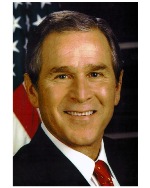
President George W. BushPresident George W. Bush visited Peoria this morning, stopping by Sterling Family Restaurant for breakfast before heading over to Caterpillar in East Peoria to give a “State of the Economy” speech at Caterpillar’s building SS.

There have been a lot of “presidential sightings” all morning: people who were in the restaurant and actually got to meet the President, people who were near the restaurant who saw the President drive by in his limousine and wave, people like me who saw Air Force One fly overhead, and many others. I’m sure we’ll be hearing more stories for some time to come.

I don’t care what party, if any, you belong to, there’s something exciting about getting a visit from the President of the United States. The office deserves honor and respect, even if you don’t agree with the politics of the office holder or don’t personally like him. It’s pretty much impossible to find a Presidential candidate with whom you will agree on everything. I certainly don’t agree with President Bush on all of his policies (e.g., free trade). But I still consider it an honor to have him visit our city.

The Journal Star has posted the text of the President’s speech here. And you can hear his speech here:

[audio:http://www.peoriachronicle.com/wp-content/uploads/Audio/President-Bush-Peoria-01302007.mp3]

Trolley service proposed for Kellar Branch line

Gomaco Trolley in PortlandWhile the Recreational Trail Advocates are stepping up their efforts to get the Kellar Branch rail line converted to a hiking/biking trail, there is another plan on the table that calls for keeping the rail line for passenger service.

Sharon Deckard, President of the Illinois Prairie Railroad Foundation, has put together a proposal for offering commuter and tourist trolley service along the Kellar Branch. The service would provide transportation from downtown, through shopping areas such as Junction City and Peoria Heights, and up through Pioneer Park to a proposed “park and ride” station. A trolley would be used from the Gomaco Trolley Company which builds replicas of historic trolley cars, but with modern train technology. They could build a replica of one of Peoria’s old street cars or an Illinois Traction interurban. (Of course, the new cars would be self-propelled, so no need to restring electric wires for power.)

Deckard has personally delivered her proposal to each Peoria City Council member and the Mayor of Peoria Heights. You can see her full proposal here: Trolley-Proposal-Full.pdf (warning: large file! 8.8 MB PDF).

If you don’t want to download the large PDF file, here is the main text of the proposal:

Using what we already have to benefit
TODAY and TOMORROW

All across the country cities are finding the need to go to commuter rail. This is a service that allows them to come from their suburban bedroom communities into the city to their jobs and businesses.

The stop and go commute, parking problems, fuel emissions in the air and a host of other things including the most important “time”, is causing these cities to install commuter rail. This ranges from park n rides to full length light rail through larger downtowns.

They are finding that providing this access to their cities is encouraging residents and businesses alike to relocate near these amenities.

The biggest problem in establishing this program for commuters is that they find it cost prohibitive and it takes many years to accomplish it. They have to buy the land, clear it, install the tracks and buy the equipment, as well as run it so that it is beneficial to itself and the community.

We, here in Peoria are way ahead of the game. We have the rail, in place and waiting. We have eliminated 90% of the cost before we start.

Peoria is a very unique community in that it has a complete ring road of trackage around the entire city. There are eight railroads that currently serve Peoria. This gives a foot in the door to numerous benefits for this community.

|inline