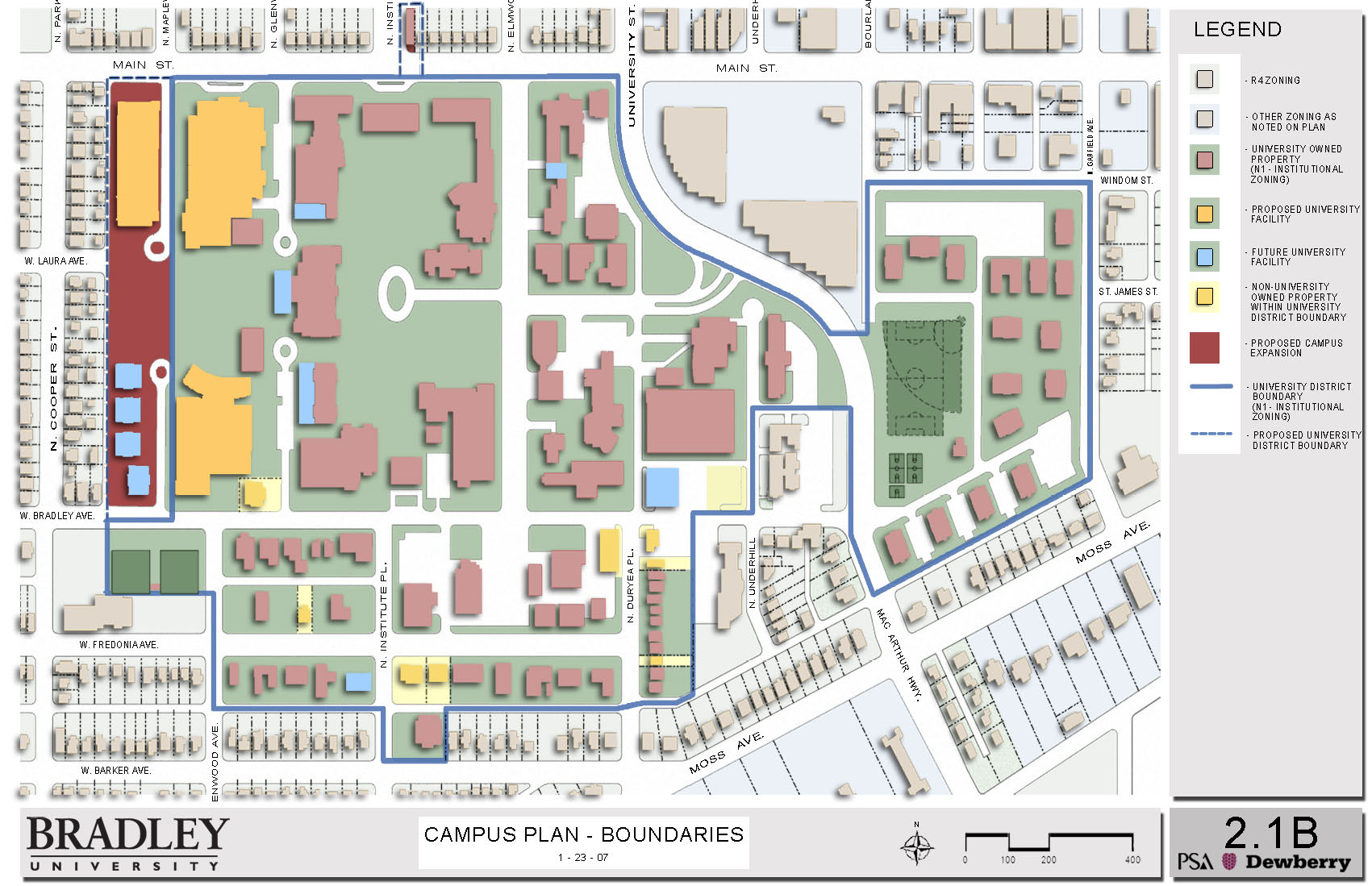
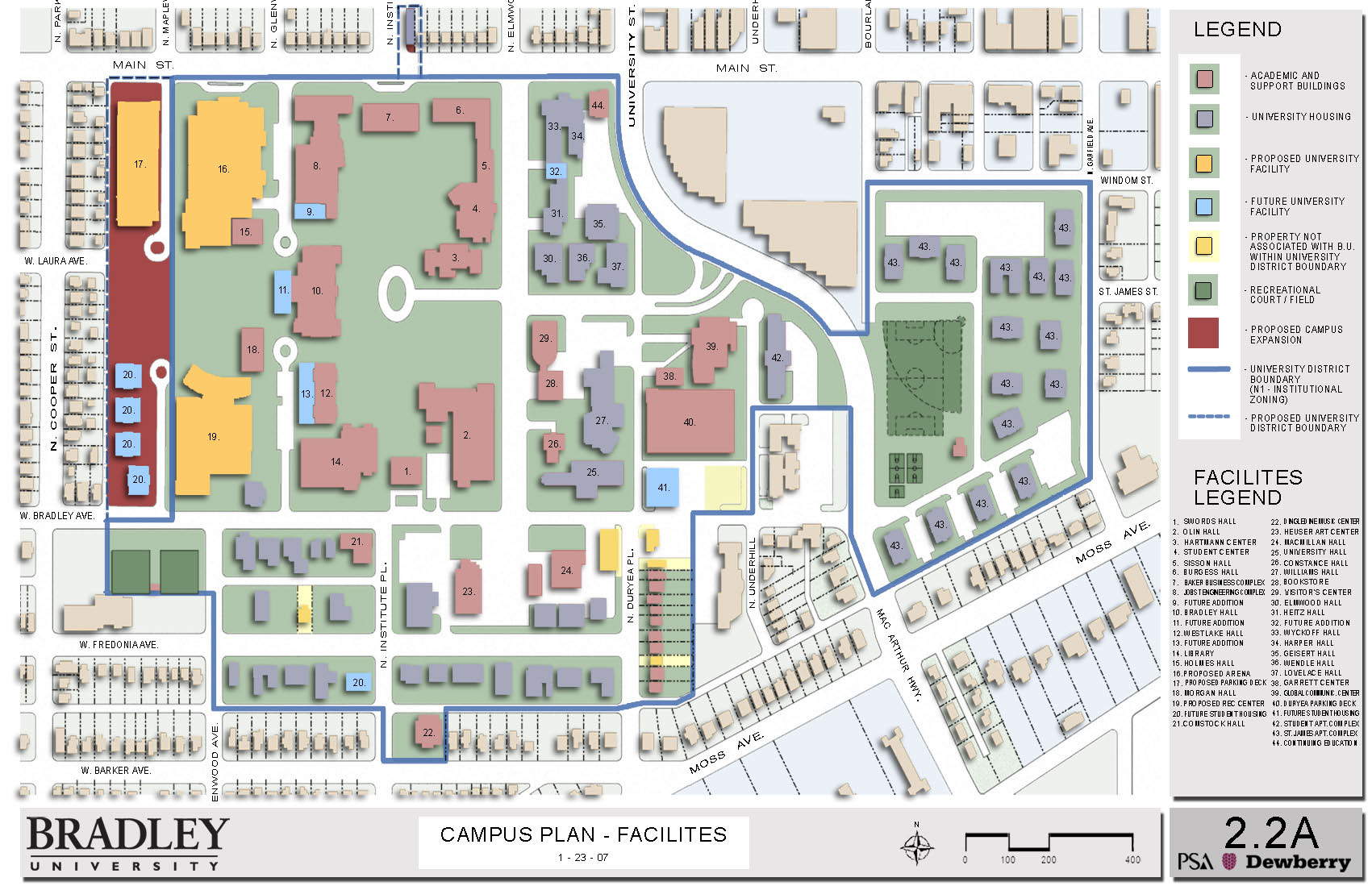
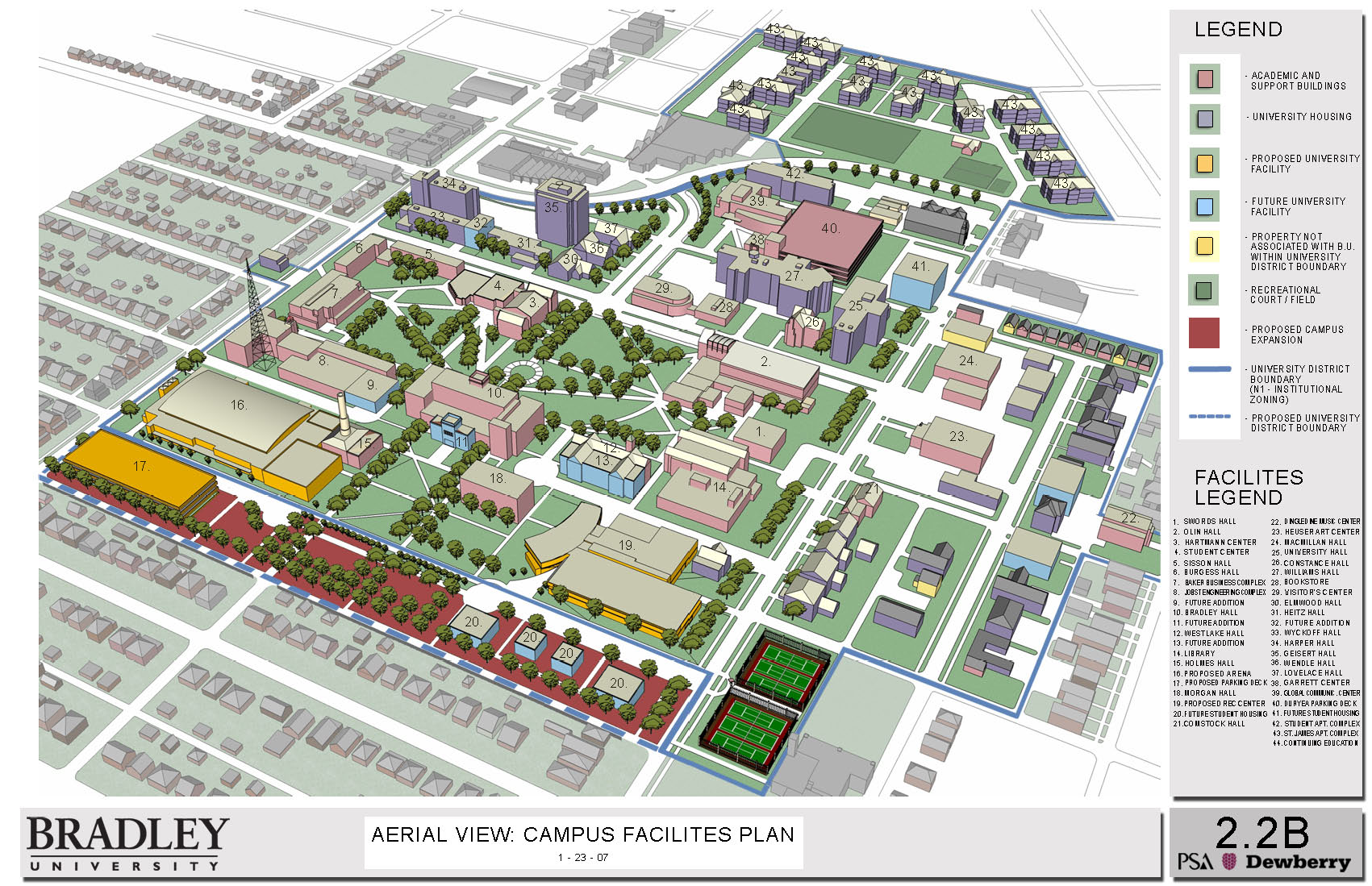
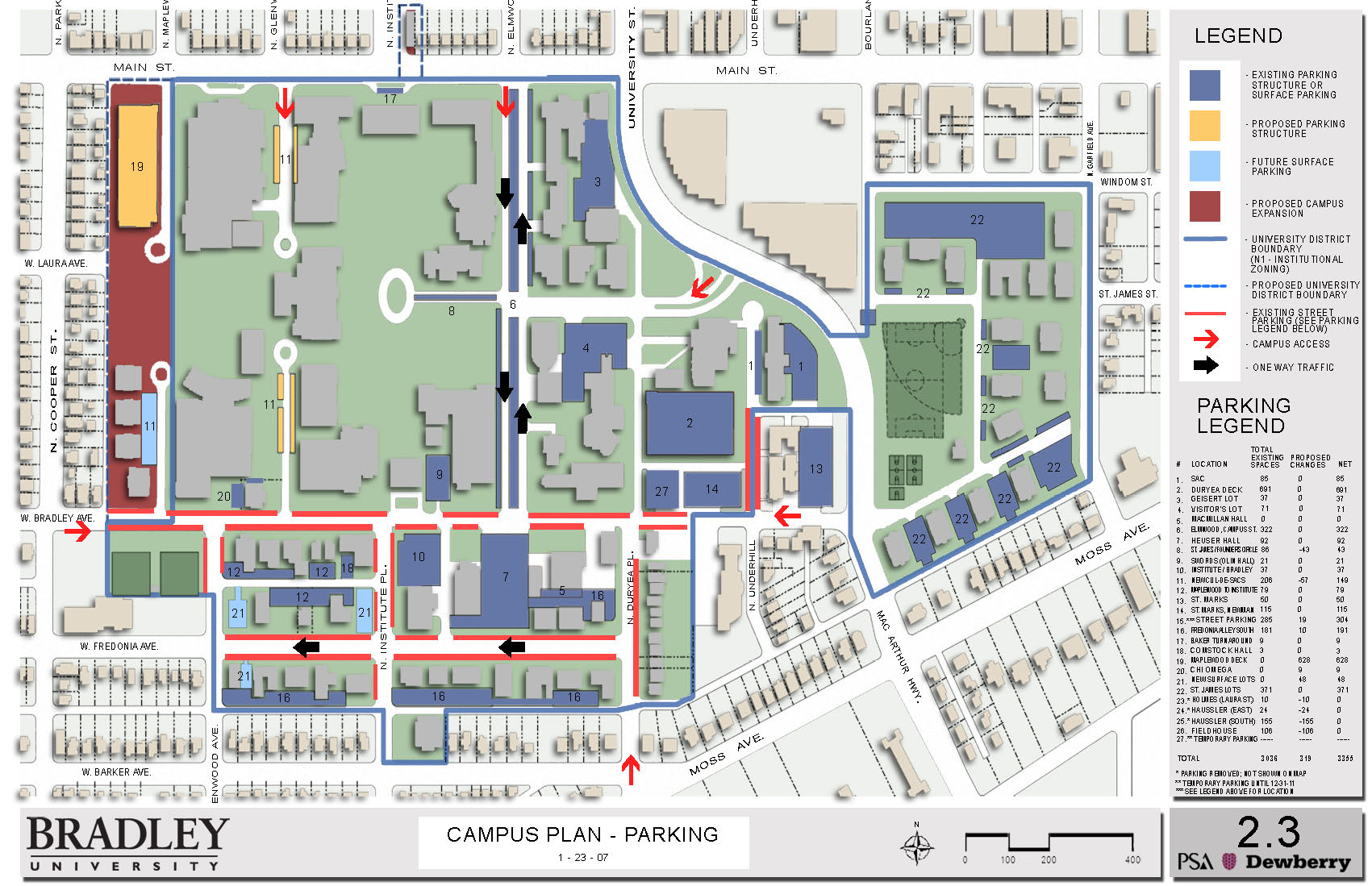
Bradley’s expansion plan in pictures!

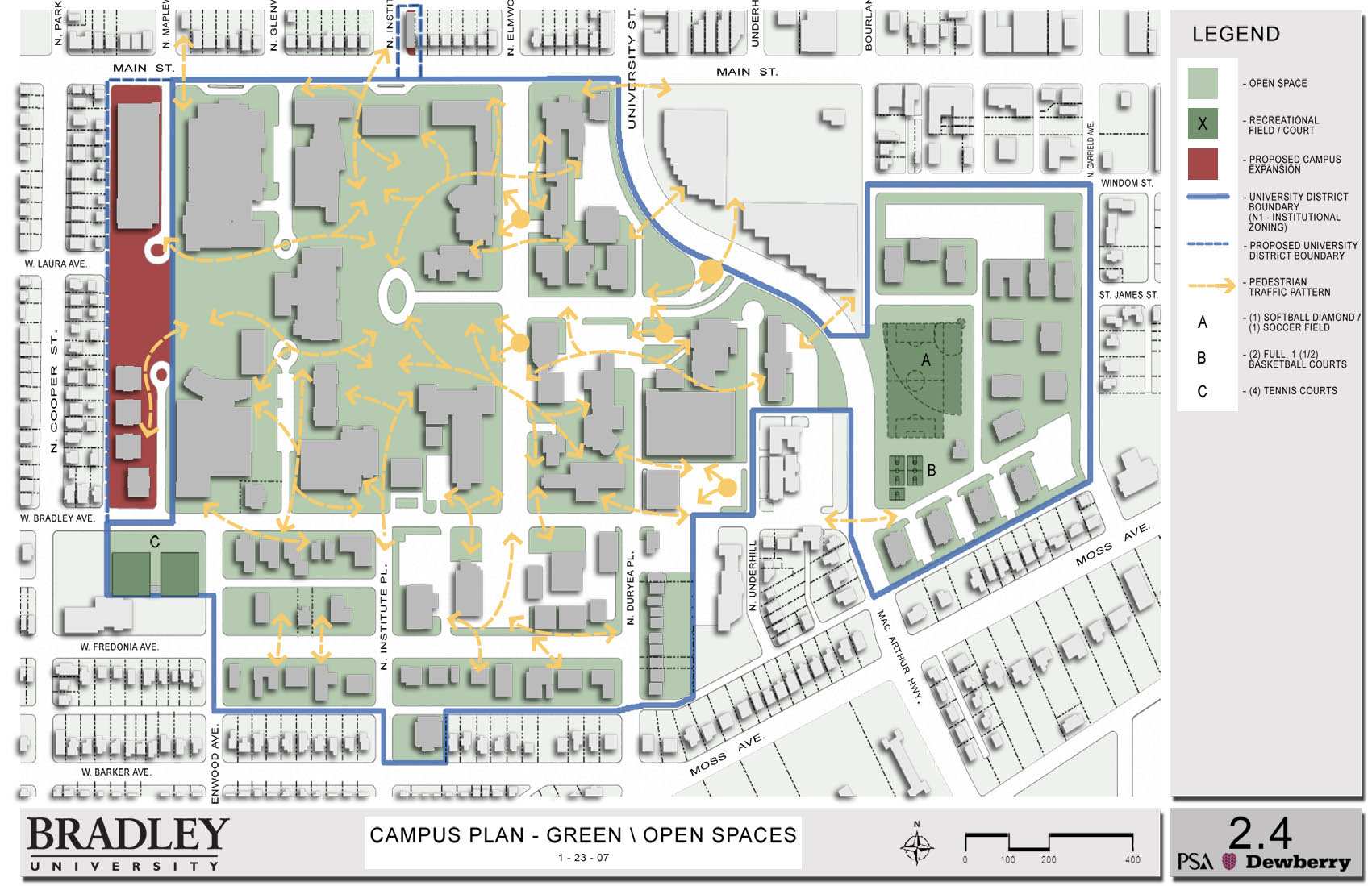
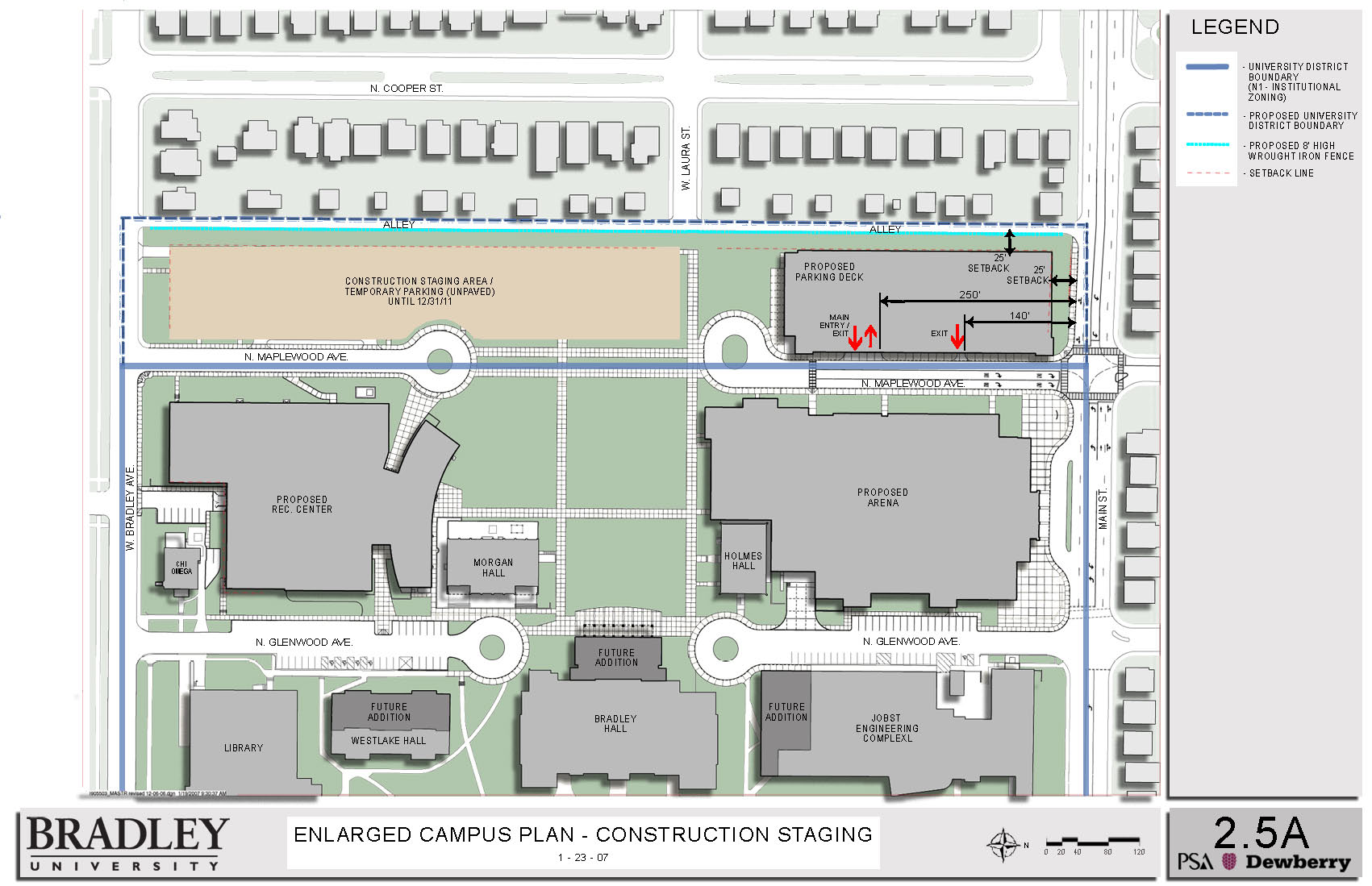
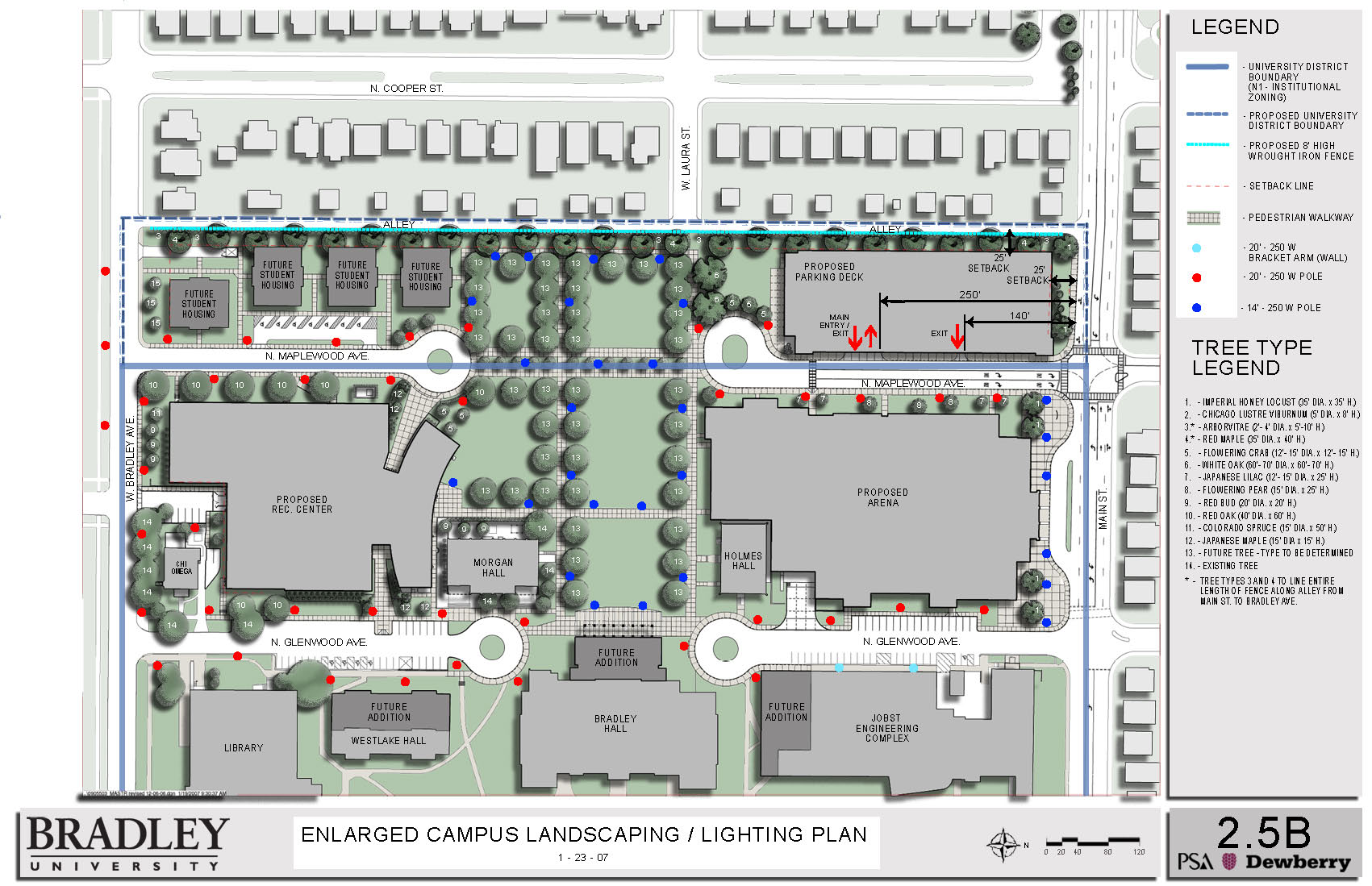
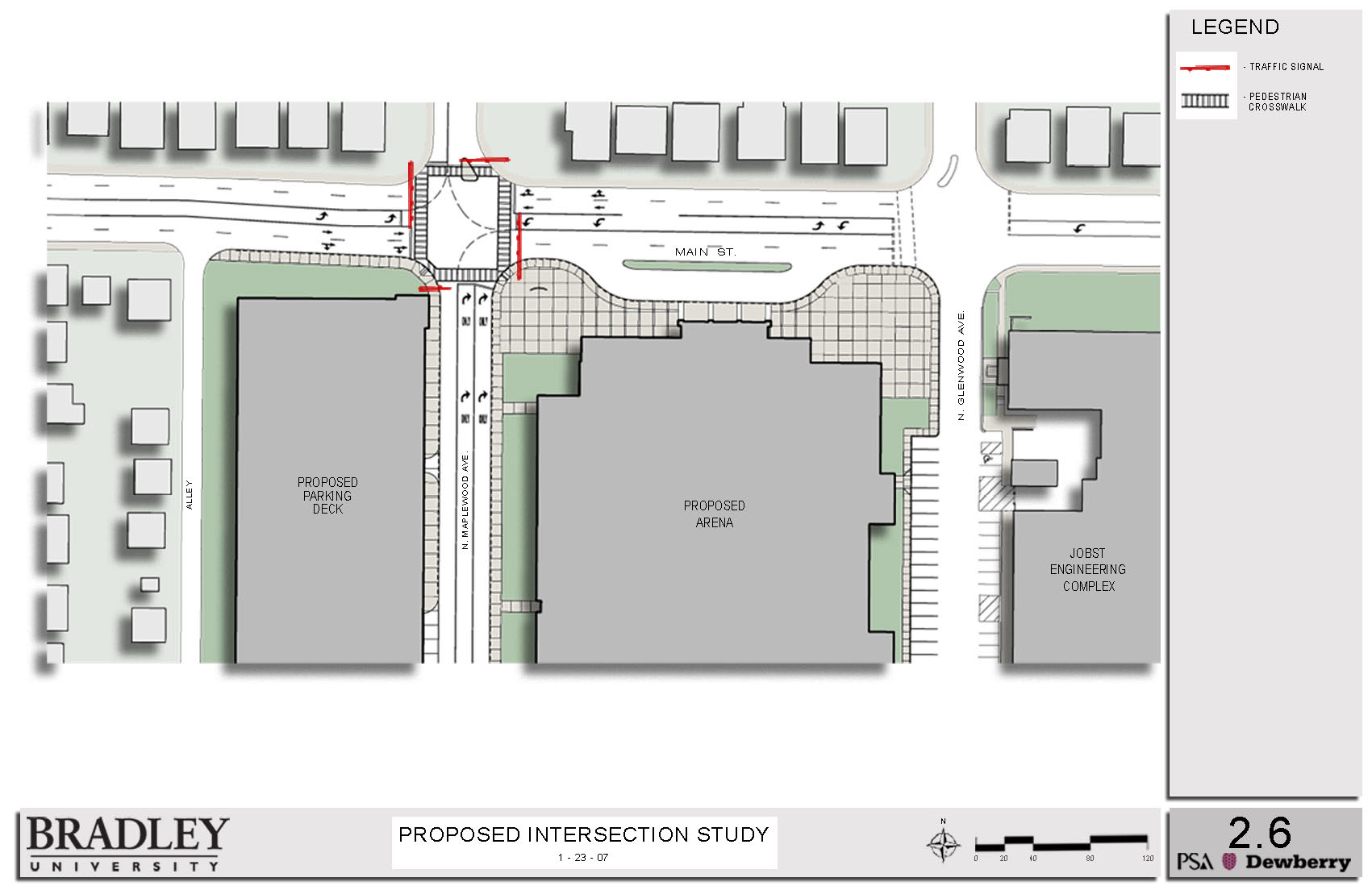
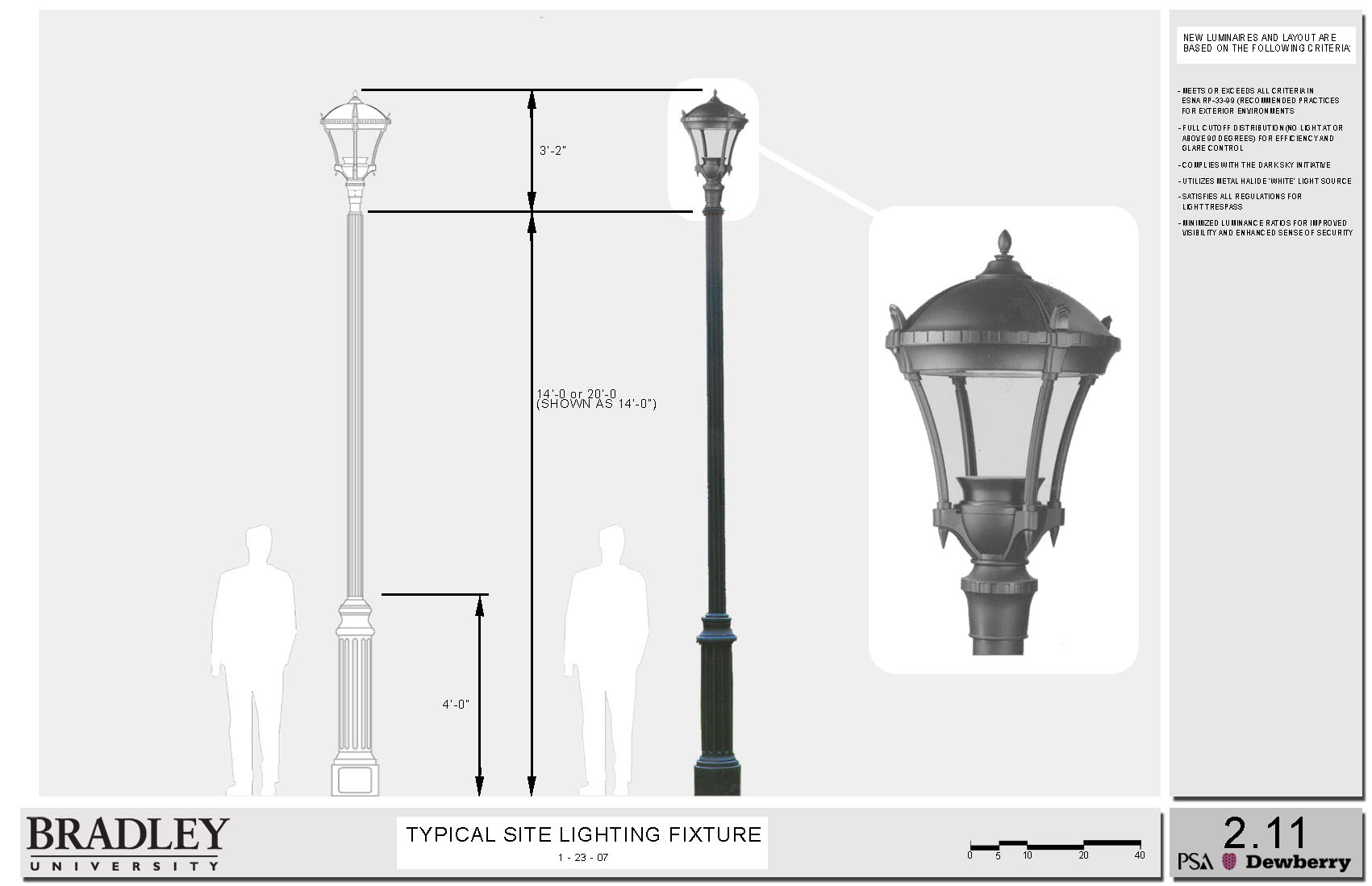
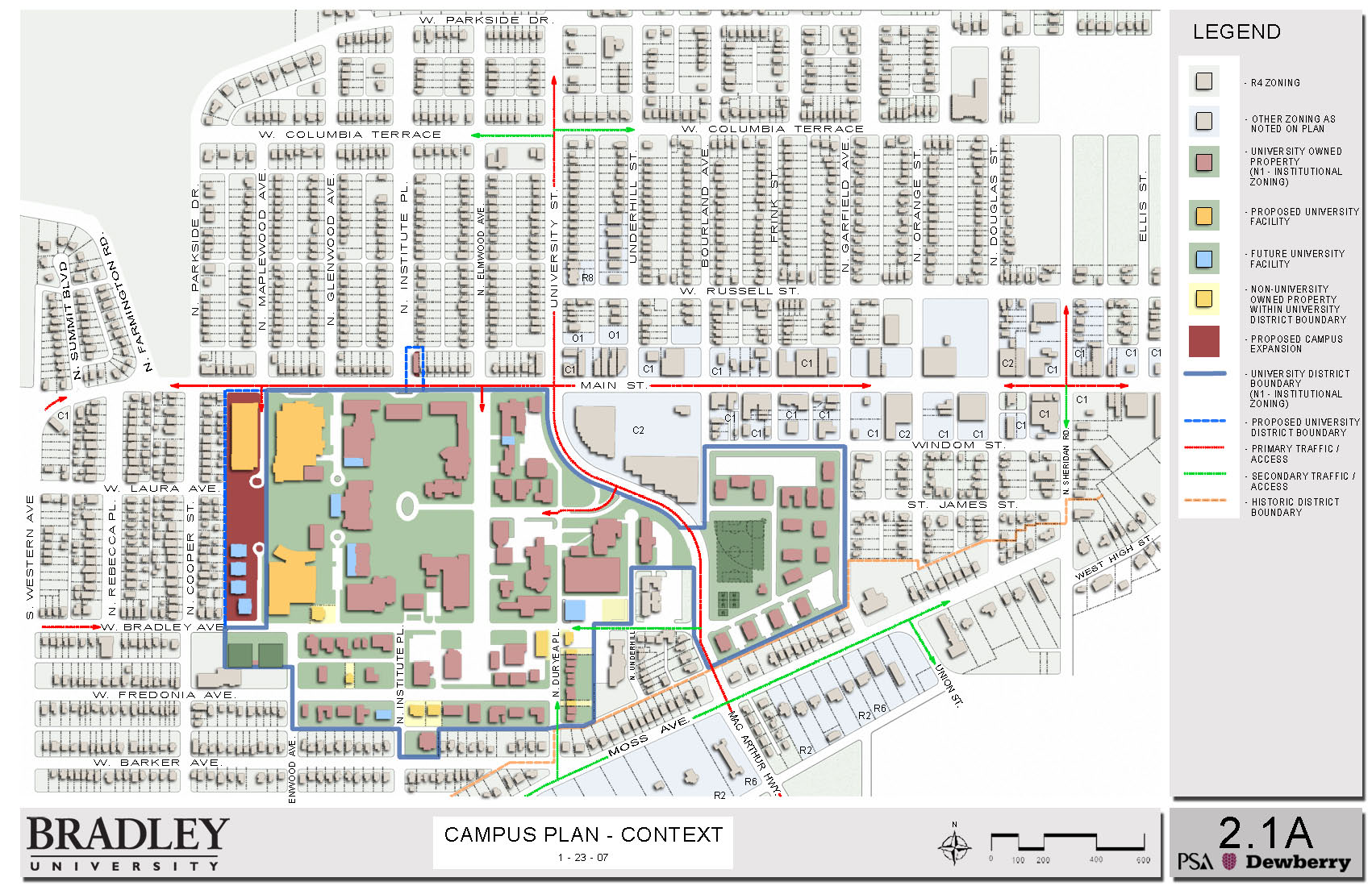
Today, I’m pleased to be able to share with you pictures I received in digital format (JPG) from Bradley’s new institutional plan. They include aerial views, elevations, and other interesting information. Take a look and tell me what you think (hover over image for description; click to enlarge):

Campus Plan -  Context Campus Plan - Boundaries Campus Plan - Facilities

Aerial View - Campus Facilities Plan Campus Plan - Parking Campus Plan - Green/Open Spaces

Enlarged Campus Plan - Construction Staging Enlarged Campus Landscaping / Lighting Plan Proposed Intersection Study

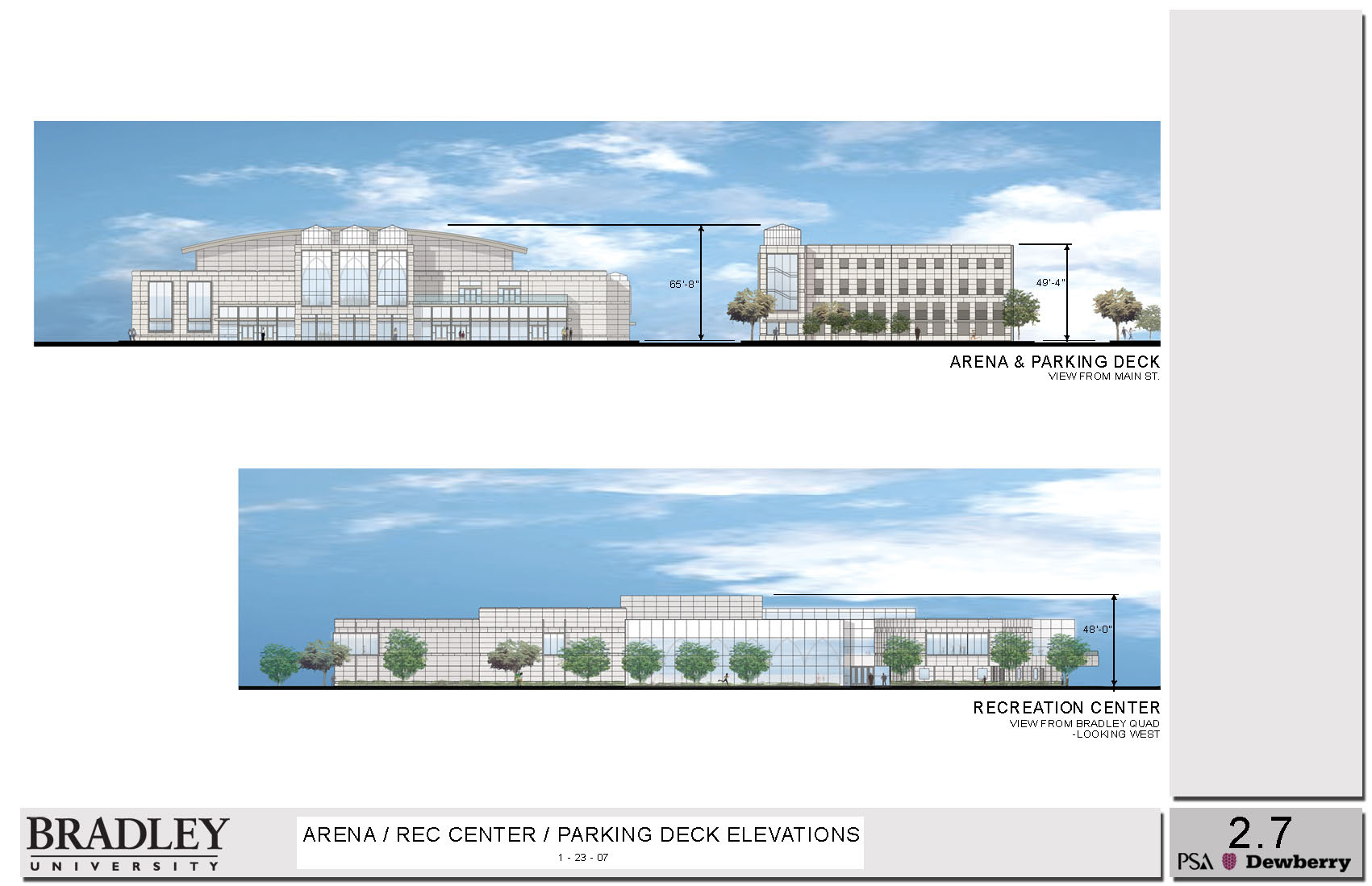
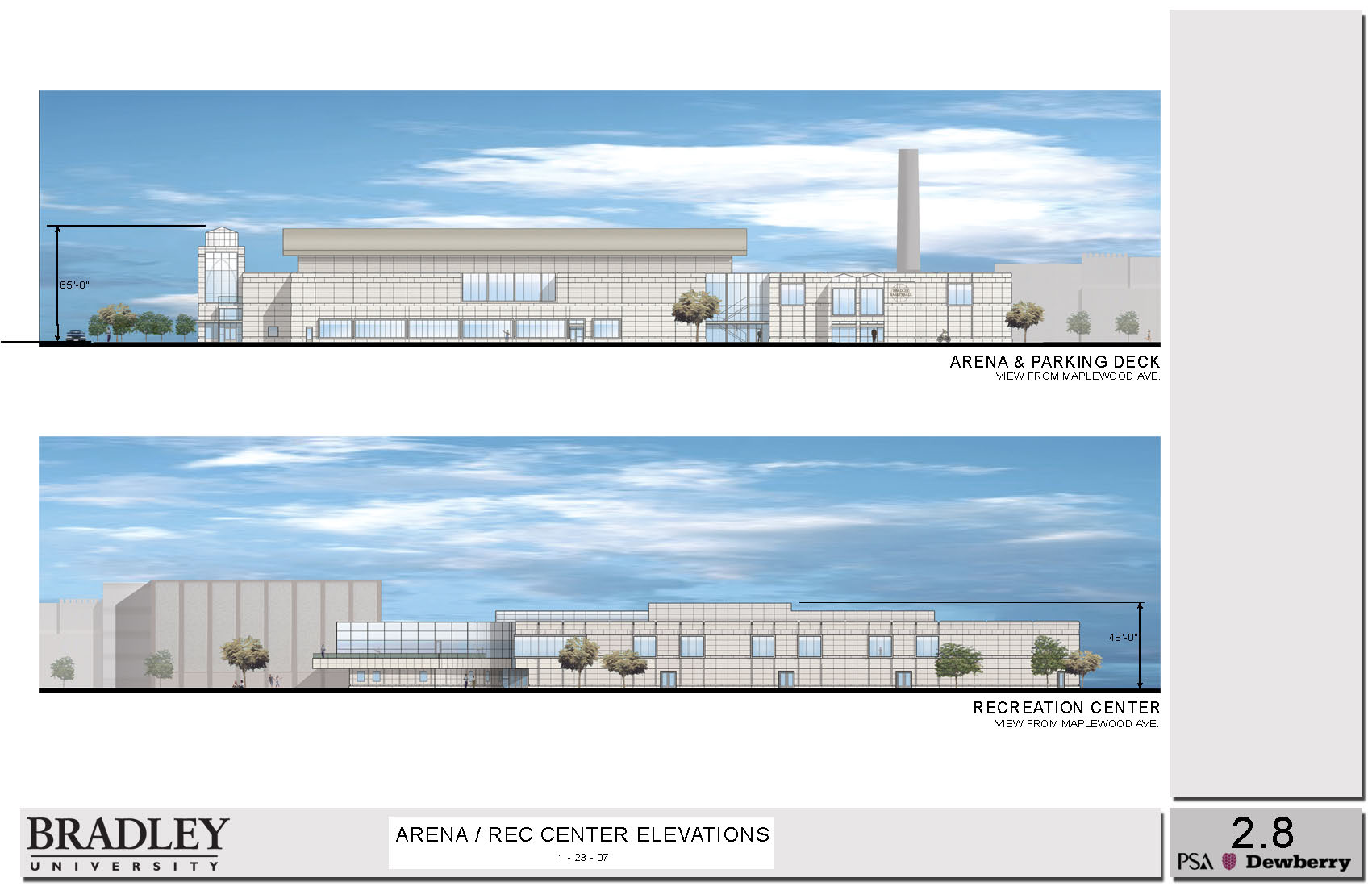
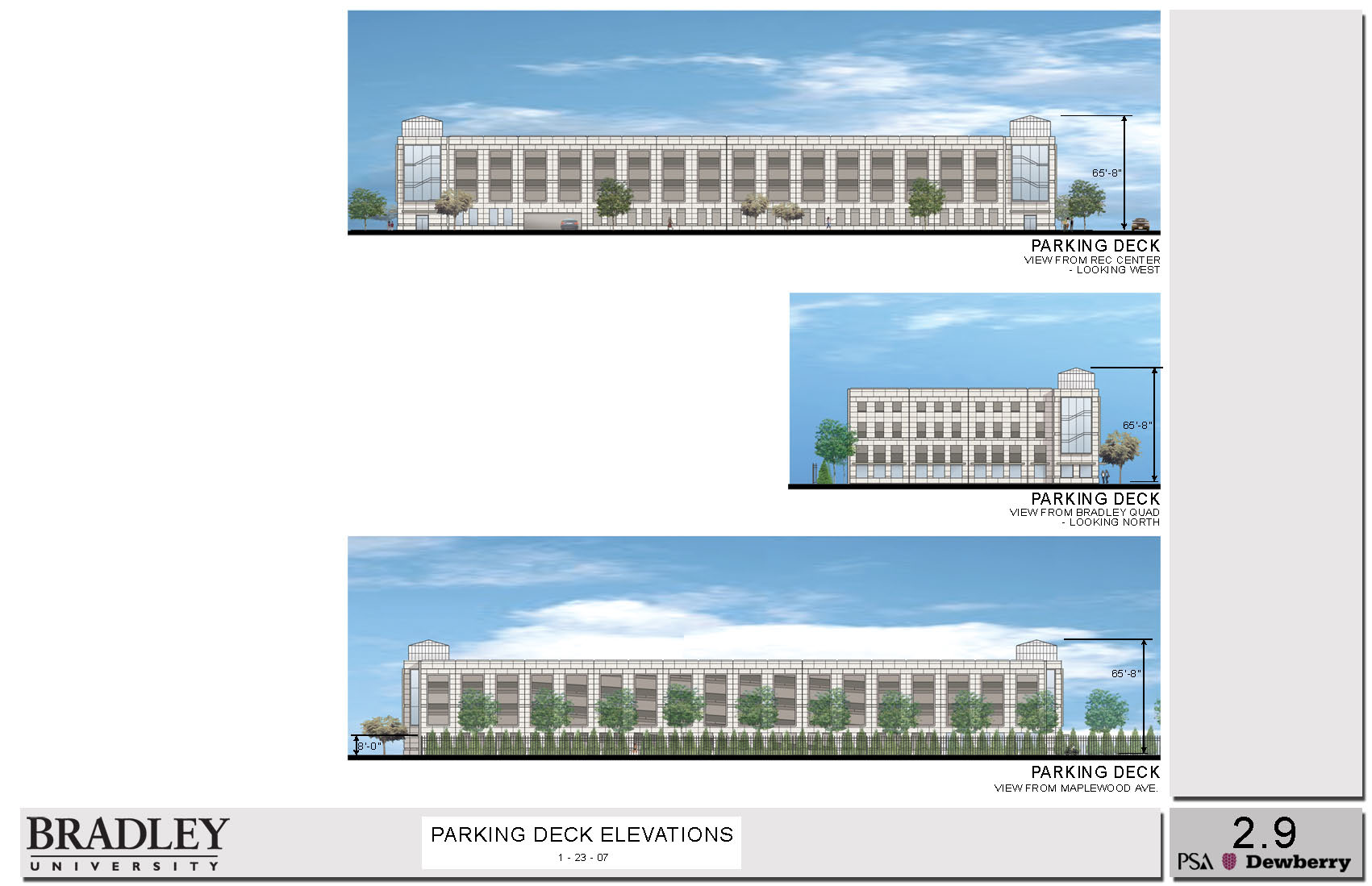
Arena / Rec Center / Parking Deck Elevations Arena / Rec Center Elevations Parking Deck Elevations

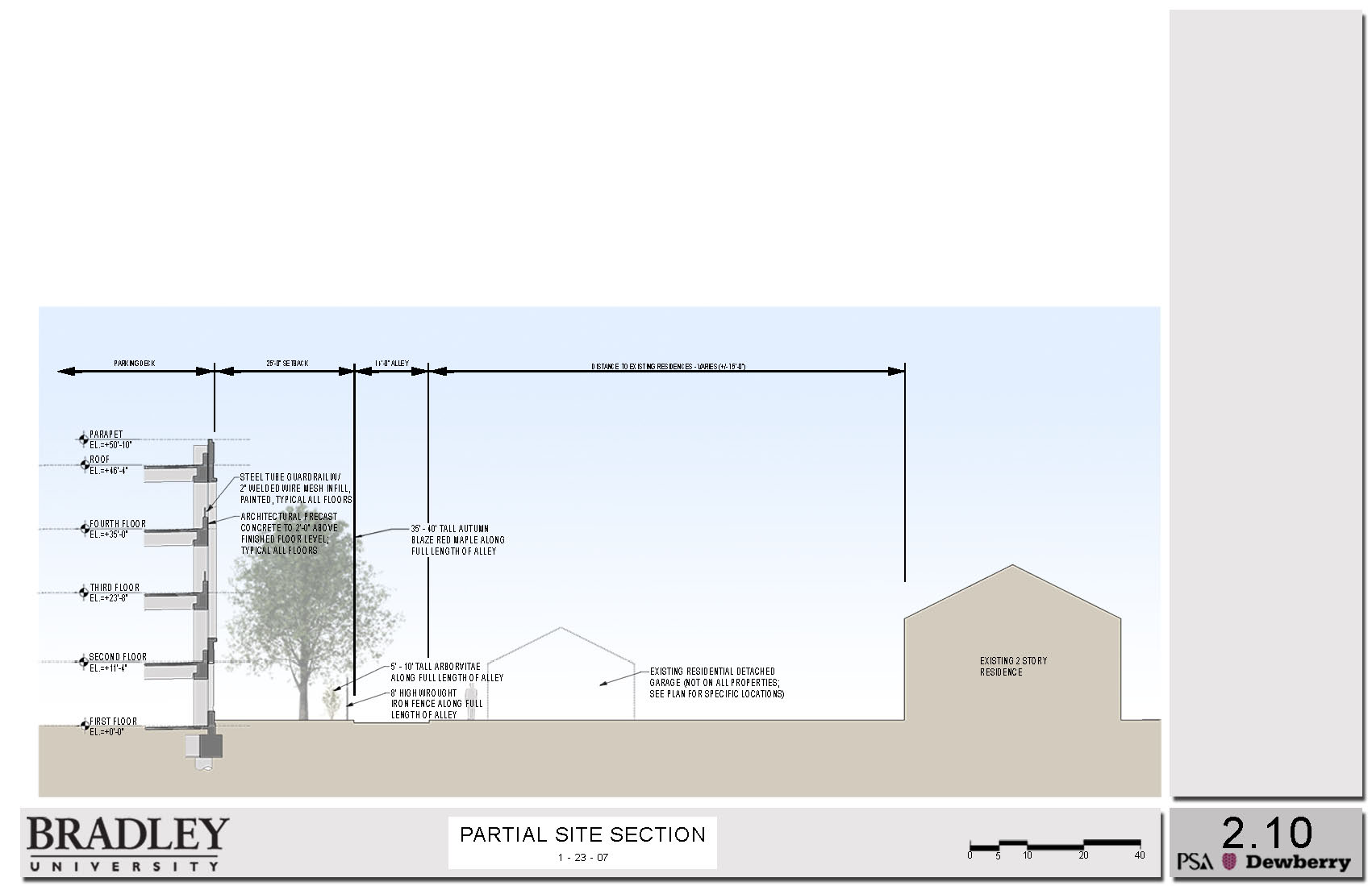
Partial Site Section Typical Site Lighting Fixture

And, just in case you missed it in the last two posts, here’s the intro and key elements in PDF format.

Posting will be light

Plates SpinningI’ve got a lot of plates spinning today, but you guys always come up with such interesting topics, please feel free to use this as an open thread to discuss whatever you’d like. I have some interesting Kellar Branch news to share. Hopefully I’ll be able to get it posted tonight sometime. Also, I’ve posted the Introduction and Key Elements of Bradley’s new Institutional Plan. You can link to it from my previous post now, or just click here.

Happy Monday, everyone!

Bradley submits expansion plans to City

Bradley University submitted its new institutional plan to the City on Thursday (1/25). Since I was downtown yesterday for a meeting anyway, I stopped by the Planning & Growth department to take a look at it. It’s a comb-bound collection of mostly artistic renderings of the physical changes the University wants to make to their campus. I was able to get a copy of their introduction and key elements — the only textual part of the plan — but the illustrations will have to wait until they’re released in PDF format because they’re too large and detailed to photocopy well. (Here’s a copy of the Introduction and Key Elements in PDF format.)

An open meeting has been scheduled for the public to review and discuss Bradley’s expansion plans Monday, February 5, at 6:00 p.m. in the Marty Theater (lower level of the Michel Center).

There are just a few observations I’d like to make after my initial view of the plan.

First, the university states their reasons for expansion in their introduction thus:

This plan represents a 10-15 year view of proposed physical changes to Bradley University’s campus facilities. These proposed changes evidence the university’s commitment to maintaining and improving its competitiveness in the upper echelon set of universities in the region and the country. These changes are not intended to facilitate undergraduate enrollment growth; the university does not have plans to grow its undergraduate enrollments or curriculum. Rather, Bradley’s services and programs require improved infrastructure support.

This was a little surprising to me because I was somehow under the impression that they were trying to grow enrollment-wise. It turns out that they are just wanting to upgrade their infrastructure to provide better facilities for their current enrollment levels and stay more competitive with similar universities.

Under their “Key Elements of the Plan” section, they have this to say about the arena they are planning to replace Robertson Memorial Fieldhouse:

It is believed that both this facility and the parking facility have been designed with consideration for New Urbanism architectural concepts given their proximity to Main St.

I would be interested to hear more about this particular aspect. To my knowledge, the Heart of Peoria Commission has never looked at or been asked to look at Bradley’s plans or comment on how well they conform to the principles of New Urbanism or the Heart of Peoria Plan. But I’ve only been on the Commission a short time, so I’ll have to check on that.

That said, they are correct that by building the proposed arena up to the sidewalk along Main street, they are in that sense following the principles of New Urbanism. They’ve also chosen to use pre-cast concrete made to look like limestone as their building façade for both the arena and the parking deck so they will blend with the existing architecture. This is durable and reflects a sense of permanence, which is desired in an urban environment. And while there’s only so much one can do with a parking deck, they’ve tried to make it look as nice and blended with surrounding architecture as possible.

However, a five-story parking deck right across the alley from single-family homes is not exactly the kind of form that’s desired in New Urbanism or in form-based coding. Setting aside the reasons for its location for a moment, a structure of that size would be better placed further into the campus’s interior or, if placed on the perimeter, it would be better placed along an arterial road like University where it fits better with the surrounding commercial context.

But, of course, the purpose of the parking deck is to provide parking primarily for the arena, recreational center, and new student housing, so it needs to be close to those structures. I think it would be better placed between the arena and recreational center on the east side of Maplewood behind (or possibly around) Morgan Hall. Right now that is designed to be another quad to the rear of Bradley Hall. Moving the parking deck there would make it equidistant from the three structures it’s primarily designed to serve and would keep it further away from the Arbor District. It would also relieve the necessity of razing all the houses on Maplewood — only those that need to be removed to make space for the new student housing would need to be torn down.

My last observation is about this part of their plan:

With the proposed campus changes, vacation of both Maplewood Ave. and Glenwood Ave. from Bradley Ave. to Main St. is requested.

The reason they want to vacate these streets and have the university take over maintenance of them is so they can terminate them at the newly-envisioned quad behind Bradley Hall. Essentially these two through-streets would become four dead-end streets. This is possibly my biggest concern about their plan. This will significantly limit the ability to get around and through Bradley’s campus and put more strain on the other streets.

If Glenwood and Maplewood are terminated, the only street that passes completely through campus will be Elmwood. Elmwood, while still a through-street, is essentially the university’s front parking lot. Through traffic will be more likely to use University to the east of campus or Cooper/Rebecca to the west of campus, meaning in the latter case that more traffic will be funneled through the Arbor District. More traffic on University means that an already busy street will get even busier, making it that much more unfriendly to pedestrians.

The next step is for the Zoning Committee to review the plan over the next few weeks and then make a recommendation to the City Council, which will make the final decision on approval.

2007 Homicide #4: David L. McCreary

From the Journal Star’s breaking-news department:

David L. McCreary, 35, of 720 S. Greenlawn Ave., was pronounced dead about 11:40 p.m. during surgery at OSF Saint Francis Medical Center. …Police don’t have a motive for the shooting. …No one is in custody.

In a related story, 1470 WMBD-AM reports that Mayor Jim Ardis “says it’s discouraging to see these crimes despite the work everyone is putting in to stopping them.”

Amen, brother.

Civic Center TIF preposterous

They’ve got to be kidding.

The Civic Center Authority decided today “to ask the Peoria City Council next month to expand the Warehouse District TIF to include the site of a proposed hotel,” according to the Journal Star.

That’ll go over like a lead balloon. I can’t wait to see the council laugh the Civic Center Authority out of council chambers when this comes up. This is such a bad idea on so many fronts, it’s hard to know where to start.

Let’s start with the fact that TIF districts are for blighted areas, and the Civic Center just completed a $55 million improvement to their property. TIF districts have to pass the “but for” test: “But for the incentive provided by Tax Increment Financing, would development occur in the designated area?” At the Civic Center, they just completed $55 million of development on the site.

On that last point, here’s a little taste of their logic:

Without the [TIF] expansion there’s little chance the developer of a full-service upscale hotel attached to the Civic Center could be lured to build on the proposed site at the northeast corner of Kumpf Boulevard and Jefferson Avenue, officials said.

I hope this is not the argument they’re planning to use to show that they pass the “but for” test. That’s not how the test works. The test is whether there would be any development, not a specific development like a hotel. Otherwise, you might just as well put a TIF out at the Shoppes at Grand Prairie because “but for” a TIF they can’t get a Nordstrom.

Then there’s the fact that the City Council already turned down a previous attempt to expand the proposed Warehouse District and Eagle View TIFs. When the Peoria Housing Authority expressed interest in being included in the TIF, the Council essentially told them to take a hike. What makes the Civic Center Authority think the Council will look on them any more favorably?

I could go on and on, but let’s wrap this up with the pièce de résistance: This whole hotel issue is the result of poor planning at best, deliberate deception at worst. As I wrote in a previous post, the Civic Center Authority said this to the City Council in a letter last March:

The Peoria Civic Center Authority is not now and has not previously requested public funding for a hotel. We have always hoped that a private development would be interested by the Peoria Civic Center expansion and upgrade to come forward with a proposal. We hope that the community will enable such a development.

The Peoria Civic Center Authority is committed and continues to be committed to the success of the expanded facilities. We believe it can be successful without an attached hotel but more and larger regional opportunities will be possible if more and better downtown hotel rooms are available.

To come back to the council with their hand out less than a year later, before the mortar is even dry on their $55 million expansion, claiming that now they can’t be successful without a publicly-incentivized hotel connected to the Civic Center is irresponsible.

Broski to retire; Bradley free to move on to Western

“As long as I’m president, we will not move farther west than Maplewood,” Broski, 61, said in addressing [Arbor District] neighborhood fears that the landlocked school wants to keep expanding that way.”

— August 24, 2006, as reported in the Journal Star

In an e-mail sent to faculty and staff Thursday, David Broski said that he planned to retire in June.

— January 25, 2007, as reported by WEEK.com

That didn’t take long, now did it?

2007 Homicide #3: Domonique Alexander

Someone asked over on Billy’s blog what the big issue is going to be in this year’s at-large City Council elections. My answer: crime.

In a sad and unwelcome underscoring of my point, the Journal Star is now reporting on Peoria’s third homicide of the year. We’re not even out of January yet.

Peoria Police responded to the shooting at approximately 11 a.m. at 231 Hancock St. Apt. 309. The victim was reportedly shot in the head. …Police said no one is in custody, but they are interviewing witnesses.

With homicides evidently on the rise and the recent riot at Club 112 downtown in which police officers were attacked, I think any candidate forum is going to include a healthy number of questions about crime and what Peoria should be doing about it.

UPDATE: The Journal Star now reports that the teen is 16-year-old Domonique Alexander, a junior at Woodruff High School who was killed while he was sleeping.

RTA plans full of sound and fury, signifying nothing

The RTA (Rabid Recreational Trail Advocates) is on the rampage again. They’ve stepped up their efforts to convert the Kellar Branch into a dedicated trail. The article in the paper is full of interesting information on their efforts:

The group then voted to spend up to $10,000 to hire its own lawyer, and will set up meetings with U.S. Rep. Ray LaHood, R-Peoria, and Democratic U.S. Sens. Dick Durban [sic] and Barack Obama, to seek their backing.

Of course, the city has had their lawyer working on this issue for about 10 years, but sure, go ahead and waste your money on yet another lawyer. That and a dollar will get you a cup of coffee.

They’ll ask members to write the U.S. Surface Transportation Board, and will gather petitions signed earlier in favor of the trail to submit to local officials.

Do these people not realize by now that the STB exists to ensure competitive rail service is protected? They’re more concerned about Carver Lumber and new businesses that may be coming on line than the efforts of trail advocates to rip up rails and ties at any cost.

They also will talk with members of the Peoria City Council and Peoria Heights Village Board.

The Heights may be a linchpin in this debate. They don’t appear to be as sold on the trail proposition as Peoria has been thus far. If they pull out of the deal, it will be a dead issue.

The group discussed proposed new shippers on the line, and said they were located either south of War Memorial Drive on a part of the line that will not be turned into a trail, or at Pioneer Park where they can be served by the $2 million line the city built to serve an industrial park there.

This ignores the whole issue behind why the discontinuance proceeding was held up in the first place. The basis for Carver Lumber’s objection to shutting down the Kellar Branch permanently was that they were not getting comparable or competitive service via the western connection. Taking out any portion of the Kellar Branch, no matter how small, breaks Carver’s link to competitive rail service and leaves them hostage to Union Pacific’s rates. That’s going to be true of any new customers that come on line in Pioneer Park as well — they’re going to want competitive rail service via the Kellar Branch.

Elsewhere in the article, Rucker claims that the STB ruling is “highly favorable” to the RTA’s goals for trail use, and City Attorney Randy Ray says he’s heard that Union Pacific (UP) is working with Central Illinois Railroad to provide competitive service to Pioneer Park from the west. This shows a profound naïveté on both Rucker’s and possibly Ray’s part.

Rucker doesn’t know the difference between “discontinuance” and “adverse discontinuance,” nor does he understand what an “alternative service request” is, so he’s misreading the STB’s decision. Ray can’t seriously believe that any “agreement” worked out between UP and CIRY is going to have any long-term impact. UP still has a monopoly on service to the western spur, and though they could lower their rates today, they could just as easily raise them tomorrow. The only guarantee of competitive service is competition. Competition is only available via the Kellar Branch.

[Park District Director Bonnie] Noble said that both Peoria and Peoria Heights agreed to pursue the trail years ago, and contracted with the park district to build and maintain it.

I don’t believe this is true. The only contract I know of is this ground lease, and that is only between the City of Peoria and the Park District, not Peoria Heights. In any event, §2.2 states that the contract does not take effect until the STB rules to discontinue service on the Kellar Branch. That hasn’t happened.

Money from the state and federal governments is still available, she [Noble] said, but they will not fund a trail beside a rail line, as some have suggested.

If the reporting is accurate on this, that’s a new story from Ms. Noble. I wonder to which grant(s) she is referring. The Illinois Bicycle Path Grant Program will indeed fund a trail beside a rail line.

[Peoria Heights Mayor Mark] Allen said he’s also interested in the potential of running a rail car along the line to transport people from the new museum on the riverfront to Peoria Heights, Junction City and the Rock Island Trail. “I think the interest would be there if it’s marketed properly.”

Great idea! You know what else they could do? They could put a bike rack on the rail car similar to the ones on CityLink buses. Then trail enthusiasts can ride the rail from downtown to Pioneer Park to pick up the Rock Island Trail. You can’t tell me that wouldn’t be a bigger tourist draw than having a trail through residents’ backyards.

The rail line is in poor condition and has been ruled unsafe by federal inspectors. Some of the rails date from 1902, Rucker said.

Pioneer has offered to pay for the line’s rehabilitation.

Bingo. Pioneer has also offered to purchase the line from the city for $565,000. The park district wants to lease the line for 99 years at $1 per year. Which do you think is a better deal for the city?

Problem in Dunlap flap is with Journal Star, not library

The Journal Star has been reporting lately on some controversy surrounding a referendum for the Dunlap library to issue bonds to build a larger library. Today’s paper has this summary:

Since the November election, controversy has surfaced over the referendum. Unofficial results first showed it had passed, but a later tally showed it had failed by 42 votes. However, absentee ballots counted in the two weeks following election day confirmed it actually had passed, with 1,185 people voting in favor of issuing bonds and 1,176 voting against them.

Despite that turnaround, no one in the media was told or reported the final results, leaving some residents to believe they were kept in the dark and, therefore, missed a deadline to seek a “petition for discovery” – essentially, a possible re-count.

However, Jonathan Ahl, news director of WCBU 89.9 FM in Peoria, says that description of the situation doesn’t jibe with his experience:

WCBU obtained the vote total of the referendum from then County Clerk JoAnn Thomas on November 8th, the day after the election. We reported at the time the yes votes outnumbered the no votes by six. Thomas said in an interview that all votes had been counted except for the provisional ballots and absentee ballots that were postmarked by November 5 that had not yet arrived in the mail. The early votes HAD been counted at that time.

We reported again on November 15th that unless there was a challenge, the referendum would pass with the yes position winning by nine votes. In addition to Ms. Thomas willingness to answer our questions on the results, all of this information was available on the Peoria County Clerk’s web site.

With that in mind, it is baffling to me to read sentences in Journal Star reports claiming the numbers were never released to the media, and that the apparent win by the yes votes was not discovered until “a few weeks later.”

Most disturbing is the Journal Star’s sweeping statement that “no one in the media was told or reported the final results.” I guess it depends on what they mean by “final.” If they mean that only certified totals are “final,” then no, probably no one in the media reported on them at that point.

But there’s a reason for that. The “unofficial” tally, which was posted on the county’s website on 11/15/06 and reported on WCBU is identical to the tally that was certified and posted on 11/28/06:

QUESTION TO ISSUE $2,500,000 LIBRARY BONDS, Vote For 1

Early/Absentee Election Total
YES 148 (66.67%) 1,037 (48.48%) 1,185 (50.19%)
NO 74 (33.33%) 1,102 (51.52%) 1,176 (49.81%)

So, why would anyone need to re-report something when the tallies didn’t change? It sounds to me like WCBU reported on the vote totals on the county website, but the Journal Star was evidently sitting around waiting for someone to call up and tell them about it. I thought reporters were supposed to go out and get information, not sit around waiting for news to come to them.

Are they now trying to cover their failure by claiming “no one in the media was told” and blaming the whole thing on the library board?

State of the Union 2007

State of the Union Address 2007

Did anyone watch the State of the Union address last night? What are your thoughts on it?

I was happy to hear the President’s comments about congressional earmarks — that they not only should be transparent and actually in the bills on which the House and Senate vote (not inserted later into conference reports anonymously), but that they should be reduced by at least half as a matter of fiscal responsibility. I wonder if Mr. LaHood got the message:

Next, there is the matter of earmarks. These special interest items are often slipped into bills at the last hour – when not even C-SPAN is watching. In 2005 alone, the number of earmarks grew to over 13,000 and totaled nearly $18 billion. Even worse, over 90 percent of earmarks never make it to the floor of the House and Senate – they are dropped into Committee reports that are not even part of the bill that arrives on my desk. You did not vote them into law. I did not sign them into law. Yet they are treated as if they have the force of law. The time has come to end this practice. So let us work together to reform the budget process … expose every earmark to the light of day and to a vote in Congress … and cut the number and cost of earmarks at least in half by the end of this session.

As far as the mechanics of the speech, I thought it sounded a lot less stilted this year than in past years, and I like how they moved the traditional “the-state-of-our-union-is-strong” line to the end of the speech this year. Bush sounded the most relaxed this year of any of the speeches of his I’ve watched. Outside of what I just mentioned, however, the speech was pretty formulaic. It had the usual laundry list of policy initiatives and a few too many special guests in the gallery. I’m looking forward to the day that a president either (a) submits his state of the union message in writing and skips the speech, or (b) delivers a speech that is a stark departure from the usual mold.

The big topic, of course, was the war in Iraq. I’m of the mindset that we should fight wars to win. This is shaping up to be just like the way we left Vietnam — and I’m afraid the fragile government in Iraq is going to fall just like Saigon did if we start pulling our troops out now. I think that would be immoral; it’s imperative for our country to finish what we started and not leave Iraq until the government is stable enough to stand on its own without U.S. military help. Thus, I think a troop surge is appropriate, and should be funded.

This is not the fight we entered in Iraq, but it is the fight we are in. Every one of us wishes that this war were over and won. Yet it would not be like us to leave our promises unkept, our friends abandoned, and our own security at risk. Ladies and gentlemen: On this day, at this hour, it is still within our power to shape the outcome of this battle. So let us find our resolve, and turn events toward victory.

What about you? What was most interesting to you about the speech? With what did you agree or disagree? Ethanol? No Child Left Behind reauthorization? Immigration policy? There were a lot of issues covered last night; take your pick.