Council Roundup 8/8/06

The council meeting was relatively short, mostly because a good number of items were deferred. Although, I have to give credit to Mayor Ardis for reining in debates — after watching several council meetings since he took over as mayor, I’ve noticed that he stresses brevity and tries to cut off debate once the council members start repeating themselves.

The council questioned staff regarding why fees have not been collected on banks that encroach on the public way, and deferred approval until they get some answers. Staff was also asked to report how much money the city has been losing because of this practice. Councilman Nichting made an excellent point as well — if the staff comes back in two weeks proposing the council continue to not collect these fees, they should bring back a request to change the municipal code so that it conforms to the city’s practices.

Councilman Nichting actually had two — count ’em, two — excellent points last night. He also questioned why the Peoria Civic Center (PCC) is giving part of their hotel tax (part of the “H” in “HRA”) to the Peoria Area Convention and Visitors Bureau (PACVB). The PACVB works on behalf of the entire tri-county area, yet only City of Peoria hotels pay HRA taxes. So the whole tri-county benefits, but the funding is coming disproportionately from Peoria hotels. Good catch. That item was deferred two weeks.

A day after the school board voted unanimously to support historic landmark status for Irving Primary School, the city council voted unanimously to make it official. The designation protects the building from demolition and the exterior from modification. The inside can be renovated and repartitioned, however, to accommodate alternative uses.

Gary Sandberg asked why the Nebraska overpass on I-74 wasn’t finished yet. IDOT officials had promised the council it would be completed in June of this year, and it’s still not open. Breaking that connection, in concert with the other I-74 construction and closures, has meant longer response times for emergency vehicles and greater inconvenience for Peoria motorists who have to drive further to get across town at a time when gas prices are soaring. Not a big deal if it were only closed for a few months, but it’s been over a year and a half now. Why isn’t it completed?

In addition to this, there were a few other notable items of business and some interesting citizen requests to address the council, which have been ably reported by Jennifer Davis in today’s Journal Star.

District 150 slowly coming back to reality

Despite some ridiculous quotes in this story about last night’s school board meeting, I actually found it somewhat encouraging. The school district is at least acknowledging that there is a limit to the amount of money it can realistically spend, even if it is for the worthy goal of children’s education.

New board president David Gorentz is quoted as saying, “My concern is that we might spend more money in a few schools and really have that be the ideal design, but is that really the best for 15,000 students in District 150?” Good question. I would say, no.

If these buildings are really as inadequate as we’ve been told by the school board, and are really hampering the children’s education, then it would be irresponsible to put all the construction money into one or two schools while the other four or so are left in a state of disrepair. I think the school board is slowly coming to the realization that they can dream up what they believe is the perfect learning environment, but in the end, it takes money — money they don’t have — to accomplish it. Compromise will have to be made.

But compromise is always talked about in the gravest of terms. To wit (emphasis mine):

Education consultant Judy Helm said the schools could be reduced to a square footage similar to original estimates but at a significant cost to kids’ education.

That sounds ominous. We don’t want to jeopardize the kids’ education…. But, what specifically would have to be cut?

The district would have to forgo the concept of a community library and a health clinic, eliminate teacher planning areas, eliminate “integrated learning areas” for kids, reduce the size of classrooms, reduce the lunch room size and eliminate all classrooms for community/parent education, Helm said. These cuts would reduce the square footage to about 93,000.

Read over that list again. Do these items really represent a “significant cost to kids’ education”? Since when is a community health clinic or the size of the lunch room vital to a child’s education, for instance? Some of those things are easy to eliminate. (I’m not sure what “teacher planning areas” are in a grade school where teachers have their own rooms; do they need a separate “planning area”? I’m open to correction on that one.)

The biggest problem is the transformation of these facilities from replacement elementary schools to “community schools.” Most of the items Helm lists are a direct result of this shift. Since “community schools” are not part of the documented Master Facilities Plan, the district should either follow the plan or revise it — if they choose the latter, they should re-crunch the numbers to see if they can afford such an aggressive plan. I bet they can’t, and it looks like the school board is coming to that same conclusion, albeit slowly.

Luciano is right about museum

In a move sure to make his bosses unhappy, Phil Luciano wrote a scathing column criticizing the city’s plans for a new downtown museum. He doesn’t think it will be much of a draw:

Think of it this way: Peoria is about the same size as Allentown, Pa.; Evansville, Ind.; and Waterbury, Conn. Would you pack up the kids, gas up the van and head to any of those places to drink in their rich history?

I think Phil makes a good point. But I don’t think having a downtown museum is the problem per se — it’s the scale of the project. Why is the whole Sears block going to be devoted to the museum? Isn’t that putting all our eggs in one basket? What happens if the city’s tourism projections don’t pan out? Aren’t we left with a multi-million dollar millstone?

This is why, as I’ve argued before, it would be better to make the museum square more densely developed, as all our handsomely-paid consultants have been telling the city for years. Add retail, restaurants, and especially a residential component. By including private development on that block, the city collects property and sales tax revenues to offset the costs of maintaining and managing a museum on part of that parcel.

Plus, if people are living, shopping, and eating down there, the block will be buzzing around the clock throughout the week and weekends. Without those components, the block after 5:00 and on weekends will look exactly as it does now before a single brick has been laid: a black hole.

In short, I think there is enough interest in Peoria and its history to support a museum, but not a “museum square.” Scale it back and allow private development.

How much does it cost to rehab Kellar rail line?

On July 24, the City of Peoria stated in a filing with the Surface Transportation Board (STB) that, according to a 2000 estimate from IDOT, it would cost approximately $2,015,469 to rehabilitate just 6.29 miles of the Kellar Branch rail line.

On August 2, just a week and a half later, the City of Peoria stated in a filing with the STB that, according to a 2006 Federal Railroad Administration (FRA) inspection report, it would only take $50,000 to rehabilitate 8 miles of the Kellar Branch rail line.

That’s a difference of about $1,965,469.

It sounds like the city is not only not putting forth a good-faith effort to provide Carver Lumber the level of service they promised, but is also reporting outdated and misleading estimates to the STB to make the track rehabilitation costs sound worse than they really are.

Corporate welfare on council agenda

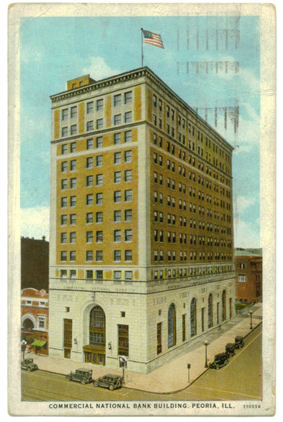
First, a little background: It’s apparently the latest thing in the banking industry. Banks have quite a bit of money tied up in real estate — their bank buildings, like the beautiful and historic Commercial National Bank building downtown. Until recently, that building was owned by National City, but they sold it (as of 3/1/06) to a company called First States Investors 4500, LLC (Delaware), a subsidiary of American Financial Realty Trust (AFRT), headquartered in Jenkintown, Pennsylvania.

Commercial National Bank buildingAccording to their website, AFRT is “a self-managed, self-administered real estate investment trust (REIT) focused on acquiring, managing and operating properties leased primarily to regulated financial institutions.” Put simply, they buy bank buildings and lease them back to the banks at rates that are mutually beneficial. That frees up more money for the bank to lend.

The sale was sort of reported in the Journal Star (3/20), buried in an article about downtown revitalization and listed as an example of downtown deals that “go unnoticed by the general public.” It’s mentioned in the city council agenda for this Tuesday because there’s a pedestrian walkway and underground storage vaults that “encroach on the public way,” and AFRT wants the council’s explicit blessing on their continued use of these, fee-free.

That’s right — here’s where the corporate welfare comes into play. The bank paid property tax on the walkway and vaults, but for some reason the city had not charged them (nor had the bank paid) the ten-cents-per-square-foot annual fee dictated by the city’s municipal code for such encroachments. Because the city didn’t charge National City, city staff wants to essentially “grandfather in” the new owners under the same policy. They see that as fair.

Considering the financial condition of the city and the upcoming budget negotiations, I would want to know a few things before I rubberstamped this transaction. First, why hasn’t the city been charging this fee? Was it purposeful, or has the staff been negligent? Do they charge it to other businesses, do they use form 205? How much money are we talking about that the city is losing by not charging it? And are there other fees that the city has just stopped charging for no apparent reason? And if there are, can we add the garbage tax fee to that list? Why should we allow a multi-billion dollar company to get out of this fee while the residents don’t have a fully-staffed fire station 11 or adequate police protection, despite paying an extra six dollars a month on their water bills for things their property taxes are supposed to fund?

The answer to that last question is, according to staff, because it would be “unreasonable …given the number of years the encroachments have existed.” So, apparently, there’s a statute of limitations on how long they can charge for encroachments? Where is that in the municipal code?

I suppose someone could say that this is just an exception. That’s great. I want to know how many exceptions we have and how much money the city is losing because of them. We’ve had a rash of shootings lately and basic services are suffering. We can’t afford to keep allowing exceptions unless there’s a darn good reason for each and every one. So far, I haven’t heard a good reason for this one.

Why should city allow park district to destroy $565,000 asset?

That’s the question the Journal Star’s editorial doesn’t ask or answer.

Pioneer Railcorp has a standing offer to purchase the Kellar Branch for $565,000 or accept a long-term lease on it.  The Peoria Park District wants to lease the right-of-way for $1 per year for 99 years and remove the rails and ties, thus destroying this half-million dollar asset owned by the city.

The city is going to begin budget negotiations soon.  On their plate: figuring out a way to fully staff fire station 11, increase police protection, and comply with GASB 45, all without raising taxes or spurious “garbage fees.”

Maybe one would argue that the trail will be more profitable than the rail line.  Of course, that’s patently ridiculous, but even if it were true, who says you have to have one or the other?  Pioneer has also offered $100,000 as well as equipment to help build the trail next to the Kellar Branch rail line.  Between that money and the state grants the park district has already applied for and received, there’s no reason we can’t have both.

In the Journal Star’s world, they would rather rob the fire department to fund the police department and give the park district a half-million dollar asset to squander.  Hopefully the city will come to its senses and not continue pursuing such short-sighted and ruinous advice.

Quote of the Day

President of Iran“The real cure for the conflict is the elimination of the Zionist regime, but there should be an immediate ceasefire first.”

–Iranian President Ahmadinejad,
reported by Aljazeera

He might as well have added “Sieg Heil” to the end of his statements. Anyone notice the frightening similarity between “real cure” and “final solution”?  Any questions as to why Iran should not get nukes?

Shell game afoot with Kellar carrier?

As reported here on Tuesday, the carrier Peoria hired to operate the Kellar Branch and western spur, Central Illinois Railroad Co. (CIRY) which is owned by DOT Rail, looks to be acquired by a mysterious company called Central Illinois Railroad Holdings, LLC.

I tried unsuccessfully to find out any information on this “Holdings” company. The document doesn’t disclose who the directors are in the company, and there’s no information on the internet about them. Making things more questionable, their address is for a third-floor suite in a building in Willow Springs, Illinois, that the West Suburban Chamber of Commerce still shows as for lease. All indications are that this LLC was created solely to acquire DOT Rail’s assets, which begs the questions “why?” and “who are the players here?”

That’s exactly what Pioneer Railcorp would like to know. In a filing yesterday with the Surface Transportation Board (STB), Pioneer seeks to at least delay the approval of this transaction until further information is disclosed. Pioneer has an interest because there is litigation pending in state court between Pioneer and CIRY, and this could be an attempt by DOT Rail to shield their assets in the event the court rules in Pioneer’s favor.

Pioneer brings up several other oddities about this transaction. For instance, the petition was submitted on CIRY letterhead, not “Central Illinois Railroad Holdings, LLC” letterhead. Yet the “Holdings” company is the petitioner. Also, the attorney who filed on behalf of “Holdings” is Melinda Sammons, the CFO of CIRY! As Pioneer succinctly put it, “This places Ms. Sammons in the position of being both the attorney for the buyer and as also having a fiduciary duty to the seller.”

I can’t help but wonder what the City of Peoria thinks of this transaction. They have an interest, too, of course. Even Pioneer points this out:

As previously noted, the Board is fully aware of the ongoing litigation surrounding CIRY, PIRY [Pioneer], and the Kellar Branch. Would Holdings’ acquisition of CIRY change that litigation? Does Holdings plan to continue pursuit of CIRY’s discontinuance once it acquires control? Would Holdings use its newfound control and ownership to actually operate the Kellar Branch? What about the Western Connection and the interchange with UP, will those continue to operate as they do today? There is absolutely no information contained in the record of this proceeding to help the Board and the public understand the answers to these questions. Yet, Holdings’ control of CIRY could completely impact or subvert the Board’s decision making process in those other proceedings.

Is the city even aware of this? It doesn’t appear they’ve filed any objection to it yet. You’d think they’d want to know who this new carrier is going to be and perhaps get some assurance from them that their contract with the city will still be honored.

This transaction gets curiouser and curiouser.

UPDATE: Central Illinois Railroad Holdings, LLC, has withdrawn their petition before the STB (today, 8/3/06). Melinda Sammons states, “It is my understanding from my discussions with Mr. [Marc] Lerner [Branch Chief in Office of Proceedings] that this filing is not required.” So, it looks like this will go through without any oversight at all, leaving us all to wonder what will happen next.