Museum Square: Boondoggle in the Making, Part III

Of course, the truth of the matter is that this underground parking deck isn’t for the Central Illinois Regional Museum at all — it’s for Caterpillar’s visitor center. As councilman Sandberg pointed out, Cat originally wanted an above-ground [underground] parking deck built on their portion of the Sears block and paid for with federal dollars. But they found out that federal rules prohibit the use of those funds for [public] parking decks on private property. Furthermore, the Heart of Peoria Commission strongly recommended there not be any surface parking on the site. So Cat, rather than doing away with the parking, now decides to put the deck underground on the public half of the property and use property tax dollars (through the TIF) to pay for it.

The rest of the council is, of course, perfectly okay with that. They had all kinds of justifications for it. Councilwoman Van Auken said that removing the cap on the TIF wouldn’t take money away from essential services like fire station staffing. Bill Dennis has the best response to that spurious argument.

But the most embarrassing justification was the “we- have- to- approve- this- plan- or- Cat- will- move- their- headquarters- out- of- Peoria” reason. To hear Chuck Grayeb talk, for instance, you’d think Cat was poised to pull up stakes and move out of town any second, and that Peorians should be sacrificing their virgin daughters on an altar outside Cat headquarters and paying tribute money to keep them here.

Let’s face it — Caterpillar is a very large employer and has been very generous to Peoria civic projects and charities. I’m all for giving credit where credit is due. But that doesn’t mean our council should just rubber stamp every Caterpillar request. To do so makes the council a mere figurehead government that represents Cat and not Peoria residents.

Museum Square: Boondoggle in the Making, Part II

For further proof that this museum will be a bust, we need only turn to the parking lot debacle, which consumed most of the deliberations last night. The council voted to give more money to the Museum Square project (by removing the TIF cap) so that an unwarranted and expensive parking garage could be added.

Yes, the 75+ street spaces plus the parking decks across the street to the northwest plus the surface lot to the southeast are just not enough parking according to the council and Museum Collaborative. Why? On-site parking is “part of the success factor for the facilities being built there,” said one of the presenters. “This is Peoria,” councilwoman Van Auken reminded us, as if we all just arrived here from outer space. People aren’t going to walk a block to the museum because “we live in a northern climate” and the weather isn’t always good.

With all due respect, that’s horse hockey. Ever been to a Bradley game? A symphony concert? A Chiefs game? Steamboat Days? Skyconcert? I would submit that Peorians park on the street and in surrounding parking decks and surface lots for these and a host of other downtown activities — in all kinds of weather. People are more than willing to park a block or two away and walk if there’s something worth walking to. If the parking deck proponents believe that people won’t walk across the street to see our beautiful, new, state-of-the-art museum, then why are we building it at all?

Museum Square: Boondoggle in the Making, Part I

Let’s play the old game, “Who Am I?”

  • I will be a regional draw
  • I will revive downtown
  • I will raise a lot of tax revenue
  • I will be self-supporting

Who am I? If you guessed Museum Square, you’re correct. And if you guessed the Civic Center, you’re also correct. Yes, the promises are remarkably similar. Also remarkably similar: the prospect that this project will not be self-supporting and will need ongoing help from the city to keep it afloat.

Councilmen Manning and Jacob ran the numbers, and this project has even less of a chance of being profitable than the water company buyout would have been in its proposed first year. They convinced the council to change the language of the redevelopment agreement amendment to say the museum collaborative will not ask for any more money from the city.

I applaud their effort, but realistically, everyone knows the museum is going to come back for more money around 2010. And what’s the city going to say? “No, we’ll let the museum close down and have a big vacant building on the Sears block again”? Not hardly. No, we’ll be subsidizing this thing for many years to come. And it started last night with the vote to give them more TIF (Tax Increment Financing) money.

King Matheson suffers the little people’s queries

The Journal Star had an interesting article today on how some ticked-off east bluff residents cornered Sean Matheson after the school board meeting last night. I just want to make a couple of quick comments:

Matheson said there isn’t enough space to build a new school on the Glen Oak site. In order to have enough room, more properties would have been impacted.

Prove it. As I stated earlier, the school district is not obligated to build on 15 acres, or even 10 acres. In fact, there is no minimum acreage requirement in the State of Illinois. What’s the justification for believing “there isn’t enough space” on the current Glen Oak School site?

Matheson said the location for the new school is final, but the programs that go into it are not. He encouraged the residents to be part of the process to design the school, which will take place in the coming months.

“Remember, we’ve made one decision, and I understand that decision is controversial, but there are many other decisions that need to be made,” he told the group of residents.

I was trying to figure out a word for this, and I think Bill Dennis hit it on the head: arrogance. Sure, they’ve just made one little decision: the decision to throw 14 long-time homeowners and 7 renters out of their houses, leave a large vacant building on the corner of Frye and Wisconsin, and take more of Glen Oak Park out of use. It’s nothing, really. Nothing the little people should have any say about.

To add insult to injury, now the board wants public input. Now, the board wants buy-in. Now they want to patch things up with the remaining neighbors. Matheson is essentially saying — in the same breath — “screw you” and “we want your input!” That engenders trust and cooperation, doesn’t it?

No doubt his remarks are a reference to the recently-created School Design & Construction Planning (SD&CP) Committee. At the February 21 school board meeting, Guy Cahill explained the purpose of this committee (emphasis mine):

[T]he goal of this committee will be to advise the Administration and Board on the programming elements that are to go into the building – how will teachers teach, how will students learn and how will that affect student achievement. The core committee will also reach out into the community with several sub committees asking, “What fits into this neighborhood, what extra curricular activities would you like to see at this site, what should be some of the partnerships and what services would you like to see offered at this site.” The core committee will also be advising the Board’s Building Committee on the selection of the architects and will select seven firms to give presentations to the Board’s Building Committee. In addition the members will visit firms and school sites to see how the firms’ designs fit our requirements.

Let’s see if we can answer one of those questions: “What fits into this neighborhood?” Neighbors fit into the neighborhood. Too bad they won’t be there anymore.

Public meeting on landlord licensing planned

NEWS RELEASE
Date: April 4, 2006
Released by: Alma Brown, Public Information Officer, 494-8554
Subject: LANDLORD LICENSING

Council Member Bob Manning will hold a meeting on April 8, 2006, from 2:00 p.m. until 4:00 p.m. at Peoria City Hall, in City Council Chambers, to discuss the possibility of requiring landlords to be licensed.

The meeting is open to the public and the community is encouraged to attend.

While Peoria waits for anonymous donors, other cities look at alternative Promise funding

Peoria isn’t the only city jumping on the Kalamazoo Promise bandwagon. The Kalamazoo Gazette reports that “there’s now a Ventura Promise in California, and talk of a Newton Promise in Iowa, a Peoria Promise in Illinois and a Promise-type program for Hammond, Ind.”

As you may remember, the money for the Kalamazoo Promise came from an anonymous group of private citizens. Mayor Ardis wants the “Peoria Promise” funded the same way, but so far there’s been no indication any anonymous donors have come forward. Other cities are considering different funding scenarios (emphasis mine below):

The Ventura Promise is a community-college scholarship program for lower-income families. Under the program, announced this month, the Ventura College Foundation will pay a year’s tuition for high school graduates and General Educational Development certificate holders from families with household incomes up to $50,000.

The version proposed by Hammond, Ind., Mayor Thomas McDermott Jr. would be funded by casino revenues and limited to children of homeowners.

In Newton, Iowa, economic-development leaders are pushing for a scholarship program funded through a local sales tax that voters approved Tuesday. City leaders said the tax would not be used to create The Newton Promise this fiscal year but have not ruled out creating such a program down the road.

I personally think the Kalamazoo Promise is fantastic, and I’d love to see it work here in Peoria. However, as the Journal Star points out today, Peoria is being tapped for an awful lot of funding for other projects right now (e.g., museum, Ren Park, zoo, schools), so perhaps the timing is a bit off to ask for large philanthropic donations.

So, if the donations don’t come through, what should the city do? Options:

    1. Find alternative funding, like other communities
    2. Continue to wait for anonymous donors
    3. Speak of it no more and hope no one remembers

    I vote for #2. The last thing Peoria needs is more taxes — sales taxes in particular — so option #1 is out. But I don’t want to see the idea just be forgotten either. I think the idea is good enough that it’s worth keeping the challenge out there for a while, even if the chances of funding seem slim at present.

Speaking of the Heart of Peoria Plan . . .

What does the Heart of Peoria Plan have to say about our District 150 schools?  This:

Project Name: Neighborhood Schools.

Finding: Peoria has maintained an architectural legacy of attractive brick school buildings, well located in its inner city neighborhoods.

Discussion: This plan has little to say about the schools, beyond emphasizing their importance to the revitalization of neighborhoods. However, the issue of the schools came up again and again at the charrette. Peoria’s inner city schools are reported to be in much better shape than in many cities, with some particularly noteworthy successes such as the programs at Harrison School. At the charrette, however, a number of citizens brought up the possibility of closing and replacing the inner city schools–including, most pominently, the high school. At a time when many cities are re-discovering the importance of smaller scale neighborhood schools to healthy communities, Peoria has an opportunity to capitalize on a resource that fortunately hasn’t yet been lost as a result of the fashion of the 1960s for increased centralization.

Recommendation:

  • Encourage the continuation and expansion of programs to strengthen Peoria’s well-located historic schools, using available funds to renovate and enhance rather than consolidate or replace these schools.
  • As a priority, renovation should include restoring the glass in the windows.

I thought the line about increased centralization being “the fashion of the 1960s” was especially amusing in light of all the people who think tearing down old buildings is “progressive.”

Cat blames HOPC for higher Museum Square costs

The Heart of Peoria Commission (HOPC) is on the agenda for Tuesday night. They are recommending approval of the proposed elevations of Museum Square. But included in their request is a copy of the HOPC’s meeting minutes, and they reveal something of Caterpillar’s mindset.

Putting Museum Square parking underground is expensive. As was reported back in February, it may add as much as $3 million to the cost. At that time, the Journal Star editorialized that, essentially, this extra expense was the HOPC’s fault because they didn’t want to see another surface parking lot downtown.

Now it’s Caterpillar’s turn to play the blame game.

Despite the fact that Cat got almost everything it wanted in the museum site plan (except the surface parking lot) even though it severely compromised the Heart of Peoria Plan, and despite the fact that this project is continuing to get support from the HOPC, commission minutes reveal that Caterpillar representative Mark Johnson (Project Manager for the Caterpillar Visitor Center) wanted this line included in the commission’s recommendation to the council on Tuesday:

“The Commission recognizes that the inclusion of the underground parking structure in the site plan has resulted in a substantial increase in infrastructure development cost and urges the Council to work with the developers to adopt a mutually acceptable financing plan.”

In other words, he wanted the Commission to take responsibility for the additional parking expense on Museum Square. Why? The minutes state:

Mr. Johnson said, “I urge the Commission to step up to their responsibility, as we developed this underground parking as a part of this plan in response to this Commission’s strong recommendation; and we have to find a way to pay for it.”

Au contraire, replied commissioner Beth Akeson:

Commissioner Akeson said she was sorry the Commission has been put in the position to make it appear they are the ones that forced the issue of underground parking, when in actuality the Commission was never brought into the conversation about what its recommendation would be.

(Emphasis mine.) That’s right. It wasn’t the HOPC that came up with the underground parking idea. They weren’t even consulted.

In fact, the need for any parking on that site is questionable. Even if it could be shown that parking is needed, the bulk of the cost is not simply to put it underground per se, but to put it below the site as it’s currently designed — i.e., with the boomerang-shaped buildings. Those building designs were not the HOPC’s either.

Mr. Johnson’s amendment was defeated, but expect this argument to surface again — on the very next agenda item.

Caterpillar and Lakeview want to amend the City of Peoria/Museum Block Redevelopment Agreement.  Among other things, they want to remove the $500,000 cap on TIF reimbursement.  I imagine this will be the source of some discussion, as it’s the only part of the amendment that “could result in additional money being paid over by the City to the Museum.”

I have an idea.  Instead of reducing the size of the museum by 15,000 square feet and trying to finagle more money from the city, why not make money and increase density by adding residential, restaurant, and retail components, like the Heart of Peoria Plan recommends?  You remember the Heart of Peoria Plan, right?  You know, the one the council adopted “in principle”?

As I was saying about the Civic Center….

Remember when I wondered whether the problem with the Peoria Civic Center could be the management? Well here’s a story about poor management and a little warning to any brides-to-be: don’t believe any Civic Center advertising you see in bridal magazines.

In the 2006 Central Illinois Wedding & Celebration Guide published by LimeLight Communications, Inc., the Peoria Civic Center placed this ad:

Now, what would you think if you saw this ad? Would you think that they were going to waive the rental fee if you booked your reception and catering at the Civic Center?

Think again.

Despite the plain language of the ad and the absence of any exclusion disclosures, the Civic Center recently refused to waive the rental fee for a bride-to-be who is (was) renting the Civic Center theater lobby. Supposedly, the lobby is excluded from this promotion. Too bad they didn’t say that in the ad.

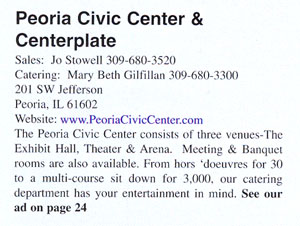
In fact, elsewhere in the same magazine, there’s this listing under “Banquet, Event & Meeting Facilities”:

Notice the wording here. They list their three large venues, then say that meeting and banquet rooms are “also available” — “also” means “in addition to” — and to “see [their] ad on page 24,” which is the ad displayed above.

The Illinois Uniform Deceptive Trade Practices Act clearly spells out what is considered false advertising. Section 2(a)(9) says it’s a deceptive trade practice to “advertise[] goods or services with intent not to sell them as advertised.” The Civic Center advertises free rental if you book your reception and catering there, but they apparently have never had any intention of waiving the rental fee in certain parts of their facility. Since they didn’t disclose those exclusions in their ad, it sure looks like deceptive advertising to me.

They should show some integrity and honor their ad. Since they won’t, they will lose an $8-10,000 wedding reception, settling for a $200 cancellation fee. Way to go, Civic Center. Keep driving the business away. You’ll always have our HRA taxes.